
Digital consensus is a poor substitute for analytical chemistry. For years, researchers relied on community “vouching” and forum-vetted vendors, but the March 2026 shutdown of Peptide Sciences proved that the gray-market status quo is unsustainable. You’re likely tired of navigating biased threads or risking your research on reagents with missing HPLC documentation. The fear of contamination or inconsistent batch quality creates unnecessary friction in your workflow.
Transitioning to professional alternatives to sourcing peptides on forums is now a requirement for data integrity. This article provides a roadmap to move from anecdotal hype toward a laboratory-grade procurement strategy. You’ll learn a repeatable protocol for verifying purity through batch-specific COAs and US-manufactured reagents. We examine how to prioritize empirical verification over community sentiment to ensure your research remains precise, accountable, and reproducible.
Key Takeaways
- Identify the analytical risks of “shilling” and anecdotal vetting that compromise research integrity in community-driven marketplaces.
- Discover professional alternatives to sourcing peptides on forums by comparing the direct laboratory supplier model against standard compounding pharmacy frameworks.
- Establish a rigorous procurement protocol that requires batch-specific HPLC and Mass Spectrometry documentation prior to sourcing any research reagents.
- Prioritize US-based manufacturing and transparent COA verification portals to ensure your materials meet strict benchmarks for purity and identity.
The Analytical Risks of Forum-Based Peptide Sourcing
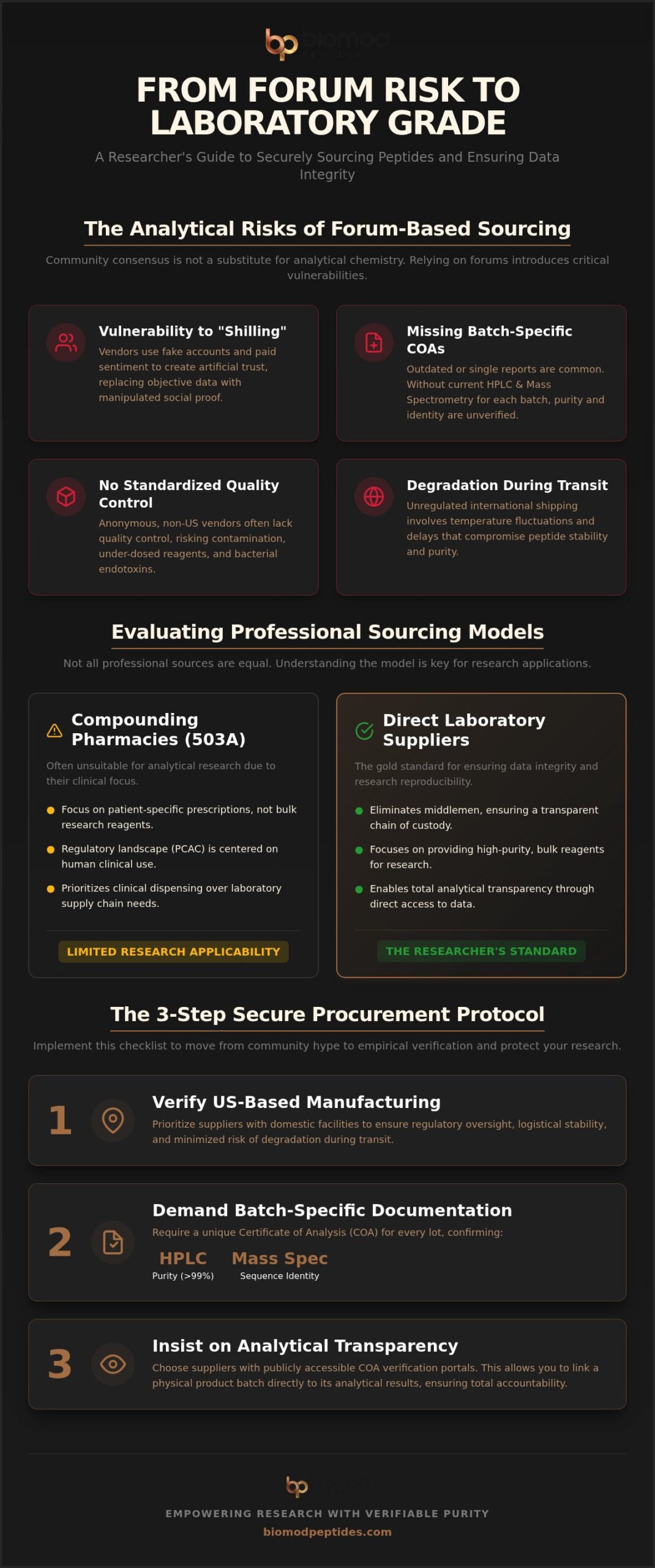
Forums operate on a system of social proof that is fundamentally vulnerable to manipulation. The “shilling” phenomenon involves vendors paying for positive sentiment or using sock-puppet accounts to manufacture artificial trust. This creates a feedback loop where community consensus replaces objective data. For researchers seeking alternatives to sourcing peptides on forums, this lack of accountability is a significant barrier to scientific accuracy. Anecdotal “feel” reports from anonymous users cannot account for the chemical reality of a compound.
Forum-driven sales rarely provide transparent, batch-specific documentation. While a vendor might display a single, static HPLC report from years ago, this does not account for batch-to-batch variability. Without High-Performance Liquid Chromatography (HPLC) and Mass Spectrometry for every sequence, the identity and purity of the reagent remain unverified. Professional standards require that professional peptide synthesis be followed by rigorous analytical confirmation of every unique lot to ensure research integrity.
Sourcing from anonymous, non-US-based entities introduces logistical and safety hazards. These vendors often operate without standardized quality controls. The absence of a physical US-based manufacturing presence means there is no recourse for contamination, under-dosed reagents, or the presence of bacterial endotoxins. Relying on “vetted” lists from community boards ignores the high probability of sequence degradation and impurity accumulation during unregulated international transit.
From Community Consensus to Empirical Data
Social proof is an insufficient metric for laboratory-grade research. Professional procurement strategies prioritize third-party validation over anecdotal testimonials. Secure alternatives to sourcing peptides on forums rely on concrete empirical data points. This shift ensures that your results are based on chemical reality, not community hype. Essential verification standards include:
- Batch-Specific Purity: Verification of purity levels exceeding 99% for every lot.
- Sequence Identity: Confirmation via Mass Spectrometry to ensure the correct amino acid sequence.
- Analytical Transparency: Publicly accessible COA verification portals that link results to physical product batches.
By prioritizing data over sentiment, laboratories can eliminate the variables that compromise experimental outcomes. Precision requires a move away from the “boards” and toward institutional-grade procurement frameworks.
Evaluating Professional Sourcing Alternatives
Distinguishing between the clinical telehealth model and the research laboratory model is essential for data integrity. Telehealth frameworks utilize 503A compounding pharmacies. These institutions focus on patient-specific prescriptions. For analytical research, 503A pharmacies are often unsuitable. They prioritize clinical dispensing over the bulk-reagent requirements of a laboratory environment. With the July 2026 PCAC meeting evaluating the 503A Bulks List, the regulatory landscape for these pharmacies remains focused on human clinical use, not research-only applications.
Professional alternatives to sourcing peptides on forums prioritize the direct laboratory supplier model. This framework eliminates the middleman. It ensures that the chain of custody remains transparent and verifiable. A professional vendor must meet three benchmarks: US-based manufacturing, independent third-party testing, and total analytical transparency. This approach provides a level of accountability that anonymous forum vendors cannot replicate.
Direct Laboratory Suppliers: The Researcher’s Standard
Sourcing directly from the manufacturer reduces degradation risks. International distribution often involves extreme temperature fluctuations and extended transit durations. These variables compromise peptide stability. Domestic US manufacturing ensures logistical stability. For Las Vegas laboratories, sourcing from domestic providers minimizes shipping friction. It provides a reliable supply chain for critical research reagents.
Innovation in reagent delivery has produced specialized formats. These include peptide softgels for research and precision spray products. These delivery systems offer stability and dosing accuracy that forum-sourced powders lack. Documentation remains the primary differentiator. A laboratory-grade supplier provides batch-specific COAs via a public portal. This moves the burden of proof from the researcher to the provider. To secure your data, prioritize US-manufactured research peptides that adhere to these rigorous standards.
Implementing a Secure Procurement Protocol for Research
Establishing a secure procurement protocol is the final step in transitioning to professional alternatives to sourcing peptides on forums. Step 1: Verify the supplier’s physical manufacturing location. Domestic US-based facilities ensure oversight and adherence to rigorous quality standards. Step 2: Request batch-specific HPLC and Mass Spectrometry reports before finalizing any procurement. These documents confirm the molecular identity and purity of the specific reagent lot you’ll receive. Don’t rely on generic, outdated reports from a vendor’s landing page.
Step 3: Utilize a COA verification portal to cross-reference laboratory results against independent databases. This step prevents the use of forged or altered documentation. Step 4: Audit the supplier’s storage and cold-chain protocols for stability. Peptides are sensitive to thermal degradation. Professional suppliers utilize climate-controlled logistics to maintain structural integrity during transit. This protocol provides a reliable framework for researchers seeking alternatives to sourcing peptides on forums.
Leveraging Documentation for Analytical Integrity
A Certificate of Analysis (COA) serves as the primary analytical document for verifying the purity and identity of a synthetic peptide. When reviewing an HPLC report, look for a single, sharp peak. Secondary peaks or baseline “noise” indicate the presence of truncated sequences or residual reagents. These impurities can skew experimental results. For a detailed breakdown of these standards, refer to our guide on peptide purity verification. Following these steps ensures that your reagents meet the benchmarks defined in USP <1503> for synthetic peptide substances. Analytical integrity is the foundation of reproducible science.
Advancing Toward Analytical Accountability
Scientific progress demands a shift from community-vetted sentiment to empirical verification. Relying on forum consensus introduces variables that compromise research integrity. Professional alternatives to sourcing peptides on forums prioritize objective data over anecdotal hype. This transition requires a commitment to batch-specific HPLC and Mass Spectrometry documentation. By auditing manufacturing locations and utilizing secure verification portals, you’ll eliminate the risks of contamination and under-dosing. Accountability is the new industry standard.
Biomod Peptides provides the infrastructure for precise research. Our materials are 100% US-manufactured and finished to ensure logistical transparency. Every batch undergoes independent third-party laboratory testing accessible via our dedicated COA verification portal. Upgrade your research standards with Biomod Peptides’ US-manufactured reagents. Precision starts with verified purity. Secure your laboratory’s future with data-driven procurement.
Frequently Asked Questions
Why is sourcing peptides from forums considered high-risk?
Forum sourcing relies on anecdotal social proof rather than empirical data. These platforms are vulnerable to “shilling,” where vendors manufacture artificial trust through sock-puppet accounts. This lack of accountability increases the risk of receiving contaminated, under-dosed, or mislabeled reagents. For researchers in Las Vegas and beyond, these variables compromise experimental reproducibility and analytical integrity. Relying on community sentiment is scientifically insufficient.
What is the difference between forum-vetted and third-party tested peptides?
Forum vetting is a subjective measure based on community sentiment, while third-party testing is an objective analytical process. Professional alternatives to sourcing peptides on forums utilize independent laboratories to verify purity and identity via HPLC and Mass Spectrometry. This method ensures that every batch meets specific chemical benchmarks. It removes the bias inherent in community-driven “vouched” lists by prioritizing raw data.
How do I verify a Certificate of Analysis (COA) for research peptides?
Verification requires cross-referencing the batch number on your product with an independent laboratory database. You should utilize a dedicated COA verification portal to ensure the report hasn’t been altered or reused from a previous lot. Check for a sharp HPLC peak indicating high purity and a Mass Spec report confirming the correct molecular weight. This protocol is essential for secure alternatives to sourcing peptides on forums.
Are US-manufactured research peptides superior to imported alternatives?
US-manufactured reagents offer superior stability and logistical transparency compared to imported products. Domestic production in facilities serving Las Vegas labs avoids the sequence degradation common during unregulated international transit. All Biomod Peptides products are finished in the United States. This ensures strict adherence to quality control standards and provides a verifiable chain of custody for every research lot. Domestic sourcing minimizes environmental variables.
Disclaimer
BIOMOD products are sold strictly for laboratory, analytical, and scientific research use only. They are not intended for human or animal consumption, administration, application, ingestion, injection, or any therapeutic, diagnostic, or cosmetic use.
The statements made on this website have not been evaluated by the United States Food and Drug Administration. BIOMOD products are not intended to diagnose, treat, cure, mitigate, or prevent any disease or medical condition.
BIOMOD is a research chemical supplier. BIOMOD is not a compounding pharmacy or chemical compounding facility as defined under Section 503A of the Federal Food, Drug, and Cosmetic Act. BIOMOD is not an outsourcing facility as defined under Section 503B of the Federal Food, Drug, and Cosmetic Act.
By accessing this site, you confirm you are at least 21 years of age and that you have read and accepted the BIOMOD Terms of Sale, Privacy Policy, and Research Use Only Policy. BIOMOD does not provide dosing, medical, therapeutic, diagnostic, veterinary, or use guidance under any channel.