
A 98% chromatographic purity specification on a Certificate of Analysis won’t protect sensitive cell assays from counterion-induced artifacts. Standard solid-phase peptide synthesis leaves between 10% and 45% residual trifluoroacetate by gross weight. Recognizing the distinct benefits of acetate vs TFA salt in peptides is essential when unexplained cell death, solubility issues, or cake collapse compromise your analytical baseline.
You shouldn’t have to wonder whether an in vitro response stems from your target sequence or an acidic counterion artifact. In this guide, you’ll understand the biochemical, cytotoxic, and stability differences between acetate and trifluoroacetate counterions to optimize your peptide experimental integrity. We examine net peptide content formulas, physiological pH impacts, and the orthogonal analytical standards needed to verify complete salt conversion on your documentation.
Key Takeaways
- Understand how residual acidic counterions originate during solid-phase synthesis and why they fundamentally alter true net peptide content.
- Evaluate the core benefits of acetate vs TFA salt in peptides to prevent non-specific cytotoxicity and false-positive antiproliferative readouts in cell assays.
- Discover how acetate counterions resolve common benchtop formulation challenges, including solution acidification, reconstitution solubility, and cake collapse.
- Identify the orthogonal analytical methods, such as ion chromatography and nuclear magnetic resonance, required to audit counterion conversion on Certificates of Analysis.
Why Counterions Matter: The Origins of TFA and Acetate Salts in Peptide Synthesis
Synthetic peptides are polyionic molecules. Basic functional groups, specifically the unprotected N-terminus along with side chains on arginine, lysine, and histidine, carry positive charges at physiological or acidic pH. These cationic centers require stoichiometric anionic partners to establish electrostatic neutrality. Rather than acting as inert spectators, these counterions directly alter molecular weight calculations and net peptide content.
Understanding the analytical benefits of acetate vs TFA salt in peptides begins with manufacturing chemistry. Solid-phase peptide synthesis (SPPS) relies on acidolysis. Evaluating trifluoroacetic acid in peptide synthesis shows why it remains the universal reagent for cleaving peptide chains from solid support resins and removing acid-labile protecting groups such as Boc, tBu, and Trt.
Solid-Phase Cleavage and HPLC Mobile Phase Artifacts
Trifluoroacetic acid acts as both a cleavage reagent and an ion-pairing modifier during reversed-phase HPLC purification, typically added at 0.05% to 0.1% volume-to-volume. This pairing sharpens chromatographic peak shapes by masking silanol interactions, but it also embeds strong conjugate bases directly into the material matrix.
- Protonation Targets: Residual trifluoroacetate ions pair tightly with primary amines, guanidinium groups, and imidazole rings.
- Salt Displacement: Producing acetate forms demands targeted post-purification intervention, using strong anion-exchange chromatography or repetitive lyophilization cycles against dilute acetic acid.
Because crude lyophilization retains default pairing, researchers evaluating the benefits of acetate vs TFA salt in peptides often discover unexchanged powders contain significant inactive mass. Sourcing high-grade reagents from Biomod Peptides ensures baseline counterion visibility before benchtop reconstitution begins.
Direct Comparison: Cellular Toxicity, Stability, and Physical Characteristics
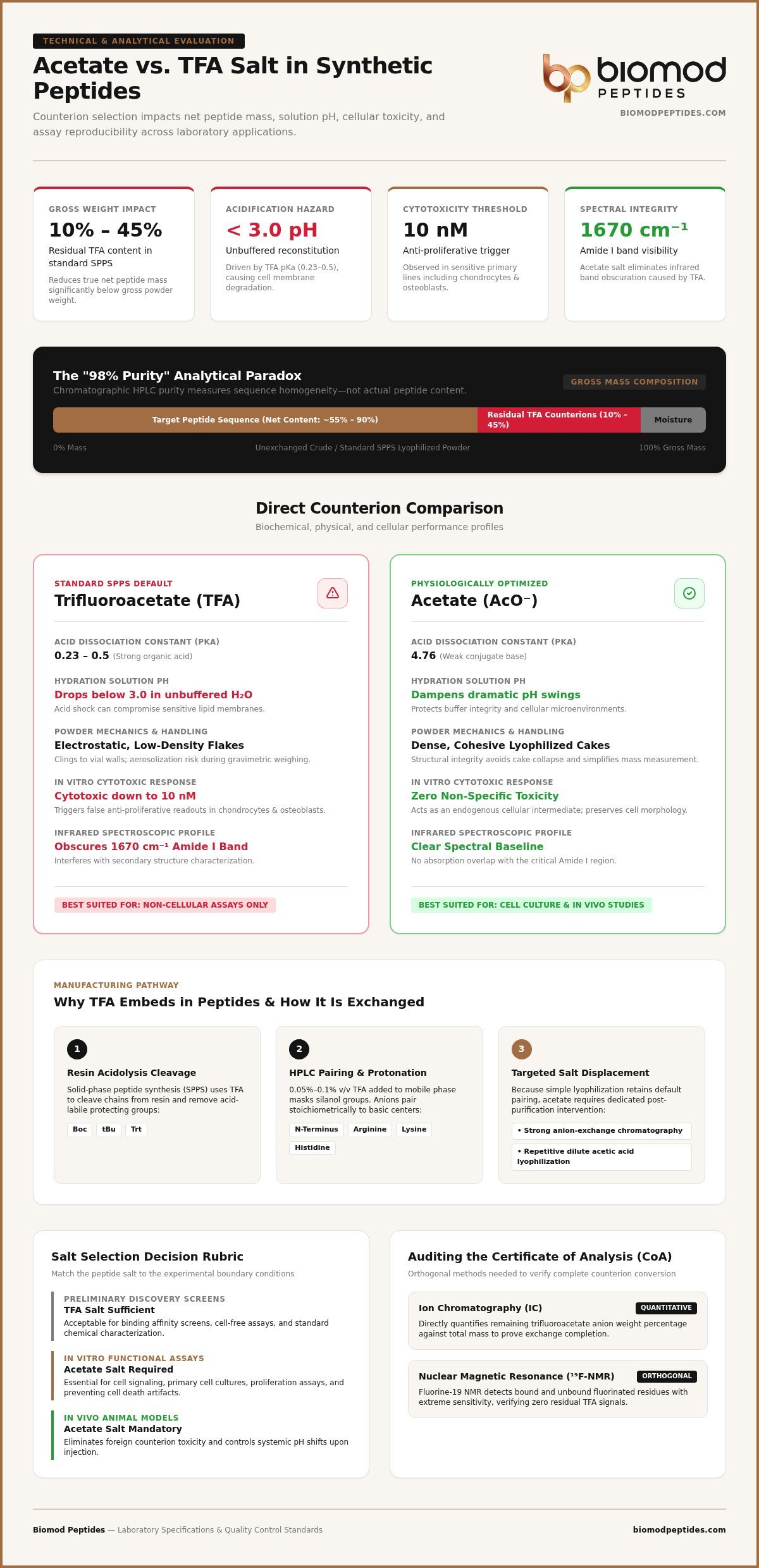
Counterion identity dictates biological fidelity and powder mechanics. Trifluoroacetic acid is a strong organic acid with a pKa between 0.23 and 0.5. Reconstituting unexchanged salts in unbuffered water drops solution pH below 3.0, threatening sensitive cellular membranes. Acetate provides a weaker conjugate base with a pKa of 4.76, dampening dramatic pH swings upon hydration.
Physical handling also shifts between these forms. Lyophilized trifluoroacetate salts frequently yield electrostatic, low-density flakes that cling to vial walls and disperse during mass measurement. Acetate salts consistently form denser, cohesive cakes. This structural integrity minimizes aerosolization risks and simplifies quantitative gravimetric handling in analytical environments.
Physiological Compatibility Versus Chemical Solubilization
Fluorinated counterions introduce significant biological interference. Published research in an overview of counterions in therapeutic peptides confirms that counterion selection alters secondary structure, solution stability, and cell interaction profiles. Unbound trifluoroacetate triggers anti-proliferative signaling and cytotoxicity in sensitive primary cell models, including chondrocytes and osteoblasts, at concentrations as low as 10 nM. Acetate serves as an endogenous cellular intermediate, eliminating confounding cytotoxic artifacts.
- Assay Viability: Acetate preserves physiological cell morphology, preventing false-positive cell death.
- Infrared Verification: TFA exhibits strong infrared absorption near 1670 cm⁻¹, obscuring the Amide I band. Acetate avoids this spectral interference entirely.
Evaluating the benefits of acetate vs TFA salt in peptides is vital for protocols addressing reconstitutions and solubility dynamics. For verified analytical-grade materials finished to strict laboratory specifications, sourcing certified research peptides protects downstream bioassay reproducibility.
Selection and Verification Protocols: Verifying Salt Forms via Laboratory Documentation
Establishing a rigorous salt selection rubric protects experimental validity. For preliminary binding screens or non-cellular chemical assays, standard trifluoroacetate salts often suffice. In vitro cell cultures, functional signaling assays, and in vivo animal workflows demand acetate forms to eliminate toxicological confounding variables. Balancing these experimental requirements lets investigators realize the core benefits of acetate vs TFA salt in peptides without overcomplicating initial discovery phases.
Validating batch documentation requires looking beyond headline purity percentages. Reversed-phase HPLC purity reflects only peptidic peak area uniformity; it doesn’t reveal salt abundance. Comprehensive peptide purity verification requires inspecting the Certificate of Analysis (COA) for direct counterion quantification rather than relying on theoretical mass balances.
Analytical Assays for Measuring Counterion Purity
Two orthogonal methods provide definitive conversion benchmarks on analytical reports:
- Ion Chromatography (IC): Coupled with suppressed conductivity detection, IC separates and quantifies residual trifluoroacetate and acetate down to parts-per-million concentrations, matching standard pharmacopoeial monographs.
- Fluorine-19 NMR (¹⁹F-NMR): This non-destructive spectroscopic technique detects fluorinated nuclei with exceptional sensitivity, validating complete counterion displacement without chromatographic column artifacts.
Thoroughly reviewing these analytical data points proves the benefits of acetate vs TFA salt in peptides before reconstitution. Demanding transparent third-party testing guarantees that high purity research peptides deliver genuine baseline reproducibility across all bioanalytical workflows.
Advancing Experimental Integrity Through Rigorous Counterion Control
Counterion selection isn’t an administrative detail; it defines bioassay validity. Recognizing the operational benefits of acetate vs TFA salt in peptides ensures your experimental results reflect genuine peptide kinetics rather than acidic cytotoxicity or distorted net peptide content. Transitioning to acetate eliminates non-specific cell inhibition and delivers predictable dissolution dynamics across laboratory workflows.
Reliable science demands transparent chemical validation. Biomod Peptides provides analytical reagents manufactured and finished in the United States to strict laboratory specifications. Every batch undergoes independent third-party analytical testing to quantify counterion ratios accurately. Use our dedicated online portal to verify analytical certificates for research peptides, ensuring your benchtop investigations proceed with complete empirical confidence.
Frequently Asked Questions
Why is TFA the default salt form for most synthetic peptides?
Trifluoroacetic acid serves as the universal acidolytic cleavage reagent in solid-phase peptide synthesis to detach chains from resin supports and strip protecting groups. Reversed-phase HPLC purification also relies on TFA mobile-phase modifiers to optimize chromatographic resolution. Without an intentional, secondary salt exchange step, basic residues retain trifluoroacetate counterions by default, making it the standard baseline form in bulk peptide synthesis.
How does residual TFA interfere with cell proliferation and in vitro assays?
Residual trifluoroacetate functions as an acidic cellular toxin, inhibiting cell proliferation, disrupting membrane integrity, and reducing metabolic activity. At concentrations as low as 10 nM, unbound TFA can trigger non-specific cellular stress that skews viability readouts. Highlighting the benefits of acetate vs TFA salt in peptides, acetate acts as an endogenous metabolite that preserves native cellular morphology and eliminates false-positive assay death.
Can acetate salt forms alter the shelf life or stability of lyophilized peptides?
Yes, acetate counterions often improve physical shelf stability. Trifluoroacetate salts typically freeze-dry into fluffy, electrostatically active powders prone to aerosolization and moisture absorption. Acetate salts form denser, more uniform lyophilizate cakes. This compact morphology protects against hygroscopic degradation and structural collapse during long-term storage when sealed under inert gas according to standard laboratory protocols.
How do analytical laboratories verify complete TFA to acetate salt conversion?
Analytical testing facilities verify exchange efficiency using orthogonal methods like suppressed-conductivity ion chromatography (IC) and fluorine-19 nuclear magnetic resonance (¹⁹F-NMR). These assays quantify residual counterion ratios down to trace levels. Benchmarking these metrics confirms the practical benefits of acetate vs TFA salt in peptides, with facilities like Biomod Peptides in Las Vegas documenting lot-specific counterion purity directly through an online verification portal.
Disclaimer
BIOMOD products are sold strictly for laboratory, analytical, and scientific research use only. They are not intended for human or animal consumption, administration, application, ingestion, injection, or any therapeutic, diagnostic, or cosmetic use.
The statements made on this website have not been evaluated by the United States Food and Drug Administration. BIOMOD products are not intended to diagnose, treat, cure, mitigate, or prevent any disease or medical condition.
BIOMOD is a research chemical supplier. BIOMOD is not a compounding pharmacy or chemical compounding facility as defined under Section 503A of the Federal Food, Drug, and Cosmetic Act. BIOMOD is not an outsourcing facility as defined under Section 503B of the Federal Food, Drug, and Cosmetic Act.
By accessing this site, you confirm you are at least 21 years of age and that you have read and accepted the BIOMOD Terms of Sale, Privacy Policy, and Research Use Only Policy. BIOMOD does not provide dosing, medical, therapeutic, diagnostic, veterinary, or use guidance under any channel.