
According to standard Arrhenius kinetics, every 10°C elevation above refrigerated storage roughly doubles the rate of hydrolytic peptide bond cleavage. When handling BPC-157 in laboratory research, even minor thermal fluctuations or improper solvent introduction can silently compromise molecular integrity. A single unmonitored freeze-thaw cycle or aggressive vortexing shears the peptide structure, invalidating weeks of assay data before plate reading begins.
You already know that unverified reagent purity and sloppy aliquoting destroy experimental reproducibility. Reagent stability shouldn’t be an uncontrolled variable in your benchtop workflow. You’ll master analytical protocols for storing, reconstituting, and maintaining the stability of research-grade BPC-157 lyophilizate. This guide breaks down aseptic diluent techniques, cold-chain storage parameters, and third-party chromatographic verification standards to guarantee uncompromised structural integrity across every run.
Key Takeaways
- Lyophilized cakes require long-term archival at -20°C in desiccated environments to shield the 15-amino-acid sequence from ambient moisture absorption.
- Mastering reconstitution mechanics, such as laminar wall dispensing and gentle rotational swirling, prevents shear degradation when handling BPC-157 in laboratory research.
- Aqueous working solutions demand strict post-dilution cold-chain control, limiting storage to 2°C to 8°C within defined assay timelines to prevent hydrolytic decay.
- Cross-referencing orthogonal RP-HPLC and mass spectrometry profiles via accessible COA portals ensures batch-specific purity benchmarks before assay execution.
Physicochemical Profile and Storage Standards for Lyophilized BPC-157
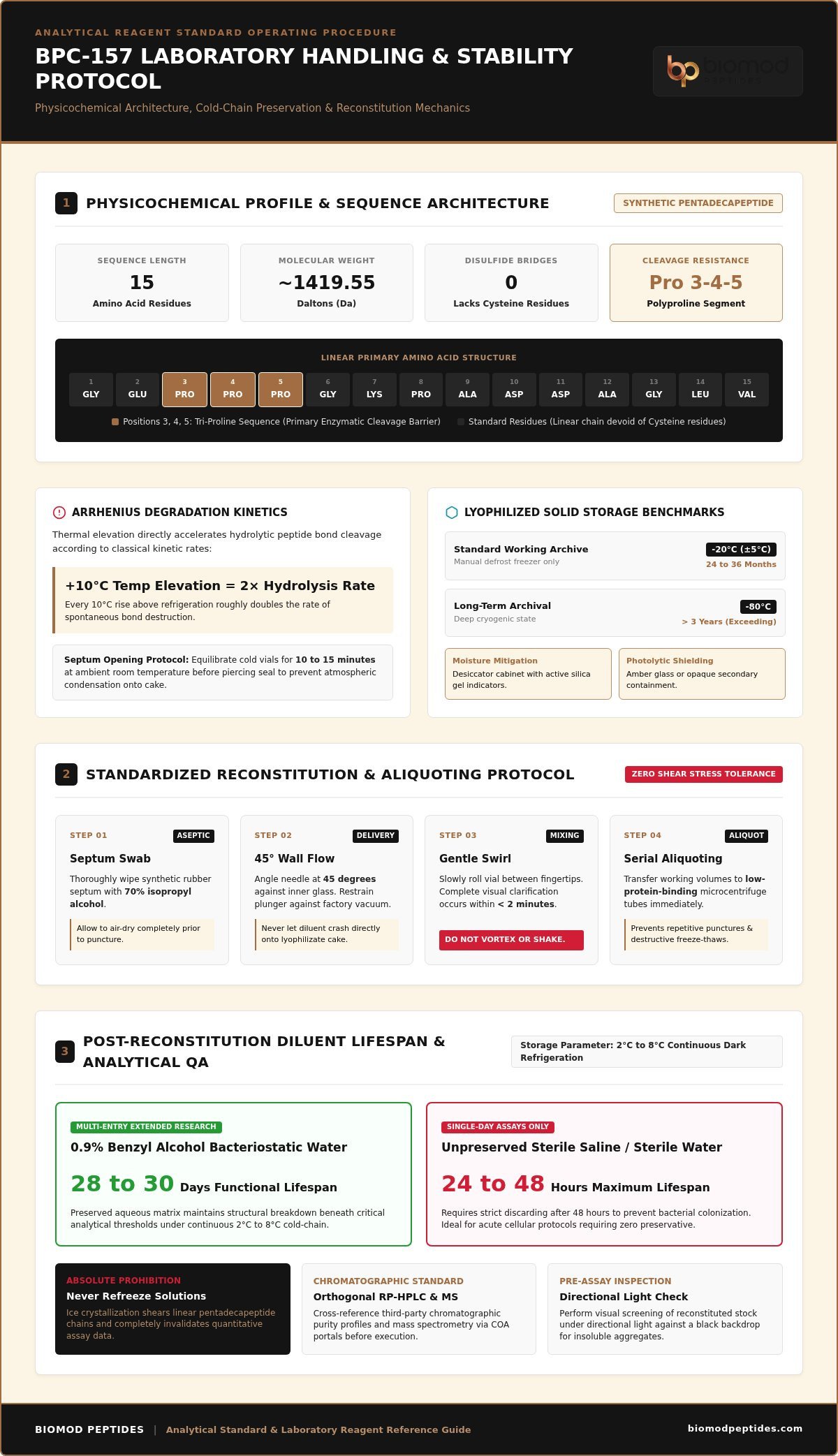
The synthetic pentadecapeptide BPC-157 consists of a 15-amino-acid chain (Gly-Glu-Pro-Pro-Pro-Gly-Lys-Pro-Ala-Asp-Asp-Ala-Gly-Leu-Val) with a molecular weight of roughly 1419.55 Da. Because it lacks cysteine residues, the sequence forms no internal disulfide bridges. Its structural stability instead relies on three consecutive proline residues at positions 3, 4, and 5. This polyproline segment offers resistance to standard enzymatic cleavage, yet solid lyophilizate remains vulnerable to environmental decay. Precise environmental controls are mandatory when handling BPC-157 in laboratory research.
Unopened lyophilized vials retain stability for 24 to 36 months when stored at -20°C in a manual defrost freezer. Auto-defrost cycles introduce cyclic thermal spikes that induce solid-state degradation. Before piercing the septum or opening the crimp seal, let the vial equilibrate at ambient temperature for 10 to 15 minutes. Cold surfaces draw moisture instantly. Opening a chilled vial condenses atmospheric water onto the cake, causing premature hydrolytic cleavage and reducing active peptide yield.
Critical Thermal Benchmarks and Moisture Control Protocols
Achieving reproducible experimental benchmarks demands rigorous storage controls:
- Thermal buffering: Maintain solid lyophilizate at -20°C (±5°C) for standard research or -80°C for archival storage exceeding three years.
- Moisture mitigation: Store sealed vials inside a desiccator cabinet with active silica gel indicators to prevent vapor penetration through rubber septa.
- Photolytic shielding: House vials in amber glass containers or opaque secondary packaging. Direct UV exposure accelerates photo-oxidation across aliphatic residues.
Strict moisture and thermal parameters protect the raw chemical standard, ensuring baseline analytical consistency across assays.
Standardized Reconstitution Protocol for Laboratory Reagent Preparation
Solvent selection dictates aqueous longevity. Use 0.9% benzyl alcohol bacteriostatic water for multi-entry experimental designs, or sterile saline (0.9% sodium chloride) for immediate single-day cellular assays. As detailed in the PubChem compound record for BPC-157, the linear pentadecapeptide structure dissolves freely in neutral aqueous media. However, physical solvent delivery demands mechanical care. Never let diluent crash directly onto the lyophilized cake. High liquid velocity causes shear stress, denaturing delicate peptide chains and generating insoluble aggregates.
Step-by-Step Reconstitution and Aliquoting Procedure
Executing precise solvent mechanics is vital when handling BPC-157 in laboratory research:
- Aseptic preparation: Swab the synthetic rubber septum thoroughly using a sterile 70% isopropyl alcohol wipe and allow it to air-dry completely.
- Controlled delivery: Draw the diluent using an analytical-grade sterile syringe. Angle the needle at 45 degrees against the inner glass wall. Depress the plunger slowly to let the liquid run gently down the glass surface, restraining the plunger against any factory vacuum pull.
- Gentle dissolution: Roll the vial slowly between your fingertips. Never vortex or shake vigorously. Complete visual clarification occurs within two minutes.
- Serial aliquoting: Transfer working volumes immediately into sterile, low-protein-binding microcentrifuge tubes. Pre-aliquoting eliminates repetitive septum punctures and destructive freeze-thaw cycles.
Starting with verified, US-finished reagents from Biomod Peptides ensures predictable solubility and eliminates insoluble manufacturing residues during reconstitution.
Post-Reconstitution Stability, Verification, and Quality Assurance
Reconstitution starts an irreversible clock. In an aqueous matrix, peptide bonds undergo continuous hydrolysis and deamidation. Keep reconstituted liquid stocks between 2°C and 8°C under continuous dark refrigeration. Reagents suspended in 0.9% benzyl alcohol preserved water exhibit a maximum functional lifespan of 28 to 30 days before structural breakdown exceeds analytical thresholds. If you select unpreserved sterile water or saline, discard unused volume after 24 to 48 hours to prevent bacterial colonization. Never refreeze liquid working solutions once thawed; ice crystallization shears linear chains and ruins assay consistency.
Mitigating Hydrolytic Degradation Through Analytical Verification
Rigorous quality assurance is critical when handling BPC-157 in laboratory research:
- Visual screening: Examine working solutions under directional light against a black-and-white background. Discard vials exhibiting turbidity, particulate suspension, or tint shift.
- Temporal tracking: Log preparation dates, diluent lot numbers, and planned discard deadlines directly on secondary vial labeling.
- Chromatographic matching: Cross-reference batch purity before running assays. Benchtop research requires purity baselines at or above 98.0% determined via reversed-phase HPLC alongside mass spectrometry validation.
Eliminate analytical ambiguity by accessing batch-specific lot documentation. Benchmarks provided through Biomod Peptides deliver transparent RP-HPLC spectra and electrospray ionization mass spectrometry reports via an accessible COA verification portal. Reviewing lot-matched documentation confirms that active reagents match their theoretical molecular mass of 1419.55 Da without synthesis truncations. Combining strict shelf-life monitoring with verified analytical paperwork guarantees high assay reproducibility across every experimental protocol.
Standardizing Analytical Integrity Across Your Workflow
Experimental precision demands absolute chemical fidelity. Managing cold-chain storage at -20°C, executing laminar-wall diluent introduction, and dividing reconstituted solutions into single-use aliquots form the foundation of proper laboratory practice. When handling BPC-157 in laboratory research, eliminating mechanical shear stress and thermal fluctuations protects sequence stability, ensuring your cellular models generate uncompromised, reproducible assay outcomes.
Every reliable experimental trial starts with verified chemistry. You can access verified research peptides and analytical COAs at Biomod Peptides to secure domestic, US-finished standards for your laboratory. Every lot undergoes independent third-party HPLC and mass spectrometry testing, fully documented in our online verification portal. Equip your bench with reagents that meet your exact analytical standards today.
Frequently Asked Questions
What is the optimal reconstitution solvent for BPC-157 in laboratory research?
Bacteriostatic water preserved with 0.9% benzyl alcohol is the standard vehicle for multi-access laboratory protocols. For immediate, single-day cellular assays where preservatives might interfere with cell viability, sterile 0.9% sodium chloride or unpreserved sterile water is preferred. When handling BPC-157 in laboratory research, maintain diluent pH between 6.5 and 7.4 to prevent accelerated chemical hydrolysis.
How long does reconstituted BPC-157 remain stable in refrigerated storage?
Reconstituted solutions stored at 2°C to 8°C remain stable for up to 28 to 30 days when prepared with bacteriostatic water. Solutions utilizing unpreserved sterile water or isotonic saline must be consumed or discarded within 24 to 48 hours to prevent microbial accumulation. Beyond these operational thresholds, hydrolytic cleavage compromises active pentadecapeptide concentration.
Why is repeated freeze-thawing detrimental to reconstituted research peptides?
Ice crystal formation during repetitive thermal cycles exerts high shear stress across the linear 15-amino-acid backbone. This mechanical stress causes structural unfolding, fragmentation, and irreversible peptide aggregation. Rigorous handling BPC-157 in laboratory research dictates dividing master solutions into single-use microcentrifuge aliquots immediately after reconstitution to eliminate cyclic thermal shocks entirely.
Can lyophilized BPC-157 be stored at room temperature during transit?
Sealed lyophilized cakes tolerate ambient transit excursions up to 72 hours provided moisture seals remain intact. However, shipments must be moved into -20°C storage immediately upon arrival. For research laboratories operating in high-heat environments like Las Vegas, insulated cold-pack logistics prevent thermal stress before vials enter permanent dark refrigeration.
Disclaimer
BIOMOD products are sold strictly for laboratory, analytical, and scientific research use only. They are not intended for human or animal consumption, administration, application, ingestion, injection, or any therapeutic, diagnostic, or cosmetic use.
The statements made on this website have not been evaluated by the United States Food and Drug Administration. BIOMOD products are not intended to diagnose, treat, cure, mitigate, or prevent any disease or medical condition.
BIOMOD is a research chemical supplier. BIOMOD is not a compounding pharmacy or chemical compounding facility as defined under Section 503A of the Federal Food, Drug, and Cosmetic Act. BIOMOD is not an outsourcing facility as defined under Section 503B of the Federal Food, Drug, and Cosmetic Act.
By accessing this site, you confirm you are at least 21 years of age and that you have read and accepted the BIOMOD Terms of Sale, Privacy Policy, and Research Use Only Policy. BIOMOD does not provide dosing, medical, therapeutic, diagnostic, veterinary, or use guidance under any channel.