
The interior of an unventilated delivery vehicle can reach temperatures exceeding 60°C during peak summer months. This environment far surpasses the standard thermal stability limits for many biological reagents. For researchers, a shipment sitting in a high-heat logistics hub isn’t just a delay. It’s a direct threat to the integrity of your data. You’ve likely experienced the uncertainty of opening a warm package and questioning if your reagents are still viable.
Understanding exactly what to check in a peptide shipment in summer moves you from speculation to scientific certainty. While high-quality lyophilized peptides are engineered for stability, they require a rigorous verification protocol upon arrival. This guide provides a clinical checklist for inspecting your reagents. We’ll examine physical cake morphology, temperature equilibration steps, and the use of COA verification portals to ensure your US-manufactured research peptides maintain their required purity levels.
Key Takeaways
- Learn exactly what to check in a peptide shipment in summer, prioritizing the inspection of vial seals and physical cake morphology for signs of thermal collapse.
- Understand the structural resilience of lyophilized reagents compared to liquid formats when subjected to transient high-heat excursions in logistics hubs.
- Validate every shipment using the dedicated COA Verification Portal to match batch numbers with independent third-party analytical data.
- Establish a precise receiving protocol that includes temperature equilibration to protect the chemical stability of your US-manufactured research peptides.
Understanding Peptide Stability and Thermal Exposure Limits
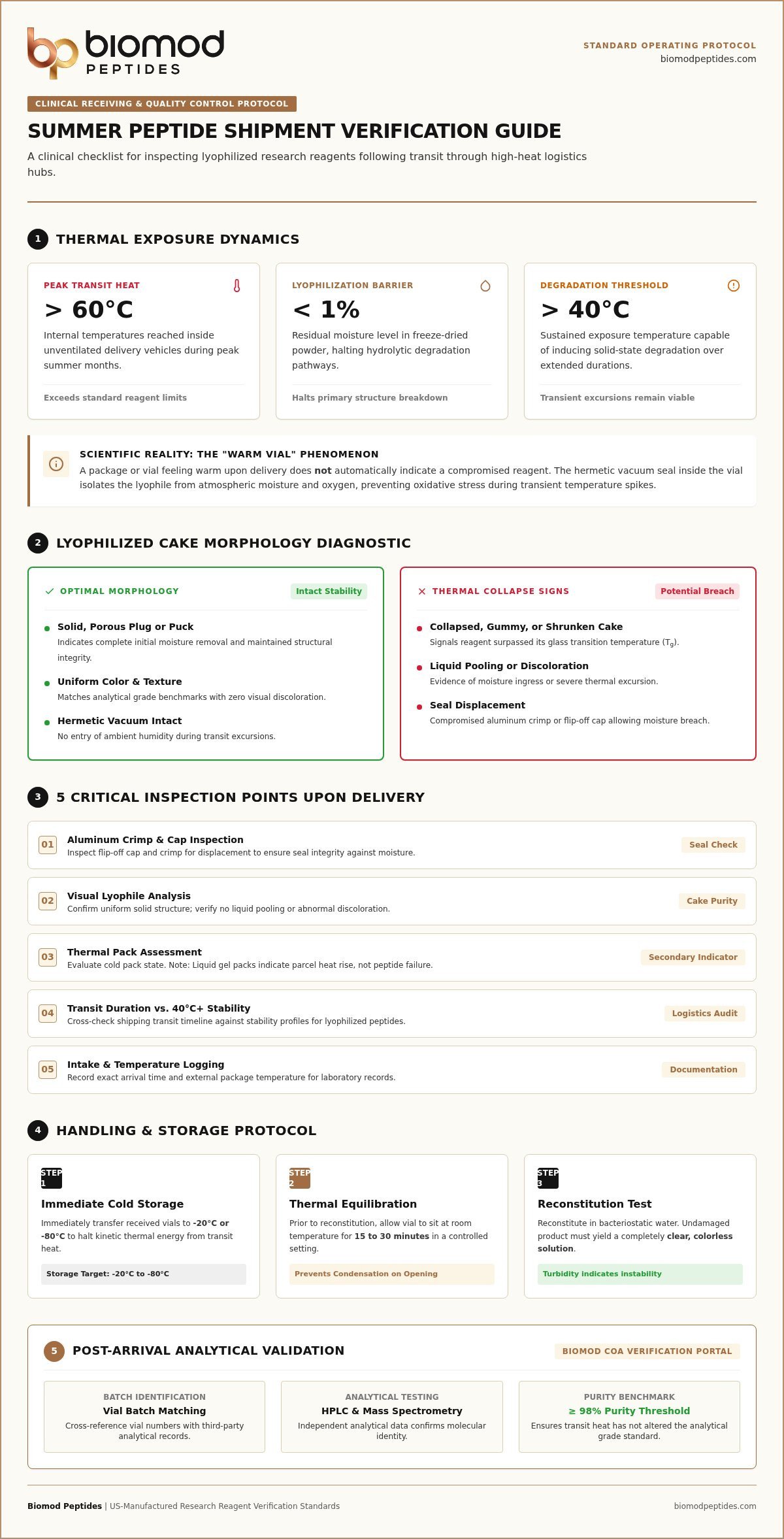
Lyophilization serves as the primary defense against thermal degradation in high-grade research reagents. By reducing residual moisture to less than 1%, the process effectively halts hydrolytic pathways that would otherwise compromise the peptide’s primary structure. When determining what to check in a peptide shipment in summer, researchers must distinguish between transient heat exposure during transit and long-term storage requirements. While sustained temperatures above 40°C can induce solid-state degradation, short-term ambient excursions are often within the stability profiles of vacuum-sealed, freeze-dried powders.
The “warm vial myth” often causes unnecessary concern. A package that feels warm to the touch upon arrival doesn’t automatically indicate a compromised product. Modern cold chain logistics aim to mitigate extreme spikes, but the vacuum seal inside the vial is what truly prevents oxidative stress. This hermetic environment ensures that even if external temperatures fluctuate, the peptide remains isolated from atmospheric moisture and oxygen. This protection is vital for maintaining the analytical purity verified in our laboratory.
The Science of Lyophilized Cake Integrity
Physical structures within the lyophilized “cake” provide immediate visual evidence of manufacturing quality and thermal history. Identifying what to check in a peptide shipment in summer involves a close assessment of this lyophile. A solid, porous plug or a well-defined puck indicates successful moisture removal and structural stability. Conversely, a collapsed, gummy, or shrunken appearance suggests the product surpassed its glass transition temperature ($T_g$) or suffered a moisture breach. High-purity research peptides finished in controlled environments, such as those provided by Biomod Peptides, maintain this integrity at room temperature for short durations. This structural resilience allows for reliable transit even when local temperatures in hubs like Las Vegas exceed standard laboratory conditions.
The Summer Receiving Checklist: 5 Critical Inspection Points
Receiving reagents in high-heat zones like Las Vegas requires an immediate, methodical protocol. When determining what to check in a peptide shipment in summer, prioritize the physical integrity of the vial. Inspect the aluminum crimp and flip-off cap for any signs of displacement. A compromised seal allows moisture ingress, which triggers rapid hydrolytic degradation in the presence of latent heat. Next, perform a visual analysis. The lyophile should match previous analytical grade benchmarks; any discoloration or liquid pooling suggests a breach in manufacturing standards or extreme thermal excursion.
Thermal pack assessment serves as a secondary indicator. While liquid gel packs suggest the internal parcel temperature has risen, they don’t confirm peptide failure. Researchers should align their intake with CDC cold chain storage and temperature excursion protocols to determine if a quarantine period is necessary. Finally, compare the total transit duration against established stability data for lyophilized research peptides. Short excursions are manageable, but extended delays in 40°C+ environments require deeper validation.
Immediate Actions Upon Delivery in High-Heat Zones
Efficiency is paramount. Document the exact arrival time and, if possible, the external package temperature for laboratory records. Transfer vials to -20°C or -80°C storage immediately to halt kinetic energy from heat. Don’t reconstitute the reagent immediately. Allow the vial to equilibrate to room temperature for 15 to 30 minutes in a controlled environment to prevent condensation upon opening. For researchers seeking high-stability reagents, Biomod Peptides provides US-finished products designed for rigorous logistical demands.
Post-Arrival Validation and Storage for Research Integrity
Physical inspection is the first step, but chemical validation confirms the reagent’s utility. When determining what to check in a peptide shipment in summer, researchers must transition from visual cues to analytical data. Utilize the Biomod COA Verification Portal to match the batch number on the vial with independent third-party HPLC and mass spectrometry results. This step ensures the reagent meets the required analytical grade standards, confirming that transit heat hasn’t shifted the purity profile below the 98% threshold.
Establishing a baseline for reconstitution provides final confirmation of stability. Undamaged lyophilized peptides should dissolve completely in bacteriostatic water, resulting in a clear, colorless solution. Any persistent turbidity, cloudiness, or insoluble particulates indicate potential aggregation or structural degradation from thermal stress. In high-heat regions like Las Vegas, maintaining rigorous storage protocols is mandatory. Once validated, vials must remain at -20°C or -80°C to prevent post-shipment degradation and ensure experimental reproducibility over time.
Verification via the Biomod Analytical Portal
The verification process is direct. Enter the batch number into the portal to retrieve the specific HPLC chromatogram and Mass Spec report for your shipment. Our US-manufactured finishing process guarantees batch-to-batch consistency, even during the most challenging seasonal logistics. If analytical results deviate from expected benchmarks or if you observe anomalies during reconstitution, contact Biomod for technical support. We prioritize data-driven accountability to support the integrity of your research.
Securing Experimental Integrity Through Rigorous Validation
High-heat logistics hubs like Las Vegas present unique challenges, but they don’t necessitate compromised results. Maintaining a strict protocol for what to check in a peptide shipment in summer ensures that your reagents remain within analytical grade specifications. By prioritizing physical cake morphology, immediate thermal equilibration, and batch-specific COA verification, you mitigate the risks of thermal degradation. Reliability in research depends on the stability of your starting materials. Our US-manufactured and finished reagents undergo independent third-party HPLC/MS testing to guarantee batch-to-batch consistency. Use the dedicated verification portal to confirm the purity of your specific lot before beginning your next study. Procure High-Purity Research Peptides from Biomod Peptides to secure the precision your laboratory requires. Professional researchers deserve reagents that withstand the environment.
Frequently Asked Questions
Is it normal for my peptide shipment to arrive warm in the summer?
It’s common for shipments to arrive warm when traversing Las Vegas hubs, where ambient temperatures regularly exceed 40°C. Transient warmth on the vial surface doesn’t signify failure. Lyophilized powders are engineered to withstand ambient excursions during short-term transit. When determining what to check in a peptide shipment in summer, prioritize the physical cake structure and seal integrity over the external package temperature.
Do peptides degrade instantly if the cold pack melts?
Peptides don’t degrade instantly upon the melting of a cold pack. Lyophilized reagents maintain stability during transient heat spikes if the moisture content is below 1%. While melted refrigerants suggest the parcel reached ambient levels, they are secondary indicators. Focus on what to check in a peptide shipment in summer; specifically, the absence of cake collapse or gummy residue in the vial.
How can I verify the purity of my peptides after a summer delivery?
Verify purity by entering the batch number into the Biomod COA Verification Portal. This tool provides access to independent third-party HPLC and mass spectrometry reports for your specific lot. In high-heat regions like Las Vegas, cross-referencing this analytical data ensures the reagent maintains its purity threshold. Empirical documentation remains the only definitive method to validate chemical integrity after potential thermal stress.
Should I reconstitute my peptides immediately after they arrive in the heat?
Immediate reconstitution is contraindicated for heat-exposed vials. Allow the reagent to equilibrate to room temperature for 15 to 30 minutes in a controlled environment. Opening a vial immediately after removing it from cold storage or a hot delivery vehicle risks moisture condensation. This condensation triggers hydrolysis, compromising the peptide. Proper equilibration is a mandatory step in protecting your US-manufactured research reagents.
Disclaimer
BIOMOD products are sold strictly for laboratory, analytical, and scientific research use only. They are not intended for human or animal consumption, administration, application, ingestion, injection, or any therapeutic, diagnostic, or cosmetic use.
The statements made on this website have not been evaluated by the United States Food and Drug Administration. BIOMOD products are not intended to diagnose, treat, cure, mitigate, or prevent any disease or medical condition.
BIOMOD is a research chemical supplier. BIOMOD is not a compounding pharmacy or chemical compounding facility as defined under Section 503A of the Federal Food, Drug, and Cosmetic Act. BIOMOD is not an outsourcing facility as defined under Section 503B of the Federal Food, Drug, and Cosmetic Act.
By accessing this site, you confirm you are at least 21 years of age and that you have read and accepted the BIOMOD Terms of Sale, Privacy Policy, and Research Use Only Policy. BIOMOD does not provide dosing, medical, therapeutic, diagnostic, veterinary, or use guidance under any channel.