
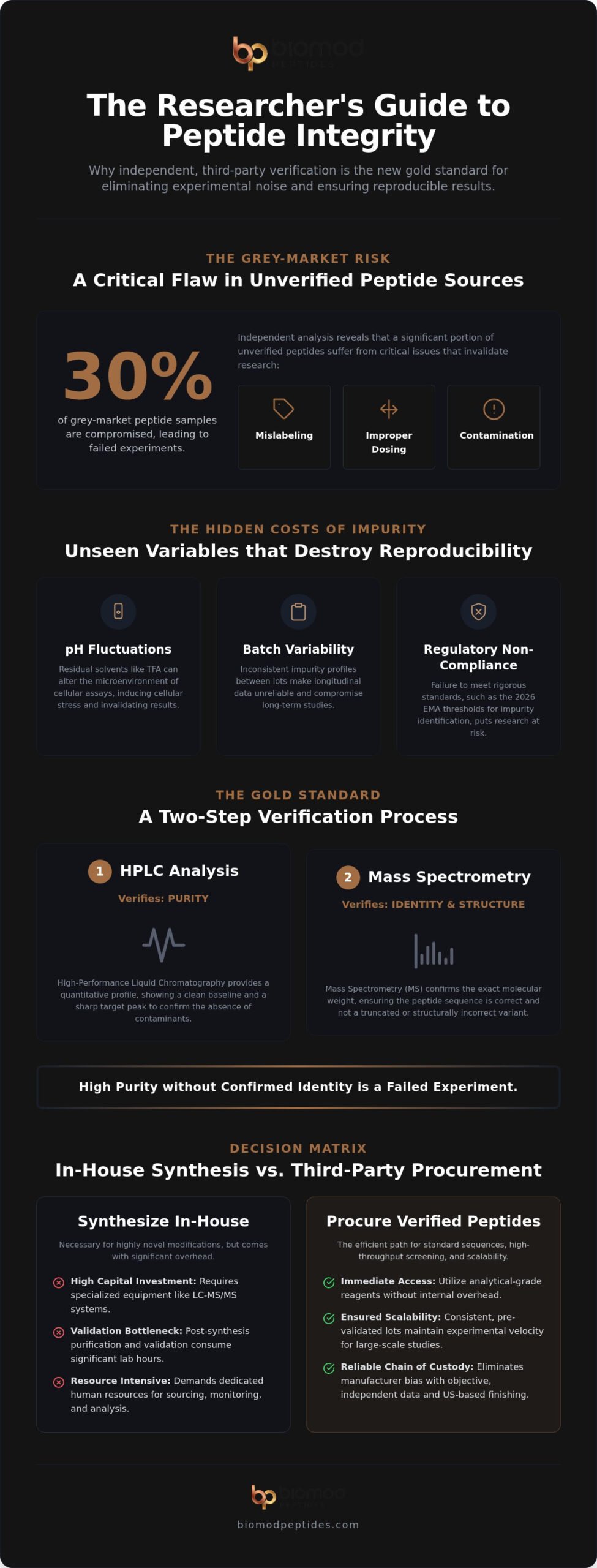
Independent analysis reveals that approximately 30% of peptide samples from grey-market sources suffer from mislabeling, improper dosing, or contamination. For a professional researcher, these aren’t just statistics; they’re failed experiments. You understand that hidden impurities like residual TFA or subtle batch-to-batch variability can invalidate months of cellular assays. Wasting laboratory hours troubleshooting unverified reagents is no longer a viable option in a climate of increasing regulatory scrutiny. The benefits of purchasing third-party tested peptides go beyond simple safety. They provide the analytical foundation necessary for 100% experimental reproducibility.
This article explores how independent HPLC and Mass Spectrometry (MS) verification eliminates confounding variables. We will examine the industry shift from reputation-based trust to empirical, multi-level validation. You’ll learn how to streamline procurement with ready-to-use analytical grade reagents that meet the rigorous 2026 EMA reporting thresholds and institutional quality standards.
Key Takeaways
- Distinguish between numerical purity and structural identity by using Mass Spectrometry to verify exact sequence accuracy.
- Optimize laboratory resource allocation by comparing the efficiency of procurement against the high overhead of in-house synthesis and validation.
- Leverage the benefits of purchasing third-party tested peptides to eliminate manufacturer bias and secure a reliable, verified chain of custody.
- Master the interpretation of HPLC chromatograms and MS reports to identify truncated sequences before they compromise your cellular assays.
Eliminating Experimental Noise: The Analytical Necessity of Independent Verification
Independent oversight is the only mechanism that effectively mitigates manufacturer bias. When a producer issues their own Certificate of Analysis (COA), the incentive to overlook minor impurities is inherent. One of the primary benefits of purchasing third-party tested peptides is the decoupling of synthesis and validation. For Las Vegas labs, US-based finishing ensures a reliable chain of custody that international sources often lack. Utilizing a COA Verification Portal allows researchers to confirm lot-specific data before initiating an assay. This ensures data is objective and untainted by commercial interests.
Analytical precision requires more than a purity percentage. A 99% purity claim on an HPLC report only indicates the absence of contaminants; it doesn’t confirm the peptide sequence is correct. Without Mass Spectrometry (MS) to verify molecular weight, you risk using a pure substance that is structurally incorrect. Various peptide synthesis methods can yield truncated sequences that mimic the target profile on a chromatogram but fail in biological assays. This lack of identity confirmation leads to false-negatives and wasted laboratory hours.
The Hidden Cost of Unverified Peptides
Unverified reagents often contain residual Trifluoroacetic acid (TFA). In delicate in vitro environments, trace TFA shifts pH levels and induces cellular stress. These variables destroy reproducibility and lead to critical risks:
- pH Fluctuations: Residual solvents altering the microenvironment of cellular assays.
- Batch Variability: Inconsistent impurity profiles between lots invalidating longitudinal data.
- Regulatory Non-Compliance: Failure to meet 2026 EMA thresholds of >0.5% for impurity identification.
Documented verification is an analytical necessity for data integrity. It’s the only way to ensure reagents don’t become the weakest link in your methodology and to maintain compliance with institutional safety standards.
Synthesis vs. Procurement: When to Buy Third-Party Tested Peptides
In-house synthesis demands significant capital and human resources. A laboratory must manage raw material sourcing, reaction monitoring, and post-synthesis purification. For many facilities, the primary bottleneck isn’t the synthesis itself but the validation required thereafter. Specialized equipment like LC-MS/MS systems represents a high-barrier investment that smaller institutions often lack. Procurement shifts this burden to a specialized provider. One of the core benefits of purchasing third-party tested peptides is the immediate access to these analytical standards without internal overhead.
Scalability is a critical factor for Las Vegas labs performing high-throughput screening or multi-phase studies. Consistent, pre-validated lots are essential to maintain experimental velocity. Recent data indicates extensive variability in purity and abundance across various commercial sources. This makes batch-specific documentation essential for data integrity. For large-scale research, purchasing ready-to-use reagents ensures studies aren’t stalled by analytical failures. This logistical transparency is a hallmark of US-based finishing and rigorous lot oversight.
Decision Matrix: Buy vs. Synthesize
Sequence complexity dictates the optimal path. Standard sequences are significantly more efficient to purchase through established Laboratory Peptide Supply channels. Highly custom modifications with novel protecting groups might necessitate in-house synthesis despite the cost. Standardized formats, such as peptide softgels, offer a streamlined solution for comparative delivery research. Labs should evaluate their internal throughput before committing to synthesis. Researchers can access the verification portal to assess current lot data for their specific study parameters.
The Gold Standard: Deciphering HPLC and Mass Spectrometry Reports
High-Performance Liquid Chromatography (HPLC) analysis provides a quantitative profile of chemical purity. A rigorous chromatogram must show a clean baseline and a sharp, well-defined target peak. Professional interpretation requires looking beyond the primary peak; you must evaluate peak integration and baseline noise. Truncated sequences often manifest as shoulder peaks or closely eluting contaminants that automated software might overlook. One of the primary benefits of purchasing third-party tested peptides is the professional oversight of this raw data. It ensures that purity claims reflect actual chemical composition rather than baseline interference.
Mass Spectrometry (MS) is the definitive method for identity confirmation. It verifies that the observed molecular weight of the sample matches the theoretical mass of the target sequence. A 99% purity score is irrelevant if the MS data reveals a sequence deletion or an incorrect amino acid substitution. MS provides the structural proof that the reagent in the vial is exactly what was synthesized. This level of verification is essential for high-stakes laboratory research where even a single amino acid error can invalidate an entire study.
Verifying Integrity via Independent Portals
Static PDF reports are no longer sufficient for professional research standards. They are easily manipulated and often lack real-time accountability. Live verification portals are the new industry standard. These systems link the physical batch number to a dynamic database of laboratory results. Accessing these results via a secure portal is one of the ultimate benefits of purchasing third-party tested peptides in the modern landscape. It ensures the analytical report you review matches the specific lot in your hand. You can visit the Biomod About page to review our US-based manufacturing chain and commitment to transparent testing protocols. Adhering to these rigorous analytical standards ensures your reagents support your experimental outcomes.
Standardizing Analytical Excellence in Research
Precision in laboratory research depends entirely on the structural integrity of your reagents. We’ve examined how independent verification removes the variables of manufacturer bias and sequence errors. One of the primary benefits of purchasing third-party tested peptides is the transition from blind trust to empirical certainty. By utilizing US-manufactured lots supported by analytical grade HPLC and Mass Spectrometry documentation, you protect your studies from the confounding effects of impurities or batch variability. Live verification portals now provide the necessary accountability for modern research standards, ensuring that the documentation in your hand matches the vial on your bench. High-throughput studies require this level of logistical transparency to maintain experimental velocity.
Secure Your Research Integrity with Biomod’s Third-Party Tested Catalogue and ensure every lot meets your rigorous benchmarks. Advance your methodology with the confidence of verified data.
Frequently Asked Questions
What is the difference between a manufacturer’s COA and third-party testing?
A manufacturer’s COA is an internal document created by the synthesis provider, which introduces inherent bias. Third-party testing offers independent oversight from an external laboratory to remove this conflict of interest. For scientists in Las Vegas and across the US, this external validation ensures purity reports are objective and accurately reflect the chemical profile of each specific research lot.
Why is HPLC purity alone not enough for research validation?
HPLC purity measures the concentration of a molecule relative to contaminants but doesn’t confirm structural identity. One of the primary benefits of purchasing third-party tested peptides is the inclusion of Mass Spectrometry to verify molecular weight. Without this, a 99% pure sample might contain an incorrect sequence, which can invalidate months of experimental data and laboratory assays.
How do residual solvents like TFA affect peptide research results?
Residual solvents like Trifluoroacetic acid (TFA) are synthesis byproducts that can lower the pH of delicate research environments. These contaminants induce cellular stress and alter in vitro microenvironments, creating confounding variables. Independent testing detects these residual solvents early. This allows researchers to maintain the precise conditions necessary for experimental reproducibility and prevents unverified reagents from compromising study outcomes.
Can I verify the testing results for Biomod Peptides independently?
Yes, you can verify results through our COA Verification Portal. This system allows Las Vegas researchers to enter batch numbers and view independent laboratory data for their specific lot. This transparency ensures that the analytical grade HPLC and MS documentation matches the physical reagents on your bench. It’s a critical step for maintaining a verified chain of custody in professional research.
Disclaimer
BIOMOD products are sold strictly for laboratory, analytical, and scientific research use only. They are not intended for human or animal consumption, administration, application, ingestion, injection, or any therapeutic, diagnostic, or cosmetic use.
The statements made on this website have not been evaluated by the United States Food and Drug Administration. BIOMOD products are not intended to diagnose, treat, cure, mitigate, or prevent any disease or medical condition.
BIOMOD is a research chemical supplier. BIOMOD is not a compounding pharmacy or chemical compounding facility as defined under Section 503A of the Federal Food, Drug, and Cosmetic Act. BIOMOD is not an outsourcing facility as defined under Section 503B of the Federal Food, Drug, and Cosmetic Act.
By accessing this site, you confirm you are at least 21 years of age and that you have read and accepted the BIOMOD Terms of Sale, Privacy Policy, and Research Use Only Policy. BIOMOD does not provide dosing, medical, therapeutic, diagnostic, veterinary, or use guidance under any channel.