
What if six months of laboratory data were invalidated by a single discrepancy on a third-party Certificate of Analysis? Precision is the only currency in a professional research environment. You expect consistency, yet batch-to-batch variation remains a primary driver of wasted funding and stalled progress. Avoiding experimental failure due to bad reagents requires more than trust in a supplier. It demands a rigorous, data-driven verification protocol. With the biotechnology reagents market reaching $909.2 billion in 2026, the density of available products makes internal quality control more critical than ever.
This article provides a comprehensive checklist for verifying research peptides. You’ll learn to navigate purity benchmarks, such as the 98% minimum standard required by UNLV protocols, and utilize COA verification portals to ensure analytical integrity. We’ll outline how to standardize your procurement process and secure reproducible experimental results. This guide ensures your laboratory resources are protected through disciplined validation and structural accountability.
Key Takeaways
- Mandate lot-specific Certificates of Analysis to verify reagent identity and purity benchmarks before initiating any experimental protocol.
- Identify physical indicators of reagent degradation, such as moisture or lyophilized cake collapse, to ensure environmental integrity from transit to storage.
- Prioritize US-manufactured reagents and transparent finishing locations as a standardized method for avoiding experimental failure due to bad reagents.
- Implement a rigorous verification checklist to protect laboratory funding and ensure the reproducibility of your analytical data.
The Pre-Experimental Verification Checklist: Purity and Identity
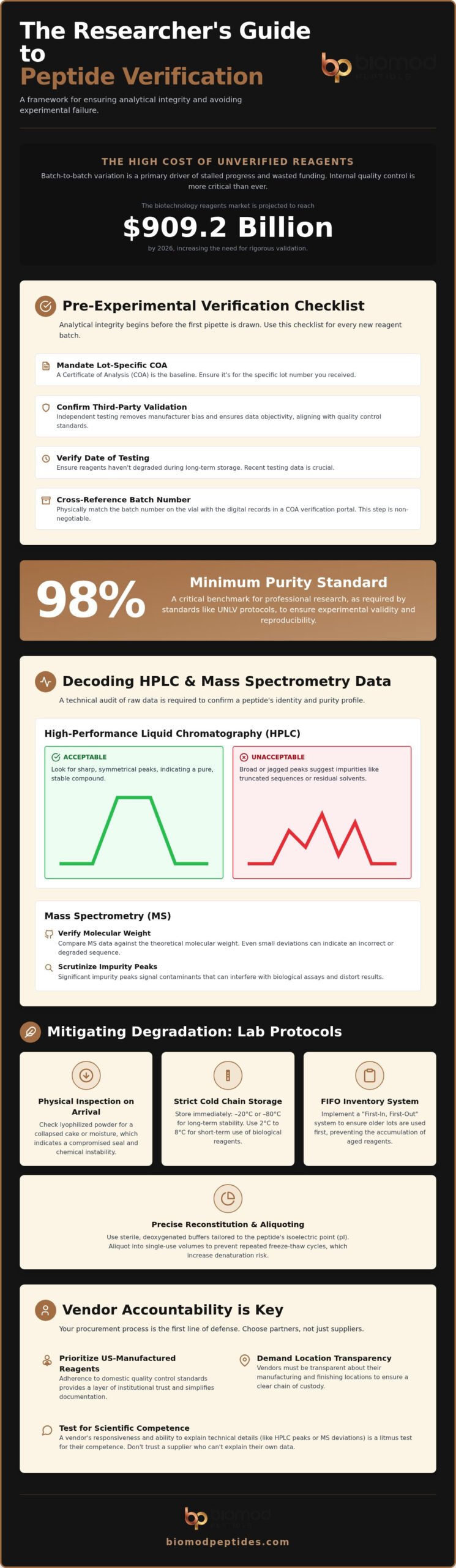
Analytical integrity begins before the first pipette is drawn. Mandating a Certificate of Analysis (COA) for every unique lot number is the baseline for professional research. A COA serves as a scientific testament to a reagent’s specifications. However, its value depends on the independence of the testing laboratory. Confirming third-party validation removes manufacturer bias and aligns with standard analytical quality control procedures. This external oversight ensures that the data provided is an objective reflection of the material’s chemical properties.
Timing is equally critical. Verify the date of testing to ensure reagents haven’t degraded during long-term warehouse storage. Even stable compounds lose structural integrity over time if environmental controls fluctuate. Once received, researchers must cross-reference the batch number on the physical vial with the digital records found in a COA verification portal. This step is non-negotiable for avoiding experimental failure due to bad reagents. It confirms that the product in hand matches the verified data exactly.
Decoding HPLC and Mass Spectrometry (MS) Reports
Verification requires a technical audit of the raw data. High-Performance Liquid Chromatography (HPLC) chromatograms must display sharp, symmetrical peaks. Broad or jagged peaks suggest the presence of truncated sequences or residual solvents. Simultaneously, verify the Mass Spectrometry (MS) data against the theoretical molecular weight of the peptide sequence. A deviation of even a few Daltons indicates an incorrect or degraded sequence. Scrutinize the report for significant impurity peaks. These minor contaminants can interfere with biological assays and distort your results.
Mitigating Degradation: Handling and Storage Protocols
Reagents are highly sensitive to environmental stressors. Avoiding experimental failure due to bad reagents requires vigilant oversight from the moment of delivery. Inspect the physical state of the lyophilized powder upon arrival. A collapsed cake or visible moisture indicates a compromised seal or inadequate vacuum. These physical defects often correlate with chemical instability. Strict cold chain protocols must remain intact throughout transit. Immediate laboratory storage at –20°C or –80°C is required for long-term stability. Biological reagents typically require refrigeration between 2°C and 8°C for short-term use.
Inventory management is equally vital. Implement a first-in-first-out (FIFO) system to ensure older lots are used before newer stock. This prevents the accumulation of aged reagents that may have surpassed their optimal validity period. According to 2026 OMCL/EDQM recommendations, reagents lacking a manufacturer’s expiration date can be assigned a validity of up to 5 years from the date of receipt, provided they are stored correctly. This systematic approach is essential for avoiding experimental failure due to bad reagents in high-throughput environments. Reference our guide on improving peptide solubility to mitigate aggregation during reconstitution.
Optimization of Reconstitution and Aliquoting
Precision in the lab extends to the choice of solvent. Use sterile, deoxygenated buffers tailored to the specific peptide sequence isoelectric point (pI). Incorrect pH levels can cause immediate precipitation. Aliquot reagents into single-use volumes to prevent repeated freeze-thaw cycles. Each cycle increases the risk of denaturation. Document the date of reconstitution and storage temperature on every secondary container. For researchers seeking high-purity standards, sourcing US-manufactured reagents adds a layer of logistical transparency that simplifies this documentation process.
Vendor Accountability: Sourcing Standards for Las Vegas Labs
Accountability is a procurement function. Prioritizing US-manufactured research peptides ensures adherence to domestic quality control standards and provides a layer of institutional trust. This is a critical step in avoiding experimental failure due to bad reagents. Vendors must be transparent regarding their manufacturing and finishing locations. Evaluate the availability of specialized delivery formats, such as peptide softgels or spray products, for specific research applications. A vendor’s responsiveness to technical inquiries regarding impurity profiles serves as a litmus test for their scientific competence. If a provider cannot explain specific HPLC peaks or MS deviations, they shouldn’t be trusted with your laboratory funding. High-tier research requires a partner invested in data integrity, not just a retail supplier.
The Significance of Domestic Manufacturing and Verification
Domestic finishing in facilities, particularly those located in Las Vegas, drastically reduces transit-related degradation. Long-distance shipping often introduces thermal fluctuations that compromise sensitive biomolecules. US-based vendors are subject to stricter legal and professional accountability for their reagent claims. This geographic proximity allows for faster lot-specific verification and tighter cold chain management. For a complete procurement framework, consult our laboratory peptide supply guide. Establishing these standards ensures your laboratory maintains analytical integrity across all research cycles. This disciplined approach to sourcing is the final pillar in avoiding experimental failure due to bad reagents. It moves quality control from a bench-side reaction to a structural protocol.
Advancing Analytical Integrity through Rigorous Verification
Securing reproducible data requires a shift from passive procurement to active verification. By mandating independent third-party testing and maintaining strict cold chain protocols, laboratories protect their research investments from the risks of chemical degradation. Systematic documentation and the use of digital COA portals provide the transparency necessary for avoiding experimental failure due to bad reagents. These standards ensure that every compound meets the precise requirements of your specific molecular biology protocols.
Biomod Peptides supports this level of precision with US-manufactured and finished research reagents. Every lot undergoes independent third-party testing to guarantee structural integrity and purity. You can secure high-purity reagents for your next experiment at Biomod Peptides and utilize our dedicated verification portal for total transparency. Elevate your laboratory standards today to ensure the success of your future discoveries.
Frequently Asked Questions
How do I know if my peptide has degraded during shipping?
Physical indicators provide the first assessment of integrity. A collapsed lyophilized cake or visible moisture within the vial suggests a vacuum seal breach or excessive thermal exposure. These defects often correlate with chemical instability. Researchers in Las Vegas should prioritize domestic shipping to minimize transit time. Biomod Peptides finishes products in the US to reduce these specific degradation risks during logistics.
What is the minimum purity required for reliable in vitro research?
A minimum purity of 98% is the established standard for molecular biology protocols, including those at institutions like UNLV. Lower purity levels introduce unknown contaminants that can skew data or inhibit biological assays. Adhering to this threshold is vital for avoiding experimental failure due to bad reagents. Every lot number must be verified via HPLC to confirm these specific purity benchmarks.
Why is third-party testing more reliable than internal manufacturer reports?
Third-party testing eliminates the inherent conflict of interest found in internal manufacturer reports. Independent laboratories provide an objective audit of purity and identity through HPLC and Mass Spectrometry. This process ensures that the reagent data is not influenced by production quotas. Biomod Peptides utilizes independent testing on all lots, providing researchers with unbiased verification of analytical integrity and structural accountability.
How long can lyophilized peptides be stored before experimental failure becomes likely?
Lyophilized peptides can remain stable for up to 5 years when stored at –20°C or –80°C, according to 2026 OMCL/EDQM guidelines. This assumes the absence of a specific manufacturer expiration date and adherence to strict environmental controls. Once reconstituted, the stability window narrows significantly. Maintaining a FIFO inventory system is a primary strategy for avoiding experimental failure due to bad reagents in long-term projects.
Disclaimer
BIOMOD products are sold strictly for laboratory, analytical, and scientific research use only. They are not intended for human or animal consumption, administration, application, ingestion, injection, or any therapeutic, diagnostic, or cosmetic use.
The statements made on this website have not been evaluated by the United States Food and Drug Administration. BIOMOD products are not intended to diagnose, treat, cure, mitigate, or prevent any disease or medical condition.
BIOMOD is a research chemical supplier. BIOMOD is not a compounding pharmacy or chemical compounding facility as defined under Section 503A of the Federal Food, Drug, and Cosmetic Act. BIOMOD is not an outsourcing facility as defined under Section 503B of the Federal Food, Drug, and Cosmetic Act.
By accessing this site, you confirm you are at least 21 years of age and that you have read and accepted the BIOMOD Terms of Sale, Privacy Policy, and Research Use Only Policy. BIOMOD does not provide dosing, medical, therapeutic, diagnostic, veterinary, or use guidance under any channel.