
Did you know that approximately 65% of FDA complete response letters for peptide-based drugs cite stability-related concerns? For researchers operating in desert environments, this challenge is magnified. Low humidity and extreme diurnal temperature swings create a volatile baseline for sensitive reagents. You’ve likely encountered inconsistent data or the premature degradation of lyophilized samples during storage. These environmental stressors require a more disciplined approach to quality control and verification.
This article establishes rigorous protocols for peptides for arid climate stability studies to solve these inconsistencies. We’ll analyze the specific chemical stressors of low-humidity environments and identify high-purity standards capable of withstanding arid stress. By following these analytical benchmarks, you can ensure reproducibility and maintain structural integrity in desert-based laboratories. We’ll also examine the essential verification methods and storage standards required to achieve a higher tier of execution compared to the status quo.
Key Takeaways
- Identify the specific chemical pathways, such as dehydration-induced aggregation, that compromise peptide secondary structure in low-humidity environments.
- Establish rigorous baseline data using HPLC and Mass Spectrometry before subjecting samples to simulated desert conditions in environmental chambers.
- Select 99%+ high-purity peptides for arid climate stability studies to prevent trace impurities from catalyzing accelerated degradation under thermal stress.
- Implement a standardized stability protocol that utilizes third-party COA verification to ensure analytical reproducibility across varying laboratory environments.
The Chemical Mechanics of Peptide Degradation in Arid Environments
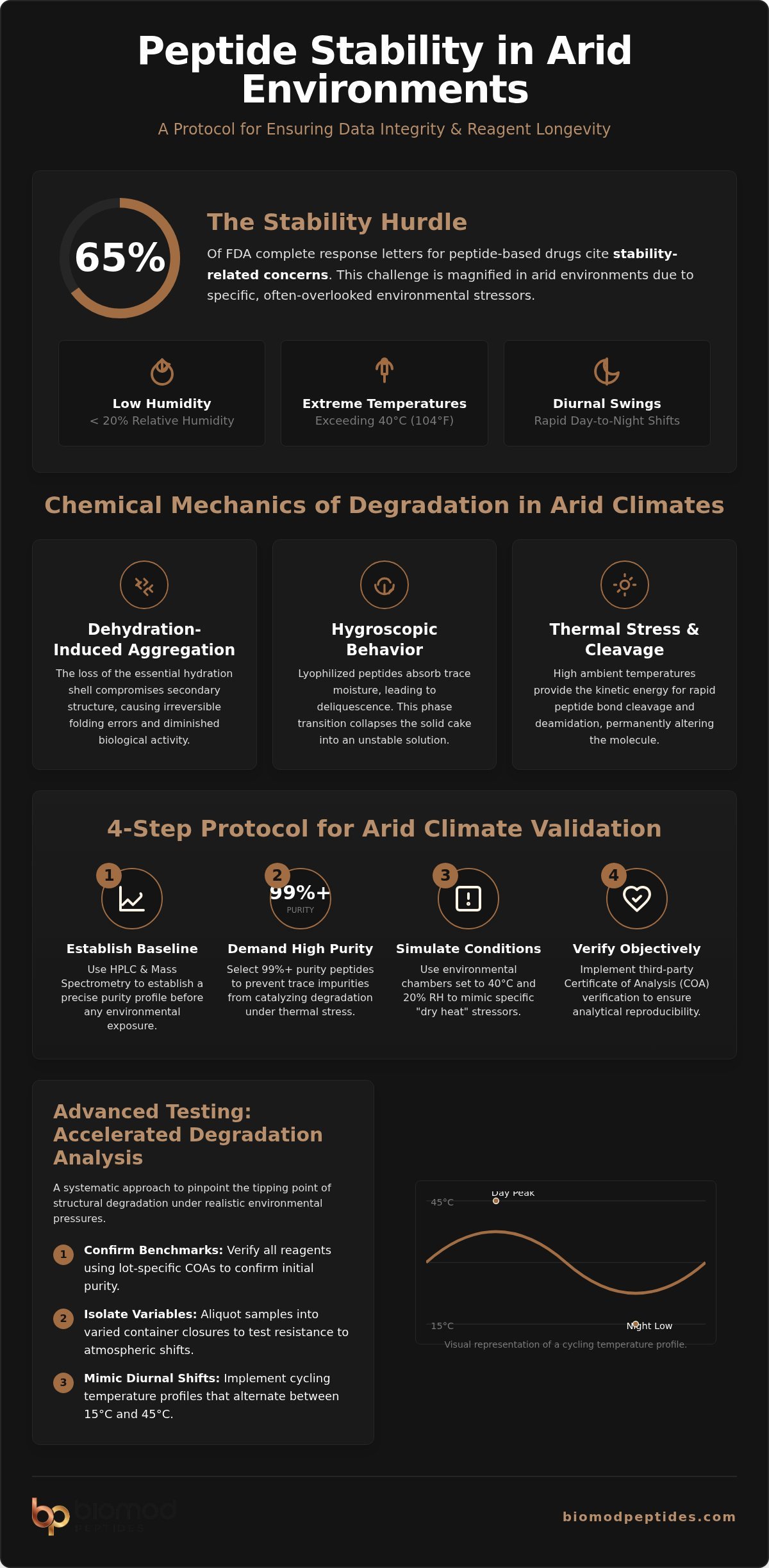
Arid environments present specific challenges for maintaining the chemical stability of laboratory reagents. These regions are defined by extreme atmospheric conditions that accelerate degradation pathways often ignored by standard humidity protocols. The primary stressors include low relative humidity (RH), frequently dropping below 20%, and extreme diurnal temperature variations. High ambient temperatures, often exceeding 40°C in desert-based laboratory settings like Las Vegas, further exacerbate the risk. These thermal peaks provide the kinetic energy required for rapid peptide bond cleavage and deamidation. In these conditions, dehydration-induced aggregation becomes a major concern. When peptides lose their essential hydration shell, secondary structure integrity is compromised. This leads to irreversible folding errors and diminished biological activity. For researchers conducting peptides for arid climate stability studies, understanding these mechanics is vital for ensuring data reproducibility and reagent longevity.
Hygroscopic Behavior and Solid-State Stability
Lyophilized peptides are highly porous and inherently hygroscopic. Even in arid climates, they can absorb trace amounts of atmospheric moisture during storage or vial access. This often leads to deliquescence, where the solid cake collapses into a concentrated, unstable solution. Such phase transitions drastically alter degradation kinetics and compromise the sample’s purity profile. It’s critical to utilize verified peptide certificates of analysis to establish a rigorous baseline for moisture content and purity levels. Without this objective documentation, identifying whether degradation occurred during manufacturing or experimental handling becomes impossible. Consistent monitoring of these variables is the only way to ensure structural integrity remains intact throughout the study duration.
Designing Stability Studies: Parameters for Low Humidity and Thermal Stress
Validating structural integrity begins with empirical baselines. Before environmental exposure, every sample must undergo High-Performance Liquid Chromatography (HPLC) and Mass Spectrometry confirmation. This establishes a precise purity profile and identifies existing impurities that might catalyze further degradation. For researchers focusing on peptides for arid climate stability studies, this initial verification is the only way to differentiate between manufacturing artifacts and environment-induced breakdown. It’s a critical step for ensuring analytical reproducibility in desert-based laboratories.
Standard stability studies often rely on high-humidity models. Arid-climate simulation requires a deliberate shift toward “dry heat” parameters. Setting environmental chambers to 40°C at 20% relative humidity mimics the specific stressors of desert regions like the Mojave. These conditions accelerate chemical degradation pathways without the interference of excessive moisture. Reliability in these studies also depends on the starting material’s history. Utilizing US manufactured research peptides ensures the logistical chain remains short and documented. This minimizes pre-study thermal stress often found in international shipping, preserving the integrity of the reagent before the study begins.
Protocol for Accelerated Arid Degradation Analysis
A systematic approach is required to identify the tipping point of structural degradation. First, verify all reagents using the Biomod COA portal to confirm lot-specific benchmarks. Second, aliquot samples into varied container closures to determine how different delivery formats resist atmospheric shifts. Finally, implement cycling temperature profiles that mimic diurnal desert shifts, alternating between 15°C and 45°C. This methodology provides a comprehensive view of how peptides for arid climate stability studies perform under realistic environmental pressure. You can verify your research reagents through our portal to ensure baseline data is accurate.
Selecting High-Purity Research Reagents for Arid Climate Validation
Achieving 99%+ purity is non-negotiable for peptides for arid climate stability studies. Lower purity levels introduce trace substances that act as catalysts for degradation under thermal stress. These impurities often trigger secondary reactions that obscure primary stability data. Rigorous third-party verification ensures an objective research baseline. This accountability eliminates variables that could compromise analytical reproducibility. Sourcing from a laboratory peptide supply company with regional expertise provides a distinct advantage. Our Las Vegas headquarters allows for a deeper understanding of diurnal temperature swings and low-humidity stressors.
Stability profiles vary significantly between delivery formats. While lyophilized powder is the standard, peptide softgels for research may offer enhanced protection against atmospheric moisture absorption. The encapsulated environment limits exposure to the fluctuating relative humidity common in arid zones. This comparative resilience is a vital consideration for long-term validation projects where structural integrity is the primary metric. It’s a strategic choice for researchers who require consistent stability data in high-stress environments.
Verification Protocols for Arid-Resistant Research
Delivery systems like intranasal spray products require specific scrutiny. High-heat exposure can alter the concentration of these solutions, impacting peptide stability. Researchers must interpret HPLC reports with precision to identify pre-existing degradation markers. Look for peak broadening or unexpected shoulders in the chromatogram before study commencement. These markers indicate that the reagent’s integrity was compromised prior to environmental testing. Establishing this high-tier baseline is essential for distinguishing between reagent-borne impurities and the actual effects of arid-climate stress.
Advancing Analytical Standards in Arid Research
Establishing a repeatable protocol for peptides for arid climate stability studies requires more than standard laboratory controls. It demands a rigorous understanding of how dehydration-induced aggregation compromises secondary structure integrity. By prioritizing 99%+ purity and utilizing third-party verification, you eliminate confounding variables that compromise reproducibility. Our Las Vegas headquarters provides unique logistical insight into managing these extreme environmental fluctuations. Every lot undergoes independent testing to ensure your baseline data remains beyond reproach. Access our comprehensive COA portal to verify the structural integrity of your research reagents before beginning your next validation phase. It’s the only way to achieve definitive results in desert-based laboratory environments.
Secure High-Purity Reagents for Your Stability Studies at Biomod Peptides. Precise data begins with uncompromising material standards.
Frequently Asked Questions
How does low humidity affect the shelf life of lyophilized peptides?
Low humidity accelerates dehydration-induced aggregation and compromises the hydration shell of lyophilized reagents. In Las Vegas, extreme aridity can cause solid-state cakes to become brittle or undergo subtle phase changes. These shifts impact reconstitution kinetics and biological efficacy. Maintaining a hermetic seal is vital to prevent atmospheric moisture exchange that leads to premature degradation during long-term storage.
What temperature ranges should be used for arid climate simulation in stability studies?
Simulation protocols should utilize cycling profiles that mimic diurnal desert shifts. We recommend alternating between 15°C and 45°C to reflect the extreme thermal range of the Mojave. This specific range identifies the kinetic tipping point for bond cleavage. Using these parameters for peptides for arid climate stability studies ensures that analytical data reflects the actual stressors of high-heat environments.
Can peptide softgels improve stability in high-temperature environments?
Peptide softgels provide an encapsulated environment that limits exposure to atmospheric fluctuations. The protective matrix serves as a barrier against rapid thermal shifts and extreme low humidity. This delivery format reduces the hygroscopic risks associated with lyophilized powder. It’s a reliable alternative for researchers seeking to maintain high-tier structural integrity in laboratories without constant climate control systems.
Why is third-party testing critical for environmental stability research?
Independent testing establishes a credible baseline by documenting initial purity and moisture levels. Researchers need this data to isolate environmental degradation from manufacturing artifacts. Biomod Peptides provides a COA verification portal to ensure every lot meets rigorous analytical standards. This level of accountability is the only way to guarantee data integrity and reproducibility in specialized stability research.
Disclaimer
BIOMOD products are sold strictly for laboratory, analytical, and scientific research use only. They are not intended for human or animal consumption, administration, application, ingestion, injection, or any therapeutic, diagnostic, or cosmetic use.
The statements made on this website have not been evaluated by the United States Food and Drug Administration. BIOMOD products are not intended to diagnose, treat, cure, mitigate, or prevent any disease or medical condition.
BIOMOD is a research chemical supplier. BIOMOD is not a compounding pharmacy or chemical compounding facility as defined under Section 503A of the Federal Food, Drug, and Cosmetic Act. BIOMOD is not an outsourcing facility as defined under Section 503B of the Federal Food, Drug, and Cosmetic Act.
By accessing this site, you confirm you are at least 21 years of age and that you have read and accepted the BIOMOD Terms of Sale, Privacy Policy, and Research Use Only Policy. BIOMOD does not provide dosing, medical, therapeutic, diagnostic, veterinary, or use guidance under any channel.