
Trust is no longer a viable procurement strategy in modern peptide research. As the global peptide therapeutics market scales toward $164 billion in 2026, the influx of new suppliers has made rigorous internal protocols mandatory. You understand that a single inconsistent batch can compromise years of longitudinal data or lead to irreproducible results. The process of validating a new batch of research peptides requires more than a cursory glance at a supplier’s documentation. It demands a systematic approach to verifying chemical integrity.
We provide a rigorous, laboratory-grade checklist designed to eliminate reagent uncertainty. You’ll gain a reproducible workflow for interpreting complex HPLC and mass spectrometry reports while leveraging the latest 2026 NIST MS/MS libraries for sequence verification. This guide outlines the essential steps for cross-referencing Certificates of Analysis (COA) and performing physical inspections to ensure your reagents meet the highest analytical standards.
Key Takeaways
- Establish a documentation hierarchy by distinguishing between third-party independent lab reports and internal manufacturer data.
- Evaluate physical batch integrity through lyophilized cake inspection and vacuum seal verification to ensure reagent stability.
- Streamline the process of validating a new batch of research peptides using secure COA verification portals for absolute data transparency.
- Prioritize reagents with US-based manufacturing and finishing to ensure adherence to domestic quality control and structural integrity standards.
The Pre-Analytical Protocol: Evaluating the Certificate of Analysis (COA)
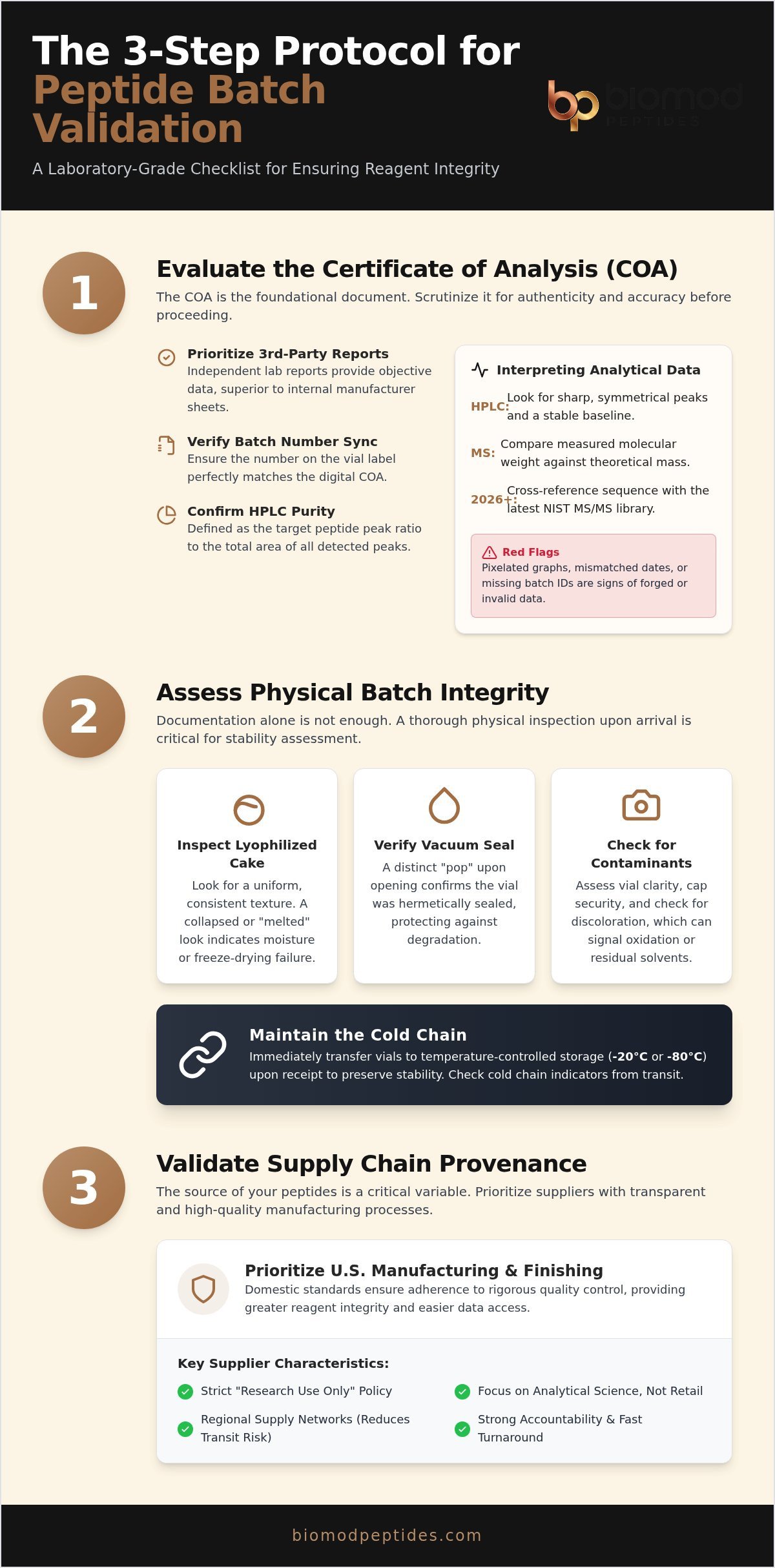
The Certificate of Analysis (COA) serves as the primary scientific and legal record of batch identity. It’s the foundational document for validating a new batch of research peptides. You must prioritize independent third-party laboratory reports over in-house manufacturer data. Internal reports often lack the objective distance required for rigorous validation. Always verify that the batch number on the physical vial label synchronizes perfectly with the digital COA. Any mismatch indicates a failure in the chain of custody or a potential reagent swap.
HPLC purity is defined as the ratio of the target peptide peak to the total area of all peaks detected. This metric quantifies chemical cleanliness following the Peptide Synthesis process. High purity is essential for minimizing variance in experimental data and ensuring reagent stability.
Interpreting HPLC and Mass Spectrometry Data
When validating a new batch of research peptides, analyze HPLC chromatograms for baseline stability and peak symmetry. Sharp peaks indicate high purity; broad or multiple peaks suggest contamination or degradation. Mass Spectrometry (MS) validates identity by comparing the measured molecular weight against the theoretical mass. For 2026 standards, utilize the updated NIST MS/MS library to ensure sequence accuracy. Watch for specific red flags. Pixelated graphs often indicate forged data. Mismatched date stamps or missing batch identifiers are critical failures. Reliable validation requires utilizing manufacturer verification portals, such as the Biomod COA portal, to cross-reference lot data against laboratory databases. This ensures the COA was actually issued for that specific lot and not repurposed from a prior batch.
Physical Batch Integrity and Stability Assessment
Physical inspection is the second critical pillar in validating a new batch of research peptides. Documentation alone doesn’t guarantee reagent viability upon arrival. You must inspect the lyophilized cake for a uniform, consistent texture. A collapsed or “melted” appearance indicates moisture ingress or a failure in the freeze-drying protocol. Color should remain consistent across the entire batch. Discoloration often signals oxidation or the presence of residual solvents that could interfere with downstream assays.
Verify vacuum seal integrity during the initial opening. A distinct “pop” or physical resistance confirms that the vial remained hermetically sealed against atmospheric humidity. This seal is the primary defense against hydrolytic degradation. You should also assess vial clarity and cap security to ensure no particulate contamination occurred during the finishing stage. For sequences known for thermal instability, check the cold chain indicators immediately. Data from Peptide Impurity Profile Studies suggest that environmental exposure during transit is a primary driver of unexpected degradation peaks.
Storage and Handling Verification for Las Vegas Labs
Local laboratories must implement immediate temperature-controlled storage protocols to maintain peptide stability for research. Transitioning vials to -20°C or -80°C environments upon receipt is mandatory. Before reconstitution, cross-reference the batch’s specific solubility data with established peptide purity standards. This step prevents unnecessary loss of material due to improper solvent selection. Rigorous physical validation is a core requirement when validating a new batch of research peptides for long-term studies. If your current supply chain lacks these finishing standards, consider reviewing the US-manufactured reagents available for precise laboratory applications.
Supply Chain Provenance: Validating the Source
Prioritizing US-manufactured research peptides is a strategic necessity for maintaining experimental integrity. Domestic finishing standards ensure that reagents are processed in facilities subject to rigorous oversight. This geographic proximity simplifies the process of validating a new batch of research peptides by providing direct access to manufacturing data. Professional suppliers strictly adhere to “Research Use Only” terms. This commitment reflects a disciplined focus on analytical science rather than retail marketing. It signals that the vendor prioritizes structural integrity over consumer-grade aesthetics.
Las Vegas laboratories should leverage regional supply networks to mitigate logistics-related risks. Shortened transit times reduce the window for thermal fluctuations and environmental degradation. This regional approach ensures that the physical batch integrity discussed previously remains uncompromised during shipping. Local procurement strengthens the accountability of the supply chain. It allows for faster turnaround times without sacrificing the stringent verification protocols required for longitudinal studies.
Leveraging the Biomod COA Verification Portal
Digital transparency is the final step in the validation protocol. You can use the Biomod Peptides portal to instantly confirm batch authenticity. Enter the unique lot code or scan the QR code to access the original laboratory records. This system prevents the use of repurposed or falsified documentation. Independent third-party testing remains the gold standard for high purity research peptides. It provides an objective layer of verification that manufacturer-only reports cannot match. This portal-based cross-referencing ensures that your data reflects the actual chemical composition of the reagent, not a generic industry average.
Securing Analytical Integrity Through Standardized Validation
Analytical success depends on the structural integrity of your reagents. Validating a new batch of research peptides requires a disciplined three-tier approach: rigorous COA interpretation, physical assessment of vial stability, and verification of supply chain provenance. By prioritizing US-manufactured reagents and independent third-party lab results, you eliminate the variables that disrupt longitudinal studies. Precision in the laboratory begins with absolute certainty in your materials. Maintaining analytical grade purity standards is not just a benchmark; it’s a requirement for reproducible science.
You can ensure the authenticity of your next lot by using specialized verification tools. Access the Biomod COA Verification Portal for Batch Validation to cross-reference your specific batch data with a secure database. Implementing these verification steps protects your research from inconsistent quality and data variance. Your commitment to rigorous methodology ensures the advancement of your niche with professional confidence.
Frequently Asked Questions
How can I tell if a peptide COA has been tampered with or fabricated?
Identify fabrication by inspecting for graphical anomalies such as pixelation or mismatched fonts. Mismatched date stamps often indicate repurposed data from older lots. For absolute certainty, Las Vegas laboratories should utilize a secure COA verification portal to cross-reference lot numbers with the testing facility’s original database. This digital validation prevents the use of forged documentation that hasn’t been issued by an independent third-party laboratory.
What is the acceptable purity threshold for analytical grade research peptides?
High-purity analytical grade reagents typically require a purity threshold of 98% or higher. While 95% may suffice for preliminary screening, higher standards are mandatory when validating a new batch of research peptides for quantitative assays. Lower purity levels often indicate the presence of truncated sequences or residual salts, which can introduce significant variance into experimental data and compromise longitudinal study results.
Why is Mass Spectrometry necessary if I already have an HPLC purity report?
HPLC quantifies the purity of a sample, but it cannot definitively confirm the molecular sequence. Mass Spectrometry (MS) is required to verify the identity of the peptide by measuring its molecular weight against a theoretical mass. Without MS, you risk using a highly pure reagent that is chemically incorrect. This dual-layered verification ensures that both the concentration and the structural identity meet US manufacturing standards.
Does the color of the lyophilized peptide cake indicate its purity level?
While color isn’t a direct measure of purity percentage, it’s a critical indicator of finishing quality. A standard lyophilized cake should appear as a uniform white or off-white solid. Yellow or brown tints often suggest oxidation, residual synthesis solvents, or improper freeze-drying protocols. Las Vegas researchers should reject vials with discolored cakes, as these physical deviations often correlate with degradation peaks in HPLC reports.
Disclaimer
BIOMOD products are sold strictly for laboratory, analytical, and scientific research use only. They are not intended for human or animal consumption, administration, application, ingestion, injection, or any therapeutic, diagnostic, or cosmetic use.
The statements made on this website have not been evaluated by the United States Food and Drug Administration. BIOMOD products are not intended to diagnose, treat, cure, mitigate, or prevent any disease or medical condition.
BIOMOD is a research chemical supplier. BIOMOD is not a compounding pharmacy or chemical compounding facility as defined under Section 503A of the Federal Food, Drug, and Cosmetic Act. BIOMOD is not an outsourcing facility as defined under Section 503B of the Federal Food, Drug, and Cosmetic Act.
By accessing this site, you confirm you are at least 21 years of age and that you have read and accepted the BIOMOD Terms of Sale, Privacy Policy, and Research Use Only Policy. BIOMOD does not provide dosing, medical, therapeutic, diagnostic, veterinary, or use guidance under any channel.