
Precise analytical data depends on far more than a calibrated refrigerator. Even minor deviations in solvent selection or pH levels can trigger rapid peptide degradation, rendering your findings statistically insignificant. You’ve likely encountered the frustration of inconsistent experimental results caused by a lack of clear protocols for maintaining reagent integrity. It’s a common challenge in high-stakes laboratory environments where the lifespan of a reconstituted stock remains uncertain.
This article provides the technical requirements to master terzepatide stability in research solutions, moving beyond basic storage to advanced analytical handling. You’ll gain a clear protocol for verifying purity post-storage and extending the shelf life of your reagents using validated 2026 standards. We’ll analyze the 28 day stability window of bacteriostatic solutions compared to the 24 hour limit of sterile water; this provides a roadmap for repeatable, high-fidelity data and rigorous structural verification.
Key Takeaways
- Understand the biochemical mechanisms of degradation, specifically deamidation at asparagine residues, to protect the primary amino acid sequence during experimentation.
- Master the technical requirements for terzepatide stability in research solutions by strictly adhering to a target pH range of 7.0 to 7.5.
- Utilize High-Performance Liquid Chromatography (HPLC) and Mass Spectrometry to verify reagent potency and detect early-stage impurity peaks post-storage.
- Standardize solvent selection between bacteriostatic water and PBS to ensure repeatable analytical data across longitudinal laboratory projects.
Mechanisms of Tirzepatide Degradation in Laboratory Environments
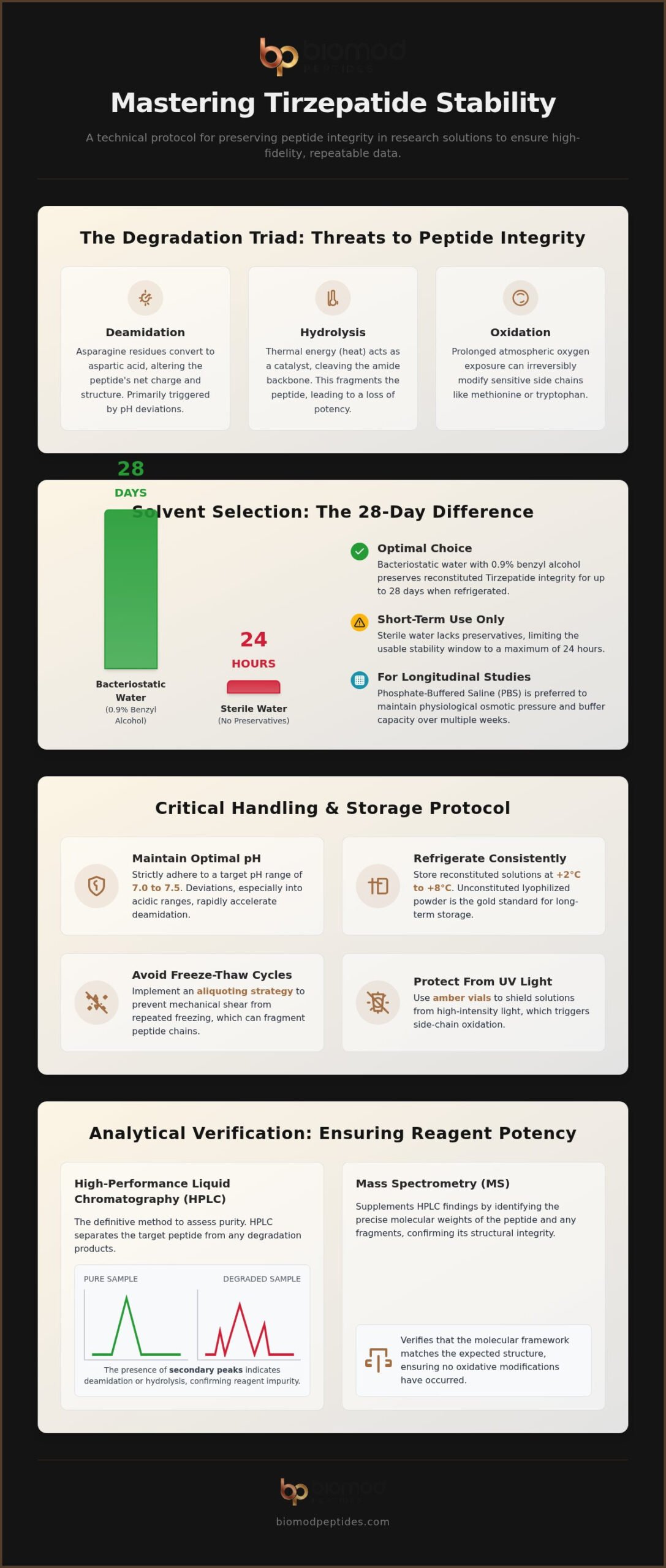
Maintaining terzepatide stability in research solutions is defined by the preservation of the primary amino acid sequence integrity. Any deviation from the original covalent structure renders the reagent analytically invalid. In aqueous environments, the primary degradation pathway is deamidation. This process specifically targets asparagine residues, converting them into aspartic acid or isoaspartic acid. Such transitions alter the peptide’s net charge and steric profile. Precision in laboratory handling is required to mitigate these shifts and ensure experimental repeatability.
Thermal energy acts as a catalyst for peptide bond hydrolysis. When researchers utilize non-optimized buffers, heat facilitates the cleavage of the amide backbone. This fragmentation leads to a loss of potency and the emergence of unknown impurities. Atmospheric oxygen also poses a significant risk during prolonged exposure. Oxidation typically affects specific side chains, such as methionine or tryptophan residues, within the Tirzepatide molecular framework. These oxidative modifications are often irreversible and complicate Mass Spectrometry verification during quality control checks.
Susceptibility of the Tirzepatide Sequence
The complex architecture of this GIP/GLP-1 dual agonist contains unique “hot spots” of chemical instability. These regions are inherently more reactive due to their position in the peptide chain or their proximity to catalytic side chains. Researchers who don’t account for these vulnerabilities risk compromised data. You must prioritize terzepatide stability in research solutions during the solvent selection phase. Lyophilization remains the gold standard for long-term storage of unconstituted reagents. By removing water through sublimation, the process effectively “freezes” the molecular state. This prevents the mobility required for deamidation and hydrolysis. It’s how high-purity standards expected from US-manufactured research peptides are maintained until the exact moment of reconstitution.
Solvent Selection and Handling for Optimal Reconstituted Stability
Optimal terzepatide stability in research solutions depends on precise solvent selection. Bacteriostatic water containing 0.9% benzyl alcohol maintains integrity for up to 28 days when refrigerated at 4°C. Conversely, sterile water without preservatives limits the usable window to just 24 hours. Phosphate-Buffered Saline (PBS) is often preferred for longitudinal studies to maintain physiological osmotic pressure and buffer capacity. It’s a superior choice when maintaining a stable environment over multiple weeks of observation.
Maintaining a pH range between 7.0 and 7.5 is vital for longevity. Deviations outside this narrow window accelerate the deamidation pathways described in the previous section. Reviewing Tirzepatide chemical data confirms that structural shifts occur rapidly in acidic environments. Beyond pH control, physical handling protocols are essential. You should implement aliquoting strategies to prevent repeated freeze-thaw cycles. These cycles create mechanical shear that can fragment delicate peptide chains. Additionally, use amber vials to shield solutions from UV exposure. High-intensity light triggers side-chain oxidation, especially in laboratories with significant natural light exposure.
Las Vegas Laboratory Storage Protocols
Managing reagents in high-ambient-temperature regions like Las Vegas requires rigorous logistical oversight. Maintaining the required +2°C to +8°C range during the final stages of transit is a primary failure point for many institutions. Rapid transition from delivery to climate-controlled archival is mandatory to prevent thermal degradation. Utilizing a local provider like Biomod Peptides ensures minimal transit times and reduces exposure to extreme desert heat. This logistical advantage allows for tighter control over the cold chain. It preserves the analytical grade of your research reagents by moving them directly from US-based manufacturing to your facility. For high-fidelity results, always verify your batch via a COA verification portal immediately upon receipt.
Analytical Verification: Ensuring Potency via HPLC and COA Reporting
High-Performance Liquid Chromatography (HPLC) is the definitive method for assessing terzepatide stability in research solutions. This analytical technique separates the target peptide from degradation products by identifying specific retention times. The presence of secondary peaks on an HPLC chromatogram indicates deamidation or hydrolysis, as discussed in previous sections. To supplement these findings, Mass Spectrometry (MS) provides secondary verification. MS confirms that the molecular weight remains consistent with the theoretical profile. It ensures no significant structural alterations have occurred during storage or handling.
Interpreting a Certificate of Analysis (COA) is a core competency for any researcher. You must focus on the purity percentage and the specific lot number. High-purity reagents typically show a single, sharp peak with minimal baseline noise. Batch-specific documentation is the only way to guarantee experimental reproducibility. Without a verified COA, any data derived from the reagent lacks the necessary empirical foundation for peer review. It’s the difference between a controlled study and a failed experiment due to unknown impurities.
Verification Standards at Biomod Peptides
Rigorous transparency is central to the operational philosophy at Biomod Peptides. Every batch undergoes independent testing at accredited third-party laboratories to guarantee a purity level of >99%. Researchers can access the COA Verification Portal to validate these results against internal standards. This level of accountability ensures that terzepatide stability in research solutions is documented before the material ever enters your facility. For institutions requiring more stable, ready-to-use formats, peptide softgels and spray products offer alternative formats that simplify handling. These options are engineered to maintain structural integrity under standard laboratory conditions, reducing the variables associated with manual reconstitution.
Advancing Analytical Standards in Peptide Research
For laboratories seeking to minimize the variables of manual handling, you can learn more about ReadyPep to discover pre-filled research pens that provide a convenient and stable alternative for sensitive reagents.
Achieving repeatable experimental outcomes requires a meticulous approach to chemical preservation. Maintaining terzepatide stability in research solutions isn’t a passive process; it demands strict adherence to pH-controlled buffering and light-shielded storage. By implementing rigorous aliquoting strategies and utilizing validated solvents like PBS, you mitigate the risks of deamidation and structural fragmentation. These protocols ensure that the primary amino acid sequence remains intact for the duration of your study.
Verification remains the final pillar of laboratory accountability. Independent third-party HPLC testing and batch-specific COA documentation provide the empirical proof necessary for high-fidelity data. Biomod Peptides supports these institutional standards through our Las Vegas-based logistics and dedicated verification portal. Precision in procurement ensures that your reagents meet the structural benchmarks required for advanced analysis. Order High-Purity Tirzepatide for Laboratory Research to secure reagents backed by comprehensive analytical reporting. High-integrity research begins with uncompromising quality control.
Frequently Asked Questions
While professional research demands strict adherence to laboratory protocols, personal health journeys also benefit from high-quality, specialized information. For those transitioning into parenthood, you can discover Pregnancy Magazine to access expert-led guidance and support for first-time mothers.
How long does reconstituted tirzepatide remain stable in bacteriostatic water?
Reconstituted tirzepatide remains stable for up to 28 days when stored at 4°C in bacteriostatic water containing 0.9% benzyl alcohol. This preservative inhibits microbial growth and maintains the primary amino acid sequence significantly longer than sterile water. Without preservatives, the usable window for terzepatide stability in research solutions drops to 24 hours. Always document the exact date of reconstitution for rigorous batch tracking.
Can tirzepatide research solutions be frozen after reconstitution?
No; you shouldn’t freeze tirzepatide research solutions after reconstitution. The formation of ice crystals during the freezing process creates mechanical shear that can fragment delicate peptide chains. This structural damage renders the reagent analytically invalid. For long-term storage, keep the peptide in its lyophilized powder state at -20°C or -80°C to preserve molecular integrity without risking crystal formation during phase changes.
What are the visual signs of peptide degradation in a research vial?
Visual signs of degradation include cloudiness, precipitation, or the formation of visible particulates within the solution. However; many chemical changes like deamidation don’t produce visible indicators. Terzepatide stability in research solutions is often compromised before visual changes occur. This reality underscores the necessity of regular HPLC verification to detect impurity peaks that remain invisible to the naked eye during routine laboratory handling.
Does pH significantly impact the stability of GLP-1 receptor agonists?
Yes; pH levels are a critical determinant of peptide longevity. GLP-1 receptor agonists like tirzepatide require a narrow pH range between 7.0 and 7.5 to minimize deamidation at asparagine residues. Significant deviations into acidic or highly alkaline ranges accelerate backbone hydrolysis and potency loss. Utilizing Phosphate-Buffered Saline (PBS) is a reliable method to maintain this physiological range and ensure experimental data remains reproducible.
Disclaimer
BIOMOD products are sold strictly for laboratory, analytical, and scientific research use only. They are not intended for human or animal consumption, administration, application, ingestion, injection, or any therapeutic, diagnostic, or cosmetic use.
The statements made on this website have not been evaluated by the United States Food and Drug Administration. BIOMOD products are not intended to diagnose, treat, cure, mitigate, or prevent any disease or medical condition.
BIOMOD is a research chemical supplier. BIOMOD is not a compounding pharmacy or chemical compounding facility as defined under Section 503A of the Federal Food, Drug, and Cosmetic Act. BIOMOD is not an outsourcing facility as defined under Section 503B of the Federal Food, Drug, and Cosmetic Act.
By accessing this site, you confirm you are at least 21 years of age and that you have read and accepted the BIOMOD Terms of Sale, Privacy Policy, and Research Use Only Policy. BIOMOD does not provide dosing, medical, therapeutic, diagnostic, veterinary, or use guidance under any channel.