
A “99% purity” claim is a statistical ghost without raw analytical data to anchor it. In high-precision laboratory research, the distance between a label and reality can compromise months of experimental progress. You recognize that the current market saturation of unverified reagents makes consistent batch-to-batch integrity a rare commodity; mastering research peptide quality control is the only path to empirical certainty. Interpreting complex HPLC/MS reports shouldn’t be a guessing game for professional researchers.
This article provides the technical foundation needed to verify peptide identity and purity with clinical accuracy. We will define the critical distinction between gross weight and net peptide content to ensure precise concentration. Finally, we provide a structured framework for utilizing COA verification portals to ensure every reagent meets the highest professional benchmarks. Our objective is to move beyond marketing claims and into the realm of verifiable scientific proof.
Key Takeaways
- Identify the critical roles of HPLC and Mass Spectrometry in establishing molecular identity and sequence accuracy for high-precision reagents.
- Distinguish between gross lyophilized weight and net peptide content to account for residual water and counterions such as Trifluoroacetate.
- Audit Certificates of Analysis by verifying raw analytical traces and batch-specific data rather than relying on generic purity claims.
- Establish a rigorous protocol for research peptide quality control through the integration of independent third-party testing and digital verification portals.
Analytical Identity and Purity: The HPLC/MS Gold Standard
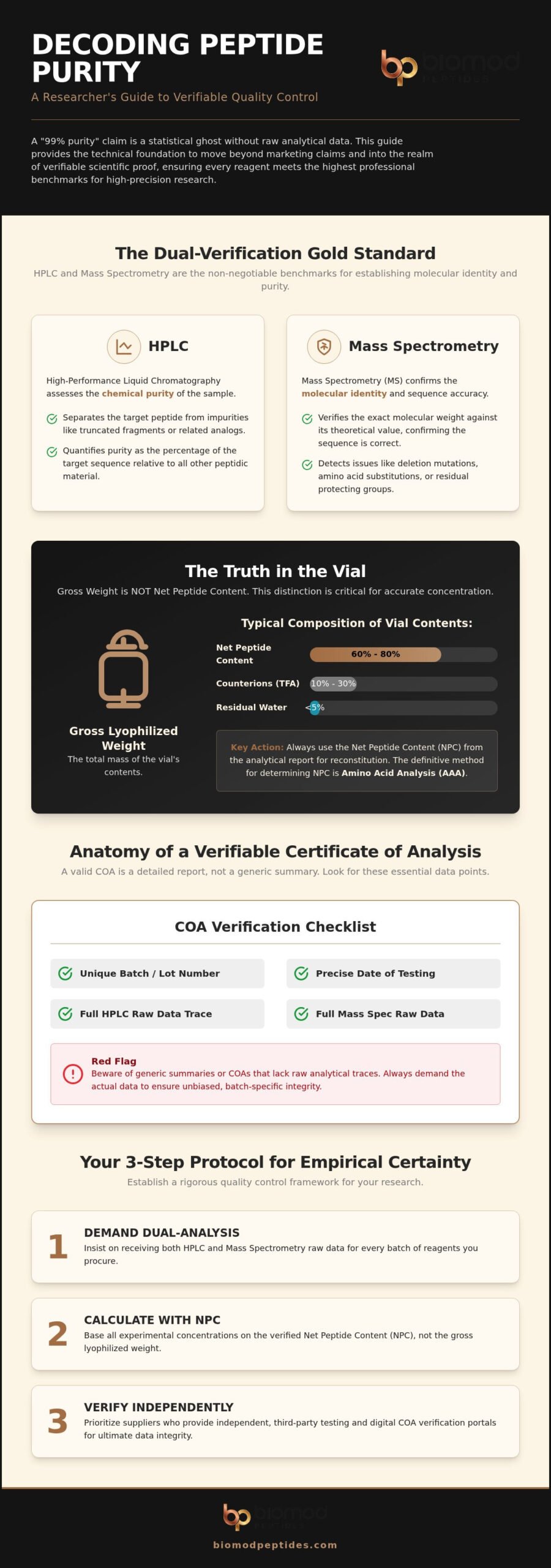
High-Performance Liquid Chromatography (HPLC) remains the non-negotiable benchmark for assessing chemical purity. While legacy methods like melting point analysis provide broad indicators, they often fail to resolve the complex impurity profiles inherent in a Peptide Synthesis Overview. Modern research peptide quality control demands high-resolution separation to distinguish the target molecule from closely related analogs or truncated fragments. Chemical purity measures the concentration of the desired peptide; however, optical purity is equally critical for experimental reproducibility. Chiral errors during synthesis can lead to diastereomers that exhibit identical molecular weights but divergent biological activities, potentially skewing data in high-precision assays. Peptide purity is defined as the percentage of the target sequence relative to the sum of all peptidic impurities present in the sample.
Mass Spectrometry and Sequence Verification
Mass Spectrometry (MS) complements HPLC by confirming the exact molecular weight against theoretical values. This step ensures the sequence is accurate and free from deletion mutations or amino acid substitutions. Techniques such as Electrospray Ionization (ESI) are vital for detecting truncated sequences that might co-elute with the target in standard chromatography. Analytical reports must also be scrutinized for ghost peaks within the chromatogram. These signals often indicate residual protecting groups, such as Pbf or Trt, or scavengers left over from the cleavage process. For a detailed breakdown of these analytical benchmarks, refer to The Protocol for Peptide Purity Verification. This rigorous dual-verification approach is the only way to ensure reagent integrity in high-stakes laboratory environments where molecular precision is the primary requirement.
Quantitative Accuracy: Determining Net Peptide Content (NPC)
Researchers often mistake the mass of a lyophilized powder for the mass of the peptide itself. This error leads to significant concentration inaccuracies in experimental models. Precise research peptide quality control demands a clear distinction between these values. Gross weight represents the total mass of the vial contents; it includes residual water and counterions. Net peptide content (NPC) measures only the actual peptide molecules. Typically, NPC ranges from 60% to 80% of the total mass. Relying on gross weight for molar calculations guarantees skewed results. Accurate reconstitution requires adjusting the volume of diluent based on the NPC percentage provided in the analytical report.
Amino Acid Analysis (AAA) is the definitive method for determining NPC. It quantifies the individual amino acids after total hydrolysis, providing an absolute concentration value. This level of verification is essential for high-precision assays where exact stoichiometry is required. Lyophilization parameters also dictate final moisture content and long-term stability. Excessive residual moisture promotes hydrolytic degradation during storage. Standard laboratory protocols aim for moisture levels below 5%. Maintaining these thresholds through rigorous research peptide quality control ensures the structural integrity of the reagent over extended research timelines.
Managing Counterion Profiles and Impurity Thresholds
Trifluoroacetate (TFA) is the standard counterion used in solid-phase synthesis. While efficient for purification, TFA is often cytotoxic. It can interfere with specific cell-based assays or analytical models. For sensitive applications, protocols for counterion exchange to acetate or HCl forms are necessary. These alternative salts alter solubility profiles and biocompatibility. Researchers should consult the guide on improving peptide solubility to select the optimal salt form. Accessing US-finished reagents through the COA Verification Portal ensures these quantitative metrics are fully documented before laboratory use.
Independent Verification: The Role of Third-Party Testing and COAs
Self-policing by manufacturers creates an inherent conflict of interest. While in-house quality control departments are standard, they often lack the objectivity required for high-stakes research. Independent third-party testing is the only way to ensure unbiased analytical data for US-manufactured peptides. This external validation acts as a critical firewall against batch-to-batch inconsistency. Rigorous research peptide quality control must include a verification step that’s entirely separate from the synthesis facility to ensure data integrity.
A valid Certificate of Analysis (COA) must include specific, verifiable data points. Essential components include unique batch numbers, precise testing dates, and raw HPLC/MS traces. Generic summaries or text-only purity claims are insufficient for professional validation. Researchers must demand the full chromatogram to verify the baseline and peak integration personally. US-based finishing in Las Vegas facilities adds a logistical layer of accountability for local laboratories, ensuring reagents are handled under domestic quality standards before final distribution. While these standards focus on chemical reagents, high-quality analytical services are equally crucial for environmental safety; you can visit Methamphetamine Testing Services NZ Limited to access expert contamination testing for properties.
The industry is shifting toward digital transparency to combat document fraud. A COA verification portal allows researchers to cross-reference batch data with independent lab results in real-time. This prevents document tampering and ensures reagent accountability throughout the supply chain. Identifying red flags is vital; recognize generic, blurred, or “recycled” HPLC reports from unreliable vendors as immediate indicators of compromised integrity. The Biomod Peptides verification portal serves as a benchmark for industry transparency and laboratory supply. Implementing these digital verification steps is the final requirement for robust research peptide quality control.
Advancing Laboratory Standards through Analytical Accountability
Analytical precision is the foundation of reproducible science. We’ve established that verifying molecular identity via HPLC/MS and calculating actual concentration through Net Peptide Content are non-negotiable steps. These protocols eliminate the variance introduced by residual salts and sequence mutations. Robust research peptide quality control requires moving beyond manufacturer claims toward independent, third-party verification. Biomod Peptides reinforces this standard by providing US-manufactured and finished reagents for Las Vegas and national laboratories. Every batch undergoes independent laboratory verification to ensure absolute transparency. We offer specialized delivery formats, including softgels and sprays, designed for high-precision applications. Secure high-purity research peptides with verified third-party COAs at Biomod Peptides and ensure your data remains beyond reproach. Your commitment to rigorous methodology deserves reagents that meet the same uncompromising benchmarks.
Frequently Asked Questions
What is the difference between peptide purity and net peptide content?
Peptide purity identifies the percentage of the target sequence relative to peptidic impurities; net peptide content quantifies the actual weight of those molecules within the total mass. Purity is a qualitative measure of sequence integrity. Net content is a quantitative measure that accounts for non-peptidic components like water and salts. Precise research peptide quality control requires both metrics to ensure accurate molar calculations in experimental designs.
Why is HPLC testing alone insufficient for a complete quality control profile?
HPLC only measures chemical purity by separating molecules based on hydrophobicity. It cannot confirm absolute molecular weight or sequence accuracy. Mass Spectrometry is required to verify that the eluted peak corresponds to the correct peptide mass. Without MS, a single HPLC peak could represent a truncated sequence or an incorrect analog with similar retention times. A complete profile must integrate both chromatography and mass verification.
How do residual salts like TFA affect laboratory research outcomes?
Trifluoroacetate (TFA) is a common counterion that can induce significant cytotoxicity in cell-based assays or alter the pH of delicate buffer systems. High residual TFA levels often interfere with protein-protein interactions and may inhibit enzyme activity in biochemical models. Researchers must account for these salt-form effects when selecting reagents. Switching to acetate or HCl salt forms is often necessary to prevent experimental artifacts.
What are the common indicators of a fraudulent or inaccurate Certificate of Analysis?
Indicators of inaccurate documentation include generic HPLC traces that lack specific batch numbers or blurred, low-resolution chromatograms that suggest digital manipulation. Recycled reports often display inconsistent testing dates or mismatched molecular weights compared to the theoretical sequence. Reliable research peptide quality control relies on raw, high-resolution data. Use digital verification portals to cross-reference batch results with independent records to ensure document authenticity and reagent accountability.
Disclaimer
BIOMOD products are sold strictly for laboratory, analytical, and scientific research use only. They are not intended for human or animal consumption, administration, application, ingestion, injection, or any therapeutic, diagnostic, or cosmetic use.
The statements made on this website have not been evaluated by the United States Food and Drug Administration. BIOMOD products are not intended to diagnose, treat, cure, mitigate, or prevent any disease or medical condition.
BIOMOD is a research chemical supplier. BIOMOD is not a compounding pharmacy or chemical compounding facility as defined under Section 503A of the Federal Food, Drug, and Cosmetic Act. BIOMOD is not an outsourcing facility as defined under Section 503B of the Federal Food, Drug, and Cosmetic Act.
By accessing this site, you confirm you are at least 21 years of age and that you have read and accepted the BIOMOD Terms of Sale, Privacy Policy, and Research Use Only Policy. BIOMOD does not provide dosing, medical, therapeutic, diagnostic, veterinary, or use guidance under any channel.