
A single compromised vial can invalidate months of empirical data and deplete significant laboratory resources. Analytical integrity begins at the loading dock, not the bench. Knowing exactly what to check upon receiving a peptide shipment is the only defense against sub-standard reagents that jeopardize research outcomes. You understand that even minor thermal fluctuations or container breaches can render a sequence useless for precise quantification. Sub-standard reagents lead to inconsistent results and wasted time.
This protocol provides a rigorous laboratory checklist to ensure your peptides arrived within thermal specifications and meet ordered purity standards. We will detail the verification of cold chain compliance, container seal integrity, and the digital documentation required to validate batch-specific purity levels. By implementing these systematic checks, you protect the validity of your data. You ensure that every milligram of material meets the highest analytical benchmarks before it ever reaches your equipment.
Key Takeaways
- Validate structural integrity and thermal indicators immediately upon arrival to confirm cold chain compliance.
- Cross-reference batch numbers with third-party HPLC reports to verify purity levels meet the >98% research standard.
- Implement immediate stabilization at -20°C or -80°C to prevent proteolytic degradation and preserve sequence longevity.
- Establish a rigorous laboratory protocol for what to check upon receiving a peptide shipment to prevent downstream experimental failure.
Initial Physical Inspection and Cold Chain Validation
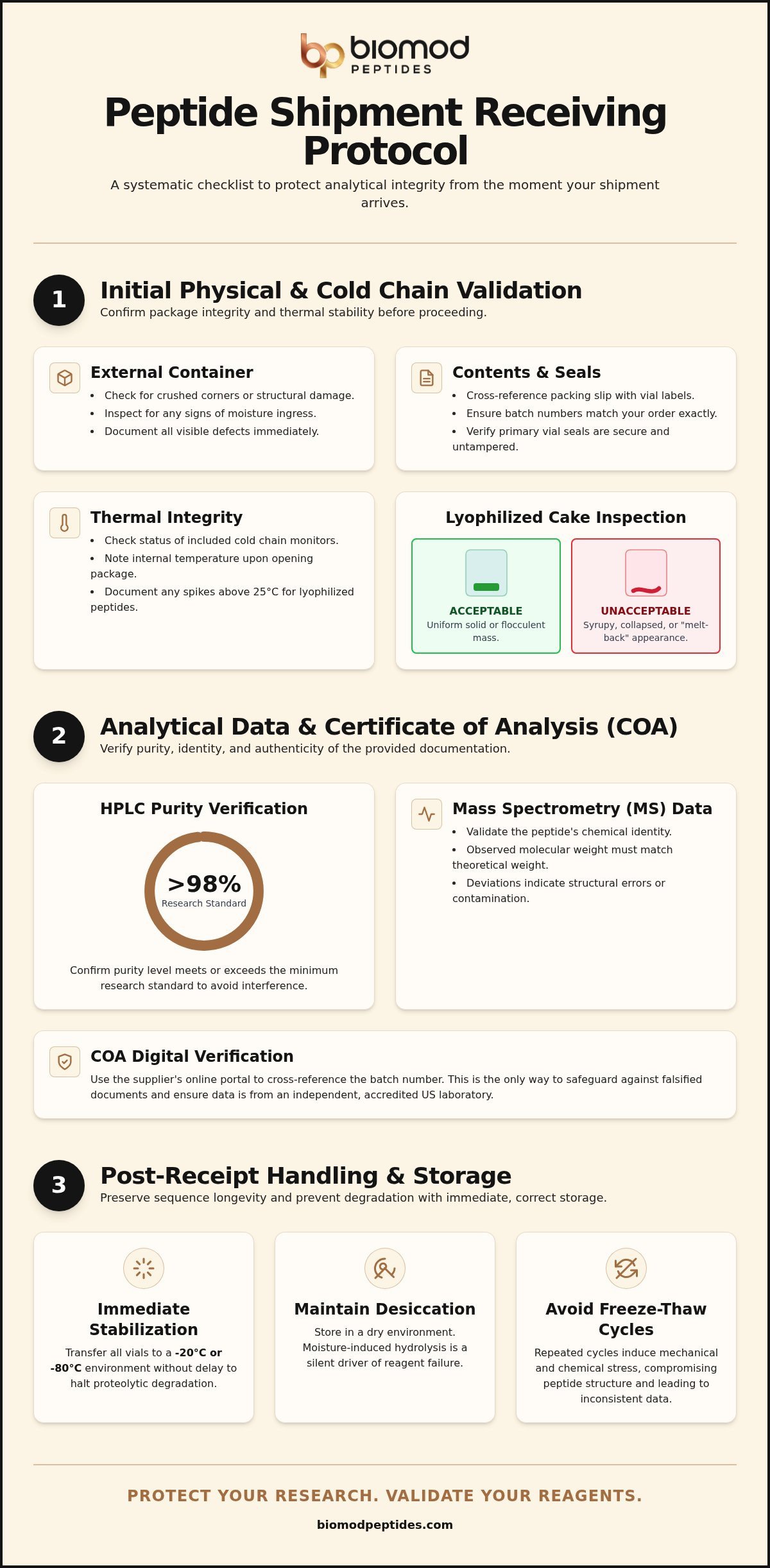
Analytical integrity begins at the loading dock. Knowing what to check upon receiving a peptide shipment is vital for rigorous laboratory quality control. It’s essential to examine the external container for structural compromise, crushed corners, or moisture ingress. These visible signs often indicate rough handling or exposure to unfavorable environmental conditions during the logistics chain. Document any defects immediately to establish a chain of custody for potential insurance or quality claims.
Cross-reference the packing slip with the physical vial labels upon opening. Batch numbers must match your order request exactly to ensure analytical traceability. This verification confirms that the sequence resulting from Peptide Synthesis aligns with your specific research requirements. Next, verify the status of included thermal monitors. Cold chain indicators provide objective data on whether the transit environment remained within acceptable limits. Don’t assume stability without empirical proof from these sensors.
Inspect the lyophilized cake within each vial under adequate lighting. A stable, high-purity product appears as a uniform solid or flocculent mass. Avoid vials showing melt-back, which presents as a syrupy or collapsed appearance at the bottom of the vial. This state suggests moisture contamination or significant thermal stress during shipping. Such degradation can compromise the peptide’s primary structure and lead to inconsistent experimental data.
Assessing Thermal Integrity and Packaging Seals
Check primary vial seals for tamper-evidence. Crimp caps must be secure and un-pierced to maintain the internal vacuum or inert gas environment established during finishing. When handling specialized delivery formats such as peptide softgels for research, record the internal temperature of the insulated packaging upon opening. Lyophilized peptides generally remain stable at ambient temperatures below 25°C for short-term transit durations. Any temperature spikes above this threshold during the shipping window require immediate documentation for analytical review.
Analytical Data Review and Certificate of Analysis Verification
Confirming the chemical identity of your sample is the next critical step. Retrieve the Batch Number from the vial label and immediately cross-reference it with the provided documentation. Discrepancies here indicate a failure in logistical tracking or a potential shipment error. This step is a foundational component of what to check upon receiving a peptide shipment to ensure the material matches the intended experimental design. Accurate batch tracking is the only way to maintain a reliable laboratory chain of custody.
Analyze the High-Performance Liquid Chromatography (HPLC) report with precision. The purity percentage must meet the >98% research standard to minimize interference from truncated sequences or residual solvents. Simultaneously, examine the Mass Spectrometry (MS) data. The observed molecular weight must align with the theoretical sequence of the peptide. Even minor deviations suggest structural errors or contamination that will compromise your data. For researchers demanding the highest standards, sourcing from verified US-manufactured supplies ensures these analytical benchmarks are consistently met, particularly when navigating local Las Vegas logistics.
Validating HPLC and MS Reports via the Verification Portal
Digital transparency is the only safeguard against falsified documentation. Enter the unique batch identifier into the COA verification portal to access original, unaltered laboratory results. This process allows you to confirm that the impurity profile matches the established peptide purity verification protocol. Verify that the third-party testing was conducted by an independent, accredited US laboratory. Relying on internal manufacturer data without external validation introduces unacceptable risk into the research environment. Validating these reports ensures that your starting material is exactly what the documentation claims.
Post-Receipt Handling and Laboratory Storage Standards
Immediate stabilization follows the successful completion of the initial verification of what to check upon receiving a peptide shipment. Transfer all vials to a stabilized -20°C or -80°C environment without delay to halt proteolytic degradation. This rapid transition preserves the structural integrity of the peptide sequence by minimizing the window of thermal exposure. Ensure all storage containers remain desiccated. Moisture-induced hydrolysis of peptide bonds is a silent driver of reagent failure. It often goes undetected until experimental results deviate from expected values.
Avoid repeated freeze-thaw cycles at all costs. These cycles induce mechanical and chemical stress on the peptide structure, leading to aggregation or denaturation. Plan a precise aliquot strategy based on your projected experimental timeline. Divide the bulk material into single-use quantities during the initial reconstitution or before the first deep-freeze. Maintain a meticulous inventory log. This record must include the date of receipt, batch number, and exact storage coordinates to ensure total analytical traceability throughout the study.
Establishing Stability Protocols for Las Vegas Research Facilities
Account for extreme regional ambient temperature spikes inherent to Las Vegas. Desert heat exceeding 110°F places immense strain on laboratory cooling infrastructure. Utilize dedicated backup power systems for laboratory freezers to mitigate the risk of thermal deviation during seasonal power grid fluctuations. Review the peptide stability for research: cold chain protocols for managing reagents in high-desert climates effectively. Implement a rigorous ‘first-in, first-out’ (FIFO) system. This protocol ensures the chronological integrity of your peptide library and prevents the accumulation of aging stock that may have undergone subtle degradation over time.
Securing Analytical Integrity Through Systematic Verification
Precision in the laboratory begins with the verification of every incoming reagent. A standardized intake protocol ensures that logistical errors or thermal fluctuations don’t compromise your experimental outputs. You’ve established the necessity of validating cold chain compliance and cross-referencing batch-specific analytical data. Implementing these rigorous steps for what to check upon receiving a peptide shipment is the only way to protect the integrity of your research data. Methodological rigor at the point of receipt prevents costly downstream failures.
Biomod Peptides supports your commitment to excellence with US-manufactured reagents designed for rigorous analytical standards. Every batch undergoes independent third-party HPLC and MS testing to confirm purity. We ensure total transparency through our digital COA verification portal. This allows for immediate validation of every sequence upon arrival. Secure High-Purity Research Peptides for Your Laboratory and proceed with absolute confidence in your starting materials. Your dedication to verification is the catalyst for meaningful scientific advancement.
Frequently Asked Questions
What should I do if the cold chain indicator shows a temperature excursion upon arrival?
Document the specific reading and photograph the sensor immediately if an excursion occurs. Don’t reconstitute the material until you’ve consulted the provider’s technical support team. Such excursions indicate a breach in logistical integrity that may have initiated proteolytic degradation or compromised the peptide’s primary structure. Maintaining a rigorous chain of custody requires this data for any potential quality claims.
Is a visual change in the lyophilized powder color a sign of peptide degradation?
A visual change, such as yellowing or a syrupy texture, typically indicates moisture ingress or significant thermal stress. High-purity peptides should appear as a uniform white or off-white solid mass. Identifying these anomalies is a primary factor in what to check upon receiving a peptide shipment to prevent the use of compromised reagents in your research.
Why is it necessary to verify the COA if the supplier claims 99% purity?
Verification is essential to confirm that the HPLC and MS data are current and batch-specific rather than recycled from previous production runs. Suppliers often claim high purity, but digital verification via an independent portal ensures the results haven’t been altered. This process validates that the impurity profile meets the required analytical standards for your specific laboratory study.
How long can research peptides remain at room temperature during the initial intake process?
Lyophilized research peptides shouldn’t remain at room temperature for more than 60 minutes during the initial intake and documentation phase. While the lyophilized state offers temporary stability, prolonged exposure increases the risk of moisture absorption. Rapid transfer to a stabilized -20°C or -80°C environment is the standard for maintaining long-term sequence integrity and preventing hydrolysis.
Disclaimer
BIOMOD products are sold strictly for laboratory, analytical, and scientific research use only. They are not intended for human or animal consumption, administration, application, ingestion, injection, or any therapeutic, diagnostic, or cosmetic use.
The statements made on this website have not been evaluated by the United States Food and Drug Administration. BIOMOD products are not intended to diagnose, treat, cure, mitigate, or prevent any disease or medical condition.
BIOMOD is a research chemical supplier. BIOMOD is not a compounding pharmacy or chemical compounding facility as defined under Section 503A of the Federal Food, Drug, and Cosmetic Act. BIOMOD is not an outsourcing facility as defined under Section 503B of the Federal Food, Drug, and Cosmetic Act.
By accessing this site, you confirm you are at least 21 years of age and that you have read and accepted the BIOMOD Terms of Sale, Privacy Policy, and Research Use Only Policy. BIOMOD does not provide dosing, medical, therapeutic, diagnostic, veterinary, or use guidance under any channel.