
The wolverine protocol is frequently discussed in research circles, yet the nickname often obscures the rigorous biochemical reality of BPC-157 and TB-500 synergy. While pop-culture references suggest immediate results, professional laboratory settings require a disciplined, analytical approach to these regenerative analogs. You likely find it difficult to navigate the ambiguity between marketing hype and actual chemical nomenclature. It’s a common challenge for researchers who prioritize data over trends. Precision matters. Accountability is paramount.
This article provides an objective examination of the synergistic mechanisms between BPC-157 and TB-500. We’ll detail the precise biochemical pathways these peptides utilize to facilitate cellular migration and tissue repair. You’ll learn how to identify reliable procurement standards for research reagents and why domestic manufacturing is a critical benchmark for quality. We’ll also cover the necessity of HPLC and Mass Spec testing to ensure the analytical purity of your laboratory supplies. Our focus remains on technical merit and empirical proof.
Key Takeaways
- Define the biochemical synergy between BPC-157 and TB-500 analogs often termed the wolverine protocol in research environments.
- Distinguish the analytical profiles of gastric-derived pentadecapeptides and synthetic thymosin beta-4 analogs used in regenerative studies.
- Validate reagent integrity through third-party HPLC and Mass Spectrometry testing to achieve 99%+ analytical grade purity.
- Identify the structural advantages of utilizing US-manufactured research peptides finished in domestic laboratories for consistent batch results.
Defining the “Wolverine” Protocol in Modern Peptide Science
The wolverine protocol represents a specific investigative framework in modern peptide science. It is not a clinical treatment or a retail product. In laboratory settings, this stack refers to the strategic combination of BPC-157 and TB-500 analogs. While the name draws inspiration from the rapid regeneration of a fictional character, the scientific application focuses on a synergistic repair mechanism. Researchers utilize this stack to observe the acceleration of angiogenic and myogenic processes in vitro. It is a methodology designed to push the boundaries of regenerative research.
Analytical studies often begin with BPC-157 research to understand its role as a pentadecapeptide derived from gastric protein. When paired with TB-500, a synthetic version of the naturally occurring 43-amino acid peptide Thymosin Beta-4, the scope of the study expands. This combination is strictly designated for laboratory research use to investigate complex tissue repair pathways. It provides a more comprehensive model than single-compound analysis. Precision in these environments is non-negotiable. Data must drive every conclusion.
The Biochemical Rationale for Peptide Synergy
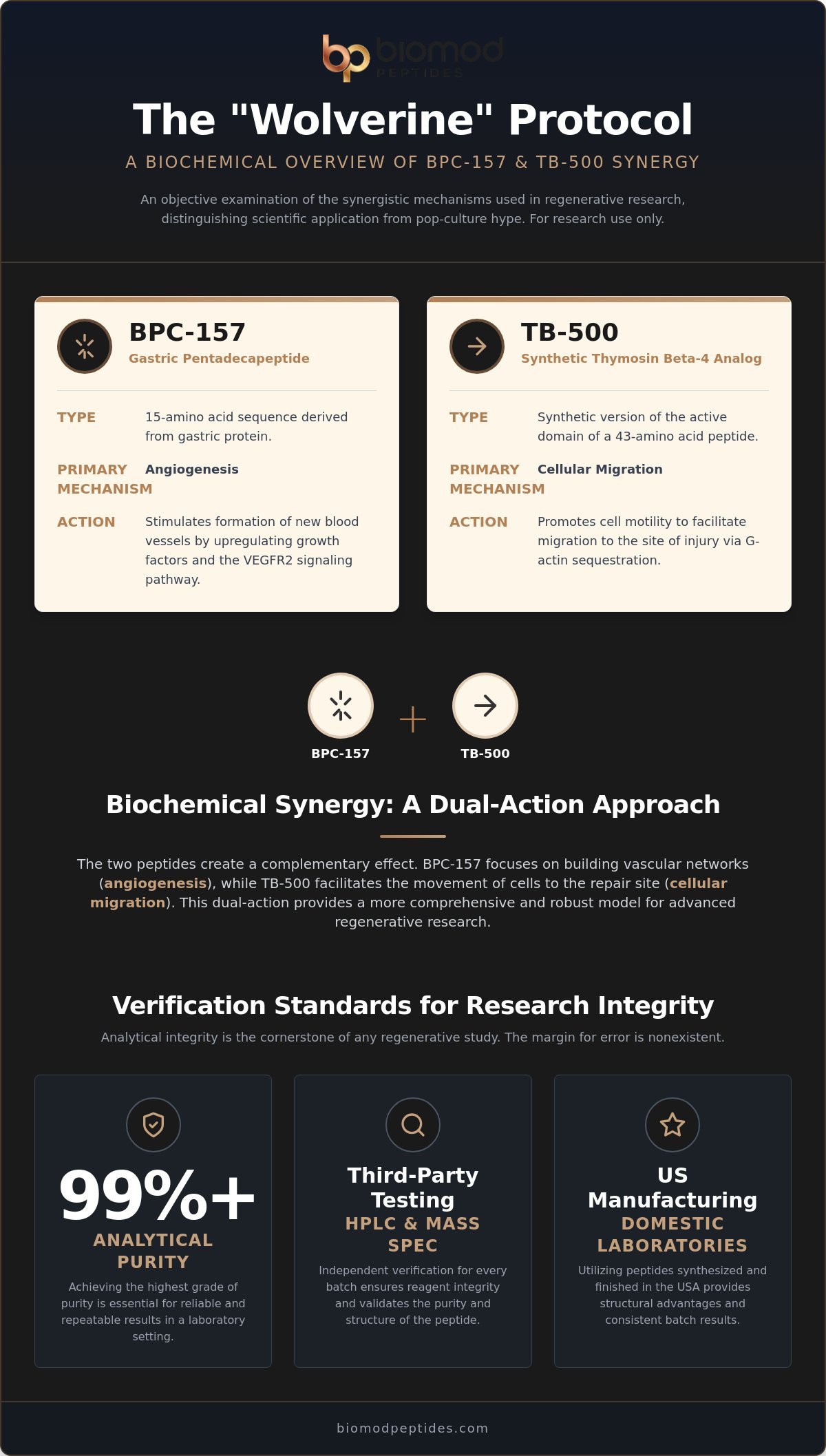
Synergy occurs when two distinct pathways complement one another to achieve a cumulative effect. BPC-157 focuses on the upregulation of growth factors to stimulate angiogenesis, the formation of new blood vessels. TB-500 operates through actin-sequestering to facilitate cellular migration to the site of injury. These processes are independent but functionally linked. In experimental models, using a peptide stack helps researchers overcome the individual limitations of a single analog. It creates a more robust environment for longitudinal observation.
By targeting both the creation of vascular networks and the physical movement of cells, the wolverine protocol offers a dual-action investigative tool. This approach is a standard in advanced regenerative research. It allows for a granular understanding of how synthetic analogs interact within a controlled environment. Biomod Peptides provides the high-purity reagents necessary to maintain the integrity of these specific investigative protocols. Verification is the foundation of progress. Analytical grade purity ensures that batch consistency never compromises your data.
Analytical Profiles of BPC-157 and TB-500 Analogs
Effective laboratory research requires a granular understanding of the individual analogs within the wolverine protocol. BPC-157 and TB-500 function via distinct biological pathways. BPC-157 is a 15-amino acid sequence with specific gastric protective origins. TB-500 is a synthetic version of the naturally occurring 43-amino acid peptide Thymosin Beta-4. Together, they offer a multifaceted model for investigating tissue repair. Success in these studies depends on the purity and stability of the lyophilized reagents used.
BPC-157: Mechanisms of Angiogenesis
BPC-157 is a pentadecapeptide derived from gastric protein. Its primary research application involves the upregulation of growth factors and the VEGFR2 signaling pathway. This pathway is essential for endothelial cell proliferation and the subsequent formation of new vascular structures. Researchers must account for the FDA safety risks of BPC-157, particularly regarding immunogenicity and impurity profiles in non-analytical grade reagents. Maintaining high verification standards is the only way to ensure batch consistency in regenerative models.
TB-500: Cellular Migration and Actin Interaction
TB-500 operates through the sequestration of G-actin. This interaction promotes cell motility and facilitates the migration of cells to the site of experimental injury. While full-length Thymosin Beta-4 is a complex 43-amino acid peptide, TB-500 is the specific synthetic analog containing the active domain responsible for these effects. This streamlined structure makes it a preferred reagent for focused cellular studies. It allows for more precise observation of myogenic processes without the variables introduced by the full-length protein.
Stability is a critical factor in laboratory environments. Lyophilized research peptides must be stored at controlled temperatures to prevent degradation. Exposure to light and moisture can compromise the structural integrity of the amino acid chains. For researchers in Las Vegas and beyond, securing high-purity research peptides from domestic sources is a standard requirement for maintaining experimental validity. Quality control begins at the point of synthesis and continues through rigorous third-party verification. Precise reagents yield precise data.
Verification Standards for Research Peptide Procurement
Analytical integrity is the cornerstone of any regenerative study. When executing a wolverine protocol, the margin for error is nonexistent. Researchers must demand third-party HPLC and Mass Spectrometry testing for every batch. These methods ensure that the reagents meet a 99%+ purity threshold. Without this verification, the presence of truncated sequences or residual solvents can invalidate experimental results. Data dictates the outcome. Precision is the baseline.
The Importance of US-Manufactured Quality Control
Offshore manufacturing often lacks the transparency required for high-stakes research. US-manufactured reagents provide a clear chain of custody. Every step of the finishing process occurs within domestic facilities under strict oversight. You can review the specifics of these laboratory benchmarks at About Biomod. This geographic proximity reduces logistical risks and ensures that the structural integrity of the analogs remains intact during transit. Accountability is a domestic standard.
Procuring Analytical Grade Research Reagents
Verification is a procedural requirement. A reliable vendor should provide immediate access to documentation. Utilize a COA Verification Portal to cross-reference batch numbers with independent lab results. This step validates the identity and concentration of the peptides before they enter your workflow. Verification steps should include:
- Sequence validation through Mass Spectrometry to confirm molecular weight.
- Purity assessment via HPLC to detect potential contaminants.
- Stability testing for lyophilized powders to ensure shelf-life consistency.
For researchers exploring diverse delivery models in investigative settings, integrating Peptide Spray Products or Peptide Softgels into your research design can offer unique comparative data. These formats must adhere to the same rigorous purity standards as injectable analogs.
Environmental factors in Las Vegas laboratories present specific challenges. High ambient temperatures and low humidity can accelerate the degradation of sensitive analogs. Lyophilized peptides must be stored in a temperature-controlled environment, typically between -20°C and -80°C for long-term stability. Once reconstituted, reagents should be kept at 4°C and used within a strictly defined window. Protecting these compounds from light exposure is equally vital. Maintaining the wolverine stack’s efficacy requires constant vigilance over these storage variables. Quality control does not end at delivery.
Advancing Regenerative Research Through Analytical Purity
The wolverine protocol serves as a sophisticated framework for investigating tissue repair pathways. Successful research depends on the precise synergy between BPC-157 and TB-500 analogs. You must prioritize reagents that meet rigorous analytical standards. Purity levels exceeding 99% are the baseline for reliable data. Verification through independent third-party testing is the only way to ensure experimental validity. It’s the difference between definitive results and compromised variables. Precision is a requirement.
Biomod Peptides provides the structural integrity necessary for advanced laboratory studies. Every batch undergoes third-party HPLC and Mass Spectrometry testing to validate sequence accuracy and concentration. Our products are US-manufactured and finished in domestic facilities to maintain a transparent chain of custody. You can verify batch integrity directly through our independent COA verification portal. Don’t settle for unverified reagents. Procure High-Purity Research Peptides from Biomod Peptides to secure the reagents your methodology demands. Your data deserves the highest tier of verification. We look forward to supporting your next breakthrough in regenerative science.
Frequently Asked Questions
What exactly is the “Wolverine” peptide stack?
The “Wolverine” peptide stack is a laboratory combination of BPC-157 and TB-500 analogs used in regenerative research models. It is named for the rapid tissue repair characteristics observed in fictional narratives. In a professional laboratory context, this stack represents a dual-pathway approach to investigating myogenic and angiogenic processes. Researchers utilize these specific analogs to observe synergistic effects that a single compound cannot provide.
Why are BPC-157 and TB-500 combined in research protocols?
BPC-157 and TB-500 are combined because they target distinct but complementary biological pathways. BPC-157 focuses on the upregulation of growth factors to stimulate blood vessel formation. TB-500 interacts with actin to facilitate cellular migration to experimental injury sites. Combining these mechanisms allows for a more comprehensive analysis of tissue regeneration in vitro. This synergy is the primary driver behind the adoption of the wolverine protocol in advanced research.
How do I verify the purity of these research peptides?
Purity verification requires independent third-party testing using High-Performance Liquid Chromatography (HPLC) and Mass Spectrometry. These analytical methods confirm the amino acid sequence and detect any residual impurities or solvents. Reliable providers offer a COA Verification Portal where researchers can cross-reference batch numbers with original lab reports. Achieving a 99%+ purity threshold is essential for maintaining the integrity of your experimental data and ensuring batch consistency.
Can these peptides be used for human consumption?
No, these peptides are strictly designated for laboratory research use and are not intended for human consumption. They don’t have FDA approval for clinical use in humans. Regulatory bodies classify these compounds as research chemicals meant for in vitro observation or animal studies within a controlled environment. Misuse of these reagents outside of a professional laboratory setting violates safety protocols and regulatory standards.
Disclaimer
BIOMOD products are sold strictly for laboratory, analytical, and scientific research use only. They are not intended for human or animal consumption, administration, application, ingestion, injection, or any therapeutic, diagnostic, or cosmetic use.
The statements made on this website have not been evaluated by the United States Food and Drug Administration. BIOMOD products are not intended to diagnose, treat, cure, mitigate, or prevent any disease or medical condition.
BIOMOD is a research chemical supplier. BIOMOD is not a compounding pharmacy or chemical compounding facility as defined under Section 503A of the Federal Food, Drug, and Cosmetic Act. BIOMOD is not an outsourcing facility as defined under Section 503B of the Federal Food, Drug, and Cosmetic Act.
By accessing this site, you confirm you are at least 21 years of age and that you have read and accepted the BIOMOD Terms of Sale, Privacy Policy, and Research Use Only Policy. BIOMOD does not provide dosing, medical, therapeutic, diagnostic, veterinary, or use guidance under any channel.