
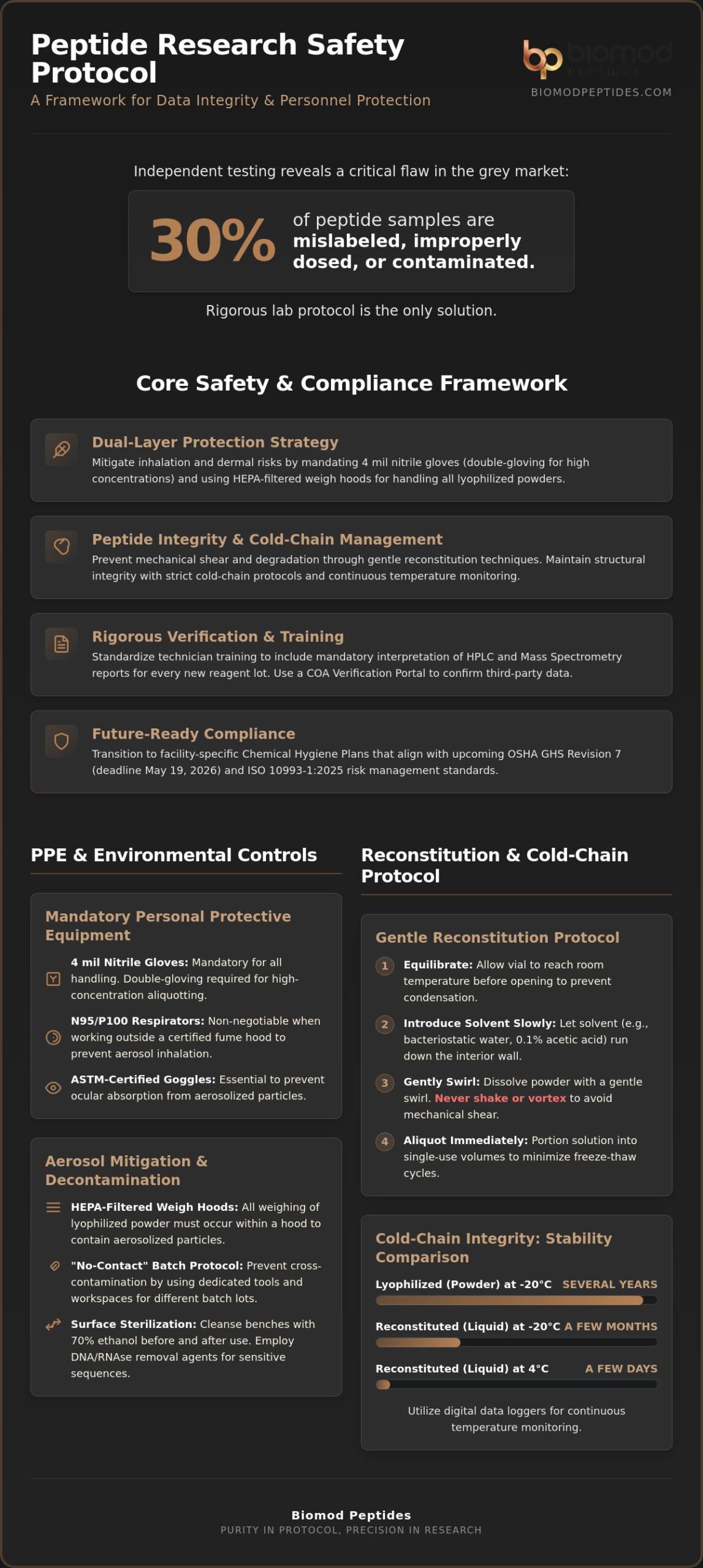
Independent testing identifies that 30% of grey-market peptide samples are mislabeled, improperly dosed, or contaminated. In a controlled laboratory setting, the margin for error is non-existent. Training lab technicians on peptide safety is not merely a regulatory hurdle; it’s a fundamental requirement for data integrity and personnel protection. You recognize that the degradation of high-purity reagents is as significant a risk as accidental exposure to potent, research-only compounds. Maintaining a sterile, compliant environment requires more than a generic chemical hygiene plan. It demands a facility-specific protocol that evolves with shifting regulatory landscapes.
This guide establishes a rigorous safety framework designed to eliminate cross-contamination and ensure full compliance with the latest OSHA GHS Revision 7 standards ahead of the May 19, 2026, compliance deadline. We examine the mandatory PPE for handling lyophilized powders, the implications of the ISO 10993-1:2025 risk management updates, and the specific documentation required for 21 CFR Part 58 compliance. By implementing this comprehensive research protocol checklist, your lab will reduce reagent waste and uphold the structural integrity of every experiment.
Key Takeaways
- Implement a dual-layer protection strategy using 4 mil nitrile gloves and HEPA-filtered weigh hoods to mitigate inhalation risks during lyophilized powder handling.
- Master the technical nuances of gentle reconstitution and cold-chain management to prevent mechanical shear and maintain the structural integrity of sensitive peptide chains.
- Standardize the process for training lab technicians on peptide safety by requiring the rigorous interpretation of HPLC and Mass Spectrometry reports for every new reagent lot.
- Leverage a COA Verification Portal to cross-reference internal batch numbers with third-party testing data, ensuring full compliance with “Research Use Only” terms of sale.
- Transition from generic safety guidelines to facility-specific Chemical Hygiene Plans that align with updated OSHA GHS Revision 7 requirements and ISO 10993-1:2025 standards.
Essential PPE and Chemical Hygiene for Research Peptide Handling
Precision starts with the physical barrier. A robust Standard Operating Procedure (SOP) must dictate the use of 4 mil nitrile gloves at all times. For high-concentration aliquotting, double-gloving is mandatory. This reduces the risk of dermal absorption through micro-tears. Technicians must maintain a dedicated workspace for all peptide reagents. This isolation prevents environmental interference and ensures the integrity of the research sequence. Training lab technicians on peptide safety requires a zero-tolerance policy for contact between different batch lots. Strict “no-contact” protocols prevent cross-contamination that could invalidate months of data. Every tool and surface must be reserved for specific sequences to maintain structural integrity.
Respiratory Protection and Aerosol Mitigation
Lyophilized peptides are inherently unstable during transfer. Opening a vial creates a pressure differential that can aerosolize fine powder. Technicians must perform all weighing within HEPA-filtered weigh hoods to contain these particles. The inhalation of peptide aerosolization in a research setting poses a significant risk of systemic exposure to compounds not intended for human biological interaction. If working outside a certified fume hood, N95 or P100 respirators are non-negotiable. Training lab technicians on peptide safety involves recognizing that invisible particles are the most common source of technician exposure. Safety goggles must be ASTM-certified to prevent ocular absorption during these procedures.
Surface Decontamination Protocols
Contamination ruins data. Bench-tops require sterilization with 70% ethanol before and after every session. For sensitive sequences, use specialized DNA/RNAse removal agents to ensure no residue remains. These agents effectively neutralize any lingering biological material that could interact with the next lot. High-purity research peptides deserve a sterile environment to prevent degradation. Verification of surface cleanliness should be part of the daily lab log. Consistent sterilization ensures that the laboratory remains a controlled environment for complex chemical analysis.
Safe Reconstitution, Solubility, and Cold-Chain Storage
Transitioning research peptides from a lyophilized state to a liquid phase introduces significant chemical risk. Precision is required. Training lab technicians on peptide safety must emphasize the chemical nuances of solvation. High-purity reagents are susceptible to proteolysis and aggregation if handled incorrectly. Technicians must select solvents based on the specific peptide’s isoelectric point and hydrophobicity. Standard solvents include bacteriostatic water, 0.1% acetic acid, or DMSO. Selecting the incorrect solvent leads to irreversible precipitation and reagent waste. Each step of the process must be documented to ensure experimental reproducibility.
Mechanical shear is a primary cause of peptide chain degradation during reconstitution. Technicians must avoid aggressive agitation. Follow this protocol for gentle reconstitution:
- Allow vials to equilibrate to room temperature to prevent internal condensation.
- Introduce the solvent slowly by allowing it to run down the interior glass wall.
- Gently swirl the vial until the powder is fully dissolved; never shake or vortex.
- Immediately aliquot the solution into single-use volumes to minimize future freeze-thaw cycles.
Solubility Testing and Solvent Selection
Determining the optimal pH for dissolution is critical for maintaining the sequence. Acidic peptides often require basic solvents, while basic peptides require acidic environments like dilute acetic acid. Technicians must handle concentrated acidic solvents within a fume hood using appropriate PPE. Ensuring the sequence remains stable during dissolution is essential for accurate Peptide Therapeutics Immunogenicity Assessment and subsequent analytical verification. If a peptide does not dissolve readily, technicians should consult the specific solubility profile before adjusting the temperature or pH.
Cold-Chain Integrity in the Laboratory
Storage temperature dictates reagent longevity. Lyophilized peptides typically remain stable for several years at -20°C. Once reconstituted, shelf life drops significantly. Most solutions only remain viable for days at 4°C or a few months at -20°C. Technicians must utilize digital data loggers for continuous monitoring of specialized storage units. In facilities located in extreme climates, such as Las Vegas, emergency protocols for power failures are mandatory to protect sensitive research stock. For researchers requiring high-stability reagents, sourcing from a trusted provider of research peptides ensures the initial cold-chain has remained intact from manufacturing to delivery.
Verification Training: Validating Reagent Identity and Purity
Validation is the final safeguard in a high-precision laboratory. Training lab technicians on peptide safety must include the rigorous interpretation of analytical data. It is insufficient to rely solely on supplier labels. Technicians must be proficient in reading High-Performance Liquid Chromatography (HPLC) chromatograms and Mass Spectrometry (MS) spectra. HPLC confirms the purity percentage by measuring the area under the primary peak. MS verifies the molecular weight of the sequence. Any deviation from the theoretical mass indicates synthesis errors or degradation. Identifying these discrepancies before research begins is critical for data integrity.
Implement a strict “Quarantine-to-Release” workflow for all incoming supplies. Reagents must remain in isolation until the batch number is cross-referenced with third-party testing data. Utilizing a verification portal provides an objective layer of accountability. This process ensures that only reagents meeting internal quality benchmarks enter the active research environment. Maintaining detailed logs of reagent usage, purity levels, and expiration dates creates a robust audit trail. This documentation is essential for regulatory compliance and internal quality control audits.
Interpreting Certificates of Analysis (COA)
Technicians must focus on three primary metrics: purity percentage, total peptide content, and moisture analysis. A purity level below 98% often indicates residual trifluoroacetic acid (TFA) or other synthesis byproducts. High moisture content suggests improper lyophilization or compromised vial seals. For benchmarks on industry-leading quality, researchers can reference the standards maintained by Biomod Peptides. Identifying red flags in analytical reports, such as unexpected secondary peaks, allows the lab to reject compromised lots immediately.
Documentation and Accountability Standards
Precision requires documentation. All COA data must be integrated into the Laboratory Information Management System (LIMS). This integration allows for real-time tracking of reagent stability across different experiments. Accountability is non-negotiable. Every technician must strictly adhere to the research-only terms of sale for analytical reagents. Training lab technicians on peptide safety ensures that every member of the team understands the gravity of quality control. Maintaining these standards protects both the technician and the long-term viability of the research project.
Advancing Laboratory Standards through Rigorous Safety Protocols
Establishing a standardized safety framework is the only way to ensure the reproducibility of your data. Success in the laboratory requires a dual commitment to technician protection and reagent integrity. By prioritizing high-grade PPE and implementing HEPA-filtered aerosol mitigation, you eliminate the most common vectors of accidental exposure. Simultaneously, mastering gentle reconstitution and strict cold-chain management prevents the degradation of sensitive peptide chains. Training lab technicians on peptide safety remains a continuous process of refinement and empirical verification.
Analytical transparency is the foundation of this methodology. Every reagent batch must undergo independent validation to confirm its identity and purity before it enters your active research sequence. Utilizing US-manufactured and finished research peptides ensures logistical transparency and structural integrity. Maintain the highest benchmarks of laboratory precision with verified materials.
Secure high-purity research reagents for your laboratory at Biomod Peptides. Our commitment to quality includes independent third-party testing for every batch and a comprehensive COA verification portal for objective data validation. Elevate your research with uncompromising standards.
Frequently Asked Questions
What are the primary safety risks for technicians handling lyophilized peptides?
Inhalation through aerosolization and accidental dermal absorption are the primary safety risks. Lyophilized powders are highly volatile when vials are opened due to pressure differentials. Training lab technicians on peptide safety must address these invisible risks. Technicians face systemic exposure to non-human-grade compounds if they don’t utilize HEPA-filtered hoods and appropriate respiratory protection. These exposures can lead to unintended biological interactions that compromise technician health and research validity.
How should a lab technician handle a peptide spill in a Las Vegas research facility?
Technicians must immediately contain the area and utilize a wet-cleanup method to prevent powder aerosolization. In arid climates like Las Vegas, rapid evaporation of solvents can leave concentrated residues on surfaces. Use 70% ethanol or a specialized decontaminant to saturate the spill before physical removal. Avoid dry sweeping or compressed air; these disperse particles. All cleanup materials must be disposed of as hazardous chemical waste according to facility-specific protocols to ensure environmental safety.
Why is third-party testing essential for laboratory peptide safety?
Third-party testing provides objective verification that the reagent’s purity and identity match the manufacturer’s claims. Independent analysis identifies synthesis byproducts, residual solvents, or heavy metals that a primary supplier might overlook. This secondary validation is a core component of training lab technicians on peptide safety. It ensures that experimental results are based on verified chemical structures rather than assumptions. This transparency reduces the risk of data contamination and protects the laboratory’s professional standing.
Can research peptides be stored in a standard laboratory refrigerator?
Standard laboratory refrigerators are acceptable only for short-term storage of reconstituted solutions at 2-8°C. Long-term stability for lyophilized powders requires specialized freezers maintained at -20°C or -80°C. Standard units often lack the precision to maintain consistent temperatures; this leads to thermal fluctuations that degrade sensitive peptide bonds. Technicians must use digital data loggers to monitor these environments. For maximum reagent integrity, storage in dedicated, medical-grade units with alarm systems is the professional standard.
Disclaimer
BIOMOD products are sold strictly for laboratory, analytical, and scientific research use only. They are not intended for human or animal consumption, administration, application, ingestion, injection, or any therapeutic, diagnostic, or cosmetic use.
The statements made on this website have not been evaluated by the United States Food and Drug Administration. BIOMOD products are not intended to diagnose, treat, cure, mitigate, or prevent any disease or medical condition.
BIOMOD is a research chemical supplier. BIOMOD is not a compounding pharmacy or chemical compounding facility as defined under Section 503A of the Federal Food, Drug, and Cosmetic Act. BIOMOD is not an outsourcing facility as defined under Section 503B of the Federal Food, Drug, and Cosmetic Act.
By accessing this site, you confirm you are at least 21 years of age and that you have read and accepted the BIOMOD Terms of Sale, Privacy Policy, and Research Use Only Policy. BIOMOD does not provide dosing, medical, therapeutic, diagnostic, veterinary, or use guidance under any channel.