
A single procedural lapse in peptide reconstitution can invalidate months of analytical data and deplete thousands of dollars in research reagents. You know that the transition from theory to benchwork is where most laboratory errors occur. Effectively training new grad students in peptide handling requires more than a verbal walkthrough. It demands a rigorous, documented framework that prioritizes chemical stability and procedural precision. This guide provides a standardized protocol to eliminate common pitfalls like improper storage temperatures and cross-contamination.
This checklist ensures every researcher in your facility maintains high-integrity, reproducible results. It establishes a technical onboarding system covering everything from verifying purity via a COA portal to maintaining the -80°C standards required for multi-year stability in 2026. This framework transforms student training into a repeatable process of verification. We’ll examine specific steps for handling lyophilized sequences, preventing moisture absorption, and documenting every stage of the workflow to meet modern analytical standards.
Key Takeaways
- Establish rigorous cold-chain protocols using -20°C for short-term and -80°C for multi-year stability to mitigate hygroscopic degradation.
- Standardize the onboarding process for training new grad students in peptide handling by enforcing a “gentle swirl” mandate to prevent mechanical sequence shearing.
- Master solvent selection criteria, ensuring researchers can distinguish between sterile water and specialized buffers required for diverse peptide sequences.
- Utilize third-party COA verification portals as a primary teaching tool for interpreting HPLC and Mass Spectrometry reports to ensure objective analytical integrity.
Protocols for Lyophilized Peptide Stability and Long-Term Storage
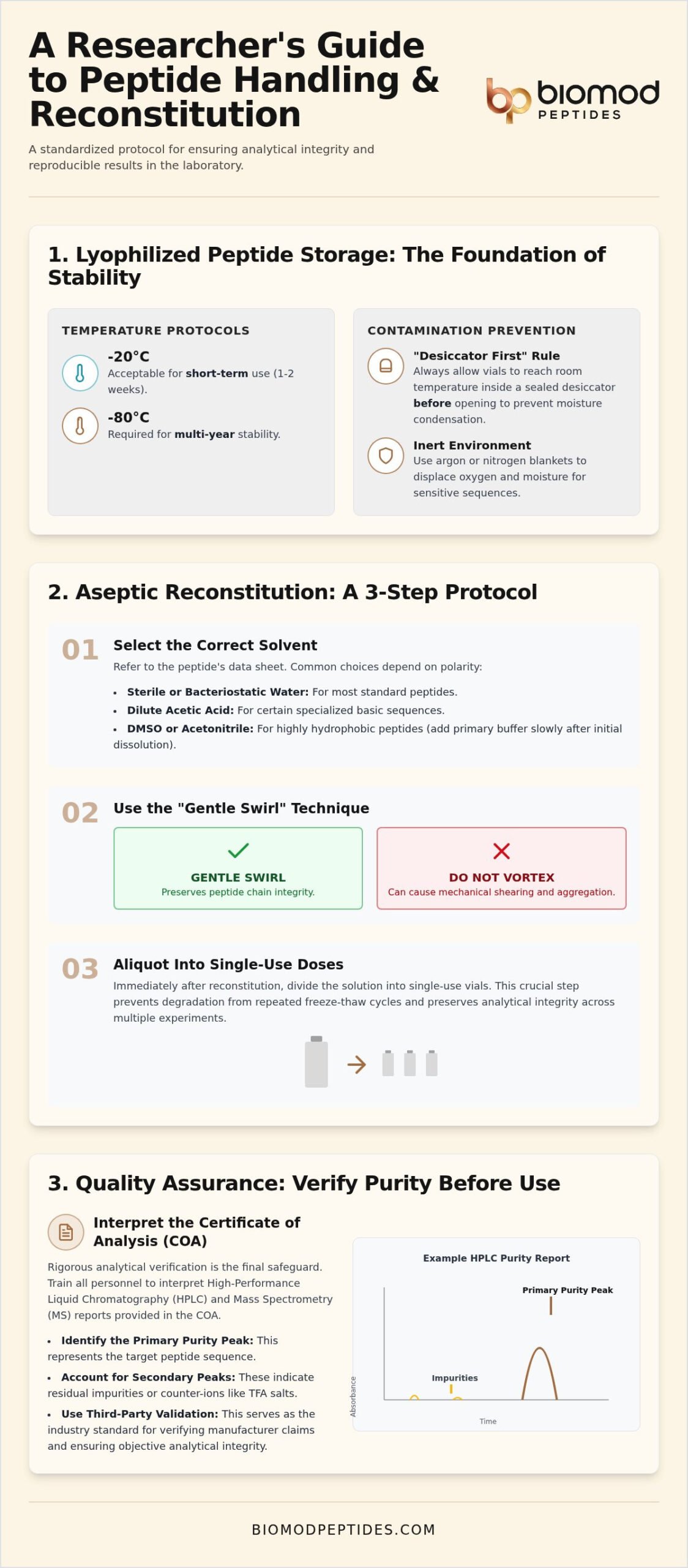
Rigorous storage protocols form the bedrock of analytical integrity. When training new grad students in peptide handling, instructors must emphasize that lyophilized powders are highly hygroscopic. These substances attract atmospheric moisture instantly. This moisture acts as a primary catalyst for peptide hydrolysis and oxidation. Establishing a temperature baseline is the first step in stabilization. For short-term use of one to two weeks, -20°C is acceptable. However, multi-year stability requires -80°C to arrest molecular motion and potential enzymatic degradation. Using US-manufactured reagents ensures a baseline of structural integrity before storage begins.
In the arid climate of Las Vegas, laboratory humidity control remains a variable that researchers often overlook. Implementation of a “Desiccator First” rule is mandatory. Vials must reach room temperature within a sealed desiccator before the seal is broken. Opening a cold vial introduces immediate condensation, compromising the sample’s chemical structure. Understanding Peptide basics regarding their susceptibility to environmental stressors is vital for maintaining batch consistency.
Mitigating Environmental Hazards in the Laboratory
High-value research reagents require an additional layer of protection through argon or nitrogen blankets. These inert gases displace oxygen and moisture, creating a stable internal environment for sensitive sequences. Lyophilized peptides typically maintain a shelf-life of one to three years when stored at -20°C in a strictly moisture-free environment. Effective inventory management must include secondary container labeling that tracks freeze-thaw cycles. Every transition from storage to benchwork increases the risk of degradation; it’s why logistical transparency is non-negotiable. Training new grad students in peptide handling must also utilize a COA verification portal to confirm purity before any experiment proceeds.
A Technical Checklist for Aseptic Peptide Reconstitution
Precision in reconstitution determines the success of subsequent assays. When training new grad students in peptide handling, the first technical hurdle is solvent selection. Standard choices include sterile water or bacteriostatic water, but specialized sequences may require dilute acetic acid to reach full dissolution. Referencing the NIBSC Peptide Handling Protocol provides a standard for matching solvents to peptide polarity. Once the solvent is added, enforce a strict “Gentle Swirl” mandate. Mechanical agitation, specifically vortexing, can shear delicate peptide chains and lead to irreversible aggregation.
Aliquoting is the final step in preserving analytical integrity. Students must divide the bulk solution into single-use doses immediately after reconstitution. This prevents the degradation associated with repeated freeze-thaw cycles. Every vial requires documentation of the exact concentration in mg/mL. This level of precision is essential for high-throughput research where dosage accuracy is paramount. For labs seeking high-integrity materials, sourcing research peptides from verified US manufacturers reduces the risk of initial impurities.
Solubility Troubleshooting and Solvent Compatibility
Hydrophobic peptides often resist standard aqueous solvents. In these cases, initial solubilization may require a small volume of DMSO or acetonitrile before slowly adding the primary buffer. Monitoring pH levels ensures the peptide remains stable; rapid shifts can trigger immediate precipitation. You can learn more about the commitment to providing high-solubility reagents on the Biomod Peptides About page. Mastery of these nuances distinguishes a technician from a rigorous researcher.
Implementing Quality Assurance and COA Verification Standards
Rigorous analytical verification is the final safeguard against experimental failure. Training new grad students in peptide handling must include the interpretation of High-Performance Liquid Chromatography (HPLC) and Mass Spectrometry (MS) reports. Students should identify the primary purity peak while accounting for any secondary peaks indicating residual impurities or TFA salts. This process ensures research accountability. It moves the lab beyond anecdotal trust into a culture of empirical proof. Third-party validation serves as the industry standard for verifying manufacturer claims, providing a layer of transparency that internal lab testing alone cannot match.
Standardizing this workflow requires every new batch to be logged through a formal system. Referencing The Protocol for Peptide Purity Verification helps students understand the analytical standards required for high-tier research. Documenting these steps creates a traceable history for every reagent used in the facility. This methodology protects the integrity of the data and the laboratory’s reputation. It also prevents the waste of expensive reagents by identifying sub-standard batches before they are introduced into a protocol.
Utilizing Analytical Portals for Reagent Validation
Efficient validation begins with the Biomod verification portal. Students must enter batch numbers to retrieve specific data before any experiment proceeds. A Certificate of Analysis (COA) is the only objective proof of peptide identity. Students should compare internal results with these manufacturer specifications to ensure consistency across batches. This comparison identifies potential degradation during transit or storage. It reinforces the necessity of US-based manufacturing and finishing standards. By mastering these portals, researchers ensure that their starting materials meet the rigorous benchmarks demanded by modern science.
Advancing Laboratory Standards through Rigorous Methodology
The integrity of laboratory research rests upon the consistent execution of technical protocols. Training new grad students in peptide handling ensures that foundational tasks, such as thermal stabilization and aseptic reconstitution, are performed with absolute precision. By moving beyond verbal instruction toward a documented checklist, facilities mitigate the risks of reagent degradation and analytical inconsistency. Every researcher must prioritize verification as a core competency. This includes utilizing independent third-party testing and dedicated COA portals to validate every batch before benchwork begins. US-manufactured reagents provide the logistical transparency required for high-stakes scientific inquiry.
Maintaining these benchmarks protects the validity of your data and the long-term success of your research facility. Secure high-purity reagents for your laboratory at Biomod Peptides to ensure your team starts with the highest analytical standards. We look forward to supporting your next breakthrough.
Frequently Asked Questions
How do I store peptides if my lab’s -80°C freezer is at capacity?
Storing peptides at -20°C is an acceptable short-term alternative for durations under two weeks. If -80°C capacity is unavailable for long-term needs, ensure all vials are vacuum-sealed or nitrogen-blanketed to minimize oxidation. Las Vegas researchers should monitor freezer stability closely during peak summer temperatures. Prioritizing high-value sequences for the coldest storage is standard practice in training new grad students in peptide handling.
Can I use a vortex mixer to dissolve stubborn peptide clumps?
Vortexing is prohibited because it causes mechanical shearing of delicate peptide sequences and leads to irreversible aggregation. Utilize gentle manual swirling or short bursts of sonication for stubborn clumps instead. If a peptide remains insoluble, re-evaluate the solvent’s pH or polarity rather than increasing mechanical force. Maintaining structural integrity is the primary goal of any reconstitution protocol in a professional laboratory.
What happens if a student forgets to desiccate a vial before opening?
Forgetting desiccation allows atmospheric moisture to condense on the cold lyophilized powder, triggering immediate hydrolysis and rapid chemical degradation. This error often invalidates the reagent’s purity and compromises subsequent analytical data. Researchers must let vials reach room temperature within a sealed desiccator. If condensation occurs, re-verify the batch through a COA portal to check for significant purity loss before starting experiments.
How often should we verify the purity of our stored peptide stock?
Verify purity upon initial receipt and again after any long-term storage exceeding six months. Standard training new grad students in peptide handling includes teaching them to cross-reference batch numbers via the Biomod Peptides verification portal. If a stock undergoes more than three freeze-thaw cycles, a new HPLC analysis is recommended to ensure the sequence hasn’t degraded into truncated fragments or impurities.
Disclaimer
BIOMOD products are sold strictly for laboratory, analytical, and scientific research use only. They are not intended for human or animal consumption, administration, application, ingestion, injection, or any therapeutic, diagnostic, or cosmetic use.
The statements made on this website have not been evaluated by the United States Food and Drug Administration. BIOMOD products are not intended to diagnose, treat, cure, mitigate, or prevent any disease or medical condition.
BIOMOD is a research chemical supplier. BIOMOD is not a compounding pharmacy or chemical compounding facility as defined under Section 503A of the Federal Food, Drug, and Cosmetic Act. BIOMOD is not an outsourcing facility as defined under Section 503B of the Federal Food, Drug, and Cosmetic Act.
By accessing this site, you confirm you are at least 21 years of age and that you have read and accepted the BIOMOD Terms of Sale, Privacy Policy, and Research Use Only Policy. BIOMOD does not provide dosing, medical, therapeutic, diagnostic, veterinary, or use guidance under any channel.