
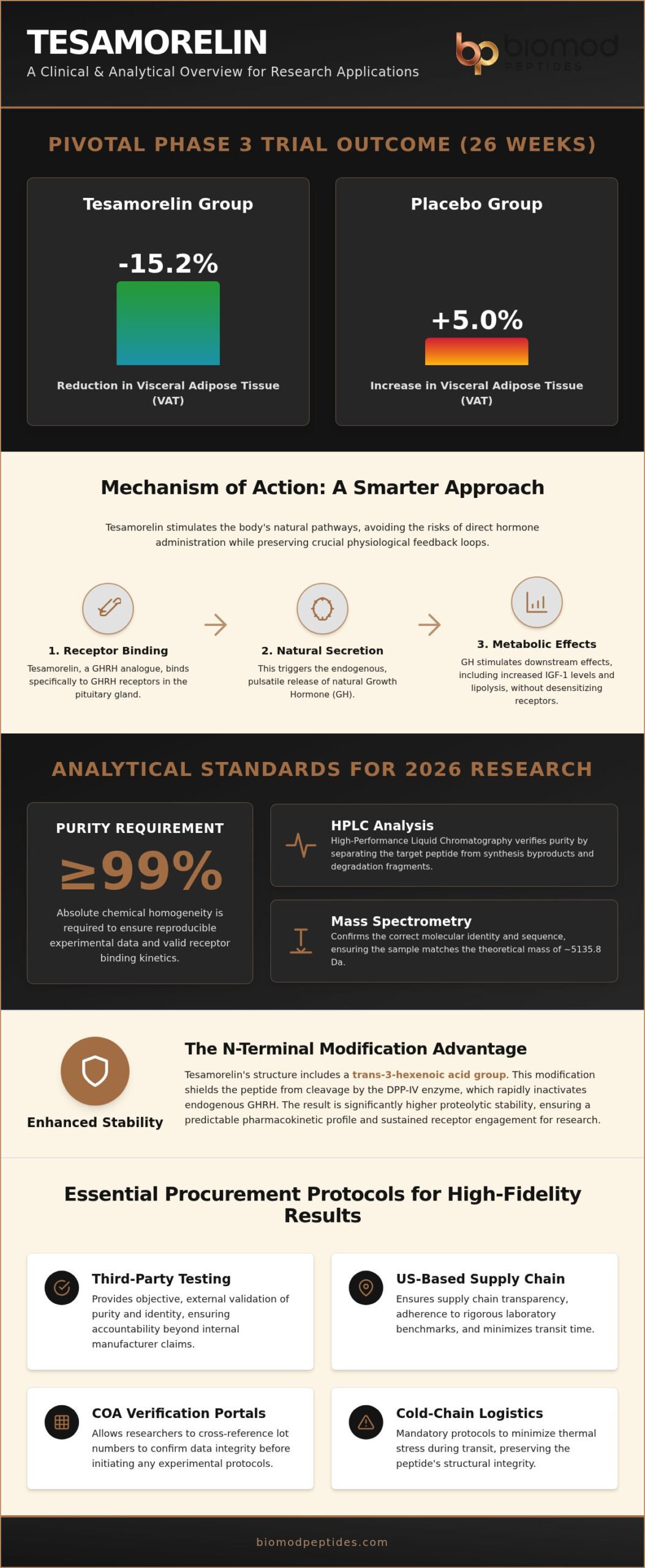
A 26-week Phase 3 trial demonstrated that Tesamorelin reduced visceral adipose tissue by 15.2 percent, whereas the placebo group experienced a 5.0 percent increase. This data underscores the significant metabolic impact of growth hormone-releasing hormone analogues. Researchers understand that replicating these clinical outcomes in a laboratory setting requires absolute chemical integrity. Inconsistent purity and a lack of transparent documentation often jeopardize experimental validity. You require data-backed certainty to maintain institutional standards. This analysis provides a clinical breakdown of the Tesamorelin mechanism and the analytical requirements for 2026 research. We define the necessity of ≥99 percent purity verified through High-Performance Liquid Chromatography and Mass Spectrometry. The following sections detail US-based manufacturing protocols, molecular weight confirmation, and the procurement standards essential for high-fidelity results. We focus on empirical verification and rigorous quality control to ensure your research remains beyond reproach.
Key Takeaways
- Examine the biochemical structure of Tesamorelin and its capacity to stimulate endogenous growth hormone through specific GHRH receptor binding.
- Identify the essential analytical standards for 2026, focusing on the necessity of ≥99% purity as validated by HPLC and Mass Spectrometry.
- Understand how to leverage third-party testing and COA verification portals to ensure the transparency and accountability of research materials.
- Determine the procurement protocols necessary for maintaining structural integrity, including the advantages of US-manufactured supply chains and cold-chain logistics.
Understanding Tesamorelin: Mechanism of Action in Growth Hormone Research
Tesamorelin is a synthetic analogue of Growth Hormone-Releasing Hormone (GHRH) comprised of a 44-amino acid sequence. Unlike exogenous growth hormone administration, this peptide operates by binding to GHRH receptors within the pituitary gland. This interaction triggers the endogenous, pulsatile secretion of growth hormone (GH). By stimulating natural production pathways, researchers can observe metabolic changes while the physiological negative feedback loop remains intact via somatostatin. This distinction is critical for modeling metabolic signaling without the risks of GH desensitization.
Current laboratory applications prioritize three primary areas of investigation:
- Metabolic Signaling: Analyzing the cascade of intracellular events following receptor activation.
- Visceral Adipose Tissue (VAT) Reduction: Quantifying the lipolytic effects on deep abdominal fat stores.
- Neuroprotection: Evaluating the potential for GH-mediated cognitive and neuronal preservation.
GHRH Receptor Signaling and Experimental Models
The structural integrity of Tesamorelin stems from its specific N-terminal modification. By adding a trans-3-hexenoic acid group, the peptide achieves significantly higher proteolytic stability compared to native GHRH. This modification effectively shields the peptide from dipeptidyl peptidase IV (DPP-IV) cleavage, which usually inactivates endogenous GHRH within minutes. This stability is vital for researchers requiring predictable pharmacokinetic profiles in vivo. It allows for sustained receptor engagement without the need for excessive dosing frequencies.
Research protocols also focus on the modulation of Insulin-like Growth Factor 1 (IGF-1) levels. Tesamorelin leads to a dose-dependent increase in IGF-1, providing a measurable metric for GH axis stimulation. Laboratories utilize these shifts to validate the potency of their research reagents and to map downstream effects on systemic metabolism. This data is essential for establishing the reproducibility of metabolic signaling models in 2026.
Analytical Grade Tesamorelin: Purity Standards and Verification Protocols
Analytical-grade research demands a minimum purity threshold of ≥98% to ensure reproducible experimental data. Any deviation from this standard introduces chemical variables that can compromise receptor binding kinetics. While clinical Tesamorelin injection information emphasizes therapeutic efficacy, laboratory standards prioritize absolute chemical homogeneity. High-Performance Liquid Chromatography (HPLC) remains the primary methodology for detecting synthesis byproducts. It functions by separating the target peptide from degradation fragments based on molecular interactions within the column. This process ensures the sample doesn’t contain truncated sequences that could skew results.
Mass Spectrometry (MS) serves as the gold standard for sequence and molecular weight verification. It confirms that the Tesamorelin sample matches the theoretical mass of approximately 5135.8 Da. This dual-verification approach ensures the reagent is both pure and correctly identified. Utilizing US-manufactured reagents provides the supply chain transparency necessary for institutional compliance. Domestic synthesis ensures that lyophilization and storage protocols meet rigorous laboratory benchmarks. It’s a critical step for maintaining a reliable research environment.
Interpreting HPLC and Mass Spectrometry Reports
HPLC chromatograms identify peptide degradation products by mapping absorbance peaks against a validated retention time baseline. Third-party testing is essential for accountability in the research peptide industry because it provides an objective, external validation of internal manufacturer claims. Researchers must be able to cross-reference their lot numbers through a COA verification portal to ensure data integrity before initiating protocols. This practice eliminates the ambiguity of self-reported results. For those conducting high-fidelity modeling, sourcing verified research peptides is the only way to maintain rigorous analytical standards.
Procuring Research-Grade Tesamorelin for Las Vegas Laboratories
Sourcing Tesamorelin for Las Vegas laboratories requires a localized understanding of logistics. Geographic proximity to a US-based supplier minimizes transit durations. This reduction in shipping time is critical for preserving the structural integrity of growth hormone-releasing hormone analogues. Every hour in transit introduces potential thermal stress. Strict cold-chain protocols are mandatory from the moment of synthesis to laboratory delivery. Maintaining a temperature-controlled environment ensures the peptide remains stable and ready for reconstitution.
Lyophilized reagents require specific handling to prevent chemical degradation. Researchers must protect samples from deamidation and oxidation by maintaining storage temperatures at -20°C for long-term use. Exposure to light and moisture must be eliminated. Adherence to “Research Use Only” (RUO) terms is a non-negotiable requirement for institutional compliance. This designation ensures that materials meet federal laboratory standards and are strictly excluded from clinical applications or human consumption.
Establishing a Reliable Supply Chain for Las Vegas Research
Domestic finishing processes provide Las Vegas research institutions with a transparent audit trail. Local researchers benefit from shorter supply lines and verified quality benchmarks. For high-throughput longitudinal studies, bulk procurement strategies allow for lot-to-lot consistency. This stability is essential for maintaining the validity of multi-month experimental models. You can review our commitment to manufacturing transparency on the Biomod Peptides about page. Our facility focuses on high-purity reagents that meet 2026 analytical requirements. Meticulous finishing protocols anchor our reputation as a reliable provider for the Nevada scientific community.
Advancing Metabolic Research with Analytical Precision
Empirical validation is the cornerstone of high-fidelity research. Replicating metabolic signaling models requires reagents that meet the most rigorous 2026 analytical standards. Throughout this guide, we’ve defined the critical role of Tesamorelin as a GHRH analogue and the necessity of independent HPLC/MS verification. Institutional integrity depends on a transparent, US-manufactured supply chain. Strict cold-chain protocols are essential. These benchmarks ensure that every vial provides the structural stability required for longitudinal studies. You can secure high-purity Tesamorelin for your research facility to ensure your data remains beyond reproach. Our commitment to third-party testing and domestic finishing provides the accountability your laboratory demands. We’re dedicated to providing the technical foundation for your next scientific advancement.
Frequently Asked Questions
What is the purity requirement for Tesamorelin in metabolic research?
Analytical-grade metabolic research requires a minimum purity of ≥99 percent as determined by High-Performance Liquid Chromatography. This benchmark ensures that experimental results are not skewed by peptide impurities or truncated sequences. High-purity Tesamorelin is essential for maintaining the reproducibility of growth hormone signaling models. Lower purity levels often introduce chemical variables that compromise institutional data integrity and experimental validity.
How should lyophilized Tesamorelin be stored for long-term stability?
Lyophilized peptides must be stored at -20°C to maintain structural integrity over extended durations. This temperature prevents deamidation and oxidation, which are common causes of peptide degradation. Vials should remain in a desiccated environment and be shielded from light exposure. Proper storage ensures the kinetic profile of the reagent remains consistent from the manufacturing facility to the laboratory bench.
Why is US manufacturing critical for research peptides?
US manufacturing ensures rigorous supply chain transparency and adherence to domestic quality control benchmarks. Domestic finishing allows for localized cold-chain logistics, which minimizes the risk of thermal stress during transit. It provides researchers with a verifiable audit trail and reliable documentation. This geographic proximity supports institutional compliance. It’s a critical factor for ensuring reagents meet the stringent requirements of federal laboratory standards.
Can Tesamorelin be used in analytical studies involving IGF-1?
Tesamorelin is frequently utilized in studies to modulate Insulin-like Growth Factor 1 (IGF-1) levels. By stimulating the pituitary gland to release endogenous growth hormone, the peptide triggers a subsequent, dose-dependent rise in systemic IGF-1. Researchers use these shifts to map the metabolic cascade. It’s a primary tool for modeling the growth hormone axis and validating the efficacy of GHRH receptor engagement.
Disclaimer
BIOMOD products are sold strictly for laboratory, analytical, and scientific research use only. They are not intended for human or animal consumption, administration, application, ingestion, injection, or any therapeutic, diagnostic, or cosmetic use.
The statements made on this website have not been evaluated by the United States Food and Drug Administration. BIOMOD products are not intended to diagnose, treat, cure, mitigate, or prevent any disease or medical condition.
BIOMOD is a research chemical supplier. BIOMOD is not a compounding pharmacy or chemical compounding facility as defined under Section 503A of the Federal Food, Drug, and Cosmetic Act. BIOMOD is not an outsourcing facility as defined under Section 503B of the Federal Food, Drug, and Cosmetic Act.
By accessing this site, you confirm you are at least 21 years of age and that you have read and accepted the BIOMOD Terms of Sale, Privacy Policy, and Research Use Only Policy. BIOMOD does not provide dosing, medical, therapeutic, diagnostic, veterinary, or use guidance under any channel.