
A single shipment delay or a 3% purity variance can invalidate months of laboratory data. You recognize that international sourcing often feels like a necessary trade-off for the research budget. However, the hidden costs of degraded samples, inconsistent batches, and zero legal recourse for failed orders are becoming unsustainable for serious research. Precision requires accountability that overseas vendors simply cannot provide. Professional labs require a higher tier of execution to maintain their internal benchmarks.
This protocol provides a rigorous framework for switching from international to domestic peptide suppliers to ensure your research rests on a foundation of 98%+ purity and reliable cold-chain logistics. Transitioning to US-manufactured supplies is a critical risk-mitigation strategy for preserving analytical integrity. We will detail the technical steps to migrate your procurement. This guide focuses on lot-to-lot consistency and the integration of transparent COA verification into your laboratory workflow.
Key Takeaways
- Identify the statistical variance in purity and thermal degradation risks associated with trans-oceanic peptide shipping.
- Implement a phased migration protocol when switching from international to domestic peptide suppliers to ensure data continuity through comparative analysis.
- Utilize centralized COA verification portals and independent third-party testing to validate 98%+ purity standards for every lot.
- Quantify the analytical ROI of domestic sourcing by reducing experimental failure rates and leveraging US-based technical support.
Auditing International Supply Chain Risks in Peptide Research
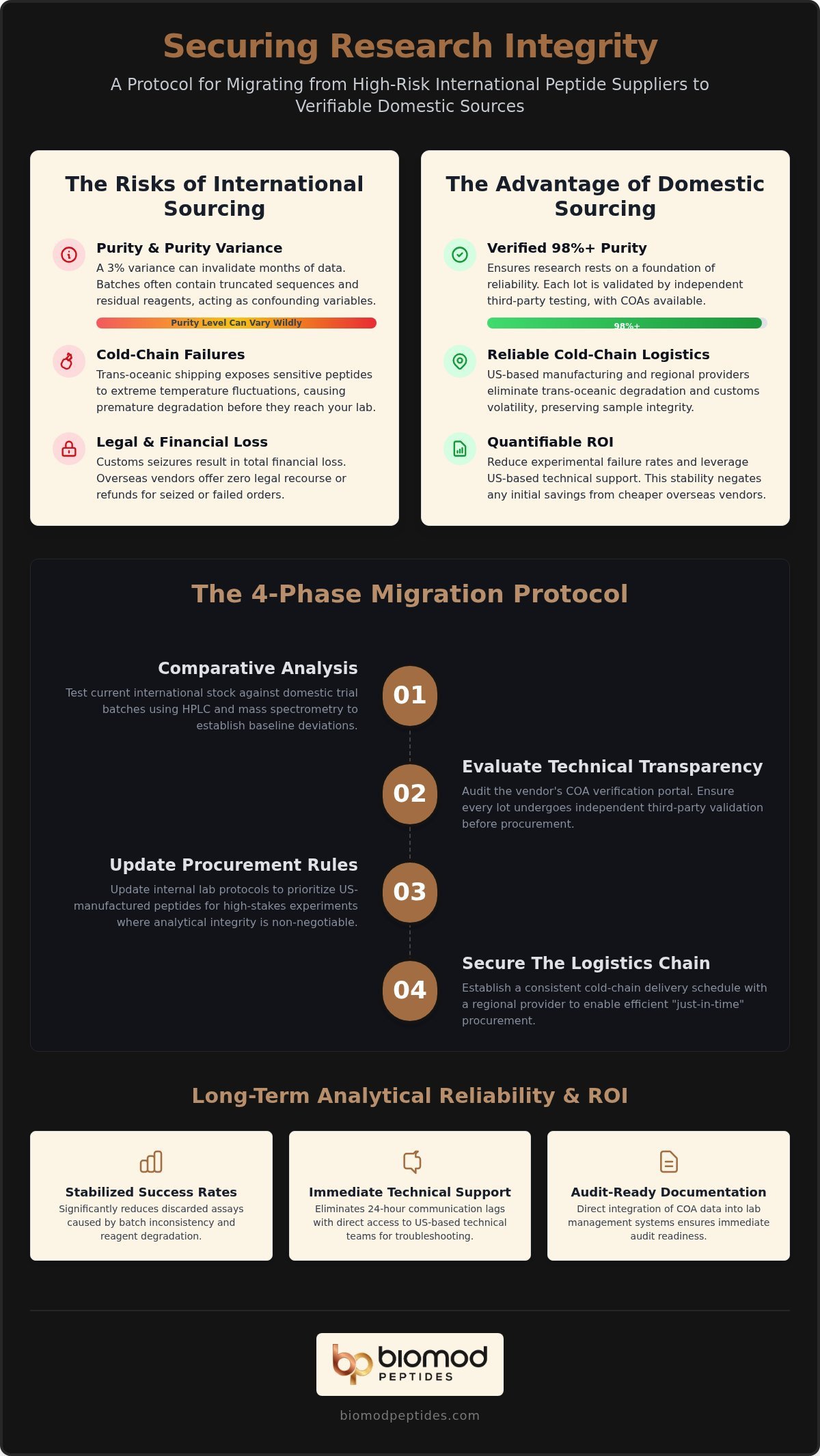
International procurement introduces variables that compromise data integrity. Statistical variance in purity from unverified overseas labs often exceeds acceptable laboratory tolerances. These deviations aren’t just minor errors. They are structural failures in the supply chain. When researchers consider switching from international to domestic peptide suppliers, they are often reacting to the high cost of experimental failure. Re-running a single failed assay can double the cost of a project. This financial drain often negates any initial savings from lower overseas price points.
Cold-chain failures during trans-oceanic shipping expose sensitive sequences to extreme temperature fluctuations. This thermal stress causes premature degradation before the sample reaches the bench. Beyond stability, the legal landscape is precarious. Importing unapproved peptides is technically illegal under the FD&C Act. Customs seizures result in total financial loss. Overseas vendors don’t usually offer refunds or reshipments for seized orders. The process of switching from international to domestic peptide suppliers involves more than changing a shipping address. It’s a shift toward institutional transparency and accountability.
Identifying Analytical Purity Variance and Impurity Profiles
Impurities are not inert. They act as confounding variables in sensitive cellular assays. Precise Peptide synthesis requires rigorous purification stages to remove truncated sequences and residual reagents. Without HPLC tested peptides, your results may reflect the impact of contaminants rather than the target molecule. Sequence verification via mass spectrometry is essential for maintaining laboratory standards. Reliable data requires reagents that match their documented specifications exactly. Domestic sourcing ensures that every lot undergoes independent verification before it enters your inventory.
The Migration Protocol: Transitioning to US-Manufactured Research Peptides
Transitioning requires a structured methodology to protect data continuity. Switching from international to domestic peptide suppliers is a strategic move toward a resilient and secure pharmaceutical supply chain. Begin with Phase 1: a side-by-side comparative analysis. Test current international stock against domestic trial batches using HPLC and mass spectrometry to identify baseline deviations. Phase 2 involves evaluating technical transparency. Audit the vendor’s COA verification portal. Ensure every lot undergoes independent third-party validation before procurement.
Phase 3 updates internal procurement rules. Prioritize US-manufactured peptides for high-stakes experiments where analytical integrity is non-negotiable. Finally, Phase 4 secures the logistics chain. Establish a consistent cold-chain delivery schedule with a regional Las Vegas provider. This eliminates trans-oceanic degradation and customs volatility. A phased approach minimizes operational disruption while maximizing the reliability of your chemical reagents. It’s about moving from uncertainty to verifiable precision.
Establishing New Baseline Standards for Analytical Integrity
Selection criteria must follow rigorous laboratory peptide supply benchmarks. Verify the availability of specialized delivery systems, such as peptide softgels, for specific longitudinal studies. Demand lot-specific documentation that exceeds standard industry summaries. Generic COAs provided by overseas vendors are insufficient for modern peer-review requirements. Professional providers offer accessible data through a secure verification portal to ensure every sample meets 98%+ purity standards.
Validating the Domestic Advantage: Long-Term Analytical Reliability
The return on investment for domestic sourcing is measured through the stabilization of experimental success rates. Switching from international to domestic peptide suppliers significantly reduces the frequency of discarded assays caused by batch inconsistency. Analytical reliability depends on this structural stability. US-based technical support provides immediate troubleshooting for formulation advice and technical queries. This eliminates the 24-hour communication lag inherent in overseas procurement. Geographic proximity to Las Vegas facilities enables efficient “just-in-time” procurement.
- Reduction in overhead costs for on-site stockpiling.
- Direct integration of COA data into laboratory management systems.
- Immediate audit readiness for institutional compliance.
Leveraging Verification Portals for Institutional Transparency
Accountability is the primary differentiator for US-finished products. Utilizing the COA verification portal provided by Biomod Peptides provides a primary trust-building tool for lead researchers. It allows for lot-specific validation that is both legally and professionally binding. In the event of a quality dispute, domestic providers offer a level of transparency that overseas vendors don’t provide.
Institutional labs should consider initiating a pilot program using intranasal peptide research sprays to evaluate domestic delivery precision. This protocol allows for a controlled assessment of purity and logistical speed before full-scale migration. Verifying precision at a small scale ensures that larger transitions remain data-driven and secure. Switching from international to domestic peptide suppliers is ultimately an investment in the longevity of your research data.
Securing the Future of Analytical Integrity
Precision in laboratory research is inseparable from the quality of chemical reagents. Transitioning away from overseas procurement eliminates the volatility of trans-oceanic shipping and unverified purity profiles. By switching from international to domestic peptide suppliers, you establish a chain of custody that prioritizes data stability over short-term savings. This shift ensures that every lot meets 98%+ purity standards through independent verification. Biomod Peptides supports this transition with US-based laboratory finishing and lot-specific HPLC/MS testing for every lot. Our Las Vegas regional distribution ensures rapid, cold-chain delivery without the risk of customs interference or sample degradation. This methodology preserves your analytical benchmarks and protects institutional resources. Secure your research integrity with Biomod Peptides—view our US-manufactured catalog. Your research deserves the certainty of a verified domestic supply chain.
Frequently Asked Questions
Why is shipping time critical for peptide stability in Las Vegas research?
Thermal degradation is the primary risk factor. Las Vegas ambient temperatures frequently exceed 100°F, which accelerates the breakdown of sensitive peptide bonds. Prolonged exposure during international transit leads to deamidation and oxidation of the sample. Utilizing a local Las Vegas provider reduces transit time from weeks to hours. This minimizes thermal stress and ensures the chemical structure remains intact for precise analytical results.
How do US manufacturing standards differ from international peptide synthesis?
US standards prioritize lot-specific accountability and independent verification. International synthesis often relies on mass production with generic batch testing that lacks transparency. Switching from international to domestic peptide suppliers ensures that finishing and quality control occur under localized oversight. Domestic labs utilize independent third-party testing for every lot. This methodology prevents the batch-to-batch purity variance common in overseas procurement.
What should be included in a domestic supplier’s Certificate of Analysis (COA)?
A comprehensive COA must include HPLC chromatograms for purity verification and Mass Spectrometry for sequence identification. It should list the specific lot number, molecular weight, and theoretical mass. Reliable domestic providers also offer a digital verification portal. This allows researchers to cross-reference their specific vial with independent laboratory results. Transparency in documentation is essential for maintaining institutional audit readiness and experimental reproducibility.
Is it more expensive to buy research peptides from a domestic supplier?
The initial unit price may appear higher, but the total cost of research is often lower. International orders carry hidden costs like customs seizures, shipping delays, and high experimental failure rates due to degraded reagents. Switching from international to domestic peptide suppliers mitigates these financial risks. Reliable domestic supply reduces the need to re-run assays. It provides superior ROI by ensuring consistent results for every experiment.
Disclaimer
BIOMOD products are sold strictly for laboratory, analytical, and scientific research use only. They are not intended for human or animal consumption, administration, application, ingestion, injection, or any therapeutic, diagnostic, or cosmetic use.
The statements made on this website have not been evaluated by the United States Food and Drug Administration. BIOMOD products are not intended to diagnose, treat, cure, mitigate, or prevent any disease or medical condition.
BIOMOD is a research chemical supplier. BIOMOD is not a compounding pharmacy or chemical compounding facility as defined under Section 503A of the Federal Food, Drug, and Cosmetic Act. BIOMOD is not an outsourcing facility as defined under Section 503B of the Federal Food, Drug, and Cosmetic Act.
By accessing this site, you confirm you are at least 21 years of age and that you have read and accepted the BIOMOD Terms of Sale, Privacy Policy, and Research Use Only Policy. BIOMOD does not provide dosing, medical, therapeutic, diagnostic, veterinary, or use guidance under any channel.