
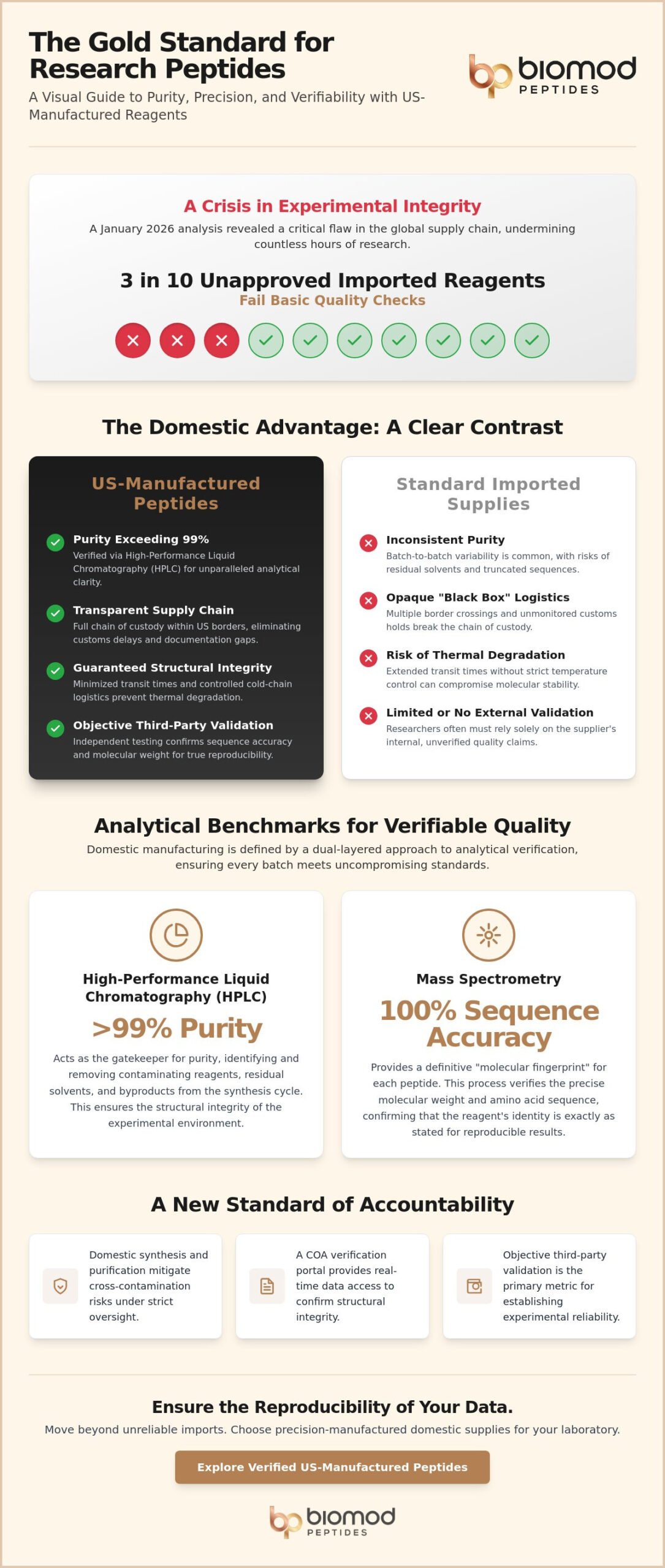
A January 2026 analysis revealed that 3 in 10 unapproved research reagents fail basic quality checks. These failures represent more than lost revenue; they represent a fundamental breach of experimental integrity. You shouldn’t have to contend with the batch-to-batch variability that characterizes so many imported supplies. Utilizing US manufactured research peptides provides the structural accountability necessary for modern laboratory standards. It’s a shift from opaque sourcing to a framework of domestic precision and verifiable purity.
We recognize that your findings are only as credible as the reagents used to produce them. This article explains how domestic manufacturing and rigorous analytical verification ensure the reproducibility of your data. You’ll learn how a transparent supply chain and standardized testing protocols eliminate the documentation gaps common in international imports. We’ll preview the technical benchmarks that define high-tier domestic production in 2026. This is the path toward a reliable, data-driven supply chain that supports the advancement of your specific niche.
Key Takeaways
- Domestic synthesis and purification within US facilities provide the rigorous oversight required to mitigate cross-contamination risks.
- High-Performance Liquid Chromatography (HPLC) serves as the technical benchmark for confirming purity levels that exceed 99%.
- Mass Spectrometry ensures sequence accuracy and molecular weight precision for reproducible laboratory results.
- A COA verification portal provides the real-time data access required to confirm the structural integrity of US manufactured research peptides.
- Objective third-party validation serves as the primary metric for establishing experimental reliability and professional accountability.
The Significance of Domestic Manufacturing in Peptide Synthesis
US manufactured research peptides are defined by their origin of synthesis. These reagents are synthesized, purified, and finished exclusively within domestic laboratory facilities. This logistical choice is not merely about a label; it’s about the rigorous control of the peptide synthesis process. Domestic oversight provides a level of accountability that international sourcing cannot match. By maintaining production within US borders, facilities adhere to established legal and scientific standards for laboratory reagents. This adherence significantly reduces the risk of cross-contamination. It ensures that the reagents remain free from the impurities often found in bulk-produced imports.
Geographic location plays a critical role in product stability. For laboratories in regional centers like Las Vegas, domestic manufacturing offers superior cold-chain stability. Peptides are inherently sensitive to thermal degradation. Minimizing transit times is essential for maintaining their structural integrity. Shorter shipping routes within the United States allow for more precise temperature control. This prevents the molecular breakdown that occurs when products sit in unmonitored customs warehouses. It’s a proactive approach to quality. It prioritizes the viability of the reagent over the convenience of low-cost international procurement. Understanding the full scope of peptide stability for research, including degradation pathways and standardized storage protocols, is essential for maintaining the structural integrity of your reagents throughout their lifecycle.
Supply Chain Integrity and Chain of Custody
Domestic manufacturing removes the “black box” of international logistics. When reagents cross multiple borders, the chain of custody is frequently broken. Customs delays and varying international regulations create uncertainty for the researcher. By utilizing US manufactured research peptides, laboratories gain a transparent view of the supply chain. Climate-controlled logistics ensure that the peptide remains stable from the initial synthesis to the final delivery. Biomod Peptides emphasizes this commitment to domestic finishing as a core part of their quality assurance. This protocol ensures that every batch meets the high standards required for reproducible science. It eliminates the variables of international transit. This allows researchers to focus on data rather than the reliability of their supply chain.
Analytical Benchmarks for US-Manufactured Research Peptides
Precision in laboratory research depends on the chemical fidelity of the reagents. Analytical verification of US manufactured research peptides requires more than just internal spot checks. High-Performance Liquid Chromatography (HPLC) is the primary tool used to confirm purity levels exceeding 99%. This process separates the target peptide from residual solvents or truncated sequences. It’s a rigorous purification step that ensures the integrity of the experimental environment. Without this level of analytical clarity, researchers risk introducing variables that can invalidate months of work.
Verification goes beyond internal benchmarks. While domestic labs follow strict FDA manufacturing guidance for impurity profiling, independent third-party testing remains non-negotiable. This external validation provides an objective layer of accountability. It confirms that the results reported by the manufacturer are reproducible. After purification, the final step of lyophilization (freeze-drying) within a US facility is vital. This process removes moisture under vacuum; it preserves the peptide’s secondary structure and ensures long-term stability during storage. Implementing rigorous analytical standards and storage protocols for peptide stability for research ensures that sequence-specific degradation risks are identified and mitigated before they compromise your experimental data.
HPLC and Mass Spectrometry Protocols
HPLC acts as the gatekeeper for purity. It identifies and removes contaminating reagents and byproducts of the synthesis cycle. To complement this, Mass Spectrometry provides a definitive molecular fingerprint. It verifies the precise molecular weight and amino acid sequence of the peptide. This dual-layered approach confirms that the reagent is exactly what it’s claimed to be. You can review the specifics of these HPLC tested peptides to understand the gold standard for analytical research purity. These protocols ensure that every batch meets the structural requirements for complex laboratory applications. For those seeking reagents that meet these uncompromising benchmarks, exploring precision-manufactured domestic supplies is the standard practice.
Verifying Quality: The Role of Third-Party Validation and Portals
Reliable research isn’t built on promises. It’s built on empirical data. While some vendors offer financial guarantees or return policies, a refund cannot restore the integrity of a compromised experiment or lost time. The primary trust metric in 2026 has shifted from marketing claims to objective verification. For US manufactured research peptides, this verification is anchored in the availability of real-time, batch-specific reporting. It moves the conversation from “trust us” to “verify the data.”
Static PDF certificates are often outdated or representative of “typical” batches rather than the specific reagent on your laboratory bench. Modern standards require a COA (Certificate of Analysis) verification portal. This tool allows researchers to input a batch number and receive an immediate, authentic analytical report. Domestic manufacturing facilitates this level of transparency. It allows for more streamlined audits and logistical oversight, particularly for Las Vegas-based research facilities that require localized accountability and shorter audit cycles. Laboratories procuring bulk research peptides should consult a structured 2026 procurement and verification checklist to ensure their sourcing protocols align with current regulatory standards and purity benchmarks. This framework ensures that the reagents used in your facility are held to the same rigorous standards as the research they support.
Utilizing Verification Portals for Data Integrity
A verification portal serves as a direct link between the laboratory and the raw analytical data. Researchers use these portals to cross-reference batch numbers with original reports from independent laboratories. These third-party labs provide unbiased purity assessments; they ensure that the results haven’t been internally filtered or manipulated. This process is essential for maintaining the chain of custody for information. You can review the specific Protocol for Peptide Purity Verification to understand the analytical standards required for contemporary research. This methodology ensures that every batch of US manufactured research peptides meets the structural and chemical benchmarks necessary for high-tier laboratory work. It’s a system designed for precision and professional accountability.
Advancing Experimental Integrity Through Analytical Precision
The shift toward domestic production represents a necessary evolution in laboratory standards. By prioritizing US manufactured research peptides, laboratories eliminate the structural uncertainties of international transit and unverified sourcing. High-tier research depends on reagents that meet consistent purity benchmarks, confirmed by HPLC and Mass Spectrometry. It’s no longer enough to rely on representative samples; precision requires batch-specific accountability and a transparent chain of custody. This framework ensures that your experimental data remains reproducible and free from the variables of opaque supply chains.
Professional confidence is maintained through rigorous verification and objective data. Every batch undergoes independent third-party testing to ensure it meets uncompromising internal benchmarks. Our dedicated COA verification portal provides real-time access to these analytical results, anchoring your research in empirical proof. Explore our catalog of US-manufactured research peptides at Biomod Peptides to secure reagents synthesized and finished with domestic oversight. We’re committed to supporting the advancement of your research with the highest level of technical integrity and structural accountability.
Frequently Asked Questions
Why is US manufacturing critical for research peptide purity?
US manufacturing ensures adherence to stringent domestic legal and scientific standards for reagent synthesis. Facilities operating within the United States maintain rigorous oversight to mitigate cross-contamination risks common in bulk international production. This environment supports the structural integrity of US manufactured research peptides through controlled environments and localized accountability. It’s a logistical framework designed to eliminate impurities that compromise experimental reproducibility.
What is the difference between domestic finishing and international imports?
Domestic finishing involves the final purification, lyophilization, and bottling of reagents within US-based laboratory facilities. International imports often involve long transit times and unmonitored customs storage; these factors can lead to thermal degradation of sensitive molecules. Finishing products domestically allows for precise cold-chain management and verified chain of custody. This process ensures that the reagent remains stable and chemically viable from the synthesis lab to the final application.
How do I verify the COA of a US-manufactured peptide?
You verify the Certificate of Analysis by accessing a dedicated COA verification portal and entering the specific batch number found on the product label. This portal provides real-time access to the original analytical reports from independent testing laboratories. It confirms the purity levels and molecular weight of the specific batch in your possession. This system replaces static or representative documentation with authentic, batch-specific data to ensure professional accountability.
Are US-manufactured peptides required for all laboratory research?
While not legally mandated for all basic research, utilizing US manufactured research peptides is the standard for studies requiring high-tier reproducibility and data integrity. Experiments involving sensitive assays or longitudinal data rely on reagents with verified purity and minimal batch-to-batch variability. Choosing domestic reagents minimizes the risk of introducing uncontrolled variables. It’s a strategic choice for researchers who prioritize the long-term credibility of their laboratory findings.
Disclaimer
BIOMOD products are sold strictly for laboratory, analytical, and scientific research use only. They are not intended for human or animal consumption, administration, application, ingestion, injection, or any therapeutic, diagnostic, or cosmetic use.
The statements made on this website have not been evaluated by the United States Food and Drug Administration. BIOMOD products are not intended to diagnose, treat, cure, mitigate, or prevent any disease or medical condition.
BIOMOD is a research chemical supplier. BIOMOD is not a compounding pharmacy or chemical compounding facility as defined under Section 503A of the Federal Food, Drug, and Cosmetic Act. BIOMOD is not an outsourcing facility as defined under Section 503B of the Federal Food, Drug, and Cosmetic Act.
By accessing this site, you confirm you are at least 21 years of age and that you have read and accepted the BIOMOD Terms of Sale, Privacy Policy, and Research Use Only Policy. BIOMOD does not provide dosing, medical, therapeutic, diagnostic, veterinary, or use guidance under any channel.

2 Responses