
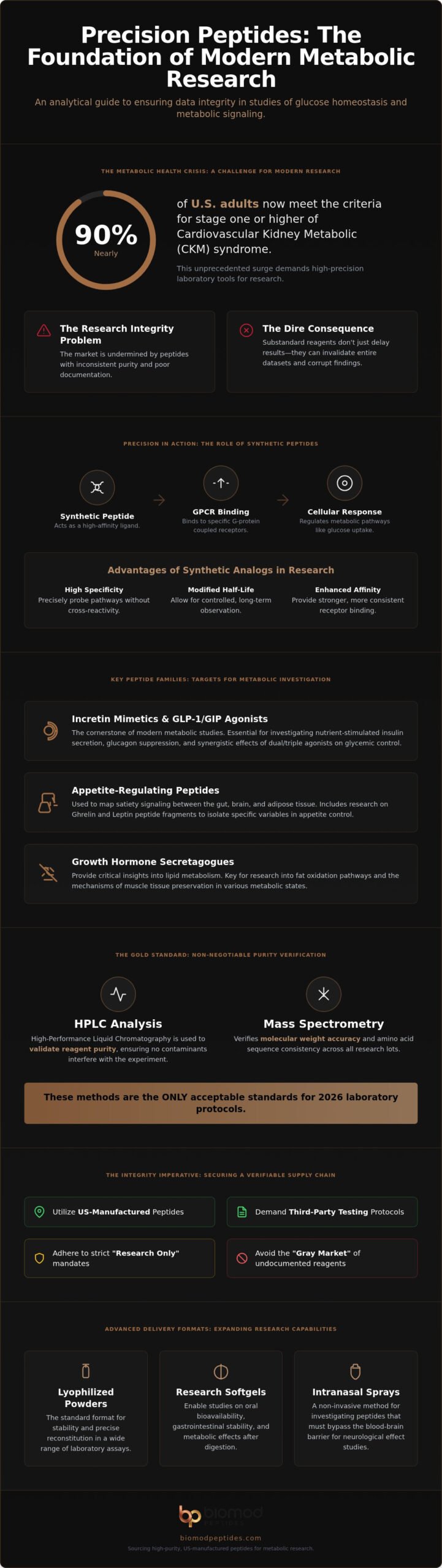
Nearly 90% of U.S. adults now meet the criteria for stage one or higher of Cardiovascular Kidney Metabolic (CKM) syndrome. This unprecedented surge in metabolic dysfunction creates an urgent demand for high-precision laboratory tools. You recognize that experimental integrity is non-negotiable when investigating complex endocrine signaling. Unfortunately, the market for peptides for metabolic disorder research is frequently undermined by inconsistent purity and poorly documented certificates of analysis. Substandard reagents don’t just delay your results; they often invalidate entire datasets.
This analytical overview serves as a technical guide to the role of high-purity peptides in investigating glucose homeostasis and metabolic pathways. You’ll understand why HPLC and mass spectrometry verification are the only acceptable standards for 2026 laboratory protocols. We’ll identify the essential compounds for modeling metabolic signaling and outline how to secure a reliable, US-manufactured supply chain. By prioritizing rigorous analytical precision, you ensure your research reflects biological reality rather than reagent error. It’s time to demand higher benchmarks for your metabolic studies.
Key Takeaways
- Define the functional role of synthetic peptides as high-affinity ligands for G-protein coupled receptors in metabolic signaling.
- Distinguish between incretin mimetics and appetite-regulating peptide fragments to isolate specific variables in glucose homeostasis research.
- Validate reagent integrity through HPLC and Mass Spectrometry to ensure molecular weight accuracy and sequence consistency across all lots.
- Secure a verifiable supply chain by utilizing US-manufactured peptides for metabolic disorder research backed by transparent, third-party testing protocols.
The Role of Synthetic Peptides in Metabolic Signaling Research
Metabolism relies on a complex network of peptide hormones that act as primary ligands for G-protein coupled receptors (GPCRs). These signaling molecules regulate everything from glucose uptake to lipid oxidation. Modern laboratory investigations utilize synthetic analogs to probe these pathways with high specificity. Unlike endogenous hormones, synthetic peptides for metabolic disorder research allow for modified half-lives and enhanced receptor affinity. Precision is paramount. Historical progress from the 1921 isolation of insulin to the 2026 development of multi-receptor incretin mimetics illustrates this shift. Synthetic analogs now provide the granularity needed to map metabolic dysfunction at the cellular level.
Metabolic Pathway Investigation and Reagent Standards
Success in metabolic modeling depends on the synthesis of precise amino acid sequences. Even a single residue substitution can drastically alter receptor binding kinetics. High-purity reagents prevent cross-reactivity in assays, which otherwise leads to false positives and obscured data. Peptide degradation is another critical variable; unstable compounds yield inconsistent results that can’t be reproduced. Researchers must utilize high-tier analytical reagents to ensure that the biological response observed is a direct result of the intended ligand interaction. Maintaining these standards is the only way to achieve data integrity in complex endocrine studies.
Research-Only Mandates in Laboratory Settings
Ethical laboratory conduct requires strict adherence to “Research Only” terms. These compounds are intended for in vitro and in vivo studies, not for clinical use or human consumption. Sourcing from verified US manufacturers like Biomod Peptides eliminates the risks associated with the “gray market” of undocumented reagents. Domestic production ensures that every lot undergoes rigorous third-party testing and verification. This transparency is vital for maintaining the integrity of metabolic studies. When sourcing peptides for metabolic disorder research, logistical transparency and verifiable documentation are the only safeguards against experimental failure.
Key Peptide Families in Metabolic Syndrome and Glucose Homeostasis
Metabolic research requires a diverse library of ligands to model complex endocrine interactions. While clinical discussions often focus on GLP-1, laboratory environments utilize a broader spectrum of peptides for metabolic disorder research. Scientific literature identifies peptides as fundamental regulators of metabolism, acting as primary messengers between the gut, brain, and adipose tissue. This includes incretin mimetics like GIP and GLP-1 receptor agonists, which are essential for investigating nutrient-stimulated insulin secretion. Beyond glucose, appetite regulation studies frequently employ Ghrelin and Leptin peptide fragments to map satiety signaling. Growth hormone secretagogues also play a significant role in lipid metabolism research, providing insights into fat oxidation and muscle tissue preservation.
Incretin Research and Glucose Regulation
Incretin research remains the cornerstone of modern metabolic studies. Investigating dual and triple agonists allows researchers to observe synergistic effects on weight loss and glycemic control. Laboratory models must account for the half-life of these analogs to simulate physiological conditions accurately. It’s critical to isolate the effects of insulin secretion from glucagon suppression in controlled environments. These studies provide the foundational data needed to understand long-term metabolic adaptations in chronic disorder models.
Advanced Delivery Formats for Metabolic Studies
Experimental design often dictates the delivery format of the reagent. While lyophilized powders are standard, newer formats allow for more sophisticated modeling. For instance, peptide softgels for research enable the study of oral bioavailability and gastrointestinal stability. Alternatively, intranasal peptide research sprays provide a non-invasive method for investigating peptides that must bypass the blood-brain barrier. These formats allow laboratories to test how different administration routes affect metabolic signaling and ligand efficacy. For high-purity reagents tailored to these specific research needs, scientists can browse the Biomod catalog for verified lots.
Ensuring Data Integrity: Purity Verification for Metabolic Reagents
Data integrity in endocrine studies rests entirely on analytical verification. When utilizing peptides for metabolic disorder research, even a 2% variance in purity can introduce confounding variables that invalidate an entire dataset. High-Performance Liquid Chromatography (HPLC) is the industry standard for assessing chemical purity. It identifies and quantifies impurities that may interfere with receptor binding assays. However, HPLC alone is insufficient. Mass Spectrometry must accompany it to confirm the peptide’s identity by verifying its molecular weight and amino acid sequence. This dual-layer verification ensures that the reagent in the vial matches the theoretical design of the experiment.
Establishing a transparent chain of custody requires independent, third-party laboratory testing. This process removes the conflict of interest inherent in self-reported data. Biomod reinforces its commitment to peptide science 2026 standards by utilizing US-based finishing and rigorous lot-specific testing. These protocols ensure that every compound meets the structural requirements necessary for high-stakes metabolic modeling.
Interpreting Certificates of Analysis (COA)
A Certificate of Analysis is more than a compliance document; it’s a technical map of reagent quality. Researchers must look beyond the primary purity percentage. Key metrics include:
- Peptide Content: The actual weight percentage of the peptide relative to salts and water.
- TFA Residue: Traces of Trifluoroacetic acid, which can impact cell viability in in vitro models.
- Sequence Consistency: Confirmation via MS to ensure no deletions occurred during synthesis.
Utilizing a verification portal to cross-reference lot numbers provides an additional layer of security for your data.
Procurement for Las Vegas Laboratories
Sourcing reagents from a domestic laboratory peptide supply company offers significant logistical advantages. US-manufactured peptides for metabolic disorder research bypass the stability risks associated with long-duration international shipping. For laboratories in Las Vegas and across the country, local manufacturing ensures a shorter chain of custody and better temperature control during transit. This logistical transparency is essential for maintaining the integrity of temperature-sensitive metabolic analogs.
Advancing Analytical Precision in Metabolic Modeling
Success in investigating glucose homeostasis and endocrine signaling depends on the structural integrity of your reagents. As metabolic dysfunction reaches critical global levels, the demand for high-fidelity laboratory tools has never been more urgent. You’ve seen that experimental reproducibility requires more than just a theoretical sequence; it demands empirical proof through HPLC and mass spectrometry. Utilizing high-purity peptides for metabolic disorder research ensures that your findings are a reflection of biological mechanisms rather than ligand degradation or chemical cross-reactivity.
Biomod Peptides supports the research community by providing compounds that meet the most rigorous analytical benchmarks. Every lot undergoes independent third-party testing to validate purity and sequence accuracy. Our US-manufactured and finished products offer the logistical transparency and stability required for complex metabolic studies. You can access our COA verification portal to confirm the data behind every vial before beginning your assays. It’s time to elevate your laboratory standards with verified materials.
Explore Verified Research Peptides for Metabolic Studies and secure the precision your data deserves. Your progress depends on reagents that are as disciplined as your methodology.
Frequently Asked Questions
What are the most common peptides used in metabolic disorder research?
Common ligands include GLP-1 and GIP receptor agonists, which are fundamental for studying nutrient-stimulated insulin secretion. Researchers also utilize Ghrelin and Leptin peptide fragments to investigate satiety signaling and appetite regulation. Newer multi-receptor agonists like Retatrutide are gaining significant attention in 2026 for modeling complex metabolic interactions. These compounds allow for granular analysis of metabolic pathways in laboratory settings.
Why is 98% purity the standard for metabolic research peptides?
A purity level of 98% or higher, determined by HPLC, is the accepted standard to ensure experimental reproducibility. Lower purity levels introduce unknown chemical impurities that can lead to cross-reactivity in sensitive signaling assays. Maintaining this benchmark is the only way to safeguard against skewed data. High-purity peptides for metabolic disorder research provide the structural integrity necessary for precise ligand-receptor interaction studies.
How do researchers verify the quality of peptides for metabolic studies?
Quality verification requires a dual-method approach using High-Performance Liquid Chromatography (HPLC) and Mass Spectrometry (MS). HPLC establishes the purity percentage by identifying contaminants; MS confirms the peptide’s molecular weight and amino acid sequence. Researchers should cross-reference these results using a lot-specific COA verification portal. This process establishes a verifiable chain of custody and ensures the reagent matches the theoretical experimental design.
Can research peptides be used for clinical applications or human consumption?
No, research peptides are strictly for laboratory use and are not intended for clinical applications or human consumption. These compounds are labeled “not for human consumption” to comply with federal regulations and ethical laboratory standards. While some peptides are FDA-approved for therapeutic use, the synthetic analogs sold for research are restricted to in vitro and in vivo studies. Misuse of these reagents compromises scientific ethics and regulatory compliance.
Disclaimer
BIOMOD products are sold strictly for laboratory, analytical, and scientific research use only. They are not intended for human or animal consumption, administration, application, ingestion, injection, or any therapeutic, diagnostic, or cosmetic use.
The statements made on this website have not been evaluated by the United States Food and Drug Administration. BIOMOD products are not intended to diagnose, treat, cure, mitigate, or prevent any disease or medical condition.
BIOMOD is a research chemical supplier. BIOMOD is not a compounding pharmacy or chemical compounding facility as defined under Section 503A of the Federal Food, Drug, and Cosmetic Act. BIOMOD is not an outsourcing facility as defined under Section 503B of the Federal Food, Drug, and Cosmetic Act.
By accessing this site, you confirm you are at least 21 years of age and that you have read and accepted the BIOMOD Terms of Sale, Privacy Policy, and Research Use Only Policy. BIOMOD does not provide dosing, medical, therapeutic, diagnostic, veterinary, or use guidance under any channel.