
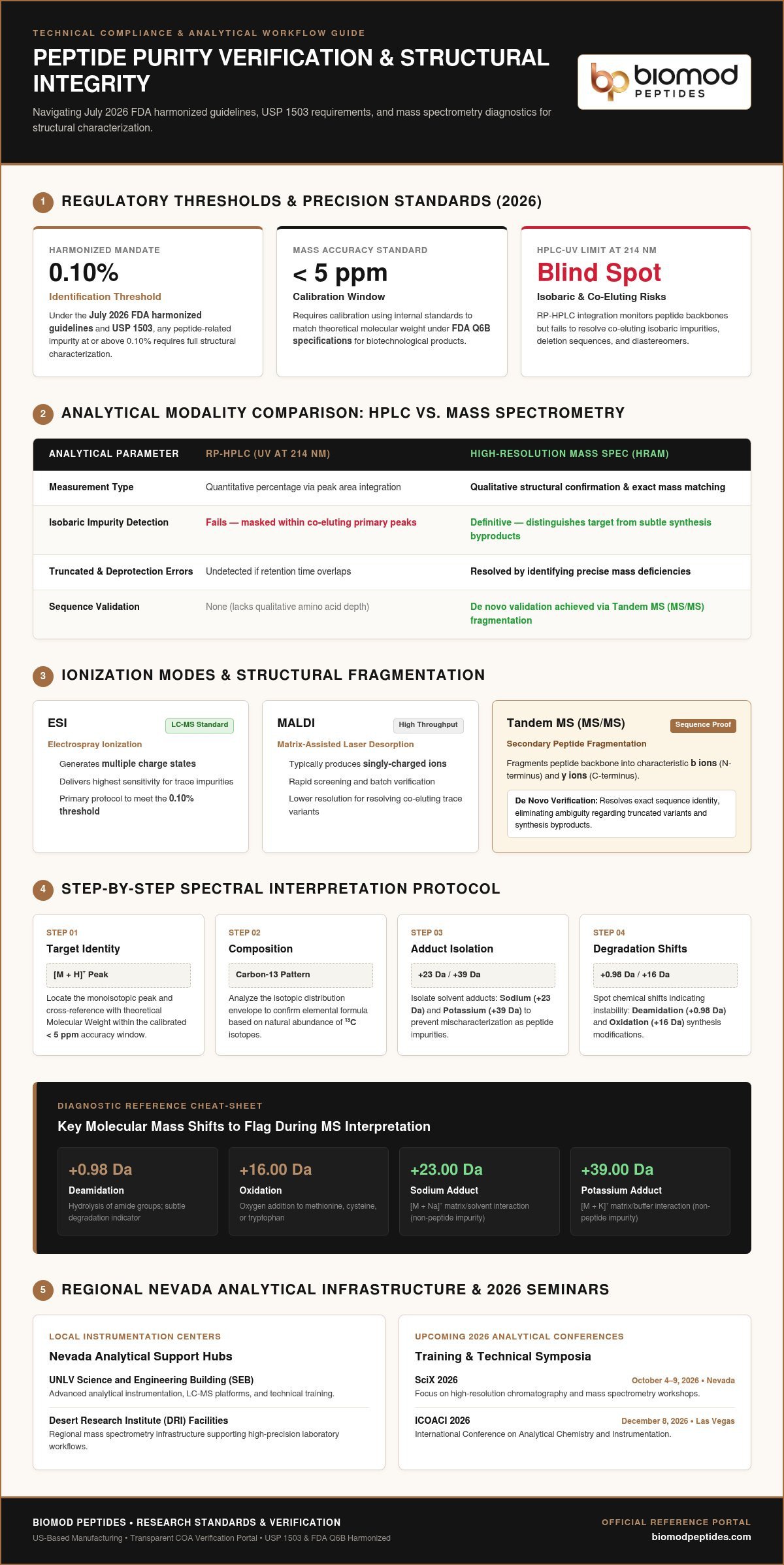
The 0.10% identification threshold is no longer a suggestion. Under the July 2026 FDA harmonized guidelines, any peptide-related impurity at or above this level requires full structural characterization. Relying solely on RP-HPLC UV detection at 214 nm is insufficient for identifying co-eluting isobaric impurities or deletion sequences. You’ve likely encountered the frustration of inconsistent vendor batches where target peptides are indistinguishable from synthesis byproducts. Verifying peptide purity with mass spectrometry is the only way to confirm identity and sequence integrity with absolute precision.
This 2026 guide provides the technical protocols required to establish a rigorous internal verification workflow. You’ll learn to implement High-Resolution Accurate Mass (HRAM) standards and navigate USP 1503 quality attributes. We also highlight local Las Vegas analytical resources, including the UNLV Science and Engineering Building and DRI facilities, to support your laboratory’s training and instrumentation needs. Mastering these advanced techniques ensures that your research reagents meet the highest benchmarks of laboratory-grade reliability.
Key Takeaways
- Understand why HPLC-UV integration alone fails to detect isobaric impurities. Mass spectrometry remains the definitive standard for sequence validation and structural profiling.
- Learn the technical distinctions between ESI and MALDI ionization when verifying peptide purity with mass spectrometry. These methods provide the high-resolution data necessary for rigorous integrity checks.
- Utilize Tandem MS (MS/MS) to resolve exact amino acid sequences. This secondary fragmentation protocol eliminates ambiguity regarding synthesis byproducts and truncated sequences.
- Identify specialized Nevada facilities and upcoming 2026 Las Vegas analytical seminars. These regional resources provide the instrumentation and technical training required for institutional-grade quality control.
The Critical Importance of Mass Spectrometry in Peptide Purity Verification
Verifying peptide purity with mass spectrometry serves as the definitive benchmark for peptide identity. While chromatography provides a quantitative percentage, it lacks the qualitative depth required to confirm a specific amino acid sequence. Mass spectrometry allows researchers to match the experimental mass to the theoretical molecular weight (MW) with a precision window often below 5 ppm. This level of rigorous validation ensures that the reagent is structurally intact and free from synthesis-induced modifications that could compromise experimental data.
Relying on HPLC alone introduces significant analytical risk. Co-eluting impurities often possess identical retention times, effectively hiding within the primary peak on a chromatogram. These contaminants frequently include deamidated peptides or diastereomers that standard UV detectors cannot resolve. By utilizing protein and peptide mass spectrometry, laboratories can distinguish the target molecule from these subtle synthesis byproducts. This process is vital for ensuring the structural integrity of the sample aligns with the intended research outcomes.
HPLC vs. Mass Spectrometry: A Multi-Modal Approach
A multi-modal verification strategy is essential for modern laboratory standards. HPLC measures chromatographic purity by integrating peak areas, typically at 214 nm to monitor the peptide backbone. However, only MS provides the structural confirmation needed to identify truncated sequences and side-chain deprotection failures. Integrating HPLC tested peptides with high-resolution MS is now the baseline for 2026 research protocols. Biomod Peptides reinforces this standard through US-based manufacturing and transparent COA documentation. Our dedicated verification portal allows researchers to cross-reference their internal MS findings against our third-party validated data, ensuring every batch meets the 0.10% characterization threshold mandated by USP 1503.
Advanced MS Techniques and Spectral Interpretation for Researchers
Ionization choice determines the resolution of your analytical data. Electrospray Ionization (ESI) is the preferred method for LC-MS workflows because it generates multiple charge states. This contrasts with Matrix-Assisted Laser Desorption (MALDI), which typically yields single-charged ions. While MALDI offers high-throughput efficiency, ESI provides the sensitivity required for detecting trace impurities at the 0.10% threshold. Tandem MS (MS/MS) further refines this by fragmenting the peptide into b and y ions. This fragmentation allows for de novo sequence validation, ensuring the sample matches the intended chemical structure rather than a truncated variant.
Accurate interpretation requires distinguishing the target signal from background noise. Solvent adducts, such as sodium (+23 Da) or potassium (+39 Da) peaks, can easily be mistaken for impurities if they aren’t properly identified. Researchers should utilize internal standards to calibrate mass accuracy, maintaining a window below 5 ppm. These protocols align with established FDA Q6B specifications guidance for characterizing biotechnological products. For labs requiring high-tier reagents, sourcing verified research peptides ensures a cleaner baseline spectrum from the start.
Step-by-Step Interpretation of a Peptide Mass Spectrum
Begin by locating the monoisotopic [M+H]+ peak. Compare this value to the theoretical molecular weight to confirm identity. Analyzing the isotopic distribution pattern is equally critical; it validates the elemental composition based on the natural abundance of carbon-13. To spot degradation, look for specific mass shifts. Deamidation typically manifests as a +0.98 Da shift, while oxidation appears as a +16 Da gain. Verifying peptide purity with mass spectrometry isn’t just about identity; it’s about detecting these subtle molecular shifts that indicate sample instability.
Roundup: Local Seminars and Analytical Resources in Las Vegas
Las Vegas researchers have access to specialized analytical infrastructure for verifying peptide purity with mass spectrometry. The International Conference on Analytical Chemistry and Instrumentation (ICOACI) is scheduled for December 8, 2026, in Las Vegas, offering deep dives into emerging bioanalytical trends. Regionally, SciX 2026 takes place October 4-9, 2026, in Nevada, focusing on high-resolution chromatography and mass spectrometry workshops. Locally, the UNLV Science and Engineering Building (SEB) and the Nevada Plasma Facility Lab provide the instrumentation necessary for trace elemental screening and molecular weight confirmation. These institutional resources allow for the independent validation of complex sequences beyond vendor-supplied data.
When submitting samples to third-party labs, researchers should utilize NIST peptide mass spectral libraries to cross-reference experimental MS/MS spectra. This practice ensures structural data aligns with standardized reference sets, mitigating the risk of misidentifying synthesis byproducts as target molecules. A rigorous peptide purity verification protocol also requires evaluating the lab’s ability to resolve co-eluting impurities that escape standard UV detection. Relying on high-resolution accurate mass (HRAM) platforms is essential for distinguishing between target peptides and closely related truncated sequences.
Leveraging Documentation for Laboratory Accountability
The Biomod COA Verification Portal provides a transparent mechanism to cross-reference batch-specific data with internal MS findings. US-manufactured standards are essential for reducing baseline noise, which simplifies the detection of low-abundance impurities during high-resolution analysis. Before outsourcing testing, researchers should confirm that the analytical facility utilizes Orbitrap or Q-TOF platforms and follows USP 1503 characterization thresholds. This disciplined approach to documentation and regional resource utilization ensures that the integrity of your research reagents remains uncompromising throughout the analytical lifecycle.
Advancing Analytical Standards in Peptide Research
Precision in research requires a transition from basic chromatographic metrics to comprehensive structural validation. Verifying peptide purity with mass spectrometry ensures that target sequences remain intact and free from co-eluting impurities that compromise data integrity. By integrating high-resolution ESI and Tandem MS protocols, laboratories can achieve the 0.10% characterization threshold required by modern regulatory frameworks. Utilizing local Nevada core facilities and 2026 analytical seminars provides the necessary infrastructure for these rigorous benchmarks. Biomod Peptides facilitates this level of accountability through independent third-party verification and US-manufactured finishing. Our dedicated COA Verification Portal allows you to cross-reference batch data with absolute transparency. It’s time to establish a higher tier of laboratory execution by securing reagents that meet institution-grade standards.
Access Verified Research Peptides and COA Documentation at Biomod Peptides
Frequently Asked Questions
What is the difference between HPLC and Mass Spectrometry for peptide purity?
HPLC quantifies the relative abundance of a sample through UV absorbance at 214 nm, but it cannot confirm molecular identity. Mass spectrometry resolves this by measuring the exact mass-to-charge ratio of the peptide. Verifying peptide purity with mass spectrometry is the only way to ensure that a 98% HPLC peak isn’t hiding isobaric impurities or truncated sequences that compromise research.
How much purity is required for reliable in vitro research?
Reliable in vitro research typically demands a purity benchmark of 98% or higher. While crude peptides at 90% or 95% are available, they frequently contain synthesis-induced modifications that skew experimental results. Biomod Peptides provides US-manufactured reagents that meet these high-purity standards. Every batch undergoes third-party testing to ensure laboratory reagents are free from interfering byproducts and residuals.
Can mass spectrometry detect D-amino acid substitutions in a peptide?
Standard mass spectrometry alone cannot detect D-amino acid substitutions because these enantiomers are isobaric. They possess the same molecular weight and elemental composition. Resolving chiral impurities requires orthogonal methods like chiral HPLC or specialized fragmentation patterns. Researchers focused on sequence integrity should combine high-resolution MS with these techniques to identify structural inversions that standard MS might overlook.
Where can I find local seminars on mass spectrometry in Las Vegas for 2026?
The International Conference on Analytical Chemistry and Instrumentation (ICOACI) is scheduled for December 8, 2026, in Las Vegas. Researchers can also access the SciX 2026 symposium in Sparks, Nevada, from October 4 to 9 for specialized mass spectrometry training. Locally, the UNLV Science and Engineering Building offers bioanalysis infrastructure and instrumentation for independent verification of research peptides within the Southern Nevada region.
Disclaimer
BIOMOD products are sold strictly for laboratory, analytical, and scientific research use only. They are not intended for human or animal consumption, administration, application, ingestion, injection, or any therapeutic, diagnostic, or cosmetic use.
The statements made on this website have not been evaluated by the United States Food and Drug Administration. BIOMOD products are not intended to diagnose, treat, cure, mitigate, or prevent any disease or medical condition.
BIOMOD is a research chemical supplier. BIOMOD is not a compounding pharmacy or chemical compounding facility as defined under Section 503A of the Federal Food, Drug, and Cosmetic Act. BIOMOD is not an outsourcing facility as defined under Section 503B of the Federal Food, Drug, and Cosmetic Act.
By accessing this site, you confirm you are at least 21 years of age and that you have read and accepted the BIOMOD Terms of Sale, Privacy Policy, and Research Use Only Policy. BIOMOD does not provide dosing, medical, therapeutic, diagnostic, veterinary, or use guidance under any channel.