
A single batch of sub-standard reagents can invalidate years of longitudinal data in an instant. For researchers establishing new facilities, the margin for error in chemical procurement is zero. You recognize that experimental reproducibility isn’t just a goal; it’s a requirement for institutional accountability. Sourcing peptides for a new lab at UNLV demands a protocol that prioritizes analytical verification over simple cost metrics.
This guide establishes a rigorous framework for identifying high-purity compounds and securing a stable supply chain. We’ll detail how to independently verify certificates of analysis (COA) through HPLC and ICP-MS data. You’ll learn to eliminate the risks of batch-to-batch inconsistency and opaque third-party results. We also address logistical bottlenecks by leveraging local Las Vegas manufacturing to reduce transit times for sensitive, lyophilized products. By the end of this protocol, your lab will possess a verified, high-purity sourcing strategy.
Key Takeaways
- Define rigorous analytical benchmarks, requiring >98% HPLC purity to ensure batch-to-batch consistency for institutional research.
- Implement a standardized protocol for sourcing peptides for a new lab at UNLV that prioritizes lot-level documentation and analytical characterization.
- Use independent COA verification portals to validate third-party testing results and maintain high levels of institutional accountability.
- Optimize logistics through local Las Vegas-based procurement to minimize transit times and preserve the stability of sensitive lyophilized reagents.
Establishing Quality Benchmarks for New UNLV Research Laboratories
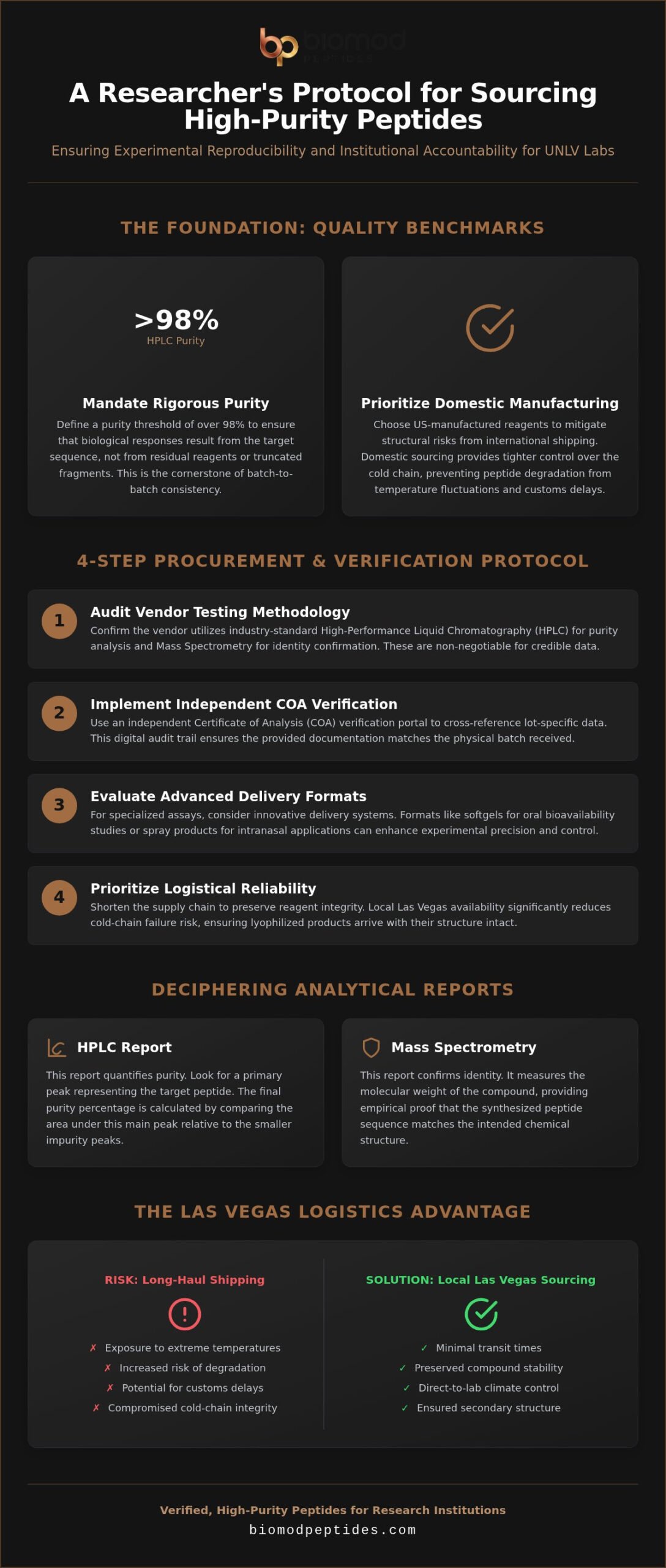
Institutional research success depends on the precision of the initial chemical inputs. When sourcing peptides for a new lab at UNLV, researchers must mandate a purity threshold of >98% as verified by High-Performance Liquid Chromatography (HPLC). This standard isn’t arbitrary. It ensures that biological responses result from the target sequence rather than residual reagents or truncated fragments. High-purity reagents eliminate the variables that frequently compromise batch-to-batch consistency in complex longitudinal studies.
Proximity dictates stability. New labs should prioritize US-manufactured reagents to mitigate the structural risks associated with international shipping. Extended transit times and fluctuating temperatures during customs clearance often cause peptide degradation, particularly for sensitive sequences. Ensuring that the peptide synthesis and finishing processes occur domestically allows for tighter control over the cold chain. This logistical transparency is vital for establishing a rigorous baseline for impurity profiles and heavy metal screening.
The Criticality of Analytical Integrity in Peer-Reviewed Research
Analytical integrity is the primary prerequisite for credible data publication. Peer-reviewed journals increasingly demand lot-specific documentation to validate experimental reproducibility. Utilizing unverified reagents in sensitive biological assays introduces “dark data” variables that can invalidate months of methodology. Third-party validation, including Mass Spectrometry and ICP-MS for heavy metal detection, provides the empirical proof necessary for institutional accountability. Without independent verification, a lab’s analytical foundation remains speculative and vulnerable to scrutiny.
Protocol for Sourcing Peptides for a New UNLV Lab
Establishing a procurement protocol requires a multi-stage validation process to ensure experimental integrity. First, audit the vendor’s testing methodology. High-Performance Liquid Chromatography (HPLC) and Mass Spectrometry are the industry standards for determining chemical identity and purity. When sourcing peptides for a new lab at UNLV, researchers must utilize an independent COA verification portal to cross-reference lot-specific data. This digital audit trail ensures that the documentation provided matches the physical batch received, preventing the use of mismatched or outdated reagents.
Beyond raw purity, evaluate the delivery format required for your specific research model. Specialized formats such as peptide softgels or spray products can enhance experimental precision in certain biological assays where traditional reconstitution is not ideal. Finally, prioritize logistical reliability. Local Las Vegas availability significantly reduces the risk of cold-chain failure. Shortening the transit distance ensures that lyophilized products arrive with their structural integrity intact, avoiding the degradation risks inherent in long-distance shipping.
Deciphering HPLC and Mass Spectrometry Reports
Interpreting analytical reports is essential for institutional quality control. A standard HPLC report features a primary peak representing the target peptide; the area under this peak relative to smaller impurity peaks determines the final purity percentage. Mass Spectrometry confirms the molecular weight, ensuring the synthesized sequence matches the intended design. For a deeper technical analysis of these benchmarks, consult The Protocol for Peptide Purity Verification. For labs requiring immediate, verified inventory, Biomod Peptides provides a transparent supply chain for Las Vegas research institutions.
Optimizing Procurement for the Las Vegas Research Corridor
Proximity is a critical variable in chemical stability. Sourcing peptides for a new lab at UNLV from a local Las Vegas provider eliminates the thermal stressors inherent in long-haul logistics. Standard shipping models often expose sensitive reagents to extreme Nevada temperatures during transit. A localized supply chain ensures that products move from climate-controlled manufacturing directly to the lab bench within minimal timeframes. This speed preserves the secondary structure of lyophilized compounds, ensuring that experimental results remain untainted by environmental degradation.
Modern experimental design often requires moving beyond standard lyophilized vials. Integrating innovative peptide delivery systems like softgels allows for precise dosing in oral bioavailability studies. Similarly, utilizing peptide spray products provides a controlled method for specialized intranasal research applications. These formats are finished under the same rigorous standards as raw powders. They offer researchers ready-to-use alternatives that reduce preparation error and minimize cross-contamination risks within the facility.
Institutional accountability requires strict adherence to procurement terms. All reagents must be acquired under explicit Research Use Only (RUO) designations. This compliance protects the university’s standing and ensures that all materials are utilized strictly within the scope of approved laboratory protocols. Maintaining these boundaries is essential for sourcing peptides for a new lab at UNLV while upholding the highest ethical and professional standards.
Leveraging Local Expertise and US Manufacturing
Quality control is significantly more effective when manufacturing and finishing occur within the same regulatory jurisdiction. US-manufactured products undergo standardized verification processes that international imports often bypass. To understand the benchmarks of localized production, researchers can learn more About Biomod and its Las Vegas-based facility. This proximity allows for direct oversight and rapid resolution of technical inquiries, fostering a transparent partnership between the supplier and the academic institution.
Securing Analytical Continuity for UNLV Research
Establishing a rigorous procurement protocol is the foundation of data reproducibility. Sourcing peptides for a new lab at UNLV requires an uncompromising commitment to analytical grade verification and structural integrity. By implementing independent third-party HPLC testing and leveraging local Las Vegas-based logistics, researchers effectively eliminate the variables associated with reagent degradation and opaque vendor documentation. These standards ensure that every compound meets the high purity benchmarks necessary for high-impact publication and institutional accountability. Reliability in the supply chain translates directly to the precision of your longitudinal data.
Success in modern bioscience demands a partner that values empirical proof over marketing claims. Biomod Peptides provides the transparency required for sophisticated institutional research. Access the Biomod Research Peptide Catalogue and COA Portal to secure US-manufactured reagents that maintain the highest standards of quality control. Precision in procurement is the first step toward breakthrough discovery in the lab.
Frequently Asked Questions
What purity levels are required for sourcing peptides for a new lab at UNLV?
Institutional research standards mandate a purity threshold of at least 98% as verified by HPLC. When sourcing peptides for a new lab at UNLV, high-purity reagents are essential to ensure that experimental responses result from the target sequence rather than residual chemical impurities. Sub-standard purity often leads to batch-to-batch inconsistency. This can compromise the integrity of longitudinal data and complicate the peer-review process for academic publications.
How can I verify the third-party test results for research peptides in Las Vegas?
Researchers can verify results by utilizing an independent COA verification portal to cross-reference lot-specific data. This process involves matching the batch number on the product vial with analytical reports. Verification must include High-Performance Liquid Chromatography (HPLC) for purity and Mass Spectrometry for identity confirmation. These steps provide the empirical proof necessary for maintaining institutional accountability within the Las Vegas research corridor and ensuring data reproducibility.
Why is US manufacturing important for laboratory peptide supply?
US-based manufacturing and finishing ensure that products adhere to domestic quality control standards and avoid structural risks associated with international transit. Domestic production allows for rigorous oversight of the synthesis process and mitigates degradation caused by customs delays. For Las Vegas labs, US manufacturing also facilitates faster logistics. This preserves the integrity of sensitive lyophilized compounds and ensures they arrive in optimal condition for analytical use.
Are peptide softgels or sprays suitable for institutional research applications?
Specialized formats like peptide softgels and spray products are suitable for institutional research when experimental models require specific delivery routes. These products undergo the same analytical grade verification and third-party testing as traditional lyophilized vials. They offer researchers ready-to-use alternatives for oral bioavailability studies or intranasal applications. All such formats must be utilized strictly under Research Use Only (RUO) terms to maintain institutional compliance.
Disclaimer
BIOMOD products are sold strictly for laboratory, analytical, and scientific research use only. They are not intended for human or animal consumption, administration, application, ingestion, injection, or any therapeutic, diagnostic, or cosmetic use.
The statements made on this website have not been evaluated by the United States Food and Drug Administration. BIOMOD products are not intended to diagnose, treat, cure, mitigate, or prevent any disease or medical condition.
BIOMOD is a research chemical supplier. BIOMOD is not a compounding pharmacy or chemical compounding facility as defined under Section 503A of the Federal Food, Drug, and Cosmetic Act. BIOMOD is not an outsourcing facility as defined under Section 503B of the Federal Food, Drug, and Cosmetic Act.
By accessing this site, you confirm you are at least 21 years of age and that you have read and accepted the BIOMOD Terms of Sale, Privacy Policy, and Research Use Only Policy. BIOMOD does not provide dosing, medical, therapeutic, diagnostic, veterinary, or use guidance under any channel.