
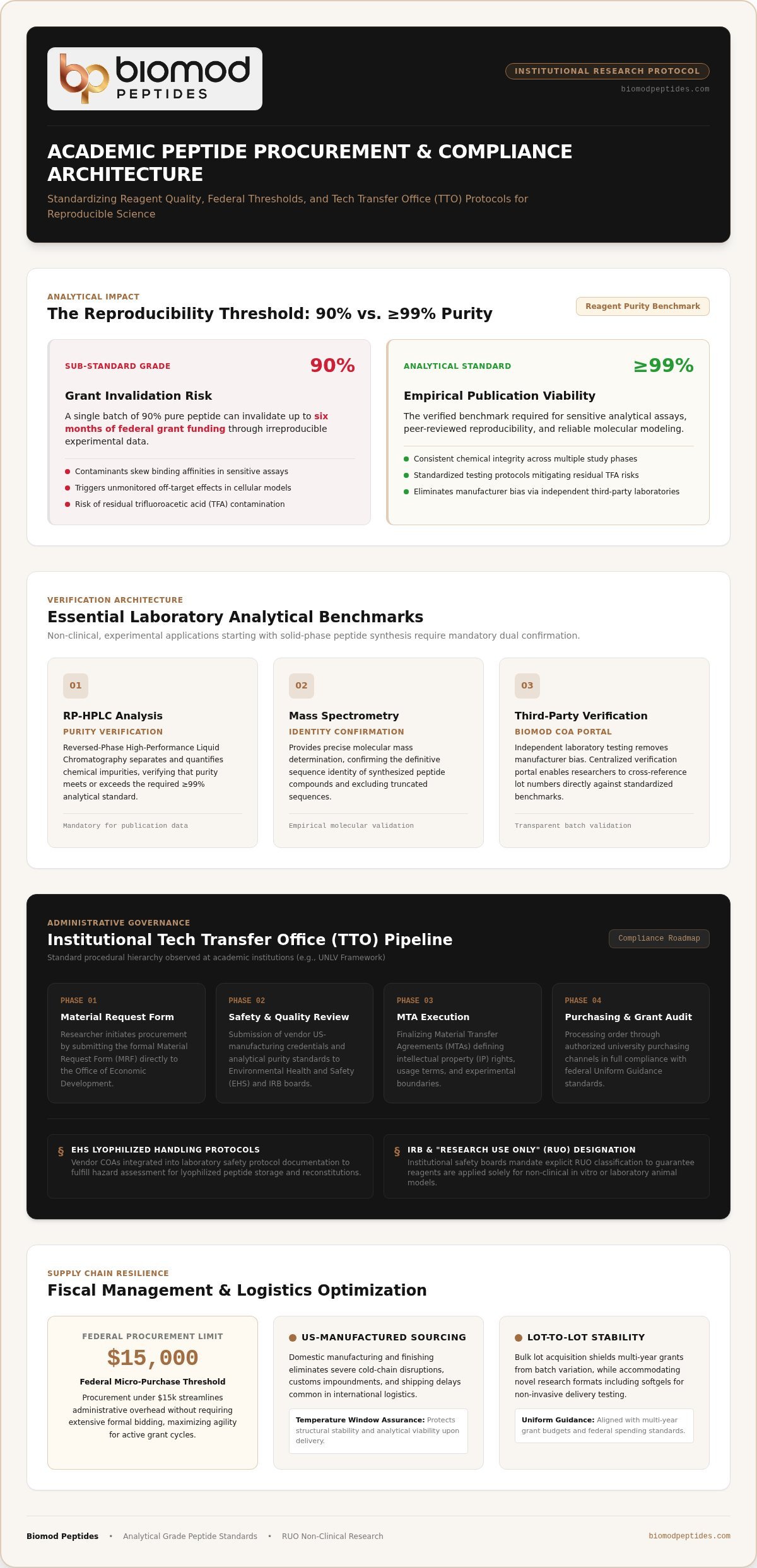
A single batch of 90% pure peptide can invalidate six months of federal grant funding through irreproducible data. For researchers, the friction between administrative mandates and laboratory requirements is a constant burden. You shouldn’t have to navigate tech transfer delays while worrying if your third party lab reports are authentic. Successful peptide procurement for academic labs requires a dual track strategy that aligns institutional compliance with analytical standards. It’s about securing a pipeline that resists supply chain volatility.
This guide provides a comprehensive roadmap for researchers. We’ll detail how to navigate the $15,000 federal micro-purchase threshold and meet tech transfer requirements at institutions like UNLV. You’ll learn to verify 99% purity through independent COA portals and prioritize US-manufactured reagents. We’ll also examine how standardized testing protocols protect your data from the risks of residual trifluoroacetic acid.
Key Takeaways
- Establish rigorous analytical benchmarks using HPLC and Mass Spectrometry to confirm reagent purity and safeguard the reproducibility of experimental data.
- Streamline peptide procurement for academic labs by aligning with Tech Transfer Office requirements and coordinating Material Transfer Agreement protocols effectively.
- Reduce logistical risks and cold-chain inconsistencies by sourcing US-manufactured and finished products designed for institutional research environments.
- Leverage bulk procurement strategies to ensure lot-to-lot stability and maximize the fiscal efficiency of multi-year federal grant funding.
The Landscape of Peptide Procurement in Academic Research
Peptide procurement for academic labs is the systematic acquisition of high-purity reagents designed for non-clinical, experimental applications. It’s a process that begins with solid-phase peptide synthesis and ends with rigorous analytical validation. Standard laboratory protocols require identity confirmation through Mass Spectrometry and purity verification via RP-HPLC. These steps are essential for any data destined for peer-reviewed publication. Institutional safety boards (IRB) mandate “Research Use Only” (RUO) designations. This classification ensures compliance with safety standards and prevents the unauthorized use of reagents in clinical settings.
Reproducibility hinges on the use of analytical grade peptides. Even minor contaminants can skew binding affinities or trigger off-target effects in cellular models. Reliable procurement pipelines prioritize chemical integrity over cost to ensure that experimental outcomes remain consistent across multiple study phases.
Analytical Standards and Third-Party Verification
In-house quality reports often lack the objectivity required for high-stakes research. Independent testing by third-party laboratories is the only way to eliminate manufacturer bias. It provides a layer of accountability that protects the lab’s reputation and its funding. The Biomod COA Verification Portal acts as a central transparency hub. Lab managers use this tool to cross-reference batch results against standardized benchmarks. “Third-party validation is the industry standard for ensuring that peptide purity meets the ≥99% threshold required for sensitive analytical assays.” This commitment to verification ensures that every lot, finished in the United States, supports precise molecular research. Effective peptide procurement for academic labs relies on this level of empirical proof.
Navigating Institutional Compliance and Tech Transfer Offices
The Tech Transfer Office (TTO) acts as the central gatekeeper for material acquisition in institutional settings. At universities like UNLV, this office manages the legal and logistical frameworks governing how reagents enter the laboratory. Material Transfer Agreements (MTAs) are essential documents in this process. They define intellectual property rights and usage restrictions for specialized research reagents. Failure to secure a signed MTA can result in significant administrative delays or non-compliance with federal grant mandates.
Environmental Health and Safety (EHS) departments also play a vital role. They require specific documentation before approving the storage and handling of lyophilized peptides. Integrating vendor Certificates of Analysis (COAs) directly into your lab’s safety protocol documentation facilitates a smoother review. This transparency provides the empirical data required for peptide quality control and impurity profiling, which is necessary to satisfy institutional safety boards.
The Tech Transfer Office (TTO) Process at UNLV
Navigating the TTO at UNLV involves a specific procedural hierarchy. Researchers must first submit a Material Request Form (MRF) to the Office of Economic Development. Following this, the lab provides the vendor’s US-manufacturing documentation and analytical purity standards for a comprehensive safety review. Finally, procurement is processed through authorized university purchasing channels to ensure full grant compliance. This structured approach to peptide procurement for academic labs protects the institution’s liability. Utilizing a verified research supplier that offers transparent, US-finished reagents significantly reduces the time spent in administrative review.
Optimizing the Procurement Pipeline for Long-Term Research
Efficient peptide procurement for academic labs requires a focus on logistical resilience. Sourcing from US-manufactured facilities eliminates the risks associated with international shipping delays and cold-chain disruptions. These disruptions often compromise the structural integrity of sensitive reagents. Domestic finishing ensures that products arrive within specified temperature windows; this preserves analytical viability. This reliability is essential for maintaining the timelines of multi-year federal grants.
Adhering to Uniform Guidance procurement standards ensures that institutional spending remains compliant. Bulk procurement strategies allow labs to lock in consistent lots, reducing the variables that complicate data interpretation. Researchers investigating novel delivery mechanisms can integrate specialized formats, such as peptide softgels for research, into their protocols. Biomod Peptides supports these advanced pipelines by providing high-purity research peptides backed by domestic supply chain transparency.
Ensuring Batch-to-Batch Consistency for Reproducible Results
Lot-specific verification is the only defense against experimental drift. Minor variations in synthesis or purification can lead to significant deviations in bioactivity over time. Lyophilization remains the gold standard for maintaining peptide stability, particularly in arid laboratory environments like those found in Las Vegas. Stable, freeze-dried powders resist degradation during long-term storage better than aqueous solutions. We recommend that principal investigators request “reserve lots” from their suppliers. This practice secures a single, analytically verified batch for the entire duration of a study. It eliminates inter-lot variability and strengthens the statistical power of the resulting research.
Advancing Laboratory Standards Through Rigorous Acquisition
Successful research outcomes depend on the intersection of administrative precision and chemical integrity. Navigating the complexities of peptide procurement for academic labs requires more than just budget approval; it demands a commitment to verified analytical benchmarks. By aligning with institutional compliance offices and prioritizing US-manufactured reagents, principal investigators can insulate their data from supply chain volatility. It’s a strategic approach that safeguards the reproducibility of long-term studies.
Biomod Peptides provides the structural transparency necessary for modern institutional research. Every lot undergoes independent third-party verification to ensure absolute purity. Researchers gain direct COA access for all products, facilitating seamless integration into lab safety protocols and grant reporting. Explore Analytical Grade Peptides for Your Lab to secure the future of your experimental data with reagents that meet the highest technical specifications.
Frequently Asked Questions
How does the tech transfer office at UNLV affect peptide procurement?
The UNLV Tech Transfer Office (TTO) acts as the administrative gatekeeper for all material acquisition. It reviews Material Transfer Agreements (MTAs) and ensures that incoming reagents meet institutional safety and intellectual property standards. Labs in Las Vegas must coordinate with the TTO to verify that vendor documentation aligns with university-specific grant compliance and risk assessment protocols.
Why is third-party testing mandatory for academic peptide research?
Independent third-party testing is essential to eliminate manufacturer bias and ensure data reproducibility in peer-reviewed publications. It provides objective verification of HPLC purity and Mass Spectrometry identity. Reliable peptide procurement for academic labs depends on these external benchmarks to confirm that reagents meet the ≥99% purity threshold required for sensitive analytical assays and cellular modeling experiments.
What are the storage requirements for research peptides in a laboratory setting?
Lyophilized peptides should be stored in a climate-controlled environment at -20°C for short-term use or -80°C for long-term preservation. Maintaining a stable temperature is critical in Las Vegas lab environments to prevent moisture absorption and chemical degradation. Vials must remain tightly sealed and protected from light exposure to ensure the structural integrity of the amino acid sequence remains intact.
Can academic labs purchase bulk peptides for long-term studies?
Yes, academic labs frequently utilize bulk procurement to secure a single, consistent lot for multi-year experimental phases. This strategy eliminates inter-lot variability and ensures that all data points remain comparable. Standard peptide procurement for academic labs often involves requesting “reserve lots” from US-manufactured suppliers to maintain a steady supply of analytically verified reagents throughout the duration of a federal grant.
Disclaimer
BIOMOD products are sold strictly for laboratory, analytical, and scientific research use only. They are not intended for human or animal consumption, administration, application, ingestion, injection, or any therapeutic, diagnostic, or cosmetic use.
The statements made on this website have not been evaluated by the United States Food and Drug Administration. BIOMOD products are not intended to diagnose, treat, cure, mitigate, or prevent any disease or medical condition.
BIOMOD is a research chemical supplier. BIOMOD is not a compounding pharmacy or chemical compounding facility as defined under Section 503A of the Federal Food, Drug, and Cosmetic Act. BIOMOD is not an outsourcing facility as defined under Section 503B of the Federal Food, Drug, and Cosmetic Act.
By accessing this site, you confirm you are at least 21 years of age and that you have read and accepted the BIOMOD Terms of Sale, Privacy Policy, and Research Use Only Policy. BIOMOD does not provide dosing, medical, therapeutic, diagnostic, veterinary, or use guidance under any channel.