
By late 2026, the $44 million Nevada Health & Bioscience Corp. facility will anchor the Las Vegas Medical District, signaling a permanent shift in the region’s biotech infrastructure. Establishing a new research lab in Las Vegas offers significant tax advantages, yet the transition presents rigorous logistical challenges. You likely recognize that local zoning and specialized reagent procurement require more than just capital. They demand precision.
This guide provides a clinical framework for facility selection and regulatory compliance within the 2026 Nevada landscape. We’ll analyze the SilverFlume portal requirements, detail specific personnel licensing fees for technicians, and outline a strategy for building a verified, US-based supply chain. By the conclusion, you’ll possess a roadmap for launching laboratory operations that meet the highest standards of accountability and scientific integrity.
Key Takeaways
- Identify high-growth zones within the Las Vegas Medical District and leverage local biotech incubators to accelerate early-stage development.
- Navigate Clark County zoning for BSL-1 and BSL-2 facilities while integrating redundant HVAC systems designed for extreme Mojave desert conditions.
- Simplify the logistics of establishing a new research lab in Las Vegas by sourcing US-manufactured reagents to eliminate international shipping risks.
- Implement a rigorous verification protocol using third-party testing and COA portals to maintain institutional-grade quality control standards.
Navigating the Southern Nevada Biotech Ecosystem
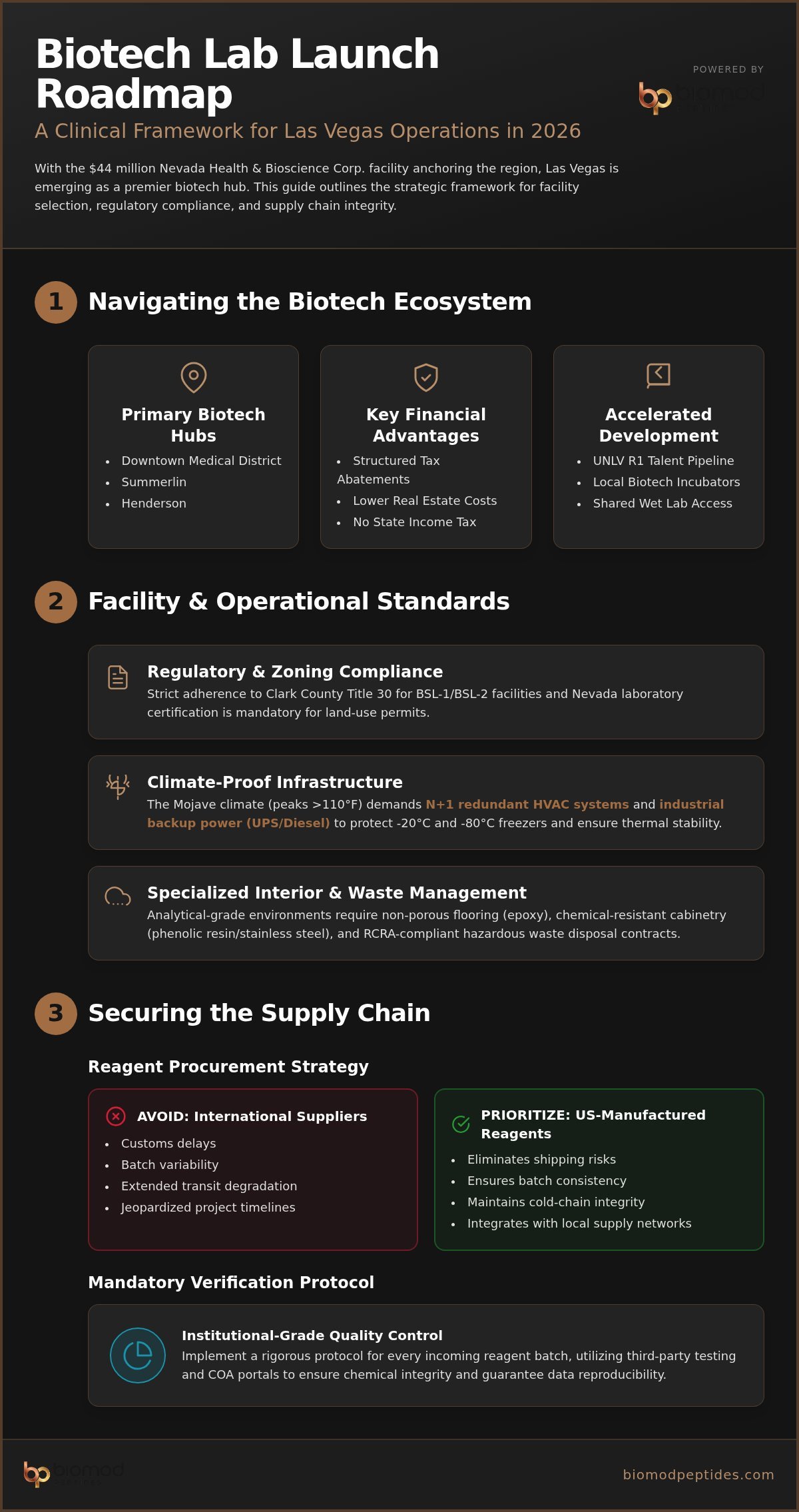
Southern Nevada’s biotech landscape is concentrated within three primary hubs: the Downtown Medical District, Summerlin, and Henderson. Each offers distinct logistical profiles. The Downtown Medical District serves as the clinical core, anchored by the Nevada Health & Bioscience Corp. development. For entities establishing a new research lab in Las Vegas, the Nevada Governor’s Office of Economic Development (GOED) provides structured tax abatements. These incentives target sales and use tax, modified business tax, and personal property tax for life science startups meeting specific capital investment thresholds.
The “Silicon Desert” designation reflects a strategic shift in operational overhead. Compared to established hubs in California, Las Vegas offers significantly lower commercial real estate costs and no state income tax. This fiscal environment facilitates efficient recruitment of specialized talent. Professionals often favor the region for its lower cost of living and modern infrastructure. It’s a landscape built for rapid scaling and long-term institutional stability.
Utilizing Local Incubators and Strategic Partnerships
Early-stage research validation often requires infrastructure that exceeds initial seed funding. The Roseman University of Health Sciences biotech incubator provides essential wet lab access and instrumentation. These shared environments allow for rigorous preliminary testing before committing to long-term leases. Local incubators serve as critical financial buffers, reducing initial capital expenditure for 2026 startups by providing access to high-tier equipment and centralized administrative support.
Developing a sustainable talent pipeline requires direct integration with regional academic institutions. The University of Nevada, Las Vegas (UNLV) operates as an R1 research institution, producing a consistent flow of graduates specialized in molecular biology and biochemistry. Establishing a new research lab in Las Vegas benefits from these existing doctoral programs. It’s a strategy that ensures access to a workforce trained in sophisticated laboratory protocols and data verification.
Logistical Standards for Nevada Laboratory Facilities
Establishing a new research lab in Las Vegas requires strict adherence to Clark County Title 30 zoning codes. BSL-1 and BSL-2 facilities must secure specific land-use permits within industrial or specialized medical districts. Compliance involves meeting Nevada laboratory certification requirements regarding physical containment and safety protocols. Beyond basic permits, the Mojave climate necessitates redundant HVAC systems. Standard cooling is insufficient. Labs require N+1 redundancy to prevent thermal excursions during summer peaks that frequently exceed 110°F.
Operational integrity depends on specialized interior finishes. Analytical grade environments require non-porous, monolithic flooring such as epoxy or welded-seam sheet vinyl. Cabinetry should utilize chemical-resistant phenolic resin or 304-grade stainless steel to prevent material degradation. Waste management involves structured contracts with local hazardous material disposal services compliant with RCRA standards. This ensures the safe removal of biological and chemical byproducts inherent to high-precision research.
Climate-Controlled Storage and Cold-Chain Integrity
Stability is the primary variable in desert logistics. Lyophilized research peptides require consistent thermal regulation to prevent structural degradation. Backup power systems, including industrial-grade UPS and diesel generators, are mandatory for -20°C and -80°C freezer stability. Power failure in Southern Nevada leads to rapid internal temperature spikes. Scientists should consult the Peptide Stability for Research protocols to establish rigorous internal handling standards. Maintaining this level of control is essential for establishing a new research lab in Las Vegas that yields reproducible data. Sourcing reagents from a local Las Vegas partner minimizes transit-related thermal stress and ensures cold-chain continuity.
Securing the Supply Chain: Reagent Procurement and Verification
Establishing a new research lab in Las Vegas requires a robust logistical framework beyond facility setup. Reliance on international reagent suppliers introduces unacceptable risks. Customs delays and batch variability jeopardize project timelines. Prioritizing US-manufactured research peptides eliminates these variables. Localized production ensures reagents arrive without the degradation risks of extended transit. As Southern Nevada’s biotech ecosystem expands, integrating with regional supply networks becomes a strategic advantage. Reliability is non-negotiable.
Every incoming reagent must undergo a mandatory verification protocol. Institutional data reproducibility depends on the chemical integrity of starting materials. We recommend third-party testing including High-Performance Liquid Chromatography (HPLC) and Mass Spectrometry (MS) reports. These documents provide objective proof of purity. Analytical grade environments cannot rely on manufacturer claims. Internal validation is the only path to professional accountability.
Analytical Grade Verification and COA Protocols
Systematic verification involves cross-referencing every batch through a dedicated COA verification portal. This process ensures the specific lot matches the verified standards established during manufacturing. For detailed procurement requirements, scientists should consult a Laboratory Peptide Supply resource. There’s a fundamental difference between standard reagents and high-purity research peptides. Standard options often lack the documentation required for high-stakes modeling. Verified reagents provide the structural integrity necessary for establishing a new research lab in Las Vegas that produces defensible, high-tier results.
Advancing Institutional Excellence in Southern Nevada
Establishing a new research lab in Las Vegas requires a synthesis of geographic strategy and logistical precision. Success depends on navigating the 2026 regulatory environment while implementing redundant climate systems to protect sensitive assays. Beyond physical infrastructure, the integrity of your data relies on a verified, resilient supply chain that eliminates the variables of international transit. Reliability is the standard.
High-purity reagents and transparent documentation form the foundation of reproducible science. Secure Your Lab Supply Chain with Biomod Peptides to access US-manufactured analytical reagents supported by independent third-party verification and local Las Vegas distribution. By prioritizing these structural and analytical benchmarks, your organization is positioned to lead the next era of Nevada’s biotech expansion.
Frequently Asked Questions
What are the zoning requirements for a biotech lab in Las Vegas?
Biotech facilities must align with Clark County Title 30 zoning codes, which typically restrict laboratory operations to industrial or specialized medical districts. Establishing a new research lab in Las Vegas also requires licensing through the Nevada Secretary of State’s SilverFlume portal and the Bureau of Health Care Quality and Compliance. These regulations ensure that BSL-1 and BSL-2 activities meet specific containment and safety standards.
How does the Nevada climate affect peptide stability and storage?
Extreme Mojave desert temperatures, often exceeding 110°F, accelerate the degradation of sensitive reagents. Lyophilized research peptides require strict thermal regulation to maintain structural integrity. Labs must implement redundant HVAC systems and backup power for -20°C and -80°C freezers. Utilizing a local supplier minimizes the exposure time during transit, which is critical for maintaining the cold-chain integrity required for reproducible data.
Are there biotech tax incentives for new research labs in Southern Nevada?
The Nevada Governor’s Office of Economic Development (GOED) provides structured tax incentives for life science startups. Qualifying businesses may receive abatements on sales and use taxes, personal property taxes, and modified business taxes. These programs aim to lower the financial threshold for establishing a new research lab in Las Vegas. Eligibility typically depends on meeting specific capital investment and job creation targets within the state.
Where can I source third-party tested research peptides in Las Vegas?
Biomod Peptides provides high-purity research peptides, softgels, and spray products directly from their Las Vegas operations. Every lot undergoes independent third-party testing to verify analytical grade purity. Researchers can utilize the company’s COA verification portal to cross-reference batch-specific HPLC and Mass Spectrometry reports. This localized supply chain ensures rapid replenishment while maintaining the rigorous documentation standards required for institutional research.
Disclaimer
BIOMOD products are sold strictly for laboratory, analytical, and scientific research use only. They are not intended for human or animal consumption, administration, application, ingestion, injection, or any therapeutic, diagnostic, or cosmetic use.
The statements made on this website have not been evaluated by the United States Food and Drug Administration. BIOMOD products are not intended to diagnose, treat, cure, mitigate, or prevent any disease or medical condition.
BIOMOD is a research chemical supplier. BIOMOD is not a compounding pharmacy or chemical compounding facility as defined under Section 503A of the Federal Food, Drug, and Cosmetic Act. BIOMOD is not an outsourcing facility as defined under Section 503B of the Federal Food, Drug, and Cosmetic Act.
By accessing this site, you confirm you are at least 21 years of age and that you have read and accepted the BIOMOD Terms of Sale, Privacy Policy, and Research Use Only Policy. BIOMOD does not provide dosing, medical, therapeutic, diagnostic, veterinary, or use guidance under any channel.