
Unconditioned airport tarmacs and delivery vehicle cargo holds regularly reach 60°C during summer operations. This environment far exceeds the 40°C threshold for “excessive heat” defined by USP standards. Safeguarding peptide stability in extreme heat transport is therefore essential for research integrity. You’ve likely experienced the frustration of a wasted research budget when degraded samples lead to inconsistent experimental results. It’s a direct consequence of cold chain failures and a lack of vendor transparency regarding thermal excursions.
Maintaining molecular integrity requires a rigorous, analytical approach to logistical protocols. This article details the biochemical impact of thermal stress on peptide structures and the specific thresholds that trigger degradation. You’ll learn the criteria for selecting vendors with validated shipping standards and why lyophilization acts as a primary stability safeguard. We provide the technical evidence needed to ensure your data reflects biological reality rather than transport-induced artifacts.
Key Takeaways
- Identify the specific chemical mechanisms, such as deamidation and oxidation, that drive irreversible structural loss during thermal excursions.
- Analyze why lyophilized powders offer superior thermal resistance over liquid formulations by arresting molecular mobility in a glassy state.
- Assess the logistical requirements for peptide stability in extreme heat transport, specifically the use of vacuum-insulated panels and phase-change materials.
- Establish criteria for verifying post-transit integrity through independent third-party testing and dedicated COA verification portals.
The Biochemistry of Thermal Degradation in Research Peptides
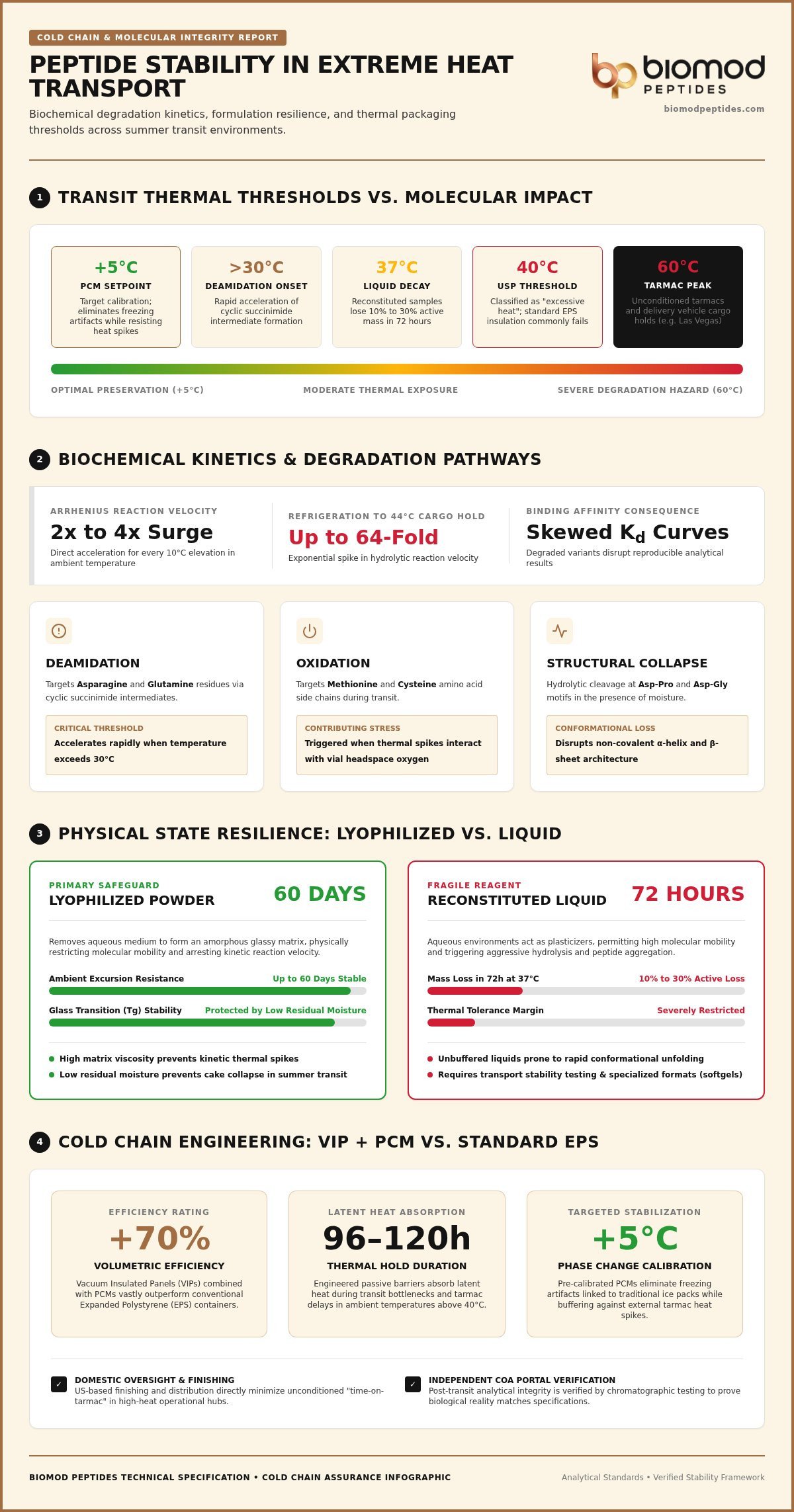
Thermal degradation is the irreversible loss of primary or secondary structure driven by kinetic energy. It isn’t a gradual decline; it’s a molecular breakdown. For researchers, peptide stability in extreme heat transport is the difference between reliable data and analytical noise. Temperature directly accelerates the Arrhenius equation for chemical reaction rates. Reaction velocities increase 2-fold to 4-fold for every 10°C rise. A shift from refrigerated storage to a 44°C cargo hold can increase hydrolytic velocities by up to 64-fold. Operating from Las Vegas, where tarmac temperatures reach 60°C, we prioritize rigorous cold chain logistics to arrest this kinetic decay.
Two primary pathways dominate heat-induced failure:
- Deamidation: Targets asparagine and glutamine residues through cyclic succinimide intermediates. This process accelerates rapidly above 30°C.
- Oxidation: Targets methionine and cysteine when thermal spikes interact with headspace oxygen.
These modifications create degraded variants that skew dose-response curves. Maintaining peptide stability in extreme heat transport ensures that binding affinity (Kd) is not compromised. Analytical results must remain reproducible to ensure research integrity.
Hydrolysis and Secondary Structure Collapse
High ambient temperatures facilitate the cleavage of peptide bonds via hydrolysis. This occurs most frequently at Asp-Pro and Asp-Gly motifs when moisture is present. Beyond the primary sequence, heat disrupts the non-covalent bonds sustaining alpha-helix and beta-sheet configurations. This leads to a total loss of the peptide’s spatial geometry. Thermal denaturation is the irreversible unfolding of a bio-reagent’s functional conformation due to thermal stress. These changes are often invisible to the naked eye, requiring advanced chromatography for detection.
Comparative Stability: Lyophilized Powder vs. Liquid Formulations
Maintaining peptide stability in extreme heat transport depends heavily on the physical state of the reagent. Aqueous environments facilitate high molecular mobility. Water acts as a plasticizer, increasing the rate of hydrolysis and aggregation. Lyophilization removes this medium. It creates an amorphous, glassy state that arrests degradation pathways. Molecular movement is physically restricted by the high viscosity of the solid matrix, protecting the sequence from kinetic energy spikes.
Specialized formats require distinct engineering. Explore analytical grade peptide softgels for research applications where precision is paramount. Unlike unbuffered liquids, these formulations are designed to meet transport stability testing standards. This ensures the primary structure remains intact despite ambient fluctuations. We also apply these rigorous benchmarks to our peptide spray products to guarantee consistency.
The Role of Lyophilization in Mitigating Thermal Kinetic Energy
US-based manufacturing ensures low residual moisture levels. This is crucial for peptide stability in extreme heat transport. High moisture lowers the glass transition temperature (Tg), risking cake collapse during summer transit. Lyophilized powders can withstand ambient excursions for up to 60 days with minimal purity loss. Reconstituted liquid samples are far more fragile. They can lose 10% to 30% of active mass within 72 hours at 37°C. Review The Protocol for Peptide Purity Verification to understand post-transport analysis. Researchers should always verify batch purity through a COA verification portal to ensure research integrity.
Cold Chain Engineering for Extreme Heat Environments
Standard Expanded Polystyrene (EPS) containers often fail when ambient temperatures exceed 40°C. In contrast, Vacuum Insulated Panels (VIPs) combined with targeted Phase Change Materials (PCMs) provide up to 70% better volumetric efficiency. These systems maintain a stable internal environment for 96 to 120 hours. Peptide stability in extreme heat transport relies on these engineered barriers to absorb latent heat during transit delays. PCMs calibrated to +5°C prevent the freezing risks associated with traditional ice packs while resisting external thermal spikes.
Location is a critical logistical variable. Learn more about Biomod Peptides and our commitment to research standards. Our US-based finishing and distribution minimize “time-on-tarmac” in high-heat zones. This geographic oversight reduces exposure to unconditioned airport tarmacs that regularly reach 60°C. Shorter transit times and domestic oversight provide a level of accountability that international shipping routes can’t match.
Protocol for High-Ambient Temperature Transit
Shipping reagents through Las Vegas summer peaks (110°F+) requires specialized protocols. We utilize real-time NIST-traceable data loggers to monitor every shipment. When excursions occur, third-party validation via HPLC or Mass Spectrometry confirms molecular integrity. You can find detailed requirements in our guide on Peptide Stability for Research: Cold Chain Protocols. These analytical benchmarks ensure that peptide stability in extreme heat transport isn’t assumed; it’s verified through empirical data. Rigorous shipping protocols protect your research from the variables of seasonal logistics.
Securing Analytical Integrity in Volatile Climates
Maintaining research integrity requires more than standard shipping; it demands a synergy between advanced biochemistry and disciplined logistics. Lyophilization provides the primary molecular defense, while vacuum-insulated packaging mitigates the kinetic risks of high-ambient transit. Ensuring peptide stability in extreme heat transport is a function of engineered precision rather than chance. We leverage US-manufactured integrity and Las Vegas-based logistics expertise to navigate these thermal challenges effectively. Every lot undergoes independent third-party testing to verify that purity remains within specification upon arrival. Don’t let seasonal logistics compromise your experimental outcomes. Access our COA verification portal to confirm the structural integrity of your reagents before beginning your next study. Procure Validated Research Peptides at Biomod Peptides today. Your commitment to rigorous science deserves a provider that prioritizes technical merit.
Frequently Asked Questions
Do research peptides degrade instantly in high heat?
Research peptides don’t degrade instantly; degradation is a kinetic function of time and temperature. While a brief excursion might only cause marginal purity loss, chemical reaction rates double or quadruple for every 10°C increase. In Las Vegas, unconditioned cargo environments can reach 60°C. These conditions accelerate deamidation and hydrolysis, potentially compromising a batch’s analytical integrity within a single afternoon of exposure.
How can I verify if my peptides survived a heat-stressed shipment?
You cannot determine structural integrity through visual inspection; you must rely on analytical verification. Every lot from Biomod Peptides undergoes independent third-party testing documented in our COA verification portal. If you suspect a thermal excursion occurred during transit, we recommend performing an independent HPLC assay. This confirms the peptide’s purity profile matches the original manufacturer specifications before you begin your experiments.
Is lyophilized powder stable at room temperature during transport?
Lyophilized powders are stable at room temperature for extended periods, making them ideal for standard logistics. These desiccated reagents can typically withstand 20°C to 25°C for 30 to 60 days without significant degradation. To ensure peptide stability in extreme heat transport, we utilize specialized packaging that keeps the vials below their glass transition temperature. This prevents the glassy state from collapsing during transit through high-heat zones.
What is the maximum temperature for peptide transport before structural loss occurs?
Structural loss typically accelerates once temperatures exceed the 40°C threshold established by USP standards. While lyophilized peptides are resilient, exposures reaching 50°C to 60°C can trigger micro-collapse of the peptide cake. Effective peptide stability in extreme heat transport requires phase-change materials that maintain internal temperatures between 2°C and 8°C. This proactive engineering prevents the thermal kinetic energy from reaching levels that drive irreversible molecular cleavage.
Disclaimer
BIOMOD products are sold strictly for laboratory, analytical, and scientific research use only. They are not intended for human or animal consumption, administration, application, ingestion, injection, or any therapeutic, diagnostic, or cosmetic use.
The statements made on this website have not been evaluated by the United States Food and Drug Administration. BIOMOD products are not intended to diagnose, treat, cure, mitigate, or prevent any disease or medical condition.
BIOMOD is a research chemical supplier. BIOMOD is not a compounding pharmacy or chemical compounding facility as defined under Section 503A of the Federal Food, Drug, and Cosmetic Act. BIOMOD is not an outsourcing facility as defined under Section 503B of the Federal Food, Drug, and Cosmetic Act.
By accessing this site, you confirm you are at least 21 years of age and that you have read and accepted the BIOMOD Terms of Sale, Privacy Policy, and Research Use Only Policy. BIOMOD does not provide dosing, medical, therapeutic, diagnostic, veterinary, or use guidance under any channel.