
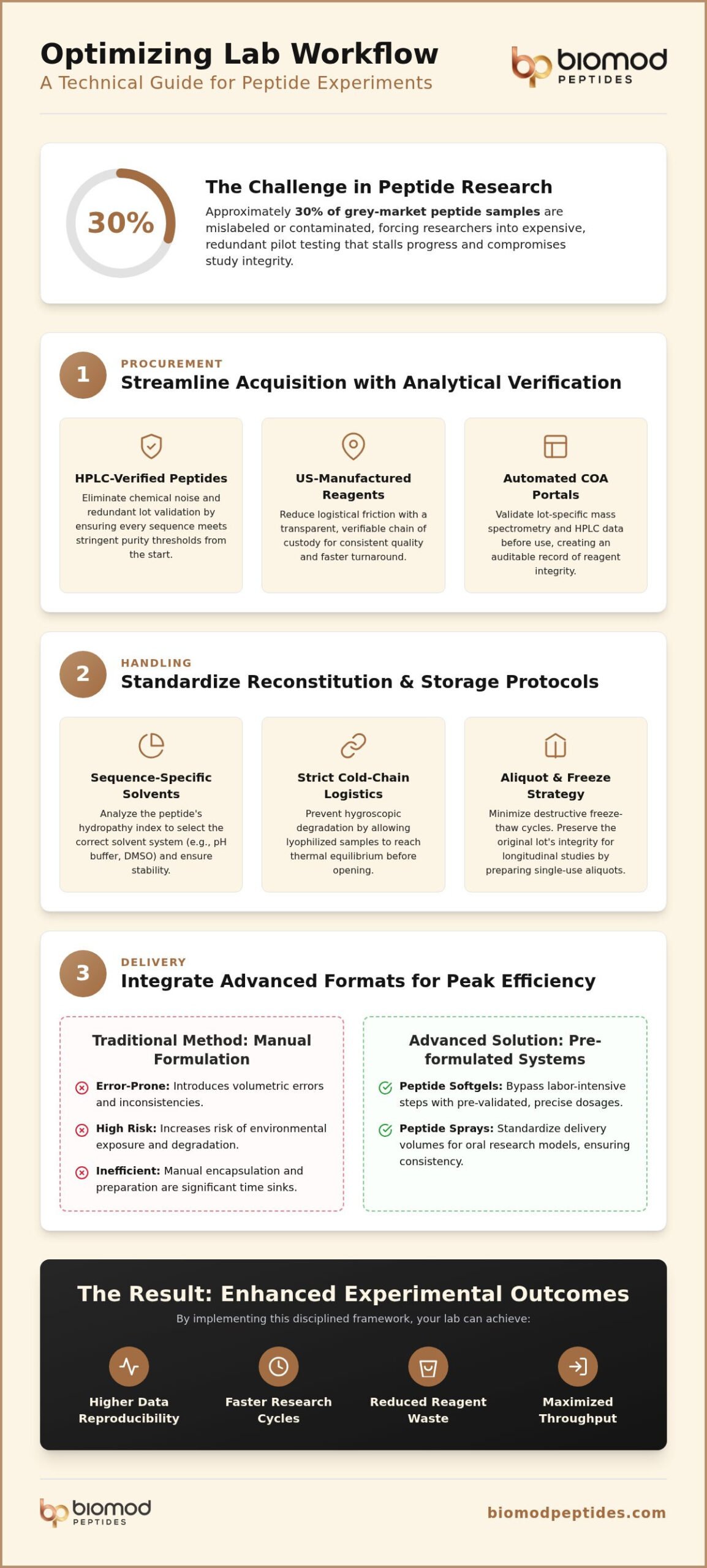
Recent independent analysis reveals that approximately 30% of grey-market peptide samples are mislabeled or contaminated. This lack of analytical transparency forces researchers into expensive, redundant pilot testing that stalls progress. You’ve likely experienced how variable purity and storage degradation can compromise an entire study’s integrity. Optimizing lab workflow for peptide experiments isn’t just about speed; it’s about establishing a foundation of verifiable data.
This 2026 technical guide provides a rigorous framework to increase experimental throughput and eliminate reagent waste. We’ll detail high-precision procurement standards, efficient reconstitution methods, and advanced storage protocols. Implementing these disciplined steps ensures your lab achieves faster cycles and higher data reproducibility. By refining your methodology, you can focus on discovery rather than troubleshooting unstable reagents.
Key Takeaways
- Eliminate experimental noise by utilizing HPLC-verified peptides and US-manufactured reagents to ensure total supply chain transparency.
- Discover technical protocols for optimizing lab workflow for peptide experiments, focusing on sequence-specific solvent matching and rigorous cold-chain management.
- Standardize bioanalytical delivery volumes and oral research models by integrating analytical-grade peptide sprays and specialized softgel formats.
- Maximize experimental throughput and reduce reagent waste by implementing disciplined storage protocols that preserve the structural integrity of lyophilized samples.
Streamlining Procurement Through Analytical Verification
Reliable data begins at the point of acquisition. Adopting a verify-first procurement model is essential for optimizing lab workflow for peptide experiments. High-purity reagents eliminate the chemical noise that often masks subtle experimental results. Researchers must prioritize HPLC tested peptides to ensure every sequence meets stringent 2026 purity thresholds. This proactive verification prevents the loss of high-value research time. Key benefits include:
- Reduction of baseline noise in bioanalytical assays.
- Elimination of redundant pilot testing for lot validation.
- Enhanced structural integrity of lyophilized samples.
Supply chain transparency remains a critical bottleneck for many facilities. Integrating US-manufactured reagents reduces logistical friction and provides a verifiable chain of custody. For Las Vegas laboratories, localizing the supply chain ensures faster turnaround times and consistent product quality. Understanding various Peptide Synthesis Methods allows lab managers to identify potential contaminants inherent in specific production routes. This technical oversight is the first step toward institutionalizing reproducibility across complex study designs. Researchers don’t have time to troubleshoot unstable reagents during active cycles.
Utilizing Automated Verification Portals
Modern intake procedures should include the Biomod COA verification portal. This tool allows researchers to validate lot-specific data before any bench work begins. Automating documentation by linking mass spectrometry results and HPLC chromatograms directly to digital experimental notebooks reduces manual entry errors. It creates a permanent, auditable record of reagent integrity. This level of precision is mandatory for optimizing lab workflow for peptide experiments in a competitive environment. It transforms procurement from a logistical task into a rigorous analytical step that safeguards the entire project lifecycle.
Standardizing Reconstitution and Handling Protocols
Precision in reconstitution is a prerequisite for optimizing lab workflow for peptide experiments. Simple dissolution often fails to account for the specific polarity requirements of complex amino acid sequences. Researchers should analyze the hydropathy index of the peptide before selecting a solvent system. Basic or acidic residues dictate the required pH of the buffer; meanwhile, hydrophobic sequences often necessitate organic cosolvents like DMSO or acetonitrile. Utilizing standardized protocols for peptide purity verification ensures that the peptide remains stable once it enters the liquid phase.
Maintaining structural integrity requires strict adherence to cold-chain logistics. Lyophilized research peptides are highly susceptible to hygroscopic degradation if exposed to ambient moisture before equilibration. Lab managers must enforce a disciplined environment where samples are only opened after reaching thermal equilibrium. This rigor is essential given the current FDA Peptide Regulations, which emphasize the necessity of maintaining high-grade analytical standards for research chemicals. For facilities aiming to uphold these standards, sourcing from a reliable US-based provider is the most efficient path to consistency.
Minimizing Degradation During High-Throughput Handling
Repeated freeze-thaw cycles are a primary cause of sequence fragmentation and aggregation. Implementing aliquot-and-freeze strategies preserves the original lot’s integrity for longitudinal studies. In high-volume oral delivery research, manual encapsulation is a significant time sink. Evaluating peptide softgels for research eliminates these labor-intensive steps. This transition standardizes dosage forms and reduces the risk of atmospheric exposure during handling. These refinements are essential for optimizing lab workflow for peptide experiments while maximizing data reproducibility.
Integrating Advanced Delivery Formats for Efficiency
Transitioning from raw lyophilized powder to pre-formulated delivery systems represents a significant leap in optimizing lab workflow for peptide experiments. Manual formulation often introduces volumetric errors and environmental exposure risks. By evaluating scientific grade peptide softgels, researchers can bypass the labor-intensive encapsulation process entirely. These pre-validated systems ensure precise dosage while reducing the time spent on reagent preparation. While traditional peptide handling and storage protocols remain foundational for raw materials, advanced formats provide a layer of procedural security that manual handling can’t match.
Bioanalytical studies requiring specific administration routes also benefit from standardized hardware. Utilizing intranasal peptide research sprays allows for consistent delivery volumes across multiple cohorts. Precise dosage. Reduced overhead. Verified integrity. This shift reduces the technical overhead associated with manual solution preparation and calibration. It allows laboratory personnel to focus on data acquisition rather than the mechanical nuances of reagent delivery. Pre-validated systems ultimately lower labor costs by streamlining the transition from storage to application.
Enhancing Reproducibility with Formulated Reagents
Precision is the primary driver for adopting formulated reagents. Traditional pipetting in intranasal models often introduces micro-volume variances that skew results. Volumetric spray systems eliminate this inconsistency through mechanical standardization. Additionally, sealed softgel formats significantly reduce cross-contamination risks. Handling open-vial powders increases the likelihood of atmospheric degradation and aerosolization. In contrast, sealed delivery systems maintain sequence integrity from the US-based manufacturing facility to the final experimental application. This transition is a core component of optimizing lab workflow for peptide experiments in high-throughput environments.
Advancing Laboratory Methodology Through Analytical Rigor
Laboratory efficiency in 2026 is defined by the elimination of procedural variability. Transitioning from reactive troubleshooting to a verify-first procurement model ensures that every sequence meets the highest purity thresholds. By standardizing reconstitution protocols and integrating advanced delivery systems like softgels and sprays, researchers significantly reduce the risk of atmospheric degradation and volumetric error. These refined methodologies are the cornerstone of optimizing lab workflow for peptide experiments, allowing for higher throughput without compromising data integrity. It’s a shift that prioritizes structural verification over traditional manual handling.
Biomod Peptides supports this transition with US-based manufacturing and independent third-party testing verification included with every order. This logistical transparency ensures rapid supply to Las Vegas facilities and beyond. Explore Analytical Grade Peptides and Specialized Delivery Systems at Biomod Peptides to secure the structural integrity of your research reagents. Precise workflows yield reproducible discovery.
Frequently Asked Questions
How does peptide purity impact laboratory workflow efficiency?
Purity directly determines the reliability of bioanalytical data. Utilizing HPLC-verified peptides minimizes experimental noise and prevents the need for redundant pilot studies. When purity thresholds fall below 2026 standards, researchers face inconsistent results and reagent waste. High-purity reagents are essential for optimizing lab workflow for peptide experiments, as they ensure that observed effects are attributable to the peptide sequence rather than contaminants.
What are the best solvents for optimizing peptide solubility in research?
Optimal solvents are selected based on the specific amino acid sequence and its hydropathy index. Sterile water or phosphate-buffered saline works for hydrophilic sequences; meanwhile, hydrophobic peptides often require organic cosolvents like DMSO or acetonitrile. Matching solvent polarity to the peptide’s chemical properties prevents aggregation. This precision is a critical step in optimizing lab workflow for peptide experiments by ensuring complete solubility before administration.
Why should Las Vegas labs prioritize US-manufactured research peptides?
Local Las Vegas facilities benefit from reduced logistical friction and verifiable supply chain transparency. US-based manufacturing ensures that reagents are finished under rigorous laboratory standards and undergo independent third-party testing for every lot. Proximity to domestic manufacturing centers allows for rapid supply and minimizes the risk of structural degradation during extended international transit. This localized approach supports the technical integrity of high-throughput research environments.
Can pre-formulated peptide softgels improve experimental reproducibility?
Pre-formulated peptide softgels eliminate the mechanical variances associated with manual encapsulation and powder handling. These sealed delivery systems prevent atmospheric exposure and hygroscopic degradation, which often compromise unformulated reagents. By standardizing the dosage form, researchers improve experimental reproducibility and reduce labor costs. This transition allows laboratory personnel to focus on analytical outcomes rather than the technical nuances of manual reagent preparation.
Disclaimer
BIOMOD products are sold strictly for laboratory, analytical, and scientific research use only. They are not intended for human or animal consumption, administration, application, ingestion, injection, or any therapeutic, diagnostic, or cosmetic use.
The statements made on this website have not been evaluated by the United States Food and Drug Administration. BIOMOD products are not intended to diagnose, treat, cure, mitigate, or prevent any disease or medical condition.
BIOMOD is a research chemical supplier. BIOMOD is not a compounding pharmacy or chemical compounding facility as defined under Section 503A of the Federal Food, Drug, and Cosmetic Act. BIOMOD is not an outsourcing facility as defined under Section 503B of the Federal Food, Drug, and Cosmetic Act.
By accessing this site, you confirm you are at least 21 years of age and that you have read and accepted the BIOMOD Terms of Sale, Privacy Policy, and Research Use Only Policy. BIOMOD does not provide dosing, medical, therapeutic, diagnostic, veterinary, or use guidance under any channel.