
Data integrity isn’t an administrative hurdle. It’s an analytical property of the reagent that researchers must verify at every stage of the lifecycle. You’ve likely faced the frustration of inconsistent results across different peptide batches or the challenge of verifying third-party purity claims. Relying on outdated documentation standards in 2026 is no longer a viable strategy for high-stakes laboratory work. Implementing a comprehensive peptide research data integrity checklist ensures that your findings remain beyond reproach during peer review.
This guide establishes a rigorous framework for data integrity through analytical verification and standardized handling. You’ll learn to move beyond basic certificates of analysis by implementing repeatable protocols for reagent verification and verifiable audit trails. We’ll examine the specific standards required for 2026, including HPLC purity thresholds and US-based manufacturing transparency. By the end of this article, you’ll have the tools to build bulletproof documentation and minimize experimental variance in your laboratory.
Key Takeaways
- Establish rigorous analytical baselines by verifying that HPLC purity exceeds 98% and cross-referencing mass spectrometry data for sequence accuracy.
- Implement a standardized peptide research data integrity checklist to ensure every reagent batch meets modern analytical benchmarks before experimentation begins.
- Protect sample stability through strict cold chain protocols and standardized reconstitution methods to eliminate experimental variance caused by thermal degradation.
- Secure a verifiable audit trail for peer review by utilizing digital chain-of-custody tracking and independent third-party verification portals to link batch numbers to lab results.
Pre-Analytical Verification: Securing Reagent Integrity
Data integrity begins at the molecular level. A robust application of data integrity principles requires more than checking a box on a shipping manifest. It demands a rigorous verification of the reagent’s chemical identity. Every peptide research data integrity checklist must prioritize the analytical verification of the starting material to prevent downstream experimental failure. Relying on supplier claims without independent validation is a primary source of data degradation.
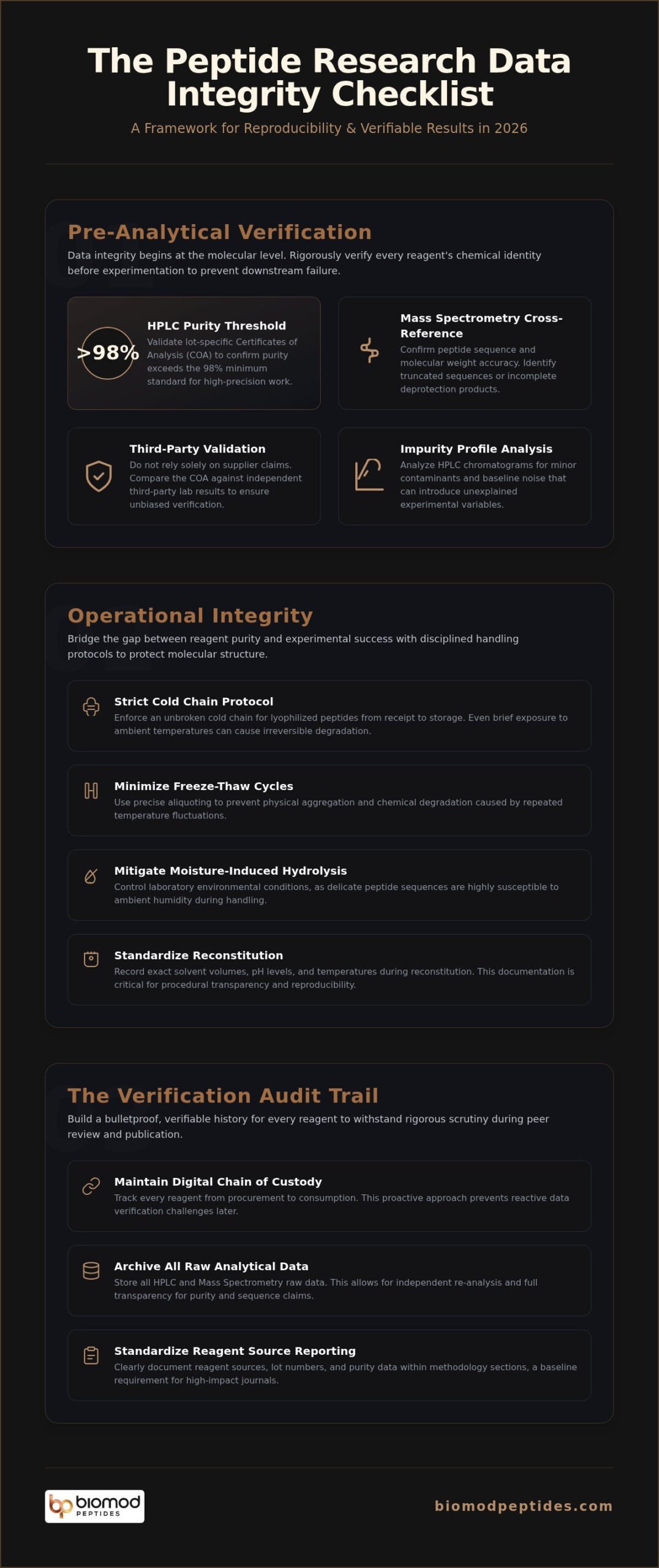
In 2026, high-precision analytical work requires HPLC purity exceeding 98%. Researchers must validate lot-specific Certificates of Analysis (COA) against independent third-party results. Cross-referencing Mass Spectrometry data confirms the peptide sequence and molecular weight accuracy. This dual-layer verification identifies impurity profiles that could cause cross-reactivity in experimental assays. High-purity reagents are the baseline. Verification is the safeguard.
Decoding Analytical Reports for Data Consistency
Precision requires a deep dive into HPLC chromatograms. It’s vital to analyze peak integration to identify minor contaminants that often hide in the baseline. These impurities can skew results and introduce unexplained variables. Use MS data to verify the absence of truncated sequences or incomplete deprotection products. These artifacts are common in complex synthesis but lethal to data consistency. Documenting batch-to-batch variance is essential for longitudinal study reproducibility. Utilizing high purity research peptides ensures that the starting material meets these exacting standards. This methodical approach transforms a simple procurement step into a pillar of scientific accountability.
Operational Integrity: Stability and Reconstitution Protocols
Operational integrity is the bridge between reagent purity and experimental success. A comprehensive peptide research data integrity checklist must account for the physical vulnerabilities of the compound after it arrives in the lab. Handling errors are often the root cause of inconsistent results that researchers misattribute to reagent quality. Protecting the molecular structure requires a disciplined approach to storage and preparation. It’s essential to prevent thermal degradation from the moment of receipt.
Implementing a strict cold chain protocol for lyophilized peptides is non-negotiable. Even brief exposure to ambient temperatures can trigger irreversible changes in secondary structure. Precise aliquoting minimizes freeze-thaw cycles; this prevents the physical aggregation and chemical degradation associated with repeated temperature fluctuations. Laboratory environmental controls must also mitigate moisture-induced hydrolysis, as delicate sequences are highly susceptible to ambient humidity during weighing and transfer.
Standardizing the Reconstitution Audit Trail
Standardized reconstitution methods are vital for maintaining peptide structural integrity. Researchers must record exact solvent volumes, pH levels, and temperatures during the process for the final lab report. Utilizing established peptide solubility protocols helps minimize aggregation-related data noise. This level of documentation aligns with FDA guidance on data integrity regarding procedural transparency. Peptide stability is the primary determinant of data reproducibility in long-term analytical studies. For researchers requiring high-stability materials, sourcing from a reliable provider ensures that the peptide research data integrity checklist starts with a resilient reagent.
The Verification Audit Trail: Documentation for Peer Review
Peer review in 2026 demands more than just a summary of results. It requires a proactive, verifiable history of every reagent used. Establishing a bulletproof peptide research data integrity checklist means maintaining a digital chain of custody from procurement through to experimental consumption. This proactive approach prevents the common pitfall of reactive data verification. It’s essential to build this trail from day one to withstand rigorous scrutiny during publication.
Documentation must be exhaustive. Researchers should archive all HPLC and mass spectrometry raw data as supplementary material. This level of transparency allows for independent verification of purity claims and sequence accuracy. Standardizing the reporting of reagent sources within methodology sections is now a baseline requirement for high-impact journals. You can utilize an analytical verification portal to link internal batch numbers directly to independent third-party lab results. This creates a direct, immutable link between the reagent’s physical properties and the resulting data set.
Leveraging US-Based Manufacturing for Supply Chain Transparency
Supply chain integrity is the foundation of analytical confidence. Prioritizing US-manufactured peptides ensures transparency in both manufacturing standards and finishing processes. Integrating COA verification into your lab’s digital inventory management system allows for real-time data integrity checks. This prevents the use of degraded or mislabeled reagents before they compromise a study. Establish a strict protocol for verifying third-party tested peptides before beginning any in-vitro or in-vivo research. This systematic approach ensures that your peptide research data integrity checklist remains a functional tool for scientific advancement rather than a mere administrative burden.
Advancing Analytical Rigor in 2026
Scientific progress relies on the unwavering stability of raw data. Implementing a peptide research data integrity checklist transforms quality control from a reactive hurdle into a proactive standard of excellence. You’ve seen how rigorous pre-analytical verification and standardized reconstitution protocols eliminate the variables that compromise longitudinal studies. Secure documentation and US-based manufacturing transparency provide the necessary evidence for high-impact peer review. Accountability isn’t optional; it’s the foundation of credible research.
Maintaining these benchmarks requires a partner committed to analytical precision. Biomod Peptides provides US-manufactured reagents that undergo independent third-party HPLC and mass spectrometry verification to ensure absolute sequence accuracy. You can access the Biomod COA Verification Portal for your research to link every batch number directly to its analytical proof. Standardizing your methodology today ensures your findings stand up to the scrutiny of tomorrow.
Frequently Asked Questions
How does peptide purity affect the integrity of research data?
Peptide purity is the primary determinant of experimental accuracy; impurities like truncated sequences or residual solvents can cause off-target effects. When purity falls below the 98% threshold, the risk of cross-reactivity in assays increases, leading to false positives or unreplicable data. For labs in Las Vegas, maintaining a peptide research data integrity checklist ensures that starting materials don’t introduce hidden variables that compromise longitudinal study outcomes.
What are the essential components of a peptide Certificate of Analysis (COA) for data integrity?
A comprehensive COA must include HPLC chromatograms for purity verification and Mass Spectrometry results for sequence identity. It should detail the batch number, manufacturing date, and net peptide content. These components allow Las Vegas researchers to cross-reference reagents against their internal peptide research data integrity checklist, ensuring every lot meets the rigorous standards required for 2026 analytical research. This documentation is vital for verifying chemical identity.
Why is third-party testing more reliable than manufacturer-provided data?
Independent third-party testing eliminates the inherent conflict of interest found in internal manufacturer reports. External laboratories provide an objective validation of chemical identity and purity levels, serving as a secondary checkpoint for quality control. Biomod Peptides utilizes this rigorous approach for its operations in Las Vegas, ensuring that every US-manufactured batch is verified by an unbiased entity before it reaches the laboratory for experimental use.
How should researchers document peptide handling for peer-reviewed journals?
Researchers should provide a detailed account of storage conditions, reconstitution solvents, and aliquoting protocols within their methodology sections. Documentation must include the specific batch number and the verification method used to confirm purity. For teams operating in Las Vegas, linking results to an independent verification portal provides a transparent audit trail. This level of detail demonstrates procedural discipline and allows peer reviewers to assess reagent stability.
Disclaimer
BIOMOD products are sold strictly for laboratory, analytical, and scientific research use only. They are not intended for human or animal consumption, administration, application, ingestion, injection, or any therapeutic, diagnostic, or cosmetic use.
The statements made on this website have not been evaluated by the United States Food and Drug Administration. BIOMOD products are not intended to diagnose, treat, cure, mitigate, or prevent any disease or medical condition.
BIOMOD is a research chemical supplier. BIOMOD is not a compounding pharmacy or chemical compounding facility as defined under Section 503A of the Federal Food, Drug, and Cosmetic Act. BIOMOD is not an outsourcing facility as defined under Section 503B of the Federal Food, Drug, and Cosmetic Act.
By accessing this site, you confirm you are at least 21 years of age and that you have read and accepted the BIOMOD Terms of Sale, Privacy Policy, and Research Use Only Policy. BIOMOD does not provide dosing, medical, therapeutic, diagnostic, veterinary, or use guidance under any channel.