
A Certificate of Analysis is not a guarantee of quality. It’s a document that requires its own rigorous audit. For many researchers, the procurement process is plagued by batch-to-batch inconsistency and fraudulent documentation. Degradation during transit remains a constant threat to experimental integrity. Utilizing a comprehensive onboarding a new peptide supplier checklist is the only way to ensure your reagents meet the 98% purity threshold required for precise results.
You need a reproducible vetting process that prioritizes data over marketing claims. This article establishes a framework to verify laboratory purity, manufacturing integrity, and analytical transparency. We’ll examine the technical benchmarks for High-Performance Liquid Chromatography and mass spectrometry. We’ll also cover logistical reliability for Las Vegas laboratory schedules. This ensures your research stays on track with verified, high-purity reagents and authenticated chain-of-custody documentation.
Key Takeaways
- Establish analytical benchmarks by requiring batch-specific HPLC and Mass Spectrometry (MS) to confirm 98% minimum purity and molecular identity.
- Evaluate manufacturing integrity by prioritizing US-based facilities that utilize specialized lyophilization for long-term reagent stability.
- Utilize a rigorous onboarding a new peptide supplier checklist to verify third-party COA authenticity and eliminate the risk of fraudulent documentation.
- Account for logistical variables by assessing transit-specific thermal protection and packaging protocols for both lyophilized and liquid research formats.
Analytical Verification: Auditing Peptide Purity and Identity
Quality control in peptide research begins with empirical data. Reliance on vendor reputation is insufficient. Every procurement workflow must include a rigorous onboarding a new peptide supplier checklist to isolate high-purity reagents from contaminated or substandard batches. Precision is the baseline requirement.
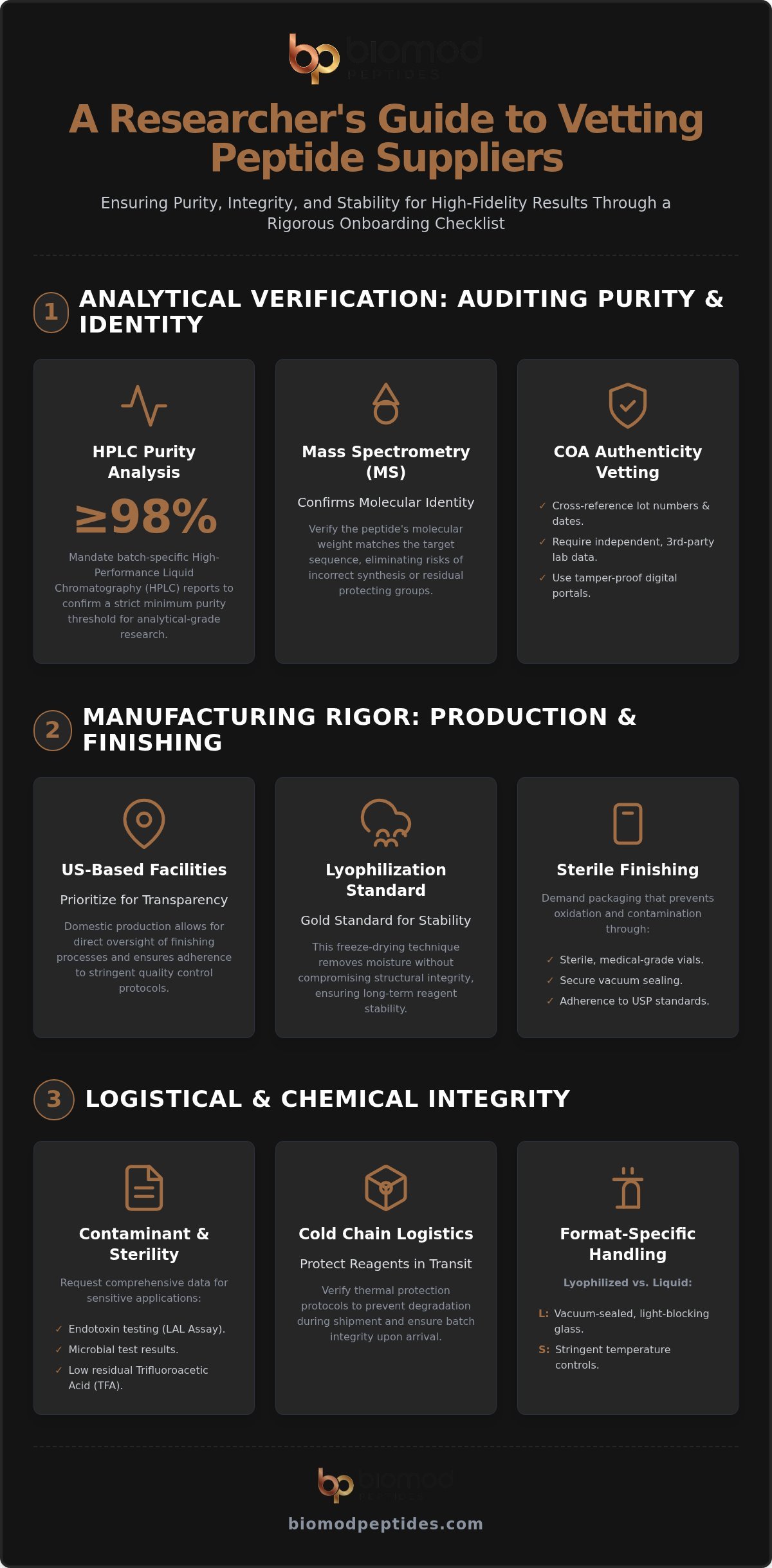
Mandate batch-specific High-Performance Liquid Chromatography (HPLC) reports for every order. This analysis determines the purity level by separating chemical components. For analytical-grade research, establish a strict minimum purity threshold of 98% to 99%. Alongside HPLC, verify peptide identity through Mass Spectrometry (MS). MS confirms the molecular weight matches the target sequence. This ensures that the peptide synthesis methods employed were precise and successful. Discrepancies in molecular weight indicate incorrect sequences or residual protecting groups.
Certificate of Analysis (COA) Authenticity Protocols
A Certificate of Analysis is only valuable if it is authentic. Cross-reference the COA date with the current manufacturing lot number. This prevents the use of recycled data from older, unrelated batches. Check for independent, third-party laboratory signatures. Internal-only testing creates a conflict of interest that compromises research integrity. Verification remains the final safeguard.
Utilize verified peptide certificates of analysis via digital portals to prevent document tampering. These portals provide a direct link to raw laboratory data. It ensures the results haven’t been edited or obscured. This level of transparency is a non-negotiable component of a modern onboarding a new peptide supplier checklist. Objective proof must precede any laboratory application.
Manufacturing Rigor: Evaluating Production and Finishing Standards
Domestic manufacturing is a critical risk-mitigation strategy. It ensures adherence to stringent quality control protocols. When utilizing an onboarding a new peptide supplier checklist, prioritize US-manufactured research peptides. Domestic production facilitates transparency. It allows for direct oversight of finishing processes. Lyophilization is the gold standard for long-term stability. This freeze-drying technique removes moisture without compromising structural integrity. It’s essential that the supplier uses sterile, medical-grade vials and vacuum sealing. These measures prevent oxidation and environmental contamination during storage.
Verification extends beyond the synthesis phase. Suppliers must align with established USP peptide standards to ensure consistency. These benchmarks define the acceptable limits for impurities and degradation products. Adhering to these rigorous protocols distinguishes a reliable laboratory resource from a retail-grade vendor. For researchers requiring high-fidelity reagents, Biomod Peptides provides US-finished products that meet these institutional requirements.
Sterility and Impurity Profile Assessment
Sensitive in vitro applications require comprehensive sterility data. Request endotoxin and microbial testing results for every batch. The Limulus Amebocyte Lysate (LAL) assay is the industry standard for detecting bacterial endotoxins. Additionally, evaluate the protocol for managing Trifluoroacetic acid (TFA) levels. High residual TFA can alter pH and impact biological assays. Detailed benchmarks for these variables are found in our laboratory peptide supply standards guide. A robust onboarding a new peptide supplier checklist must account for these chemical nuances. Precision in manufacturing is as vital as purity in synthesis.
Logistical Stability and Institutional Accountability
Precision in the lab is negated by failures in logistics. An effective onboarding a new peptide supplier checklist must account for geographic and environmental variables. For Las Vegas laboratories, transit times are critical. Excessive heat exposure accelerates thermal degradation, even in stable molecules. Suppliers must provide data on thermal protection protocols for domestic shipments to ensure batch integrity upon arrival. Verification of the cold chain is a prerequisite for high-stakes analytical work.
Packaging protocols differ between lyophilized and liquid research formats. Lyophilized powders offer greater stability but require vacuum sealing and light-blocking glass. Liquid formats demand more stringent temperature controls to prevent peptide cleavage. Institutional accountability relies on clear terms of sale. These must strictly enforce research-only use to align with institutional compliance. Rigorous Vendor Qualification Under FDA Regulations ensures the supplier operates within a framework of professional accountability rather than retail convenience.
Advanced Delivery Format Vetting
Advanced research often requires specialized delivery systems. Audit the quality standards for peptide softgels for research to ensure shell integrity and unit uniformity. Similarly, verify the stability and concentration of peptide spray for laboratory use. These formats require unique analytical verification to ensure the peptide remains active within the delivery matrix. Consult Biomod’s about page for insights into professional-grade manufacturing and finishing processes that support these advanced formats. Meticulous logistical planning completes the onboarding a new peptide supplier checklist.
Advancing Laboratory Integrity Through Analytical Rigor
Successful research depends on the verification of reagent purity and identity. Implementing a systematic onboarding a new peptide supplier checklist ensures every batch meets the 98% purity threshold through HPLC and MS validation. Manufacturing standards, specifically US-based synthesis and specialized lyophilization, provide the structural stability required for reproducible results. Institutional accountability is further reinforced by auditing logistical protocols to prevent thermal degradation during transit to Las Vegas facilities.
Biomod Peptides maintains these benchmarks through independent third-party testing and a dedicated COA verification portal. Every product is manufactured and finished in the United States to meet demanding analytical standards. Secure High-Purity Reagents for Your Laboratory at Biomod Peptides. It’s essential that precise data begins with uncompromising sourcing.
Frequently Asked Questions
How do I verify a peptide supplier’s HPLC report for accuracy?
To verify an HPLC report, analyze the peak integration and baseline noise for consistency. Confirm the lot number on the report matches the physical product received. Researchers should utilize a COA verification portal to cross-reference data directly with the testing facility. This verification step is a cornerstone of a robust onboarding a new peptide supplier checklist, ensuring that reported purity reflects the actual chemical composition.
Why is US manufacturing critical for research peptide stability?
US manufacturing minimizes the risk of thermal degradation by reducing transit times and international customs delays. Local production in hubs like Las Vegas allows for tighter oversight of the lyophilization and finishing processes. This proximity ensures that reagents aren’t exposed to extreme environmental variables. Domestic facilities prioritize structural stability, providing researchers with reagents that maintain their integrity throughout the experimental lifecycle.
What is the difference between analytical grade and standard research peptides?
Analytical grade peptides must meet a minimum purity threshold of 98% or higher, whereas standard research peptides often fall below this mark. Analytical grade also requires identity confirmation through Mass Spectrometry (MS) to verify molecular weight. For Las Vegas laboratories, using analytical grade reagents reduces the risk of assay interference from synthesis impurities. This higher standard is necessary for experiments requiring absolute precision and reproducibility.
How should a laboratory handle the onboarding of bulk peptide lots?
Laboratories should utilize a tiered validation strategy when managing bulk lots. Start by including a onboarding a new peptide supplier checklist that mandates random sampling for independent third-party re-verification. Confirm that vacuum sealing and sterile vial protocols were maintained across the entire shipment. Documenting initial assay performance for each new lot helps identify batch-to-batch inconsistency before it impacts long-term research data or institutional budgets.
Disclaimer
BIOMOD products are sold strictly for laboratory, analytical, and scientific research use only. They are not intended for human or animal consumption, administration, application, ingestion, injection, or any therapeutic, diagnostic, or cosmetic use.
The statements made on this website have not been evaluated by the United States Food and Drug Administration. BIOMOD products are not intended to diagnose, treat, cure, mitigate, or prevent any disease or medical condition.
BIOMOD is a research chemical supplier. BIOMOD is not a compounding pharmacy or chemical compounding facility as defined under Section 503A of the Federal Food, Drug, and Cosmetic Act. BIOMOD is not an outsourcing facility as defined under Section 503B of the Federal Food, Drug, and Cosmetic Act.
By accessing this site, you confirm you are at least 21 years of age and that you have read and accepted the BIOMOD Terms of Sale, Privacy Policy, and Research Use Only Policy. BIOMOD does not provide dosing, medical, therapeutic, diagnostic, veterinary, or use guidance under any channel.