
A five-star review is the weakest form of evidence in a high-stakes research environment. While anecdotal testimonials might suffice for consumer goods, they offer zero protection against the data irreproducibility caused by impure reagents. You’re likely aware that the peptide market is currently saturated with lifestyle-oriented marketing that obscures technical reality. This makes finding authentic social proof for choosing a peptide vendor a matter of analytical verification rather than popularity.
This article provides a rigorous framework for evaluating vendor transparency through objective data. You’ll learn how to distinguish between superficial marketing claims and the verifiable, batch-specific HPLC/MS reports that ensure institutional compliance. We’ll examine the transition toward stricter standards following the 2026 FDA reclassifications and explain why a dedicated COA verification portal is the only metric that matters. By the end, you’ll have the tools to secure laboratory-grade reagents that meet strict RUO requirements.
Key Takeaways
- Identify why verifiable batch-specific data, rather than anecdotal consumer reviews, constitutes the only legitimate social proof for choosing a peptide vendor in a high-precision research environment.
- Distinguish between internal marketing claims and independent third-party HPLC/MS reports to ensure the chemical integrity of laboratory reagents.
- Utilize a COA Verification Portal as a mandatory step for confirming the authenticity of analytical documentation and maintaining data reproducibility.
- Establish a procurement framework that prioritizes US-based finishing and strict RUO compliance over lifestyle-oriented marketing and non-scientific vendor promises.
Defining Analytical Social Proof in the Peptide Industry
Analytical social proof is the verifiable chain of batch-specific data that confirms a reagent’s identity and purity. While social proof typically relies on the volume of public approval, research procurement requires a more rigorous standard. Authentic social proof for choosing a peptide vendor involves auditing technical documentation rather than counting star ratings. High-purity reagents aren’t validated by popular opinion; they’re validated by HPLC and Mass Spectrometry (MS) results.
Standard consumer review platforms are insufficient for scientific procurement. Sites like Trustpilot or Google Reviews cannot verify the chemical integrity of a product. These platforms are also susceptible to manipulation. Lifestyle marketing is a significant red flag. Vendors using fitness-style testimonials or athletic imagery often bypass the clinical rigor required for laboratory work. This marketing style signals a retail orientation that often conflicts with Research Use Only (RUO) compliance standards.
The Failure of Anecdotal Evidence in Laboratory Procurement
Online communities are frequently compromised by astroturfing. This involves vendors generating fabricated feedback to simulate a positive reputation. This soft proof is based on subjective experience and carries no weight in a professional lab setting. In contrast, hard proof consists of independent analytical data that remains constant regardless of user perception. Peer-reviewed analytical data is the only social proof that ensures data reproducibility and maintains the integrity of your research outcomes.
Establishing RUO compliance is the baseline for vendor credibility. It ensures the provider understands the legal and technical boundaries of research reagents. Biomod Peptides maintains strict operational standards to ensure that every batch meets these laboratory requirements without the interference of lifestyle marketing hype.
Verifiable Technical Markers as Objective Social Proof
Internal lab reports represent a fundamental conflict of interest. Objective social proof for choosing a peptide vendor requires independent third-party validation to eliminate bias. External laboratories provide an unbiased audit of purity and chemical identity, ensuring that the results remain credible. When Evaluating a Supplier, researchers must prioritize vendors that utilize external HPLC and Mass Spectrometry testing. These reports serve as a technical baseline for all research-only procurement.
Geographic accountability further reinforces this trust framework. US-based manufacturing and finishing, supported by Las Vegas laboratory oversight, provide a layer of logistical transparency. This physical presence ensures that the vendor is subject to domestic standards and accountability. It’s a necessary counterweight to the anonymity of international suppliers.
Trust is also a product of longitudinal data. A single high-purity report is an isolated data point; true reliability is found in batch-to-batch consistency. Access to an archive of historical testing data demonstrates a commitment to technical precision over time. This transparency is more valuable than any individual testimonial or marketing claim.
The COA Verification Portal: A Modern Trust Framework
The 2026 standard for ensuring report authenticity is the COA Verification Portal. This system enables researchers to match a physical vial lot number directly to a secure, digital certificate. It effectively eliminates the risk of forged or recycled data. Utilizing verified peptide certificates of analysis is essential for maintaining institutional compliance. Biomod Peptides provides this portal to ensure that every batch of research peptides is accompanied by verifiable analytical proof.
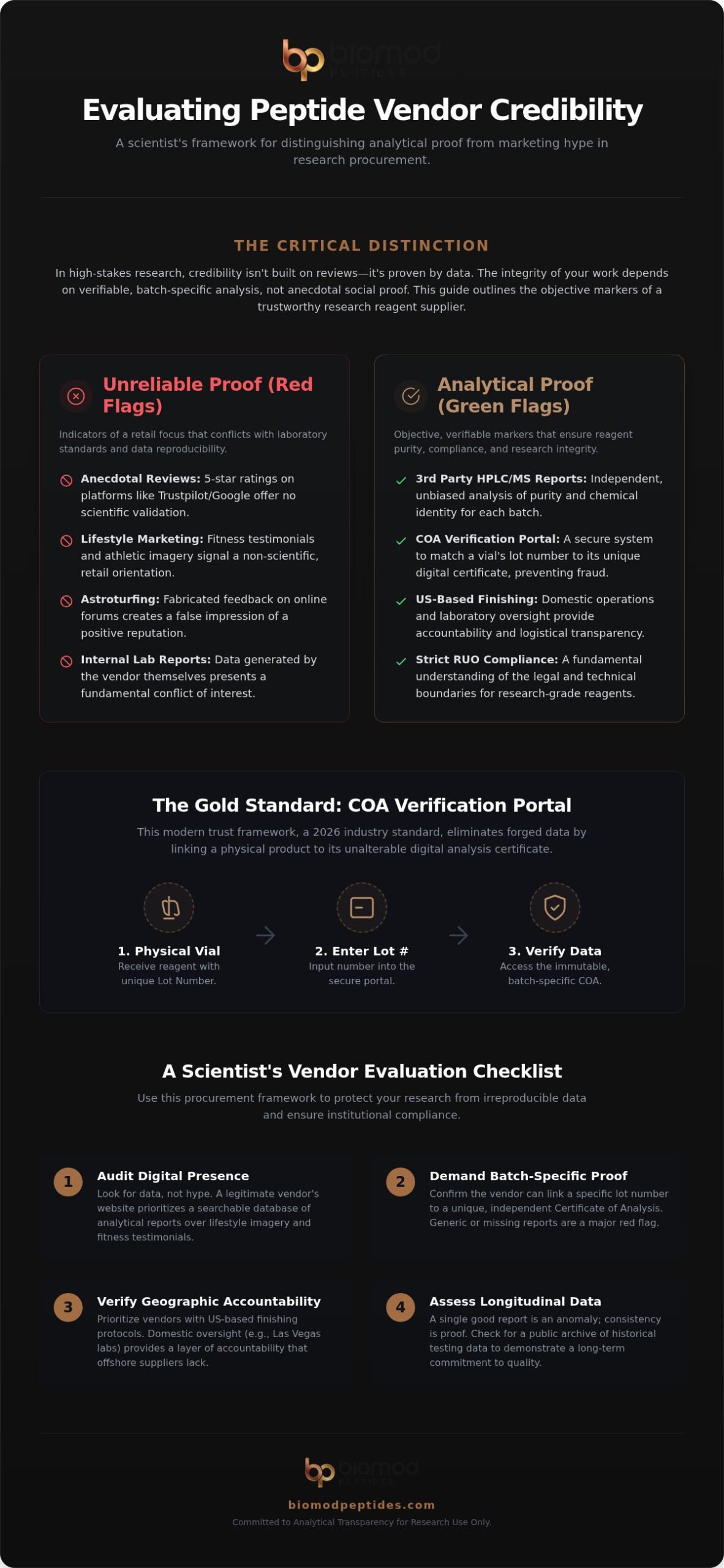
Evaluating Vendor Credibility: A Scientist’s Checklist
Audit the vendor’s digital interface first. Legitimate social proof for choosing a peptide vendor is never found in lifestyle imagery or fitness-oriented testimonials. These signals indicate a retail focus that often ignores laboratory standards. This mismatch increases the risk of institutional non-compliance. Verify the existence of an active, searchable database for batch-specific analytical reports. If a vendor cannot link a specific lot number to a unique certificate, the data lacks credibility and shouldn’t be used in reproducible research.
Physical infrastructure dictates accountability. Confirm the vendor’s finishing protocols are US-based to ensure domestic oversight. Las Vegas laboratory oversight provides a localized trust signal that international suppliers can’t match. Assess the depth of their research peptide quality assurance by auditing their technical support response times and accuracy. Professional suppliers provide detailed HPLC/MS methodology rather than generic marketing responses.
Identifying RUO Compliance and Operational Integrity
Operational integrity extends to logistical execution. Cold chain storage and shipping protocols are silent trust markers; reagents requiring thermal stability must be handled through validated logistics. Failure to maintain these standards compromises chemical purity. Strict “Research Only” terms of sale are non-negotiable. This standard prevents the regulatory complications highlighted in recent FDA warning letters to peptide vendors. Request “Analytical Grade” documentation for every bulk lot order to confirm that the reagents meet your specific purity benchmarks before procurement.
Transitioning to Analytical Procurement Standards
Precision in research requires a shift from anecdotal trust to analytical verification. Subjective feedback isn’t enough for professional laboratories. True social proof for choosing a peptide vendor is found in supply chain transparency. Access to raw data is mandatory. Every batch must undergo independent third-party testing to ensure structural integrity and chemical identity. US-based manufacturing and finishing provide the necessary accountability to maintain institutional standards. Prioritizing technical markers over lifestyle marketing secures the reproducibility of your data. Strict research-only terms of sale must be maintained to ensure institutional compliance. The 2026 standard for procurement relies entirely on verifiable, batch-specific documentation.
Access the Biomod Verification Portal for your next laboratory procurement to confirm your reagents meet the highest analytical benchmarks. Secure your research with batch-specific documentation and maintain full confidence in your laboratory results.
Frequently Asked Questions
Is a 99% purity claim on a website sufficient social proof?
A static purity claim on a website is marketing copy rather than social proof. Authentic social proof for choosing a peptide vendor requires batch-specific, independent third-party HPLC reports. Without a verifiable link to a current lot number, a 99% claim lacks the clinical rigor necessary for Las Vegas laboratories. Researchers should prioritize raw analytical data over generic percentages to ensure data reproducibility.
How can I tell if a peptide Certificate of Analysis (COA) is forged?
Forged COAs often lack specific lot numbers or display mismatched dates between the testing laboratory and the vendor. Researchers should verify the report through a dedicated COA verification portal to match the physical vial to a secure digital record. Authentic reports from independent labs feature unique identifiers. These can be cross-referenced directly with the testing facility to prevent data recycling or forgery.
Why do researchers prefer US-manufactured peptides over international alternatives?
US-based manufacturing and finishing offer superior logistical transparency and legal accountability. Las Vegas researchers prioritize domestic suppliers to ensure adherence to strict RUO compliance and avoid the regulatory risks associated with international imports. US finishing also ensures better control over cold chain logistics. This is a critical silent trust marker for maintaining chemical stability and purity during regional transit.
What is the difference between a review and an analytical verification portal?
A review is anecdotal evidence based on subjective experience, which is easily manipulated through astroturfing. An analytical verification portal is a technical framework providing objective, batch-specific data. While reviews focus on customer service, a portal ensures chemical integrity by allowing researchers to audit HPLC and Mass Spectrometry results directly. This distinction is vital for maintaining high-purity standards in experimental applications.
Disclaimer
BIOMOD products are sold strictly for laboratory, analytical, and scientific research use only. They are not intended for human or animal consumption, administration, application, ingestion, injection, or any therapeutic, diagnostic, or cosmetic use.
The statements made on this website have not been evaluated by the United States Food and Drug Administration. BIOMOD products are not intended to diagnose, treat, cure, mitigate, or prevent any disease or medical condition.
BIOMOD is a research chemical supplier. BIOMOD is not a compounding pharmacy or chemical compounding facility as defined under Section 503A of the Federal Food, Drug, and Cosmetic Act. BIOMOD is not an outsourcing facility as defined under Section 503B of the Federal Food, Drug, and Cosmetic Act.
By accessing this site, you confirm you are at least 21 years of age and that you have read and accepted the BIOMOD Terms of Sale, Privacy Policy, and Research Use Only Policy. BIOMOD does not provide dosing, medical, therapeutic, diagnostic, veterinary, or use guidance under any channel.