
What if the variance stalling your publication isn’t a flaw in your pipetting technique, but an invisible failure in reagent integrity? High inter-assay variability in peptide experiments is often treated as an inevitable experimental tax. It isn’t. Inconsistent data sets delay critical progress and drive up the costs of repeating failed runs. It’s often difficult to identify if a 20% CV stems from mechanical error or fluctuating reagent quality.
You can master the technical protocols and reagent standards required to minimize this variance and ensure the reproducibility of your data. This article explores the 2026 analytical benchmarks, including ISO/IEC 17025:2017 compliance and the use of COA verification portals. You’ll learn how to standardize laboratory protocols for peptide handling and validate the integrity of your research reagents to achieve an inter-assay CV of less than 10-15%.
Key Takeaways
- Maintain a Coefficient of Variation (CV) below 15% to validate the statistical significance and reproducibility of your experimental data.
- Identify reagent stability as the leading non-human driver of variance to protect longitudinal studies from subtle molecular degradation.
- Reduce inter-assay variability in peptide experiments by standardizing reconstitution protocols to prevent peptide aggregation and adsorption to laboratory surfaces.
- Eliminate batch-to-batch fluctuations by implementing Master Lot validation and selecting high purity research peptides for all analytical runs.
Defining Inter-Assay Variability and the Coefficient of Variation (CV)
Inter-assay variability in peptide experiments quantifies the degree of variance between independent experimental runs conducted under the same parameters. It serves as the primary metric for system-wide reproducibility. While intra-assay precision tracks consistency within a single plate, inter-assay metrics expose fluctuations across different days, operators, or reagent lots. Precision is objectively defined by the Coefficient of Variation (CV). This formula represents the ratio of the standard deviation to the mean, expressed as a percentage.
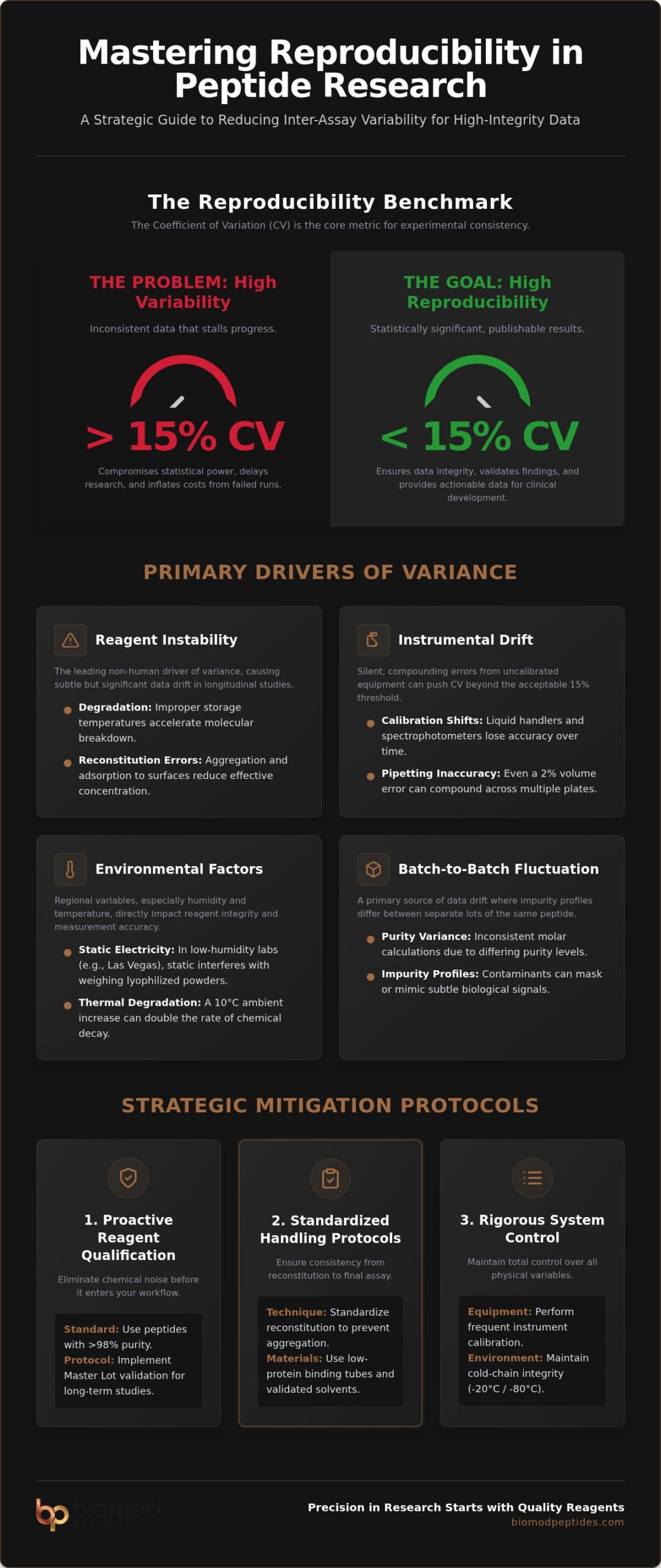
Standardized benchmarks for 2026 mandate an inter-assay CV threshold below 15% for robust data. This limit ensures that observed effects are biological rather than artifacts of technical drift. Identifying the specific source of error is critical for mitigation. Intra-assay errors often stem from mechanical pipetting or plate edge effects. Conversely, inter-assay drift usually arises from systemic issues. These include reagent degradation over time, batch-to-batch impurity fluctuations in synthetic sequences, and shifts in equipment calibration. Distinguishing between these sources allows for targeted protocol refinement to reduce inter-assay variability in peptide experiments.
The Impact of Reproducibility on Peer-Reviewed Data Integrity
High inter-assay variance compromises the statistical power of research findings. It obscures genuine biological signals with technical noise, making it difficult to replicate results in external laboratories. Standardized reporting in modern peptide science now demands rigorous analytical verification and transparent documentation. Reproducibility is the cornerstone of peer-reviewed validation. By maintaining strict CV limits, researchers provide empirical proof of experimental consistency. This discipline is essential for research that aims to transition from basic preclinical inquiry into formal clinical development pipelines. Precision ensures that data remains actionable across the entire research lifecycle.
Primary Drivers of Variance in Peptide Analytical Protocols
Reagent instability remains the primary non-human driver of inter-assay variability in peptide experiments. Improper storage conditions, specifically temperature fluctuations, accelerate chemical degradation and compromise molecular integrity. Following FDA guidelines on peptide impurities, researchers must characterize reagents to prevent these artifacts from skewing longitudinal data. Reconstitution introduces further risk; peptides often exhibit hydrophobic tendencies that lead to aggregation or adsorption to plasticware. This reduces the effective concentration in the final assay. Using low-protein binding tubes and validated solvents is a non-negotiable standard for maintaining titer consistency.
Instrumental drift is a silent contributor to variance. Automated liquid handlers and spectrophotometers require frequent calibration to ensure volume accuracy and detection sensitivity. Even a 2% error in pipetting can compound across multiple plates, pushing the CV beyond the 15% threshold. Utilizing US-manufactured research peptides provides a baseline of stability that simplifies these calibration requirements and ensures more predictable experimental outcomes.
Environmental and Instrumental Factors in Las Vegas Laboratory Settings
Regional variables dictate precision limits. In low-humidity environments like Las Vegas, static electricity interferes with the weighing of lyophilized powders. This leads to inaccurate mass measurements before reconstitution. Laboratories should utilize anti-static ionizers and controlled-environment chambers to maintain accuracy. Cold-chain integrity is equally vital in high-temperature regions. Thermal degradation occurs rapidly if samples deviate from -80°C for long-term storage or -20°C for short-term archiving. Data shows a 10°C increase in ambient temperature can double the rate of chemical degradation. Precision requires total environmental control.
Strategic Mitigation through High-Purity Reagents and Standardized Handling
Eliminating inter-assay variability in peptide experiments requires a shift from reactive troubleshooting to proactive reagent qualification. Batch-to-batch impurity fluctuations are a primary source of data drift. Researchers must utilize high purity research peptides with a minimum purity of 98% to ensure consistent molar calculations. Impurities exceeding the 0.1% threshold mandate rigorous documentation. Standardizing these inputs removes the chemical “noise” that often masks subtle biological signals.
Implement a Master Lot validation protocol for long-term studies. This involves procuring a single, large-scale lot of the target sequence, verifying its integrity, and aliquoting it into single-use vials stored at -80°C. This creates a stable baseline across months of experimentation. It prevents the subtle drift associated with switching manufacturers or lots mid-study.
Relying solely on manufacturer claims is insufficient in 2026. Advocate for independent third-party testing and verified peptide certificates of analysis. These documents must include raw HPLC chromatograms and mass spectrometry (MS) spectra to confirm sequence identity and net peptide content. Verification ensures that the reagent’s structural integrity matches the experimental design.
Leveraging Analytical-Grade Peptides for Consistent Baseline Values
Biomod Peptides’ US-manufactured standards provide a rigorous alternative to imported reagents. Domestic manufacturing ensures tighter control over finishing processes and reduces the risk of degradation during trans-oceanic transit. Use the COA verification portal as a mandatory step in the pre-experiment quality control checklist. This portal allows for the immediate verification of batch-specific data, ensuring that every vial meets the ISO/IEC 17025:2017 competency standards before any assay begins. Verification isn’t optional; it’s the foundation of empirical certainty.
Establishing a New Standard for Analytical Reproducibility
Achieving statistical significance requires an uncompromising approach to reagent integrity. By maintaining an inter-assay CV below 15% and implementing Master Lot validation, you eliminate the technical noise that often delays peer-reviewed publication. Managing inter-assay variability in peptide experiments isn’t merely about refined technique; it’s about the verifiable quality of your starting materials. Standardizing your protocols around US-manufactured, third-party tested reagents ensures that your data remains robust across every independent run. This systematic approach transforms inconsistent results into a foundation of empirical certainty.
Secure High-Purity Reagents for Your Next Experiment at Biomod Peptides to access our real-time COA verification portal and ensure the precision your research demands. Rigorous methodology paired with validated reagents creates the essential framework for breakthrough discoveries and reproducible science.
Frequently Asked Questions
What is an acceptable inter-assay CV for peptide experiments?
An acceptable inter-assay CV in peptide research is typically below 15%. Targeting a threshold of 10-15% ensures that experimental results remain reproducible and are not artifacts of technical drift. High inter-assay variability in peptide experiments often indicates systemic errors in reagent handling or equipment calibration. Researchers must monitor these values to maintain the statistical power required for rigorous peer-reviewed validation.
How does peptide purity affect inter-assay variability?
Peptide purity directly impacts molar accuracy and batch-to-batch consistency. Current 2026 industry standards require a purity of at least 98% to eliminate fluctuations caused by secondary sequences or residual solvents. Impurities exceeding 0.1% must be documented because they introduce analytical noise that skews baseline values. Biomod Peptides utilizes third-party testing to verify these levels before reagents enter the laboratory environment.
Can improper peptide reconstitution lead to high inter-assay variance?
Improper reconstitution is a primary cause of high variance. Hydrophobic peptides often aggregate or adsorb to the surface of non-validated plasticware, reducing the effective concentration of the solution. In Las Vegas laboratories, low humidity creates static electricity that interferes with the accurate weighing of lyophilized powders. Utilizing anti-static ionizers and standardized solvents is essential for maintaining consistency across independent experimental runs.
Why is US-based manufacturing important for reducing experimental variability?
US-based manufacturing ensures rigorous cold-chain integrity and transparent analytical verification. Domestic finishing reduces the risk of thermal degradation during long-distance transit, which is critical for maintaining peptide stability in high-temperature regions like Las Vegas. Biomod Peptides provides US-manufactured reagents supported by a real-time COA verification portal, allowing researchers to confirm lot-specific data and reduce inter-assay variability in peptide experiments.
Disclaimer
BIOMOD products are sold strictly for laboratory, analytical, and scientific research use only. They are not intended for human or animal consumption, administration, application, ingestion, injection, or any therapeutic, diagnostic, or cosmetic use.
The statements made on this website have not been evaluated by the United States Food and Drug Administration. BIOMOD products are not intended to diagnose, treat, cure, mitigate, or prevent any disease or medical condition.
BIOMOD is a research chemical supplier. BIOMOD is not a compounding pharmacy or chemical compounding facility as defined under Section 503A of the Federal Food, Drug, and Cosmetic Act. BIOMOD is not an outsourcing facility as defined under Section 503B of the Federal Food, Drug, and Cosmetic Act.
By accessing this site, you confirm you are at least 21 years of age and that you have read and accepted the BIOMOD Terms of Sale, Privacy Policy, and Research Use Only Policy. BIOMOD does not provide dosing, medical, therapeutic, diagnostic, veterinary, or use guidance under any channel.