
A single degree of thermal deviation during a Nevada summer can invalidate months of high-potency research before a vial even reaches the bench. You’re likely already managing the complexities of the 2026 OSHA HCS updates while mitigating the critical risks of respiratory exposure during the handling of lyophilized powders. Consistency is the only metric that matters in a professional laboratory. These variables demand a specialized approach to containment and stability that exceeds standard operating procedures. This guide establishes the definitive lab safety protocols for handling peptides in Las Vegas to ensure a zero-incident environment and absolute batch purity. We will analyze rigorous containment strategies, Nevada-specific environmental stability standards, and the role of third-party COA verification in maintaining experimental safety. By aligning your facility with these 2026 benchmarks, you secure both researcher health and the structural integrity of your reagents.
Key Takeaways
- Establish primary containment using Class II Biological Safety Cabinets and dual-glove protocols to eliminate respiratory exposure to lyophilized sequences.
- Adopt rigorous lab safety protocols for handling peptides in Las Vegas to mitigate thermal degradation risks inherent to high-heat, arid climates.
- Ensure reagent stability through aseptic reconstitution techniques and the application of sequence-compatible bacteriostatic buffers.
- Verify every research batch via HPLC and Mass Spectrometry to confirm structural integrity and the absolute absence of hazardous synthesis by-products.
Primary Containment and Environmental Mitigation in Arid Climates
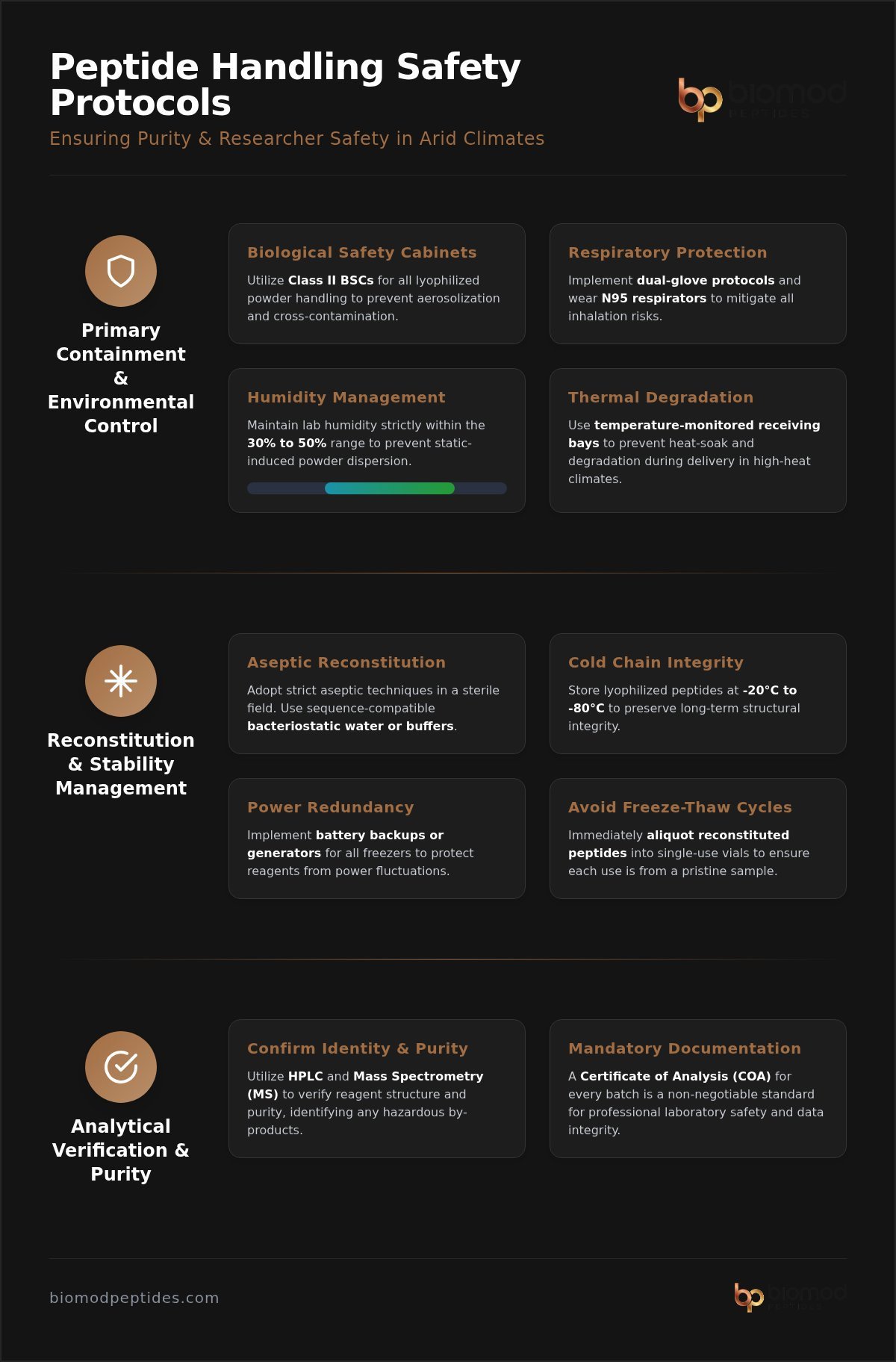
Precision is mandatory for high-potency research. Establish a primary containment barrier using Class II Biological Safety Cabinets (BSC) for all lyophilized powder handling. This setup prevents the aerosolization of potent sequences during weighing and transfer. Implement dual-glove protocols and N95 respiratory protection to mitigate accidental inhalation risks. These measures align with established General Laboratory Safety Standards. Implementing rigorous lab safety protocols for handling peptides in Las Vegas begins with these physical barriers. High-standard containment is the first line of defense against cross-contamination.
The arid Nevada environment introduces specific physical hazards. Maintain laboratory humidity strictly between 30% and 50%. This range is critical to prevent static-induced powder dispersion. Static electricity in dry air causes lyophilized particles to migrate unpredictably, complicating containment efforts. Avoid the inherent risks of “DIY science” environments. Non-institutional handling lacks these essential environmental controls, leading to inconsistent safety outcomes and compromised data. Professional research requires structured, verifiable environments.
Mitigating Thermal Degradation in Las Vegas Facilities
Extreme Nevada external temperatures threaten reagent stability during facility intake. High heat accelerates peptide degradation before a sample reaches cold storage. Utilize temperature-monitored receiving bays to prevent heat-soak during the delivery of sensitive research materials. For local researchers, Biomod Peptides provides US-based manufacturing to minimize transit exposure and ensure shorter lead times. Incorporate inert gas blanketing, such as Argon or Nitrogen, during the reconstitution process. This step prevents oxidative stress, which is often accelerated by desert heat. Adhering to these lab safety protocols for handling peptides in Las Vegas preserves structural integrity and ensures experimental reproducibility.
Aseptic Reconstitution and Stability Management Protocols
Precision during reconstitution prevents irreversible sample loss. Adopt strict aseptic techniques to eliminate microbial contamination of the peptide matrix. This requires a dedicated sterile field and validated handling protocols. Use bacteriostatic water or specialized buffers only when they align with the specific peptide sequence and research objectives. Implementing these lab safety protocols for handling peptides in Las Vegas ensures these procedures remain within a safe, institutional framework. Following OSHA Chemical Hygiene Recommendations is essential for maintaining experimental reproducibility and researcher safety.
Ambient heat in Nevada poses a constant threat to molecular stability. Minimize the duration reagents remain at room temperature in Las Vegas labs. Rapid enzymatic or chemical degradation occurs quickly when environmental stability is neglected. Implement a clear, standardized labeling system for every vial. This documentation must include the date of reconstitution and the calculated expiration based on specific stability data. For labs prioritizing reagent integrity, sourcing high-purity research peptides from US-based facilities reduces initial transit stress and ensures reagent provenance.
Cold Chain Integrity and Lyophilized Reagent Storage
Maintain long-term storage of lyophilized peptides at -20°C or -80°C to preserve structural integrity. These temperatures are the industry standard for preventing primary structure breakdown. Las Vegas laboratories face unique infrastructure challenges during summer grid strain. Implement redundant power systems, such as battery backups or dedicated generators, for all laboratory freezers. This protects high-value sequences from localized power fluctuations. Avoid frequent freeze-thaw cycles by aliquoting reconstituted peptides into single-use vials immediately. Adhering to these lab safety protocols for handling peptides in Las Vegas ensures that every experimental iteration utilizes a pristine, uncompromised sample.
Analytical Verification: The Final Tier of Laboratory Safety
Analytical verification is the final safeguard in a high-stakes laboratory environment. It utilizes High-Performance Liquid Chromatography (HPLC) and Mass Spectrometry (MS) to confirm reagent identity and purity. These methods are essential for identifying hazardous synthesis by-products that could compromise both data and researcher safety. Requiring a Certificate of Analysis (COA) for every batch is a non-negotiable standard. These Harvard Peptide Handling Protocols underscore the necessity of rigorous verification to prevent the use of degraded or misidentified materials. Verification is the primary tool for mitigating the risk of unknown chemical hazards.
Adhering to lab safety protocols for handling peptides in Las Vegas requires proactive verification before any experiment begins. Researchers must cross-reference batch numbers through a verified peptide certificates of analysis portal. This step ensures that the reagent’s profile matches the intended research specifications exactly. Use laboratory peptide supply resources to interpret complex impurity profiles and understand the safety implications of specific contaminants. Transparency in reagent data is the cornerstone of professional accountability.
Utilizing Verification Portals to Confirm Reagent Provenance
Sequence accuracy is verified through third-party mass spectrometry reports, which map the exact molecular weight of the sequence. Reviewing HPLC purity percentages allows researchers to identify potential safety hazards before exposure occurs. Standard research typically requires >98% purity to ensure the absence of truncated sequences or residual solvents. Documenting reagent provenance is a core component of institutional safety and facilitates experimental reproducibility. Integrating these analytical steps into your lab safety protocols for handling peptides in Las Vegas minimizes risk and maximizes scientific precision. Objective data must replace assumptions in the laboratory.
Advancing Research Integrity Through Standardized Safety
Adhering to rigorous lab safety protocols for handling peptides in Las Vegas is the only way to ensure experimental reproducibility in extreme environments. Success requires a multi-tiered approach; establishing primary containment barriers, managing arid-climate stability, and mandating analytical verification are essential steps. Every reagent must be backed by objective data to eliminate the risks of molecular degradation or chemical contamination. Biomod Peptides supports these benchmarks through rigorous US manufacturing standards and independent third-party HPLC and MS testing for every batch. This level of transparency provides the structural integrity necessary for sophisticated research. Ensure your facility meets the 2026 standards by prioritizing verified provenance and environmental control. Secure your laboratory reagents at Biomod Peptides today. Precision in handling leads to breakthroughs in discovery.
Frequently Asked Questions
What is the primary risk when handling lyophilized peptides in a Las Vegas lab?
The primary risk is accidental respiratory exposure to aerosolized powders. In the arid Nevada climate, humidity levels often fall below 30%, which significantly increases static electricity. This causes lyophilized particles to disperse rapidly upon opening a vial. Implementing lab safety protocols for handling peptides in Las Vegas requires using Class II Biological Safety Cabinets to contain these volatile particles and prevent inhalation.
How does the Las Vegas climate affect peptide stability during transport?
Extreme Nevada temperatures accelerate chemical degradation through “heat-soak” during transit and facility intake. External temperatures exceeding 110°F can compromise the primary structure of sensitive sequences within minutes. Utilizing US-based manufacturing reduces transit duration. Local labs must use temperature-monitored receiving bays and immediate cold-storage transfer to maintain reagent integrity throughout the delivery process and prevent irreversible thermal damage.
Why is third-party HPLC testing considered a safety protocol?
Third-party HPLC testing serves as a safety protocol by confirming the absence of hazardous synthesis by-products and residual solvents. High-purity reagents, typically exceeding 98%, ensure that experimental results aren’t skewed by unknown chemical contaminants. This analytical verification allows researchers to document reagent provenance, which is a core requirement for maintaining a zero-incident laboratory environment and ensuring institutional accountability and data precision.
What PPE is mandatory for handling potent research peptides?
Mandatory personal protective equipment includes N95 or higher respiratory protection, dual-glove protocols, and chemical-resistant eye protection. These items prevent direct contact and inhalation of potent sequences during weighing or reconstitution. These requirements are foundational to lab safety protocols for handling peptides in Las Vegas. All PPE must be donned before entering the primary containment area to ensure absolute researcher safety and prevent cross-contamination.
How should laboratory waste from peptide reconstitution be disposed of?
Dispose of all waste, including used vials and syringes, as regulated hazardous or medical waste according to Clark County standards. As of July 2026, improper disposal in Clark County can result in daily fines ranging from $5,000 to $25,000. Laboratories must utilize certified waste management services and maintain detailed disposal logs to ensure full regulatory compliance and protect the local Nevada environment.
Can I store reconstituted peptides in a standard laboratory refrigerator?
Standard refrigerators are only suitable for very short-term storage at 2°C to 8°C. For long-term preservation, reconstituted peptides require storage at -20°C or -80°C to prevent enzymatic breakdown. Given the summer grid strain in Nevada, laboratories should use freezers equipped with redundant power systems. Aliquoting into single-use vials is also necessary to avoid the degradation caused by frequent freeze-thaw cycles.
Disclaimer
BIOMOD products are sold strictly for laboratory, analytical, and scientific research use only. They are not intended for human or animal consumption, administration, application, ingestion, injection, or any therapeutic, diagnostic, or cosmetic use.
The statements made on this website have not been evaluated by the United States Food and Drug Administration. BIOMOD products are not intended to diagnose, treat, cure, mitigate, or prevent any disease or medical condition.
BIOMOD is a research chemical supplier. BIOMOD is not a compounding pharmacy or chemical compounding facility as defined under Section 503A of the Federal Food, Drug, and Cosmetic Act. BIOMOD is not an outsourcing facility as defined under Section 503B of the Federal Food, Drug, and Cosmetic Act.
By accessing this site, you confirm you are at least 21 years of age and that you have read and accepted the BIOMOD Terms of Sale, Privacy Policy, and Research Use Only Policy. BIOMOD does not provide dosing, medical, therapeutic, diagnostic, veterinary, or use guidance under any channel.