
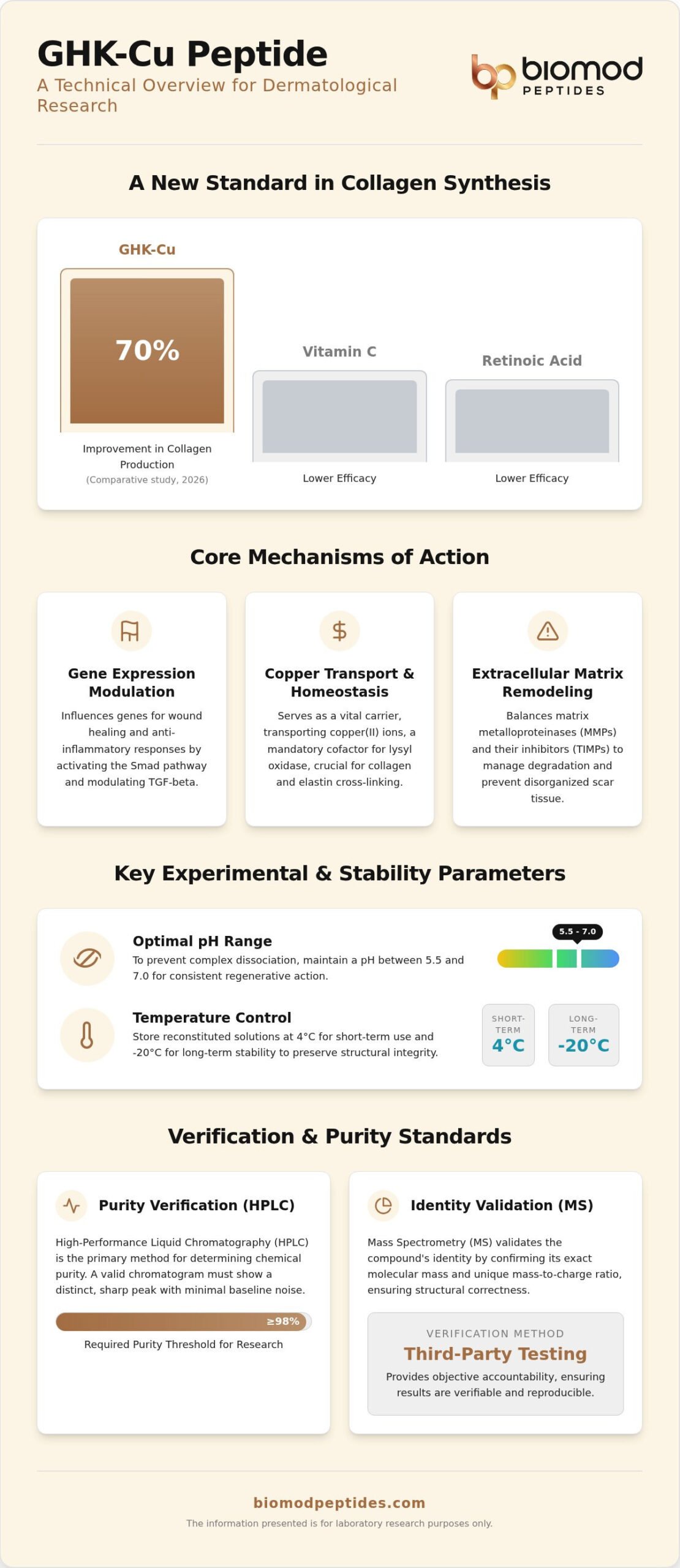
A 2026 comparative study revealed that GHK-Cu improved collagen production in 70% of participants, outperforming both vitamin C and retinoic acid. Despite these metrics, many investigators face significant hurdles when sourcing GHK-Cu for dermatology research. You likely recognize that inconsistent peptide purity and opaque documentation frequently compromise experimental reproducibility. Formulation instability remains a persistent barrier. High-fidelity data requires absolute reagent integrity.
This article delivers a rigorous examination of GHK-Cu molecular pathways and the analytical standards required for precise dermatological research. We analyze specific signaling mechanisms, including TGF-beta modulation and extracellular matrix remodeling. You’ll find a standardized protocol for verifying peptide purity through HPLC and MS validation. We also identify the benchmarks for US-manufactured reagents that ensure your laboratory results remain objective, verifiable, and structurally sound.
Key Takeaways
- Analyze the molecular affinity of Glycyl-L-histidyl-L-lysine and its specific role in modulating gene expression within dermal fibroblasts.
- Determine optimal laboratory protocols by evaluating the solubility and stability of copper-peptide complexes across varying temperature and pH levels.
- Implement rigorous analytical standards using HPLC and MS reports to verify the precise purity of GHK-Cu for dermatology research.
- Utilize third-party verification portals and transparent COA documentation to eliminate formulation variables and ensure consistent experimental reproducibility.
The Molecular Biochemistry of GHK-Cu in Dermatological Research
The Copper peptide GHK-Cu is a naturally occurring tripeptide consisting of glycyl-L-histidyl-L-lysine with a high affinity for copper(II) ions. In GHK-Cu for dermatology research, this complex acts as a vital carrier. It facilitates the transport of copper into the intracellular environment. Copper serves as a mandatory cofactor for lysyl oxidase, which is the enzyme responsible for the cross-linking of collagen and elastin fibers. This structural integrity is the foundation of dermal density and resilience.
Signal peptide functions extend beyond simple transport. GHK-Cu actively modulates gene expression within dermal fibroblasts. It influences the transcription of genes associated with wound healing and anti-inflammatory responses. By maintaining copper homeostasis, the peptide prevents the accumulation of free copper ions that could otherwise trigger oxidative stress. This precise regulation is central to tissue remodeling. For those conducting GHK-Cu for dermatology research, understanding this homeostasis is paramount for experimental accuracy and reagent stability.
Mechanisms of Signal Transduction and Collagen Synthesis
Quantitative analysis demonstrates that GHK-Cu induces the synthesis of collagen, elastin, and glycosaminoglycans. It achieves this by activating the Smad pathway and modulating transforming growth factor-beta (TGF-beta). The peptide also regulates the balance between matrix metalloproteinases (MMPs) and tissue inhibitors of metalloproteinases (TIMPs). This dual action manages the degradation process to prevent disorganized scar tissue. It doesn’t just increase protein production; it organizes the extracellular matrix. Precision in these studies depends on reagent purity, a standard upheld by US-manufactured analytical reagents. The GHK-Cu copper-binding constant is log K = 16.4, which defines its biological stability and its ability to compete with albumin for copper ions in a laboratory environment.
Experimental Protocols for Copper Peptide Application in Skin Studies
Successful GHK-Cu for dermatology research depends on precise formulation protocols. Lyophilized GHK-Cu is highly hydrophilic. It exhibits excellent solubility in aqueous bases but presents complex challenges in lipid-heavy experimental vehicles. Investigators must monitor pH levels closely. The Regenerative Actions of GHK-Cu Peptide are most consistent within a pH range of 5.5 to 7.0. Deviations from this specific window can cause the copper-peptide complex to dissociate, rendering the reagent inert. Temperature control is equally critical. Storing reconstituted solutions at 4°C preserves structural integrity for short-term use, while long-term stability requires -20°C.
Uniformity in topical application is essential for dose-response accuracy. Utilizing peptide spray products allows for even distribution across the target substrate. This method minimizes mechanical stress on the skin model compared to manual spreading. Researchers often choose these delivery systems to eliminate variables associated with inconsistent application thickness and ensure reproducible results in GHK-Cu for dermatology research.
Solubility and Stability Factors in Topical Formulation Research
Reconstitution protocols must prioritize analytical integrity. Use sterile, deionized water or bacteriostatic saline. Avoid vigorous agitation to prevent peptide shearing. For investigators exploring systemic effects in laboratory models, peptide softgels provide a standardized oral delivery model. These formats protect the peptide from early gastric degradation. Maintaining a rigorous testing schedule is mandatory. Use HPLC to evaluate peptide degradation every 30 days under varying storage conditions. For high-purity reagents that meet these strict laboratory benchmarks, consult the catalog at Biomod Peptides.
Analytical Standards for GHK-Cu Purity and Verification
Quantitative verification is the only safeguard against experimental failure. In GHK-Cu for dermatology research, precision is non-negotiable. Independent third-party testing provides an objective layer of accountability that external manufacturer data can’t replicate. High-Performance Liquid Chromatography (HPLC) remains the primary tool for determining chemical purity. A valid HPLC chromatogram must show a distinct, sharp peak representing the target peptide, with minimal baseline noise. For research applications, a purity threshold of ≥98% is the standard. Mass Spectrometry (MS) further validates the compound by confirming the exact molecular mass. It’s the identifier for the unique mass-to-charge ratio. This step ensures the Glycyl-L-histidyl-L-lysine structure is correctly synthesized. Proper chelation with copper ions is verified. This prevents the use of degraded or incorrectly sequenced materials.
Utilizing Third-Party Testing and COA Portals for Research Integrity
Maintaining research integrity requires proactive verification of every reagent lot. Investigators can’t rely on unverified data and should instead validate lot-specific information through the Biomod COA verification portal. This digital infrastructure allows for the immediate cross-referencing of laboratory results against verified manufacturer benchmarks. Common impurities in synthetic peptides, such as truncated sequences or residual trifluoroacetic acid (TFA), can skew results in GHK-Cu for dermatology research. These contaminants often induce unintended cellular toxicity or interfere with fibroblast signaling pathways. US-manufactured peptides offer superior logistical transparency for Las Vegas researchers by ensuring that every stage of production and finishing is subject to domestic regulatory oversight.
Advancing Dermatological Methodology with Analytical Precision
Rigorous research requires more than theoretical understanding; it demands absolute material integrity. We’ve analyzed how GHK-Cu modulates fibroblast activity and the critical role of pH-stabilized formulation in maintaining complex stability. Achieving reproducible results in GHK-Cu for dermatology research depends entirely on the verification of reagent purity via HPLC and MS analysis. Biomod Peptides provides the structural foundation for these studies through US-manufactured reagents and independent third-party testing. Access lot-specific data via our verification portal and leverage local Las Vegas laboratory support to maintain your internal benchmarks. Procure High-Purity GHK-Cu for Research at Biomod Peptides to ensure your experimental outcomes are built on a foundation of objective, laboratory-grade proof.
Frequently Asked Questions
Is GHK-Cu stable for long-term dermatological research storage?
Lyophilized GHK-Cu remains stable for up to 24 months when stored at -20°C in a desiccated environment. Once you reconstitute the peptide in sterile water or saline, the shelf life decreases significantly. Researchers should utilize aliquots to prevent repeated freeze-thaw cycles. Maintaining a pH between 5.5 and 7.0 is essential to prevent copper dissociation and ensure the integrity of GHK-Cu for dermatology research.
How do I verify the purity of GHK-Cu for my laboratory study?
Verification requires a combination of High-Performance Liquid Chromatography (HPLC) and Mass Spectrometry (MS). HPLC determines the purity percentage by measuring the area under the curve; a threshold of 98% or higher is the industry standard. MS confirms the molecular weight and sequence. Always cross-reference batch numbers with an independent COA verification portal to validate third-party testing results and identify residual synthesis impurities.
What are the primary molecular targets of GHK-Cu in skin remodeling research?
The primary targets include dermal fibroblasts and the modulation of TGF-beta signaling pathways. GHK-Cu influences the expression of genes responsible for collagen, elastin, and glycosaminoglycan synthesis. It also regulates the balance of matrix metalloproteinases (MMPs) and tissue inhibitors (TIMPs). This molecular control ensures organized extracellular matrix remodeling rather than disorganized scar tissue formation during experimental skin regeneration studies.
Can GHK-Cu be used in liquid spray formats for topical research?
Yes, GHK-Cu is highly suitable for liquid spray formats in topical research models. These delivery systems ensure a uniform distribution across the target substrate, which is critical for dose-response accuracy. Peptide spray products eliminate the mechanical variables associated with traditional cream or gel applications. This standardized delivery method enhances reproducibility when evaluating the peptide’s impact on dermal density and GHK-Cu for dermatology research.
Disclaimer
BIOMOD products are sold strictly for laboratory, analytical, and scientific research use only. They are not intended for human or animal consumption, administration, application, ingestion, injection, or any therapeutic, diagnostic, or cosmetic use.
The statements made on this website have not been evaluated by the United States Food and Drug Administration. BIOMOD products are not intended to diagnose, treat, cure, mitigate, or prevent any disease or medical condition.
BIOMOD is a research chemical supplier. BIOMOD is not a compounding pharmacy or chemical compounding facility as defined under Section 503A of the Federal Food, Drug, and Cosmetic Act. BIOMOD is not an outsourcing facility as defined under Section 503B of the Federal Food, Drug, and Cosmetic Act.
By accessing this site, you confirm you are at least 21 years of age and that you have read and accepted the BIOMOD Terms of Sale, Privacy Policy, and Research Use Only Policy. BIOMOD does not provide dosing, medical, therapeutic, diagnostic, veterinary, or use guidance under any channel.