
A single compromised sequence can invalidate months of laboratory work. When experimental reproducibility fails, the culprit is often hidden at the molecular level. Peptide degradation is a silent variable. It compromises analytical integrity. Understanding research peptide stability testing methods isn’t just a compliance requirement. It’s the only way to ensure your data reflects biological reality rather than chemical decay. Precision requires accountability. You can’t rely on assumptions when structural integrity is at stake.
You likely already recognize that supplier transparency is often insufficient. This leaves researchers questioning if samples maintained integrity during transit or storage. We’ll provide a rigorous examination of the analytical protocols necessary to verify peptide stability and ensure laboratory-grade reliability. This article details the distinct roles High-Performance Liquid Chromatography (HPLC) and Mass Spectrometry (MS) play in detecting impurities. We’ll establish a standardized protocol for verifying stability in-house. We’ll also clarify how specific storage environments affect purity over time. This is the foundation of a verification-first research philosophy.
Key Takeaways
- Identify the primary chemical pathways—hydrolysis, oxidation, and deamidation—that compromise peptide sequences in both lyophilized and liquid states.
- Implement research peptide stability testing methods, specifically HPLC and Mass Spectrometry, to provide empirical proof of purity and sequence integrity.
- Standardize storage protocols using lyophilization and strict cold chain adherence to ensure long-term reagent longevity and structural precision.
- Utilize third-party verification tools and COA portals to maintain analytical integrity and ensure laboratory-grade reliability for every sequence.
Understanding Peptide Degradation Mechanisms in Research Environments
Peptide stability defines the resistance of a sequence to chemical and physical modifications over time. It’s the fundamental metric of analytical integrity. Without it, experimental results are skewed by degraded fragments rather than the intended molecule. Identifying these peptide degradation mechanisms is a prerequisite for selecting appropriate research peptide stability testing methods. Precision requires understanding how sequences interact with their environment.
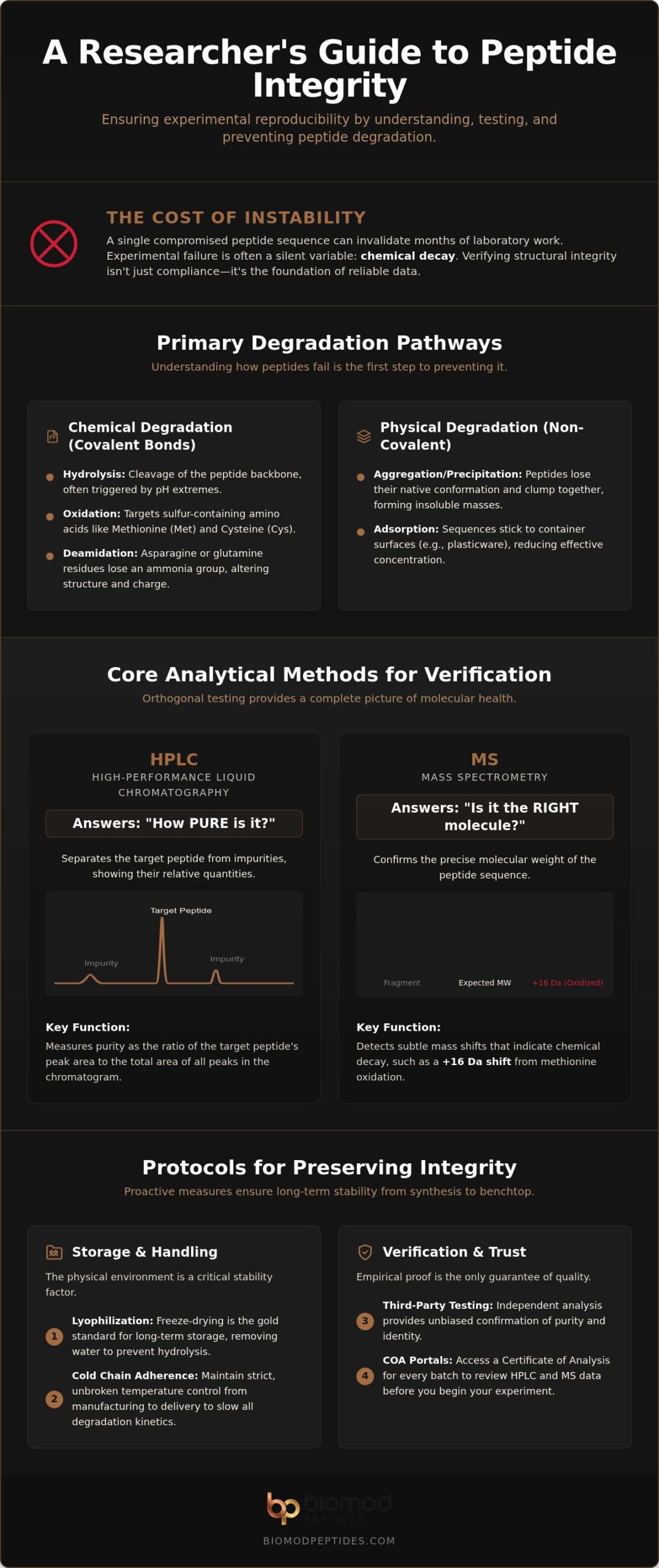
Chemical degradation involves covalent bond changes. Primary pathways include hydrolysis, which cleaves the peptide backbone, and deamidation, where asparagine or glutamine residues lose an ammonia group. Oxidation is particularly aggressive. It targets sulfur-containing amino acids like methionine and cysteine. Physical stability involves non-covalent shifts. Aggregation and precipitation occur when peptides lose their native conformation. Adsorption to laboratory plasticware can also deplete concentration, leading to inaccurate dosing in research models. Sequence composition dictates risk. Amino acids like Cysteine (Cys), Methionine (Met), and Tryptophan (Trp) significantly increase susceptibility to these pathways.
Chemical vs. Physical Stability in Analytical Research
Chemical stability focuses on the structural identity of the sequence. Physical stability concerns the spatial arrangement. Aggregation can be deceptive. Large clusters of peptide molecules can mask underlying chemical impurities during standard assays. This makes multi-modal testing essential. You can’t assume a clear solution equals a pure sequence. Rigorous research peptide stability testing methods must account for both covalent cleavage and conformational aggregation to ensure laboratory-grade reliability.
Environmental Triggers for Research Peptide Instability
Thermal stress is a primary catalyst for decay. This is especially true for logistics involving high-heat regions like Las Vegas. Temperature fluctuations accelerate reaction kinetics for hydrolysis and oxidation. Photolytic degradation is another risk. UV exposure can trigger free radical formation, specifically targeting aromatic residues like tryptophan. Standardized cold chain protocols are mandatory for maintaining structural integrity from synthesis to final delivery. US-manufactured reagents must adhere to strict thermal benchmarks to prevent environmental compromise before they reach the bench.
Core Analytical Methods for Peptide Stability Verification
Identifying degradation is only the first step; quantifying it requires specific research peptide stability testing methods. Analytical integrity depends on orthogonal testing. This approach uses multiple independent methods to cross-verify results. Relying on a single assay often leaves gaps in the stability profile. A rigorous protocol utilizes chromatography and spectrometry to provide a complete picture of molecular health.
The Role of HPLC in Purity Verification
Reversed-phase HPLC (RP-HPLC) is the primary tool for separating impurities from the parent peptide. It utilizes a hydrophobic stationary phase to isolate the main sequence from related substances or degradation products. Purity is defined as the ratio of the target peptide’s peak area to the total integrated area of all peaks in a chromatogram. For a deeper look at these technical benchmarks, review The Protocol for Peptide Purity Verification. This method ensures that the reagent meets specified concentration requirements before research begins.
Mass Spectrometry: Confirming Molecular Identity
HPLC measures purity, but Mass Spectrometry (MS) confirms identity. Electrospray Ionization (ESI-MS) verifies the precise molecular weight of the parent peptide sequence. It’s essential for detecting subtle mass shifts that indicate chemical decay. For example, a +16 Da shift in the mass spectrum provides definitive evidence of methionine or cysteine oxidation. Without MS, a researcher might have a “pure” peptide that’s actually the wrong molecular variant.
Advanced protocols also include Size-Exclusion Chromatography (SEC) to quantify physical aggregation. While RP-HPLC identifies chemical changes, SEC detects dimers and polymers that often form during improper storage. To predict long-term shelf life, laboratories utilize forced degradation studies. These stress tests use pH extremes, thermal elevation, and oxidants to map potential decay trajectories. Adhering to Regulatory Guidelines for Peptide Analysis ensures these protocols meet the highest standards for empirical proof. You can verify these metrics for your own sequences through the Biomod Peptides verification portal to ensure total laboratory-grade reliability.
Ensuring Integrity: Storage Protocols and Format-Specific Stability
Lyophilization serves as the primary stabilization strategy for high-purity reagents. By removing moisture through sublimation, the process effectively halts hydrolysis and enzymatic degradation. This freeze-dried state is the industry standard for ensuring long-term shelf life. Structural integrity remains dependent on rigorous thermal management. Cold chain protocols must maintain temperatures of -20°C or -80°C from the point of US-based manufacture to laboratory delivery. This is especially critical for distribution in high-ambient-heat regions like Las Vegas, where even brief exposure to room temperature can accelerate decay.
Stability requirements vary across delivery formats. While lyophilized powders offer maximum longevity, specialized research formats like peptide softgels and spray products require unique analytical considerations. These formats are engineered to maintain sequence integrity within their respective carriers. Verification of these products still relies on established research peptide stability testing methods to confirm that the active sequence hasn’t partitioned or degraded within the formulation.
Handling and Reconstitution Protocols
The transition from a lyophilized powder to a solution is a high-risk phase for analytical integrity. Improper reconstitution can trigger rapid aggregation or oxidation. Researchers should allow vials to reach room temperature before opening to prevent moisture condensation. Use only degassed, sterile bacteriostatic water or buffered solutions as specified. For detailed handling instructions, consult the Peptide Stability for Research: Cold Chain Protocols. Adhering to these steps ensures that the research peptide stability testing methods performed at the facility remain valid at the bench.
Verification Through Documentation
Empirical proof is found in the Certificate of Analysis (COA). A standard COA identifies purity levels, mass spectrometry confirmation, and moisture content. These markers are the primary indicators of a sequence’s stability profile. Biomod Peptides prioritizes transparency through a dedicated COA verification portal. This tool allows researchers to access batch-specific analytical data, ensuring that every reagent meets laboratory-grade benchmarks for structural precision and accountability.
Advancing Analytical Integrity in Peptide Research
Analytical integrity isn’t a static achievement. It’s a continuous process of verification and rigorous control. You’ve identified the chemical pathways of decay and the orthogonal methods required to detect them. Now, the focus shifts to sourcing sequences that meet these exacting standards. Implementing rigorous research peptide stability testing methods ensures that your data remains reproducible and your conclusions remain sound. Precision in the lab starts with precision in the supply chain. Structural certainty is the only foundation for credible discovery.
Biomod Peptides prioritizes this level of accountability through US-based manufacturing and finishing. Every batch undergoes independent third-party HPLC and MS verification to guarantee structural identity. You don’t have to rely on opaque supplier claims. Our transparent COA verification portal provides direct access to the empirical data your research demands. Secure high-purity reagents from Biomod Peptides to anchor your work in verified analytical truth. It’s time to eliminate the variables of degradation and focus on the progression of your methodology. Your results deserve absolute structural certainty.
Frequently Asked Questions
How do you test peptide stability in a laboratory setting?
Laboratory stability testing requires orthogonal analysis using High-Performance Liquid Chromatography (HPLC) and Mass Spectrometry (MS). These research peptide stability testing methods identify both purity levels and molecular identity. Stress testing protocols further predict shelf life by exposing sequences to controlled thermal or pH stressors. This rigorous approach ensures that the reagent remains structurally intact throughout the experimental lifecycle. Precision depends on using verified analytical standards for every sequence.
What is the difference between chemical and physical peptide stability?
Chemical stability refers to the integrity of covalent bonds within the peptide sequence. Common degradation pathways include hydrolysis, oxidation, and deamidation. Physical stability concerns the higher-order structure and spatial arrangement. Issues like aggregation, precipitation, or adsorption to laboratory glass represent physical instability. Both must be verified to ensure experimental reproducibility. A sequence can be chemically pure but physically aggregated, which compromises its biological activity in research models.
Why is HPLC-MS considered the gold standard for peptide testing?
HPLC-MS is the gold standard because it provides a comprehensive profile of both purity and identity. HPLC quantifies the ratio of the target sequence to impurities through area-under-the-curve (AUC) analysis. MS confirms the molecular weight, detecting subtle shifts that indicate chemical modifications. This dual-verification strategy eliminates the risk of using sequences that have undergone silent structural changes. It provides the empirical proof necessary for high-stakes analytical research.
How does lyophilization improve the stability of research peptides?
Lyophilization improves stability by removing moisture through a controlled sublimation process. This freeze-drying halts hydrolysis and enzymatic cleavage, which are the primary drivers of peptide decay in aqueous states. Lyophilized reagents are significantly more resistant to thermal stress. This format allows for extended storage and safer transport across long-distance cold chains. It’s the industry standard for maintaining structural precision from the point of manufacture to the bench.
What are the signs that a research peptide has degraded?
Degradation is often invisible but manifests as a loss of chromatographic purity or shifts in molecular mass. On an HPLC chromatogram, degradation appears as secondary peaks or a reduced main peak area. Mass spectrometry might show a +16 Da shift, indicating oxidation. Physical signs include visible precipitation, cloudiness in solution, or a change in the color of the lyophilized powder. These indicators suggest the sequence no longer meets laboratory-grade reliability standards.
How long are research peptides stable at room temperature?
Stability at room temperature is highly dependent on the peptide’s format and sequence composition. Lyophilized powders can often withstand room temperature for several weeks during transit without significant decay. However, reconstituted peptides in liquid form are extremely vulnerable. Liquid sequences may begin to degrade within hours or days if not maintained at -20°C or -80°C. Standardized cold chain adherence is mandatory for maintaining the integrity of US-manufactured reagents.
Disclaimer
BIOMOD products are sold strictly for laboratory, analytical, and scientific research use only. They are not intended for human or animal consumption, administration, application, ingestion, injection, or any therapeutic, diagnostic, or cosmetic use.
The statements made on this website have not been evaluated by the United States Food and Drug Administration. BIOMOD products are not intended to diagnose, treat, cure, mitigate, or prevent any disease or medical condition.
BIOMOD is a research chemical supplier. BIOMOD is not a compounding pharmacy or chemical compounding facility as defined under Section 503A of the Federal Food, Drug, and Cosmetic Act. BIOMOD is not an outsourcing facility as defined under Section 503B of the Federal Food, Drug, and Cosmetic Act.
By accessing this site, you confirm you are at least 21 years of age and that you have read and accepted the BIOMOD Terms of Sale, Privacy Policy, and Research Use Only Policy. BIOMOD does not provide dosing, medical, therapeutic, diagnostic, veterinary, or use guidance under any channel.