
What if the variance in your replicates isn’t a failure of the peptide sequence, but a failure of your buffer’s ionic strength? High coefficients of variation (CV) are the silent killers of research budgets and the primary cause of delayed data publication. When you’re troubleshooting inconsistent peptide assay results, the culprit often hides in the subtle physics of non-specific binding or solvent-induced aggregation. You’ve likely spent weeks questioning whether you’re seeing genuine peptide degradation or simple analytical interference. It’s a frustrating cycle that compromises the reliability of your binding affinity data.
Precision is not an aspiration; it’s a requirement for laboratory-grade validation. This article provides a rigorous analytical framework to identify and eliminate the technical variables causing variance in your research assays. We’ll examine standardized reconstitution protocols, the impact of US-manufactured purity standards, and how to leverage third-party COA verification to rule out reagent quality as a variable. You’ll gain the specific diagnostic steps needed to achieve low CV across replicates and restore the structural integrity of your data. We’ll move from broad observations to specific technical evidence to ensure your methodology meets the highest industry benchmarks.
Key Takeaways
- Mitigate non-specific binding (NSB) by transitioning to low-protein binding (LPB) plasticware to ensure accurate detectable peptide concentrations.
- Control DMSO concentrations to prevent solvent-induced aggregation and maintain consistent protein-peptide binding kinetics during analysis.
- Apply a rigorous framework for troubleshooting inconsistent peptide assay results by isolating HPLC baseline drifts and isobaric interferences in MRM-MS.
- Establish a standardized solubility pilot study using varying pH levels and organic modifiers to guarantee reproducible reconstitution across batches.
- Leverage US-manufactured standards and third-party COA verification to systematically rule out reagent impurity as a source of analytical variance.
Identifying Chemical and Handling Variables in Peptide Assays
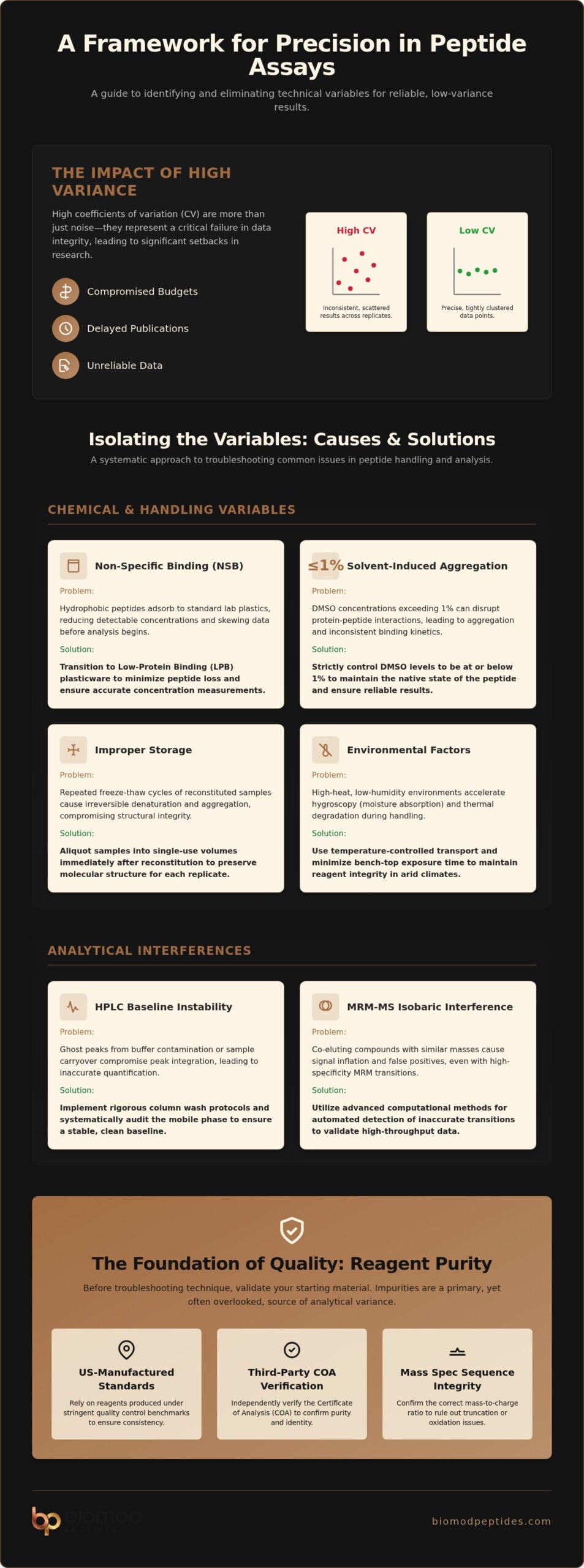
Non-specific binding (NSB) is the primary driver of analytical variance. Peptides, particularly hydrophobic sequences, exhibit a high affinity for standard laboratory surfaces. This adsorption reduces the detectable peptide concentration before the assay even begins. When troubleshooting inconsistent peptide assay results, researchers must quantify this loss. Analytical methods like the Bradford protein assay often reveal discrepancies between theoretical and actual concentrations due to these surface interactions. Adsorption isn’t just a loss of material; it’s a loss of data integrity.
The concentration of Dimethyl sulfoxide (DMSO) also dictates binding kinetics. While DMSO is a necessary solvent for many sequences, levels exceeding 1% can disrupt the hydrophobic interactions required for protein-peptide recognition. This shifts the observed binding affinity and produces unreliable data. The hydrophobic effect leads to spontaneous aggregation in aqueous buffers. These aggregates are frequently misidentified as peptide degradation, yet they result from sequence-specific traits that favor self-association over solvent interaction.
Storage conditions introduce further variance. Lyophilized powders are stable at -20°C, but reconstituted samples are fragile. Repeated freeze-thaw cycles cause irreversible denaturation and aggregation. It’s critical to aliquot samples immediately after reconstitution to preserve the molecular structure. This practice ensures that each replicate originates from an identical chemical state.
Solubility and Reconstitution Dynamics
Surfactants like Tween-20 or Triton X-100 at 0.01% effectively mitigate surface adsorption. If standard buffers fail, adjust the pH. Moving to 0.1% acetic acid for basic peptides or dilute ammonia for acidic sequences often resolves solubility bottlenecks. For researchers requiring high-purity reagents, utilizing US-manufactured research peptides with verified COAs ensures that the starting material isn’t the source of your variance.
Environmental Factors in Las Vegas Laboratories
Las Vegas laboratories operate in a high-heat, low-humidity environment. This aridity accelerates peptide hygroscopy during weighing. When a vial is opened, the powder rapidly absorbs atmospheric moisture, which leads to inaccurate mass measurements. Thermal degradation is an additional risk. Bench-top handling in arid climates can trigger premature breakdown. Use temperature-controlled transport and minimize exposure time to maintain the structural integrity of your reagents. Effective troubleshooting inconsistent peptide assay results requires accounting for these localized logistical variables.
Analytical Troubleshooting: Interferences in HPLC and MRM-MS
HPLC baseline stability is the foundation of quantitative accuracy. Ghost peaks often arise from buffer contamination or hydrophobic carryover from previous injections. These artifacts compromise the integration of peptide peaks, leading to skewed results. Effective troubleshooting inconsistent peptide assay results requires a systematic audit of the mobile phase and column equilibration state. Small shifts in retention time indicate column degradation or inconsistent gradient delivery.
Multiple Reaction Monitoring (MRM) transitions offer high specificity, but they aren’t immune to error. Isobaric interferences occur when co-eluting compounds share similar precursor and product ion masses. This leads to signal inflation and false positives. Advanced computational methods, such as the automated detection of inaccurate and imprecise transitions, are essential for validating high-throughput data. Manual review of transitions is insufficient for complex matrices.
Normalizing recovery inconsistencies requires stable isotope-labeled internal standards (SISs). SISs track the peptide through the entire analytical workflow, compensating for matrix effects and ionization suppression. Without these standards, distinguishing between experimental variance and genuine sample loss is nearly impossible. Finally, verify sequence integrity via Mass Spectrometry. Truncation or oxidation during synthesis or storage will shift mass-to-charge ratios, rendering the assay invalid. Using analytical-grade research peptides ensures that your starting material meets the rigorous identity standards required for high-precision MS analysis.
Baseline Stability and Column Carryover
Establish rigorous column wash protocols. High-concentration samples leave residual material that elutes in subsequent runs. Implement a saw-tooth gradient of high organic solvent to clear the stationary phase. Monitor UV absorbance at 214nm for peptide backbone detection and 280nm for aromatic side chains. Discrepancies between these wavelengths often indicate co-eluting impurities or sequence truncation.
Purity Verification via COA Analysis
Interpret HPLC purity reports with skepticism. Ensure the vendor utilized a gradient capable of resolving closely related impurities. For researchers prioritizing data reproducibility, the Biomod COA Verification Portal provides a centralized platform to confirm batch-to-batch consistency. Verifying the certificate of analysis is a critical step before initiating complex assays. This level of documentation provides the empirical proof needed to rule out reagent quality as a source of variance.
A Standardized Protocol for Reproducible Peptide Assays
A standardized protocol is the final requirement for troubleshooting inconsistent peptide assay results within high-precision environments. Achieving reproducibility requires a unified checklist that bridges chemical preparation and physical handling. This diagnostic framework eliminates the variability that compromises quantitative data.
- Step 1: Perform a solubility pilot study. Use milligram-scale quantities to evaluate varying pH levels and organic modifiers like ACN or DMSO. This prevents the loss of bulk reagents during full-scale reconstitution and identifies the optimal solvent system for your specific sequence.
- Step 2: Implement a low-protein binding (LPB) plasticware mandate. Standard polypropylene surfaces act as a sink for hydrophobic peptides. LPB plasticware significantly reduces surface adsorption, ensuring that the concentration in the vial matches the concentration in your assay.
- Step 3: Establish a master-mix approach for technical replicates. Pipetting microliter volumes into individual wells introduces unacceptable variance. Prepare a single bulk solution and distribute it into replicates to eliminate cumulative pipetting error.
- Step 4: Conduct a forced degradation study. Expose the peptide to stress conditions to determine the T90, or the time to 10% degradation. Defining this window allows you to set objective expiration limits for working solutions.
Batch Control and Documentation
Precision requires meticulous record-keeping. Document every lot number and cross-reference them with peptide purity verification standards to ensure batch-to-batch consistency. Implement a “Single-Use Aliquot” policy for all reconstituted samples. This practice eliminates the freeze-thaw cycles that trigger aggregation and maintains the structural integrity of the peptide. Consistent documentation is the only path to objective verification.
Advanced Delivery Formats for Research
Complex delivery research demands even stricter analytical controls. When evaluating peptide softgels for oral delivery studies, the consistency of the lipid matrix is a critical variable. Similarly, troubleshooting spray-actuated delivery in intranasal peptide research requires verifying that each actuation delivers a uniform volume. These formats provide a leap in methodology but require rigorous validation to ensure the dosing remains constant across every replicate.
Achieving Analytical Excellence in Peptide Research
Variance in your data is not an inevitability; it’s a technical variable waiting to be isolated. By aggressively managing non-specific binding through LPB plasticware and validating transitions in MRM-MS, you transition from speculative results to empirical proof. Standardizing your reconstitution and aliquoting protocols ensures that your binding affinity data remains reproducible across every batch. Precise results require this rigorous intersection of chemical preparation and analytical verification.
Effective troubleshooting inconsistent peptide assay results begins with the integrity of your starting material. Secure the foundation of your research with US-manufactured analytical grade peptides that have undergone independent third-party lab validation. Access transparent documentation for every sequence to rule out reagent impurity as a source of variance. Verify your research peptide purity at the Biomod COA Portal to ensure your methodology meets the highest industry benchmarks. Scientific advancement depends on the precision of your data. Secure your next breakthrough with a foundation of objective verification.
Frequently Asked Questions
Why does my peptide concentration appear lower than the COA suggests?
Discrepancies between theoretical and observed concentrations usually stem from non-specific binding to vessel walls. Hydrophobic peptides adsorb to standard polypropylene surfaces, which effectively removes active material from the solution before analysis. This is a primary factor when troubleshooting inconsistent peptide assay results. Additionally, the net peptide content on a COA accounts for counter-ions and residual water. The total mass weighed always includes these non-peptide components, which must be factored into your final concentration calculations.
Can DMSO interfere with my downstream biological assay results?
High concentrations of DMSO often disrupt protein-peptide binding kinetics and compromise cell membrane integrity in biological models. While it’s an effective primary solvent for hydrophobic sequences, maintaining a final concentration below 1% in the assay buffer is critical. Levels exceeding this threshold can lead to solvent-induced aggregation or denature target proteins. This interference produces skewed binding affinity data that doesn’t reflect the peptide’s true physiological activity or structural potential.
How many freeze-thaw cycles can a research peptide typically withstand?
Research peptides should ideally undergo zero freeze-thaw cycles once reconstituted. Each cycle of phase transition introduces significant thermal stress and promotes spontaneous aggregation or chemical oxidation. This degradation is a common culprit when troubleshooting inconsistent peptide assay results across different days of an experiment. Aliquoting the stock solution into single-use volumes immediately after reconstitution is the only reliable method to preserve sequence integrity and ensure long-term inter-assay reproducibility.
What is the best way to store reconstituted peptides in a Las Vegas lab?
Reconstituted peptides must be stored in single-use aliquots at -20°C or -80°C to prevent rapid thermal degradation. In high-heat environments like Las Vegas, bench-top exposure time should be strictly minimized to avoid hygroscopic weight gain and heat-induced breakdown. Use low-protein binding vials to mitigate adsorption during storage. For maximum stability, keep the lyophilized powder in a desiccated environment at -20°C until the exact moment of reconstitution to ensure the highest analytical grade standards.
Disclaimer
BIOMOD products are sold strictly for laboratory, analytical, and scientific research use only. They are not intended for human or animal consumption, administration, application, ingestion, injection, or any therapeutic, diagnostic, or cosmetic use.
The statements made on this website have not been evaluated by the United States Food and Drug Administration. BIOMOD products are not intended to diagnose, treat, cure, mitigate, or prevent any disease or medical condition.
BIOMOD is a research chemical supplier. BIOMOD is not a compounding pharmacy or chemical compounding facility as defined under Section 503A of the Federal Food, Drug, and Cosmetic Act. BIOMOD is not an outsourcing facility as defined under Section 503B of the Federal Food, Drug, and Cosmetic Act.
By accessing this site, you confirm you are at least 21 years of age and that you have read and accepted the BIOMOD Terms of Sale, Privacy Policy, and Research Use Only Policy. BIOMOD does not provide dosing, medical, therapeutic, diagnostic, veterinary, or use guidance under any channel.