
A single peak on a chromatogram is not a guarantee of success. It’s a starting point for rigorous verification. In high-stakes research, the difference between a breakthrough and a failed replication often resides in the nuances of your reagent’s molecular profile. Since understanding HPLC and MS data for peptides is the only way to ensure structural integrity, relying on superficial data risks compromising your entire experimental framework with impure or incorrectly identified sequences.
You recognize that precision is non-negotiable. However, the ambiguity of complex reports can obscure critical impurities that interfere with biological assays. This article provides a clinical breakdown of how to interpret these reports to verify both purity and identity with absolute confidence. It’s a necessary step for those who value data and empirical proof over manufacturer claims.
We’ll detail the protocols for quantifying purity percentages from HPLC data and utilizing mass spectrometry to validate peptide signatures against modern standards like USP 1132.1. You’ll establish a disciplined workflow for reagent verification that eliminates guesswork from your research process.
Key Takeaways
- Differentiate between HPLC for purity assessment and MS for identity confirmation to ensure total reagent integrity.
- Master the technical framework for understanding HPLC and MS data for peptides by matching retention times and theoretical mass values.
- Identify primary peaks and resolve ambiguities in complex chromatograms to quantify purity percentages accurately.
- Establish a rigorous verification protocol using independent third-party laboratory reports to eliminate manufacturer bias.
- Utilize local and national standards to anchor your procurement process in objective, laboratory-grade data.
The Role of HPLC and Mass Spectrometry in Peptide Quality Assurance
Precision is the baseline. Ambiguity is the enemy. In high-stakes laboratory research, the structural integrity of a reagent dictates the validity of the entire dataset. Understanding HPLC and MS data for peptides isn’t a luxury; it’s a procedural requirement for accountable science. Relying on a single analytical method is a failure of protocol that leads to non-reproducible results. High-Performance Liquid Chromatography (HPLC) establishes the purity profile. Mass Spectrometry (MS) provides the molecular signature required for identity confirmation.
HPLC: Measuring the Purity Profile
HPLC separates a sample into its constituent parts based on chemical affinity. The primary metric for this process is the “Area Under the Curve” (AUC) calculation. By measuring the area of the target peptide peak relative to the total area of all detected peaks, laboratories determine the exact purity percentage. Secondary peaks indicate the presence of synthesis byproducts, residual solvents, or truncated sequences. A 98% purity rating means 2% of the sample consists of these impurities. In sensitive biological assays, even a 1% variance in purity can significantly skew experimental outcomes.
Mass Spectrometry: Confirming Molecular Identity
Purity does not prove identity. A sample can be 99% pure but contain the wrong peptide sequence. MS addresses this by measuring the mass-to-charge ratio (m/z) of ions. It differentiates the target sequence from byproducts that might share similar chromatographic retention times. Utilizing a Liquid chromatography–mass spectrometry (LC-MS) workflow allows researchers to match the observed molecular weight against the theoretical mass with absolute precision. This step is critical for detecting subtle modifications like deamidation or isomerization. Regulatory trends, including the USP 1132.1 standard that became official on May 1, 2025, increasingly demand this orthogonal approach to ensure reagent transparency and experimental reproducibility.
A Practical Framework for Interpreting HPLC Chromatograms and MS Spectra
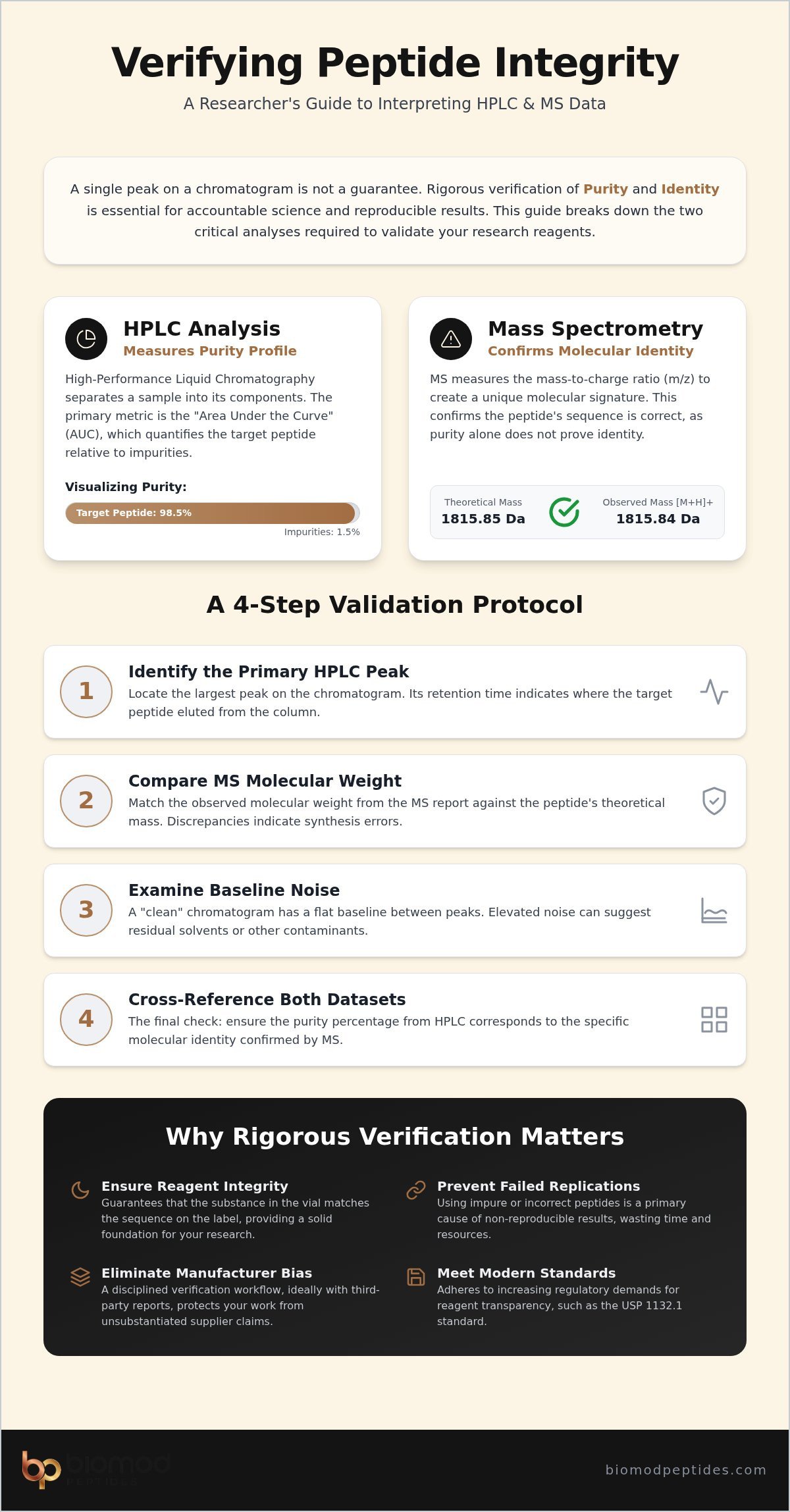
Systematic interpretation converts raw data into actionable proof. Understanding HPLC and MS data for peptides requires a four-step validation protocol. This methodology ensures that the substance in the vial matches the sequence on the label. It eliminates the risk of using sub-standard reagents that jeopardize months of laboratory work.
- Step 1: Identify the primary peak on the HPLC chromatogram. This peak’s retention time indicates the point where the target peptide eluted from the column.
- Step 2: Compare the observed molecular weight from the MS report against the theoretical mass. Discrepancies signify incorrect sequences, synthesis errors, or significant degradation.
- Step 3: Examine baseline noise. Elevated signal levels between peaks suggest residual solvents or excessive trifluoroacetic acid (TFA) from the cleavage process.
- Step 4: Cross-reference both datasets. The purity calculated in HPLC must correspond to the specific identity confirmed by the MS spectrum.
Decoding the HPLC Chromatogram
A “clean” chromatogram is defined as one where the main peak accounts for ≥98% of the total area. Distinguishing between significant impurities and standard baseline fluctuations is essential. Impurities appear as distinct, secondary peaks with measurable area. Baseline noise is typically stochastic and lacks the defined Gaussian shape of a peptide peak. For researchers requiring verified purity, accessing a reliable peptide source with transparent COA documentation is the gold standard for experimental integrity.
Analyzing the MS Spectrum Peaks
Mass spectra often display multiple ions for a single peptide. You’ll commonly observe the [M+H]+ and [M+2H]2+ ions; these represent the single and double protonated states of the molecule. A single, sharp peak in the MS report is the hallmark of a successfully synthesized sequence. Broad peaks or multiple high-intensity signals indicate a heterogeneous sample. Precision in this area prevents the use of truncated sequences that could lead to false-positive results in your research. Verify that the m/z values align with the calculated molecular weight of your specific peptide batch.
Validating Peptide Integrity through Independent Laboratory Verification
Analytical data is only as credible as its source. While understanding HPLC and MS data for peptides allows for internal verification, independent third-party testing is required to eliminate manufacturer bias. Relying solely on in-house reporting creates a conflict of interest that can compromise experimental outcomes. Rigorous laboratories prioritize external validation to ensure that purity claims are backed by objective, empirical evidence.
Accountability is maintained through accessible documentation. The COA Verification Portal serves as a centralized hub for cross-referencing batch numbers with original laboratory reports. This level of transparency is essential for standardized procurement protocols. For Las Vegas research institutions, utilizing US-based verification standards provides a logistical and qualitative advantage. It ensures that reagents are held to national benchmarks for structural integrity and chemical purity.
The Biomod Standard: Transparency and Verification
Every Certificate of Analysis (COA) must be a comprehensive reflection of the material’s current state. Biomod Peptides integrates raw HPLC chromatograms and MS spectra into every report. This provides the density of information required for professional validation. US-based finishing is a critical component of this standard. It protects the structural integrity of lyophilized peptides by ensuring the final processing occurs in controlled, high-tier environments. You can learn more about Biomod and our commitment to analytical precision through our rigorous testing sequences.
Procurement Checklist for Research-Grade Peptides
Generic claims of “99% purity” are insufficient without batch-specific evidence. Standardize your intake protocol by asking vendors these essential questions:
- Does this specific batch have a corresponding HPLC and MS report?
- What laboratory conducted the third-party verification?
- Are the raw data files accessible for independent review?
Avoid vendors who provide “typical” purity reports. A typical report is a historical average, not a guarantee of the current sample’s quality. Demand batch-specific data to maintain the integrity of your research framework.
Advancing Research Through Analytical Rigor
Precision is the final arbiter of research success. You now have the technical framework to distinguish between manufacturer claims and empirical reality. By utilizing AUC calculations for purity and m/z ratios for identity confirmation, you eliminate the variables that lead to experimental failure. This methodology transforms raw chromatographic data into a rigorous shield for your research integrity. It ensures that every sequence matches its theoretical signature without exception.
Accountability requires absolute transparency. Mastering the process of understanding HPLC and MS data for peptides is the definitive step toward establishing a disciplined reagent protocol. Biomod Peptides supports this standard through US-manufactured and finished products, backed by independent third-party lab reports for every batch. Our dedicated analytical verification portal provides the logistical transparency needed for modern laboratory procurement.
Access the Biomod Verification Portal to Validate Your Peptide Quality. Secure your data. Elevate your standards. Progression begins with verified evidence.
Frequently Asked Questions
What is the difference between peptide purity and peptide content?
Peptide purity represents the percentage of the target peptide relative to all other peptide-related impurities in the sample. Peptide content is the actual mass of the peptide compared to the total mass of the lyophilized powder, which often includes residual salts and moisture. A batch can maintain 99% purity while having a 75% peptide content. This distinction is critical for accurate dosing in laboratory environments.
Can I rely solely on HPLC data to verify my peptide?
No, HPLC data alone cannot confirm a substance’s identity. While HPLC quantifies purity by separating molecules, it doesn’t provide molecular weight or structural signatures. Understanding HPLC and MS data for peptides as an integrated report is mandatory. Mass spectrometry provides the necessary orthogonal data to prove that the isolated peak from the HPLC chromatogram actually corresponds to the intended peptide sequence.
What does a purity level of 98% actually mean in a research context?
A 98% purity level indicates that 98% of the signal detected during chromatography belongs to the target peptide. The remaining 2% consists of synthesis byproducts, such as truncated sequences or deamidated variants. In high-stakes research, these minor impurities can interfere with binding affinities or elicit unintended biological responses. Relying on batch-specific reports ensures these contaminants don’t compromise your experimental results.
How does mass spectrometry confirm the sequence of a peptide?
Mass spectrometry validates the sequence by measuring the precise mass-to-charge ratio of the peptide ions. The instrument produces an observed molecular weight that must match the theoretical mass calculated from the amino acid sequence. This process identifies synthesis errors, such as missing residues or incomplete deprotection. It provides a molecular signature that HPLC cannot achieve, ensuring the structural integrity of the research material.
Disclaimer
BIOMOD products are sold strictly for laboratory, analytical, and scientific research use only. They are not intended for human or animal consumption, administration, application, ingestion, injection, or any therapeutic, diagnostic, or cosmetic use.
The statements made on this website have not been evaluated by the United States Food and Drug Administration. BIOMOD products are not intended to diagnose, treat, cure, mitigate, or prevent any disease or medical condition.
BIOMOD is a research chemical supplier. BIOMOD is not a compounding pharmacy or chemical compounding facility as defined under Section 503A of the Federal Food, Drug, and Cosmetic Act. BIOMOD is not an outsourcing facility as defined under Section 503B of the Federal Food, Drug, and Cosmetic Act.
By accessing this site, you confirm you are at least 21 years of age and that you have read and accepted the BIOMOD Terms of Sale, Privacy Policy, and Research Use Only Policy. BIOMOD does not provide dosing, medical, therapeutic, diagnostic, veterinary, or use guidance under any channel.