
A 99% purity claim is a marketing statistic, not a scientific guarantee. In a landscape where the FDA is reclassifying peptides over 40 amino acids as biologics, the margin for error in your laboratory has vanished. You recognize that high-stakes research demands more than a supplier’s word. It’s difficult to parse complex HPLC chromatograms when they’re presented without context; the fear of using under-dosed or contaminated compounds is a legitimate professional concern. This protocol provides the technical framework you need for how to read a peptide certificate of analysis with clinical precision.
You’ll master the interpretation of HPLC and Mass Spectrometry reports to ensure the absolute integrity of your reagents. We’ll examine why the standard UV detection wavelength of 214-220 nanometers is non-negotiable and how to distinguish between Area % purity and actual peptide identity. This guide outlines the methods for verifying batch numbers through secure portals and identifying the red flags of fraudulent documentation. You’ll move beyond surface-level metrics to achieve total transparency in your procurement process. Data, not marketing, must dictate your methodology.
Key Takeaways
- Distinguish between HPLC purity percentages and Mass Spectrometry identity verification to ensure your compounds are both unadulterated and correctly sequenced.
- Establish absolute batch accountability by cross-referencing unique lot identifiers on your vials with the primary laboratory documentation.
- Master the technical protocol for how to read a peptide certificate of analysis to identify critical parameters like UV detection wavelengths and molar ratios.
- Implement digital forensics and date-alignment checks to detect manipulated data or inconsistencies in the production timeline.
- Utilize secure verification portals to provide independent validation and maintain a transparent chain of custody for all laboratory reagents.
Essential Components of an Analytical Certificate of Analysis
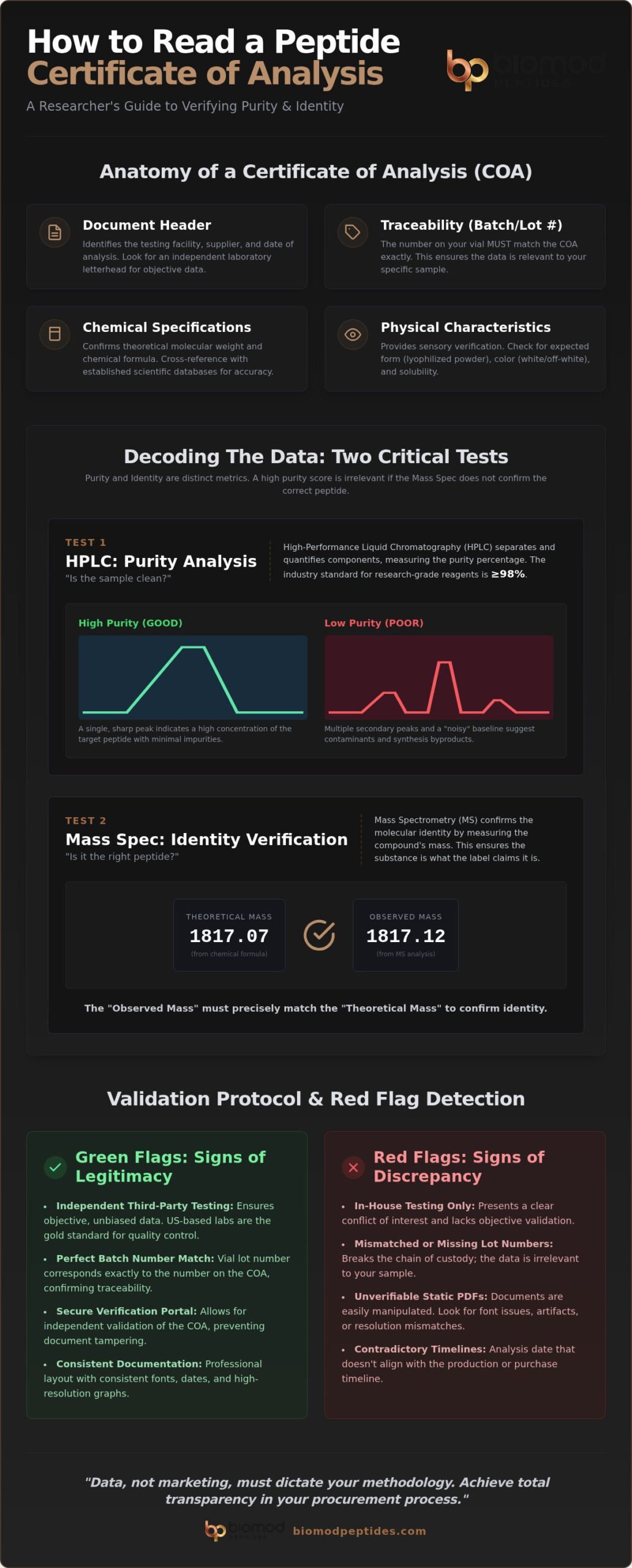
A Certificate of Analysis (COA) serves as the definitive record of a reagent’s chemical integrity. Understanding how to read a peptide certificate of analysis begins with the document header. This section must clearly identify the testing facility, the supplier, and the specific date of analysis. A missing laboratory letterhead or a date that contradicts the production timeline is a critical failure. Professional standards require that the laboratory remains an independent entity from the manufacturer to ensure objective data.
Traceability creates the necessary link between the analytical data and your laboratory sample. The batch or lot number on your vial must match the COA exactly. This isn’t a suggestion; it’s a requirement for professional accountability. Any deviation indicates a breakdown in the chain of custody, rendering the test results irrelevant to your specific sample. Verification is the only path to certainty.
The report specifies the theoretical molecular weight and chemical formula of the peptide. Researchers must cross-reference these values with established databases to confirm structural accuracy. Physical characteristics provide a final layer of sensory verification:
- Form: Lyophilized powder, often appearing as a uniform cake.
- Color: Typically white or off-white.
- Solubility: Precise behavior when introduced to sterile water or bacteriostatic saline.
The Role of Independent Third-Party Testing
Internal reports from a manufacturer present a conflict of interest. They lack the objective distance required for validation. For Las Vegas-based research institutions, domestic, US-based testing is the gold standard. It ensures reagents meet high-tier benchmarks. Verifying lab credentials in the header is vital when learning how to read a peptide certificate of analysis. Biomod Peptides prioritizes this transparency through independent third-party validation for every batch.
Decoding HPLC and Mass Spectrometry Results
High-Performance Liquid Chromatography (HPLC) is a technique for separating and quantifying components in a mixture. This analytical process measures the purity percentage of the target compound. For research-grade reagents, the industry standard is 98% or higher. Understanding how to read a peptide certificate of analysis requires looking past the final percentage to the raw data provided in the chromatogram. High purity is the baseline for laboratory safety.
Interpreting the HPLC Chromatogram
The chromatogram is a visual representation of the sample’s composition. You must analyze the main peak’s height, width, and area under the curve (AUC). A single, sharp peak indicates high purity. Secondary peaks, even small ones, represent impurities or synthesis byproducts. Integration tables show how the software calculates the final purity percentage by comparing the AUC of the main peak against the total area of all detected peaks. If the baseline is “noisy” or shows multiple significant peaks, the reagent is unsuitable for sensitive applications.
Confirming Identity via Mass Spectrometry
Mass Spectrometry (MS) confirms the molecular identity of the peptide sequence. It ensures the substance is exactly what the label claims. You must compare the “Observed Mass” on the MS graph to the “Theoretical Mass” listed in the chemical specifications. Small shifts in the observed peak often result from salt adducts or isotopes. These are common in peptide synthesis. However, a high purity score is irrelevant if the Mass Spec does not confirm the identity. Researchers who value this level of empirical proof often source from verified US-manufactured suppliers to ensure total batch transparency.
Purity and identity are distinct metrics. HPLC detects contaminants, while MS validates the chemical structure. Mastery of how to read a peptide certificate of analysis involves triangulating these two data sets to confirm both the quality and the nature of the compound. If the observed mass deviates from the theoretical mass by more than a negligible margin, the batch integrity is compromised. Empirical data must always override marketing claims.
Validation Protocols and Detecting Document Discrepancies
Document integrity is the final barrier against laboratory error. Static PDF reports are susceptible to unauthorized modification. Digital forensics involve scrutinizing the document for artifacts of manipulation, such as font inconsistencies, mismatched resolutions, or overlapping layers in the chromatogram. A legitimate report follows a standardized formatting structure. Any deviation from a lab’s established template suggests a compromise in authenticity. Rigorous scrutiny is a prerequisite for how to read a peptide certificate of analysis effectively.
Temporal alignment is equally critical. You must ensure the date of analysis aligns logically with the batch production timeline. A certificate dated before the synthesis of the reagent is an immediate red flag. Consistent reporting structures from accredited facilities allow researchers to establish a baseline for document validation. Discrepancies in metadata or headers often signal fraudulent activity. Precision in documentation reflects the precision of the underlying science.
Utilizing Verification Portals for Batch Authenticity
Static attachments lack the security of a live database. Modern validation requires a direct link to the source of truth. You can utilize our COA Verification Portal to ensure batch integrity by retrieving original reports directly from a secure database. This method eliminates the risk of manipulated results and provides a transparent chain of custody. Portals allow you to input unique batch numbers and receive immediate, unalterable confirmation of purity and identity.
For Las Vegas laboratories, verifiable data is the only acceptable standard. Biomod Peptides prioritizes this transparency to eliminate the ambiguity inherent in third-party retail. Moving beyond surface-level inspection is essential when mastering how to read a peptide certificate of analysis. Accountability is not a marketing claim; it’s a technical requirement verified through secure, portal-hosted documentation. Empirical proof remains the ultimate tool for researcher safety.
Advancing Laboratory Standards Through Empirical Verification
Scientific rigor requires a transition from passive consumption to active verification. You now possess the technical framework for how to read a peptide certificate of analysis with institutional precision. By triangulating HPLC purity data with Mass Spectrometry identity markers, you’ve eliminated the ambiguity that often compromises research outcomes. Document forensics and batch traceability are no longer optional; they’re the baseline for professional accountability in modern laboratories.
Integrity is maintained through US-manufactured and finished processes that prioritize transparency over marketing aesthetics. Every batch undergoes independent third-party lab validation to ensure it meets the highest analytical benchmarks. Our secure COA verification portal provides the final layer of security, offering unalterable proof of chemical composition for every vial. Don’t leave your methodology to chance or unverified claims. Browse Analytical Grade Research Peptides and Access Verified COAs to secure the reagents your work demands. Professional confidence starts with verifiable data.
Frequently Asked Questions
What is the difference between peptide purity and peptide content?
Peptide purity defines the percentage of UV-absorbing material that is the target sequence. It typically utilizes HPLC Area % to quantify the ratio of the peptide against other synthesis byproducts. Peptide content represents the actual weight of the peptide in the vial. It’s often lower than purity because it accounts for non-peptide components like residual water and counter-ions. Both metrics are required for precise dosing calculations.
Why does my COA show a molecular weight slightly different from the theoretical weight?
Mass Spectrometry identifies the mass-to-charge ratio of the sample. Observed mass often shifts slightly from the theoretical weight due to the presence of isotopes or salt adducts like sodium and potassium. These minor variances are expected in complex peptide synthesis and don’t indicate a structural failure. If the observed peak aligns with the predicted molecular weight within a standard margin of error, the identity is confirmed.
Can I trust a COA that is issued by the manufacturer instead of a third party?
Manufacturer-issued reports lack the objectivity required for clinical-grade research. They present a clear conflict of interest. Independent third-party validation is the industry standard for ensuring document accuracy. When you’re determining how to read a peptide certificate of analysis, always verify that the testing facility is a separate, accredited entity. This separation ensures that the data is an empirical reflection of the batch rather than a marketing tool.
What are the most common red flags on a fraudulent peptide COA?
Fraudulent reports often feature perfectly rounded purity percentages or lack a specific date of analysis. Inconsistent fonts and low-resolution chromatogram images suggest digital manipulation. A critical red flag is a batch number that fails to match the identifier on your vial. Mastery of how to read a peptide certificate of analysis involves checking for these discrepancies. Legitimate documents maintain consistent formatting and provide clear, high-resolution raw data for verification.
Disclaimer
BIOMOD products are sold strictly for laboratory, analytical, and scientific research use only. They are not intended for human or animal consumption, administration, application, ingestion, injection, or any therapeutic, diagnostic, or cosmetic use.
The statements made on this website have not been evaluated by the United States Food and Drug Administration. BIOMOD products are not intended to diagnose, treat, cure, mitigate, or prevent any disease or medical condition.
BIOMOD is a research chemical supplier. BIOMOD is not a compounding pharmacy or chemical compounding facility as defined under Section 503A of the Federal Food, Drug, and Cosmetic Act. BIOMOD is not an outsourcing facility as defined under Section 503B of the Federal Food, Drug, and Cosmetic Act.
By accessing this site, you confirm you are at least 21 years of age and that you have read and accepted the BIOMOD Terms of Sale, Privacy Policy, and Research Use Only Policy. BIOMOD does not provide dosing, medical, therapeutic, diagnostic, veterinary, or use guidance under any channel.