
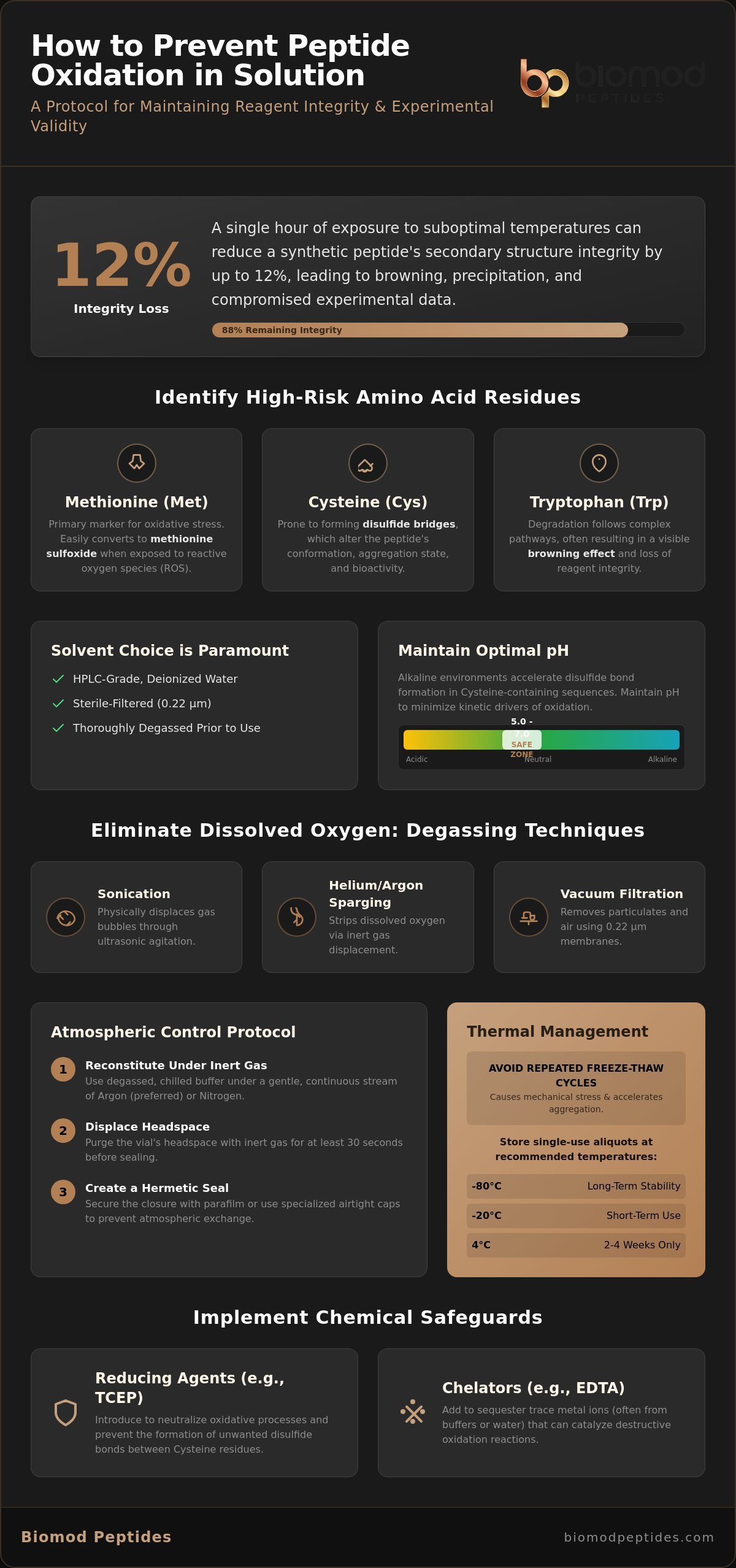
A single hour of exposure to suboptimal temperatures can reduce the secondary structure integrity of a synthetic peptide by up to 12%. This rapid kinetic degradation often leads to browning, precipitation, and the loss of high-purity reagents mid-experiment. You understand the frustration of inconsistent HPLC data caused by these chemical shifts. Mastering how to prevent peptide oxidation in solution is essential for data reproducibility and experimental validity.
You shouldn’t have to tolerate wasted reagents or compromised potency. This protocol details the analytical techniques and chemical safeguards required to maintain peptide integrity in aqueous environments. We will analyze the implementation of high-purity inert gas blankets, the necessity of degassed solvents, and the specific vulnerabilities of residues like Cysteine and Methionine. By refining these laboratory workflows, you’ll ensure stable peptide solutions and precise analytical results for the duration of your research.
Key Takeaways
- Identify high-risk residues including Methionine, Cysteine, and Tryptophan to implement sequence-specific protective measures.
- Optimize solvent pH and preparation techniques to mitigate the kinetic drivers of thioether and thiol oxidation.
- Master how to prevent peptide oxidation in solution by deploying inert gas manifolds and amber storage to eliminate oxygen and light exposure.
- Evaluate the use of reducing agents like TCEP and chelators like EDTA to neutralize metal-catalyzed reactions and prevent disulfide aggregation.
Mechanisms of Peptide Oxidation and Solvent Selection
Stability begins with the raw material. Researchers must establish a baseline for stability by starting with high purity research peptides. Even the most rigorous protocol fails if the initial sample contains pre-existing oxidative impurities. Understanding how to prevent peptide oxidation in solution requires a deep dive into the chemical vulnerabilities of the peptide structure and synthesis process. Precision is mandatory. Reagents aren’t static; they’re in a constant state of potential degradation.
Residue-Specific Vulnerabilities
Methionine (Met) is a primary marker for oxidative stress. It converts to methionine sulfoxide when exposed to reactive oxygen species (ROS). Cysteine (Cys) residues are equally problematic. They form disulfide bridges that alter the peptide’s conformation and bioactivity. Tryptophan (Trp) degradation follows complex pathways, often resulting in a visible browning effect in solution. These shifts aren’t just cosmetic. They indicate a fundamental loss of reagent integrity and experimental validity.
Solvent choice is paramount. Use only HPLC-grade, deionized, and sterile-filtered water for all research solutions. Solvent pH significantly influences the rate of thioether and thiol oxidation. Alkaline environments typically accelerate disulfide bond formation in Cysteine-containing sequences. Maintaining a pH between 5.0 and 7.0 is often necessary to minimize these kinetic drivers. It’s a delicate balance that requires constant monitoring.
The Role of Solvent Degassing
Dissolved oxygen is the primary catalyst for degradation in aqueous environments. You must remove it before reconstitution to ensure longevity. Effective degassing techniques include:
- Sonication: Physically displaces gas bubbles through ultrasonic agitation.
- Helium Sparging: Strips dissolved oxygen through inert gas displacement.
- Vacuum Filtration: Uses 0.22 μm membranes to remove both particulates and air.
By removing the oxygen source, you eliminate the primary pathway for oxidative damage. This step is non-negotiable for sensitive sequences.
A Step-by-Step Protocol for Atmospheric and Thermal Control
Atmospheric management is your primary defense against reagent loss. Once you’ve selected the appropriate solvent, you must isolate the solution from environmental catalysts. Ambient oxygen and light exposure trigger rapid degradation. Implementing a rigorous protocol for how to prevent peptide oxidation in solution requires specialized equipment and disciplined handling. Precision isn’t optional. It’s the baseline for reproducible research.
Inert Gas Purging and Sealing
Displacing ambient air with an inert gas manifold is a laboratory standard for sensitive sequences. Nitrogen is common, but Argon is often superior due to its higher density. Follow this sequence to ensure atmospheric exclusion:
- Step 1: Reconstitute the lyophilized powder using degassed, chilled buffer under a gentle, continuous stream of Argon.
- Step 2: Displace the vial headspace with inert gas for at least 30 seconds before final sealing.
- Step 3: Secure the closure with parafilm or utilize specialized airtight caps to maintain a hermetic seal.
This process mirrors the industrial standards used in preventing therapeutic protein oxidation, ensuring that dissolved oxygen doesn’t compromise your results. Use amber or opaque vials to mitigate photo-oxidation of sensitive side chains.
Thermal Management and Aliquotting
Repeated freeze-thaw cycles are deleterious to peptide stability. They cause mechanical stress and localized concentration shifts that accelerate aggregation. You must implement strict aliquotting protocols. Calculate single-use volumes based on your daily experimental needs. Store these aliquots at -20°C for short-term use or -80°C for long-term stability. Refrigeration at 4°C is only acceptable for 2 to 4 weeks depending on the sequence’s inherent vulnerability.
Maintain a consistent cold chain for all reagents. This is particularly vital for peptide spray products and other reconstituted formats used in sensitive environments. Variations in storage temperature directly correlate with potency loss. For consistent data, start your study with precision-manufactured research peptides that meet rigorous purity benchmarks.
Chemical Stabilization and Analytical Verification
Physical controls provide the first line of defense, but chemical safeguards offer the necessary redundancy for long-term stability. When considering how to prevent peptide oxidation in solution, the addition of specialized scavengers and chelators is a standard analytical requirement. These additives neutralize reactive species before they can interact with vulnerable side chains. Precision in chemical selection is as vital as atmospheric control.
Utilizing Radical Scavengers and Reducing Agents
Reducing agents are essential for sequences containing Cysteine. TCEP (tris(2-carboxyethyl)phosphine) is often preferred over DTT (dithiothreitol) due to its superior stability at room temperature and broad pH compatibility, typically ranging from pH 1.5 to 8.5. Unlike DTT, TCEP is odorless and doesn’t interfere with most downstream assays or maleimide-based labeling. You should also incorporate EDTA to chelate trace metal ions like Cu2+ or Fe3+, which catalyze oxidative reactions. Recommended concentrations for EDTA typically range from 0.1 to 1.0 mM. This chemical intervention is a core component of modern peptide stability strategies.
Monitoring Purity and Degradation
Analytical verification is the final pillar of research stability. Regular monitoring via HPLC and Mass Spectrometry (MS) identifies degradation before it compromises your data. Methionine sulfoxide formation is easily detectable as a +16 Da mass shift in MS profiles. If you observe this shift, the reagent’s integrity is already compromised. Consistent tracking allows you to adjust your protocol before experimental variance becomes unmanageable.
Verification must occur before the first pipetting step. You must verify the integrity of your starting material through the Biomod COA verification portal. Starting with a verified baseline ensures that any observed changes are a result of experimental variables rather than pre-existing impurities. By combining chemical stabilization with rigorous analytical standards for research, you maintain a laboratory-grade environment that prioritizes data integrity and reagent longevity.
Ensuring Analytical Integrity in Peptide Research
Mastering how to prevent peptide oxidation in solution requires a disciplined, multi-layered approach. You’ve analyzed the role of pH-optimized, degassed solvents and the necessity of atmospheric exclusion using inert gas blankets. You’ve also evaluated the integration of chemical scavengers like TCEP and the importance of regular HPLC/MS monitoring to detect oxidative mass shifts. These rigorous steps transform a vulnerable reagent into a stable, reproducible tool for your study. Precision in the protocol directly correlates with the validity of your final data set.
High-quality research depends on the verified integrity of the starting material. Our research peptides are US-manufactured in Las Vegas facilities and undergo independent third-party HPLC/MS testing to ensure stringent purity benchmarks. We provide transparent documentation through our dedicated verification portal for all Certificates of Analysis. This commitment to quality control eliminates baseline impurities that compromise your experimental outcomes. Secure High-Purity Reagents for Your Next Study and refine your laboratory workflow with professional-grade materials. Consistent methodology yields definitive results.
Frequently Asked Questions
Can I use antioxidants in all peptide research solutions?
No. Antioxidant selection depends on the specific peptide sequence and the intended assay requirements. While reducing agents like TCEP or DTT are effective for Cysteine-containing sequences, they may interfere with downstream enzymatic assays or maleimide-based labeling protocols. You must verify chemical compatibility before adding stabilizers. In many research contexts, physical controls like inert gas purging are safer than chemical additives that might alter experimental variables.
How long do peptides remain stable in solution at room temperature?
Stability at room temperature is extremely limited. Most reconstituted peptides begin degrading within hours. For sensitive sequences containing Methionine or Tryptophan, a single hour of exposure to suboptimal temperatures can reduce structural integrity by up to 12%. It’s best practice to keep solutions on ice during active use and return them to cold storage immediately. Understanding how to prevent peptide oxidation in solution requires minimizing any duration spent outside of controlled thermal environments.
What is the most effective gas for purging peptide vials?
Argon is the most effective inert gas for displacing atmospheric oxygen in the vial headspace. Since Argon is denser than air, it forms a more stable protective blanket over the solution surface compared to Nitrogen. This higher density ensures more efficient displacement of oxygen during the sealing process. Researchers should utilize high-purity (99.999%) Argon to prevent the introduction of trace contaminants that could catalyze oxidative degradation over time.
Does the concentration of the peptide solution affect its oxidation rate?
Yes. Solution concentration directly influences the rate of both oxidation and molecular aggregation. Higher concentrations increase the frequency of intermolecular interactions, which can accelerate the formation of disulfide bridges in Cysteine-rich sequences. Conversely, extremely dilute solutions are more vulnerable to surface adsorption on vial walls. Maintaining a moderate concentration, typically between 1 and 5 mg/mL, provides a balance between stability and utility while managing how to prevent peptide oxidation in solution effectively.
Disclaimer
BIOMOD products are sold strictly for laboratory, analytical, and scientific research use only. They are not intended for human or animal consumption, administration, application, ingestion, injection, or any therapeutic, diagnostic, or cosmetic use.
The statements made on this website have not been evaluated by the United States Food and Drug Administration. BIOMOD products are not intended to diagnose, treat, cure, mitigate, or prevent any disease or medical condition.
BIOMOD is a research chemical supplier. BIOMOD is not a compounding pharmacy or chemical compounding facility as defined under Section 503A of the Federal Food, Drug, and Cosmetic Act. BIOMOD is not an outsourcing facility as defined under Section 503B of the Federal Food, Drug, and Cosmetic Act.
By accessing this site, you confirm you are at least 21 years of age and that you have read and accepted the BIOMOD Terms of Sale, Privacy Policy, and Research Use Only Policy. BIOMOD does not provide dosing, medical, therapeutic, diagnostic, veterinary, or use guidance under any channel.