
The standard for peptide procurement in Nevada has shifted from simple availability to verifiable molecular integrity. Many researchers find that retail-grade options fail to meet the rigorous benchmarks required for reproducible results. Sourcing high-purity peptide softgels in Las Vegas requires more than a local search; it demands a technical evaluation of analytical data and stability protocols. Inconsistent purity levels and the absence of comprehensive Certificates of Analysis (COAs) can compromise months of laboratory work. Precision is the only acceptable metric in a professional research environment.
You likely recognize that the transition of compounds like BPC-157 into investigational clinical categories has tightened the requirements for Research Use Only compliance. This guide provides a technical framework for sourcing HPLC-verified reagents that maintain structural integrity during regional transport to Nevada labs. We will examine the necessity of third-party validation, the logistics of reliable regional shipping, and the specific criteria for selecting laboratory-grade softgels in 2026. Our objective is to ensure your procurement process matches the sophistication of your experimental design. This analysis prioritizes data-driven sourcing over traditional market narratives.
Key Takeaways
- Distinguish between retail-grade supplements and laboratory reagents to maintain rigorous compliance standards in Nevada research facilities.
- Analyze how softgel delivery systems protect sensitive peptide chains from oxidation and ensure uniform concentration across experimental batches.
- Evaluate the necessity of HPLC verification and Mass Spectrometry data for confirming the sequence identity and purity of your reagents.
- Implement procurement strategies for peptide softgels in Las Vegas that prioritize cold-chain logistics to prevent thermal degradation during regional transport.
- Identify the technical advantages of sourcing US-manufactured peptides that are subject to independent, third-party validation protocols.
Sourcing Laboratory-Grade Peptide Softgels in Las Vegas
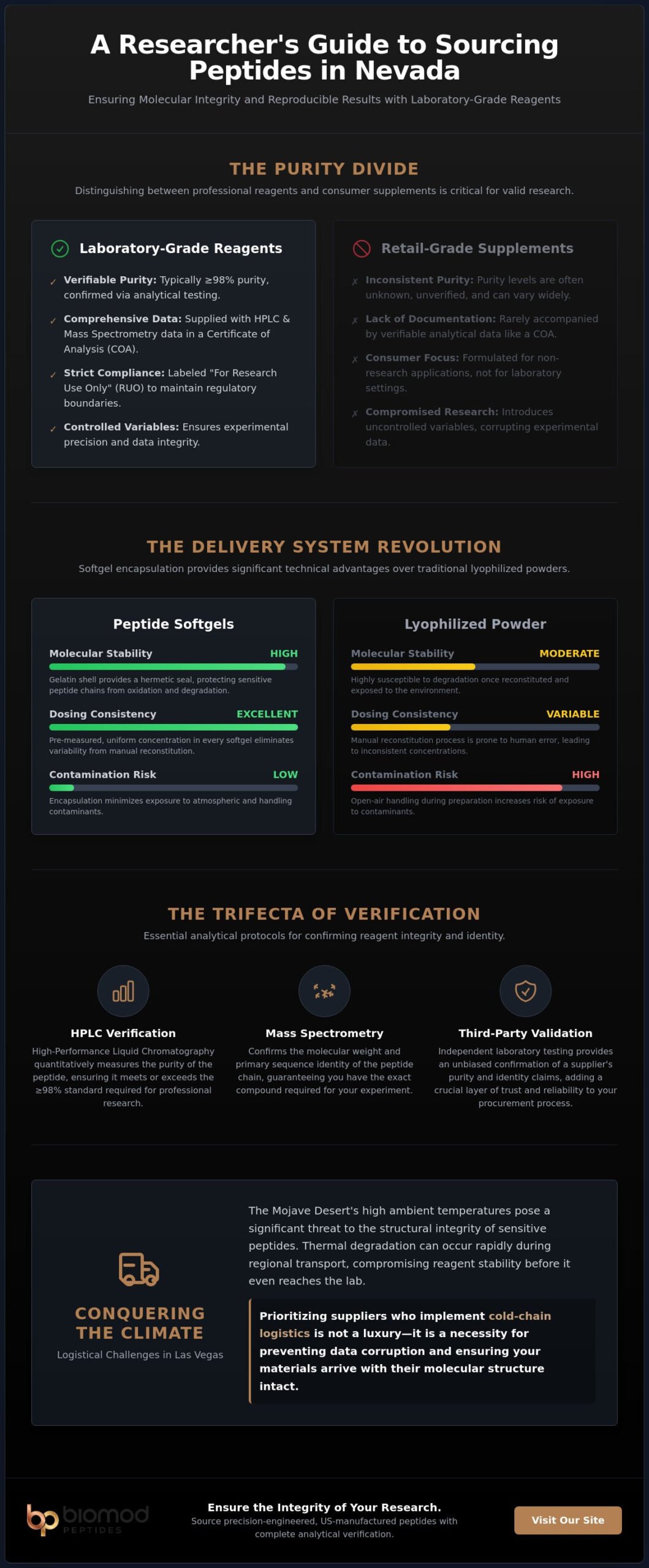
Effective laboratory procurement in Southern Nevada begins with a clear separation between therapeutic applications and analytical reagents. Professional researchers don’t source materials from wellness boutiques. They require reagents with documented molecular integrity. Peptides are short chains of amino acids that serve as the foundation for complex metabolic and neurological modeling. In the specialized field of peptide softgels in Las Vegas, the “Research Use Only” (RUO) designation isn’t a mere label. It’s a regulatory boundary that ensures materials haven’t been diverted into the consumer supply chain. This distinction is critical for maintaining institutional compliance and ensuring that experimental variables remain controlled. Precision in the procurement phase prevents data corruption in the analytical phase.
The Las Vegas Research Landscape
The Clark County biotech sector is expanding rapidly. Private laboratories and academic institutions now drive significant demand for high-purity reagents. Nevada’s life sciences growth centers on metabolic research and neuro-degenerative studies. These projects require purity levels of 98% or higher, verified via High-Performance Liquid Chromatography (HPLC). Sourcing peptide softgels in Las Vegas involves navigating a regional supply chain where stability is often threatened by environmental heat. Local facilities must prioritize suppliers that understand Nevada’s logistical challenges. Compliance with state-level procurement laws requires rigorous documentation of the reagent’s origin and its analytical profile. Meticulous record-keeping is the standard for Clark County’s scientific community.
Softgels vs. Traditional Lyophilized Formats
While lyophilized powders are the historical standard, softgel encapsulation offers distinct advantages for high-throughput environments. Precision matters. Softgels provide a pre-measured, stable format that eliminates the variability of manual reconstitution. This reduces human error during reagent preparation.
- Stability: The gelatin or polymer shell protects sensitive peptide chains from oxidation and degradation.
- Contamination Risk: Encapsulation minimizes exposure to atmospheric contaminants during handling.
- Consistency: Large research lots benefit from uniform ingredient distribution across the entire batch.
In a laboratory setting, these factors contribute to more reproducible data sets. Softgels represent a leap in methodology for researchers who require consistent delivery systems without the logistical friction of traditional powder handling. They provide a streamlined workflow for labs focused on efficiency and structural integrity. The transition to this format reflects a broader movement toward refined reagent delivery in modern biochemistry.
Technical Advantages of Softgel Delivery in Peptide Research
Molecular vulnerability defines the storage and handling requirements of synthetic peptides. These compounds are highly susceptible to enzymatic degradation and oxidative stress when exposed to laboratory environments. Standard lyophilized powders require immediate reconstitution, which often initiates a rapid decline in structural integrity. Softgel encapsulation provides a hermetic seal that isolates the peptide from atmospheric oxygen and moisture. This barrier is essential for maintaining the primary sequence of the reagent throughout the duration of a study. Research into the oral delivery of therapeutic peptides highlights the necessity of advanced delivery systems to overcome biological and chemical barriers. In a laboratory setting, these same systems serve as protective vessels for analytical grade materials.
The implementation of peptide softgels in Las Vegas facilities addresses the specific logistical risks of the Mojave environment. High ambient temperatures and low humidity can accelerate the degradation of non-encapsulated reagents. Softgel technology utilizes a specialized shell, often composed of gelatin or advanced polymers, to create a stable micro-environment for the active ingredient. This mechanical property ensures that the peptide remains in its intended state without the risk of sublimation or clumping associated with loose powders. Researchers can verify the precision of these formats through the analytical data sets provided by specialized suppliers.
Chemical Stability and Shelf Life
Softgel technology significantly mitigates the effects of light and oxygen on sensitive amino acid chains. The opaque or tinted nature of many shells provides a secondary layer of protection against UV-induced degradation. For Las Vegas facilities, this means reagents maintain their titer for longer periods under standard refrigeration. The stability coefficient of encapsulated peptides is defined as the ratio of preserved molecular activity over time relative to the rate of atmospheric exposure. Maintaining this coefficient is vital for longitudinal studies where reagent consistency is the primary variable.
Dosage Precision for In Vitro Studies
Experimental consistency relies on the uniformity of mass across all research lots. Manual weighing of lyophilized powders introduces a margin of error that can skew in vitro results. Softgel production utilizes high-precision filling equipment that ensures each unit contains an identical concentration of the peptide. This uniformity minimizes variance in longitudinal research data. Researchers can calculate concentration with higher confidence, as the active ingredient is already distributed within a standardized lipid or aqueous carrier. This level of precision is indispensable for modeling dose-response curves in complex biological systems. It allows for a more rigorous assessment of peptide behavior without the noise of measurement fluctuations.
Verification Protocols: HPLC Testing and Purity Standards
High-Performance Liquid Chromatography (HPLC) represents the analytical benchmark for assessing peptide purity. It isn’t optional. For researchers sourcing peptide softgels in Las Vegas, HPLC data provides the only empirical proof of chemical composition. This process separates the primary peptide from synthesis byproducts and truncated sequences based on chromatographic resolution. Mass Spectrometry (MS) complements this by confirming the molecular weight. It ensures the sequence synthesized matches the intended sequence exactly. Without these dual protocols, researchers risk using reagents that contain deleterious impurities. Common contaminants include residual solvents, moisture, and Trifluoroacetic acid (TFA), which can alter pH and interfere with sensitive in vitro assays. Precision in the laboratory requires absolute certainty regarding the reagent’s molecular identity.
Modern research requires more than internal synthesis reports. Independent validation is the standard. Scientific literature regarding strategies to enhance oral bioavailability emphasizes that formulation integrity depends entirely on the initial purity of the active pharmaceutical ingredient (API). Biomod Peptides addresses this by subjecting every production lot to third-party verification. This protocol ensures that the structural integrity discussed in previous sections is supported by objective, external data. Accountability is maintained through rigorous testing cycles that occur after the encapsulation process is complete.
Interpreting Certificates of Analysis (COA)
A Certificate of Analysis (COA) is a document of accountability. Researchers must scrutinize three primary metrics: purity percentage, TFA content, and moisture levels. Purity should be measured via the area under the curve (AUC) in an HPLC chromatogram. TFA, a common ion-pairing agent used in synthesis, must be quantified as high levels can be cytotoxic to certain cell lines. Digital transparency is essential. Utilizing a COA Verification Portal allows Las Vegas laboratories to cross-reference batch numbers with original laboratory results in real time. This prevents the use of expired or mislabeled reagents. Objective data remains the only shield against inconsistent manufacturing standards.
Purity Standards for Analytical Research
The scientific benchmark for high-tier research is 99% purity or higher. Reagents below this threshold introduce unknown variables into experimental models. Using non-validated peptides can lead to irreproducible data and false positives. Accountability in the supply chain is bolstered by US-based manufacturing and finishing. When procurement occurs within a domestic framework, the oversight regarding analytical standards is significantly more rigorous. For those procurement officers managing peptide softgels in Las Vegas, prioritizing US-manufactured reagents ensures that the chemical profile matches the technical specifications exactly. Precision is the foundation of scientific credibility. High-purity reagents are the only viable path for laboratories seeking to publish peer-reviewed, reproducible results.
Procurement Logistics for Las Vegas Research Facilities
Logistics in the Mojave Desert require specialized thermal management. Standard shipping protocols are insufficient for maintaining the molecular stability discussed in previous sections. Sourcing peptide softgels in Las Vegas necessitates a localized understanding of extreme temperature fluctuations. High-performance insulation and phase-change materials are required for every transit cycle. This ensures the chemical integrity of the reagent isn’t compromised before it reaches the lab bench. Institutional procurement must prioritize providers with established cold-chain capabilities to mitigate the risks of Nevada’s climate. Precision in shipping is as vital as precision in synthesis.
Compliance is the foundation of institutional research. Every acquisition must align with “Research Use Only” (RUO) terms of sale. These legal frameworks protect the facility by clarifying the intended analytical application of the material. Bulk procurement strategies should focus on lot-to-lot consistency. This allows for longitudinal studies without the noise of batch variation. Researchers can secure analytical grade reagents that meet these rigorous institutional standards through established supply channels. Reliability in the supply chain prevents experimental downtime and data gaps.
Regional Shipping and Handling
Optimizing delivery to the Las Vegas valley involves minimizing transit duration. Overnight or expedited shipping is the laboratory standard. Packaging must be engineered to withstand external temperatures exceeding 110°F during peak summer months. Softgels require specific handling to prevent shell softening or adhesion caused by thermal stress. Laboratory inventory managers should implement immediate receiving protocols. This includes verifying temperature indicators upon arrival and logging batch numbers into the internal tracking system. Prompt transition to climate-controlled storage is mandatory for maintaining the stability coefficient of the peptides.
Institutional Procurement Checklists
A systematic approach to vendor selection prevents procurement failures and ensures data reproducibility. Checklists should include verification of manufacturing origin and independent testing documentation. Institutional safety officers often require these documents for routine audits and compliance reviews.
- Manufacturing Origin: Confirm US-based manufacturing and finishing to ensure oversight.
- Analytical Data: Verify valid HPLC and Mass Spectrometry data for the specific batch number.
- Safety Documentation: Review Safety Data Sheets (SDS) for laboratory safety and handling compliance.
- Supply Continuity: Establish recurring supply schedules to avoid interruptions in ongoing studies.
These steps ensure that the laboratory remains audit-ready and scientifically sound. Meticulous documentation of the supply chain is as important as the experimental data itself. Reliable procurement allows scientists to focus on discovery rather than reagent instability. When the logistics are handled with clinical rigor, the research outcomes are significantly more dependable. Accountability starts at the point of origin and continues until the reagent is utilized in the experimental model.
Biomod Peptides: Precision Research Supply for Nevada Laboratories
Biomod Peptides functions as a specialized primary source for the scientific community. We don’t operate as a wellness clinic or a retail intermediary. Our methodology centers on the production and finishing of US-manufactured reagents within a strictly controlled supply chain. For institutions procuring peptide softgels in Las Vegas, this domestic oversight ensures that every unit meets established analytical benchmarks. We prioritize the structural integrity of the compound over traditional marketing aesthetics. Accountability is our primary metric. Precision in synthesis is meaningless without equal precision in the finishing and delivery phases.
Every production lot undergoes rigorous independent testing. This isn’t a secondary consideration; it’s the core of our quality management system. We provide transparent access to original HPLC and Mass Spectrometry data through our COA Verification Portal. This level of disclosure allows researchers to verify the molecular identity of their reagents before any experimental phase begins. It eliminates the ambiguity often found in retail-grade alternatives. By maintaining a direct connection between the manufacturing data and the end-user, we ensure that the integrity of your research is never compromised by unverified materials.
Our Commitment to Analytical Integrity
Precision is achieved through the continuous refinement of our delivery systems. We utilize technical feedback from the scientific community to optimize our formulations for maximum stability and consistency. Our focus remains on the development of high purity research peptides that adhere to the most stringent verification standards of 2026. This commitment ensures that your laboratory data is built on a foundation of chemical certainty. We maintain a laboratory-grade identity because the complexity of modern research leaves no room for impurities or sequence errors. Data reproducibility depends on the quality of the initial reagent.
Accessing the Biomod Catalogue
The Biomod inventory includes a diverse range of peptide softgels in Las Vegas and specialized peptide spray products. Each product category is engineered for specific laboratory applications, providing researchers with versatile delivery options that maintain sequence stability.
- Inventory Range: High-purity softgels and precision spray formats designed exclusively for RUO applications.
- Bulk Procurement: Streamlined protocols for Las Vegas facilities requiring large-scale lot consistency for longitudinal studies.
- Technical Support: Direct access to our technical team for inquiries regarding specialized research requirements or batch-specific analytical data.
Initiating a procurement cycle with Biomod Peptides ensures that your facility receives reagents validated through industry-standard protocols. We support the Nevada research sector by providing the logistical transparency and analytical depth required for high-tier scientific inquiry. Professional research demands professional supply. Our systems are designed to meet the gravity of your work with disciplined, data-backed reliability.
Advancing Analytical Standards in Southern Nevada
The integrity of laboratory data depends on the precision of the initial reagent. High-purity procurement requires a rigorous transition from retail wellness products to analytical-grade materials. Implementing peptide softgels in Las Vegas facilities provides a technical solution for stability and dosage consistency in complex experimental models. Success in 2026 requires objective verification through third-party HPLC testing and transparent documentation. Relying on US-manufactured and finished reagents ensures that sequence identity and purity benchmarks are consistently met. This domestic oversight provides the logistical transparency needed to navigate Nevada’s environmental challenges.
Accountability remains the standard for every research lot. Accessing a verifiable COA portal allows for real-time validation of molecular weight and purity percentages before laboratory use begins. This methodology eliminates the variables that compromise longitudinal studies and ensures that your results are built on a foundation of chemical certainty. We prioritize the gravity of your work through disciplined quality control and empirical proof. Precision is the only acceptable metric for modern biochemistry.
Browse Analytical Grade Peptide Softgels to secure reagents that meet these rigorous institutional benchmarks. Your commitment to scientific discovery deserves a procurement partner that values data as much as you do.
Frequently Asked Questions
Are peptide softgels in Las Vegas intended for human consumption?
No, peptide softgels in Las Vegas are strictly for laboratory research and analytical applications. These products aren’t intended for human or veterinary use. Every unit is labeled with the Research Use Only (RUO) designation to ensure compliance with institutional procurement standards. Biomod Peptides doesn’t provide medical advice or products for therapeutic use.
How does Biomod Peptides verify the purity of its softgel products?
We utilize a multi-stage verification protocol involving High-Performance Liquid Chromatography (HPLC) and Mass Spectrometry (MS). Every production lot is sent to an independent, third-party laboratory to confirm the primary sequence and purity levels. This process identifies potential impurities like residual solvents or truncated sequences. We only release batches that meet our internal benchmarks for molecular integrity.
What is the advantage of softgels over lyophilized powder for lab research?
Softgels offer superior protection against oxidation and enzymatic degradation compared to loose lyophilized powders. The hermetic seal created by the encapsulation process isolates the reagent from atmospheric moisture and light. This format also eliminates the variability of manual reconstitution. It provides a pre-measured concentration for high-throughput in vitro studies while reducing human error and contamination risks during reagent preparation.
Do you offer bulk procurement for Las Vegas-based biotech companies?
Yes, we provide specialized bulk procurement strategies for biotech facilities and academic institutions. Our system ensures lot-to-lot consistency, which is vital for maintaining the integrity of longitudinal research projects. Large-scale orders are managed with dedicated logistical support to ensure a reliable supply chain. Facilities can establish recurring delivery schedules to prevent experimental downtime and data gaps.
How are research peptides shipped to Las Vegas to ensure stability?
Every shipment of peptide softgels in Las Vegas utilizes advanced cold-chain logistics and high-performance thermal insulation. We use phase-change materials to maintain stable internal temperatures during transit, especially during peak summer months. Expedited shipping protocols minimize time in the regional logistical network. This rigorous approach prevents thermal degradation and maintains the stability coefficient of the peptides until they reach your climate-controlled storage.
What documentation is provided with each peptide softgel order?
Each order includes a comprehensive Certificate of Analysis (COA) and a Safety Data Sheet (SDS). The COA details the purity percentage, molecular weight, and batch-specific analytical results from third-party testing. This documentation is essential for laboratory safety audits and institutional compliance. We provide the technical evidence required to validate the structural integrity of every reagent delivered to your facility.
Can I verify the HPLC results for my specific batch online?
Yes, researchers can access batch-specific analytical data through our COA Verification Portal. By entering the unique batch number found on the product packaging, you can view the original HPLC chromatograms and Mass Spectrometry reports. This real-time transparency allows for immediate validation before initiating experimental protocols. It ensures that the material in your lab matches the technical specifications exactly.
What are the storage requirements for peptide softgels in a lab setting?
Laboratory managers should store peptide softgels in a climate-controlled environment, typically between 2°C and 8°C for short-term use. For long-term stability, deeper refrigeration or freezing protocols may be required depending on the specific peptide sequence. It’s critical to avoid frequent temperature fluctuations and exposure to direct light. Proper storage maintains the primary sequence integrity and prevents the shell from softening or adhering.
Disclaimer
BIOMOD products are sold strictly for laboratory, analytical, and scientific research use only. They are not intended for human or animal consumption, administration, application, ingestion, injection, or any therapeutic, diagnostic, or cosmetic use.
The statements made on this website have not been evaluated by the United States Food and Drug Administration. BIOMOD products are not intended to diagnose, treat, cure, mitigate, or prevent any disease or medical condition.
BIOMOD is a research chemical supplier. BIOMOD is not a compounding pharmacy or chemical compounding facility as defined under Section 503A of the Federal Food, Drug, and Cosmetic Act. BIOMOD is not an outsourcing facility as defined under Section 503B of the Federal Food, Drug, and Cosmetic Act.
By accessing this site, you confirm you are at least 21 years of age and that you have read and accepted the BIOMOD Terms of Sale, Privacy Policy, and Research Use Only Policy. BIOMOD does not provide dosing, medical, therapeutic, diagnostic, veterinary, or use guidance under any channel.