
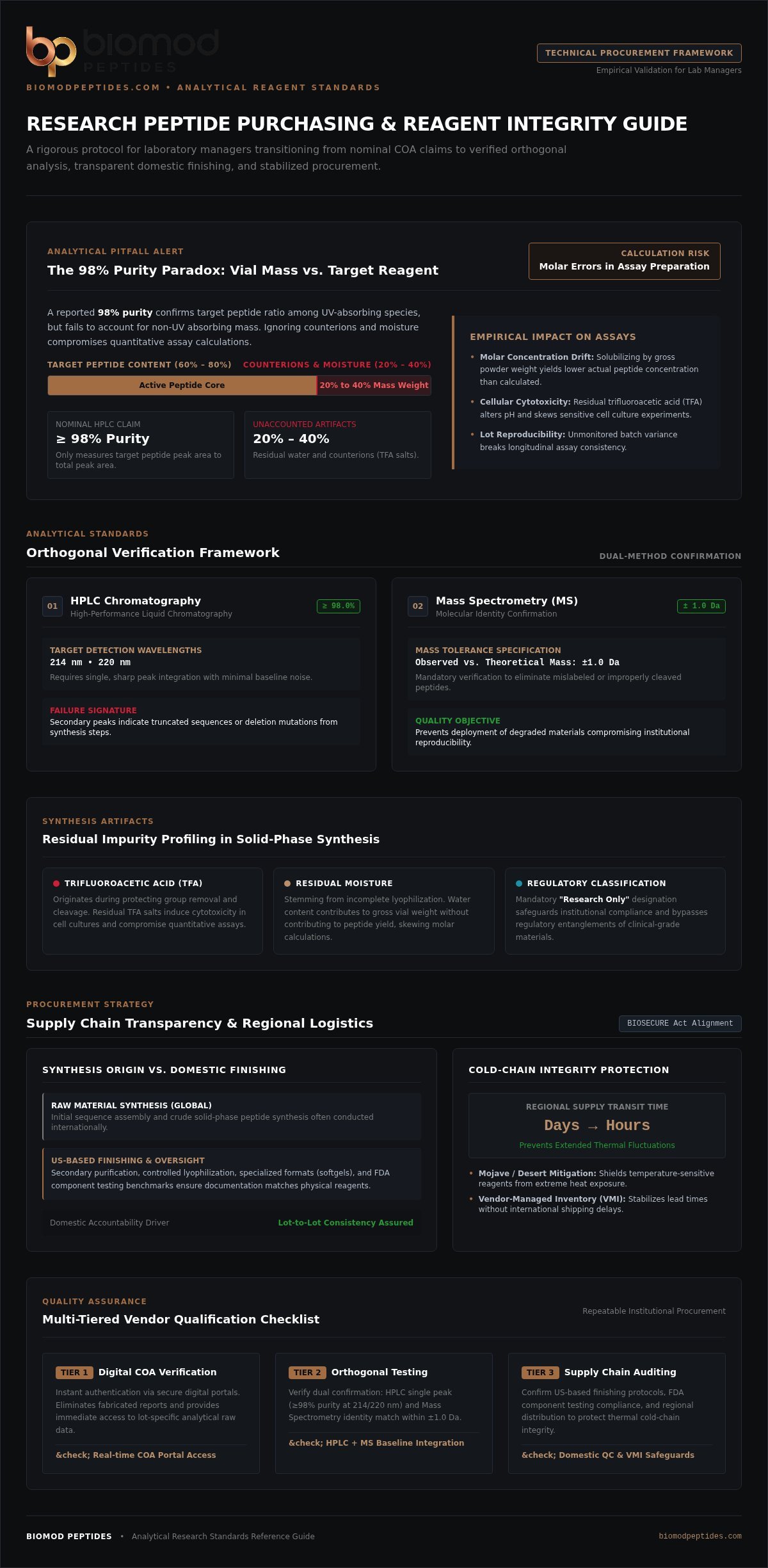
A 98% purity report on a Certificate of Analysis doesn’t guarantee a successful assay. If your lab ignores the 20% to 40% of vial mass consisting of counterions and moisture, your molar calculations are already compromised. You recognize that batch-to-batch inconsistency and opaque manufacturing origins represent the highest risks to experimental reproducibility. This 2026 research peptide purchasing guide for lab managers establishes a rigorous framework for evaluating reagent integrity and stabilizing procurement protocols. We’ll provide a repeatable vendor qualification checklist and verify how the BIOSECURE Act impacts domestic supply chains. You’ll learn to navigate the transition toward US-manufactured reagents and specialized formats like softgels. We prioritize empirical proof over marketing claims to ensure your laboratory operates with absolute technical precision. This guide moves your procurement from simple acquisition to rigorous validation.
Key Takeaways
- Establish analytical-grade benchmarks. Require 98% purity thresholds verified through orthogonal HPLC and Mass Spectrometry analysis.
- Evaluate supply chain transparency. Use this research peptide purchasing guide for lab managers to assess the impact of US-based finishing on reagent stability.
- Implement rigorous qualification protocols. Leverage secure digital portals for immediate, third-party Certificate of Analysis (COA) verification.
- Mitigate experimental risk. Identify critical impurity profiles, including residual trifluoroacetic acid (TFA), that compromise quantitative assay results.
Establishing Technical Benchmarks for Analytical Grade Peptides
Precision in procurement begins with a rigid definition of analytical grade. For lab managers, this standard requires purity thresholds exceeding 98% as verified by High-Performance Liquid Chromatography (HPLC) and Mass Spectrometry. This research peptide purchasing guide for lab managers emphasizes that nominal purity isn’t sufficient for high-stakes assays. HPLC purity is the ratio of the target peptide peak area to the total peak area. Accuracy matters. This metric alone doesn’t account for non-UV absorbing contaminants like moisture or counterions.
Robust impurity profiling must identify residual water content and trifluoroacetic acid (TFA). These artifacts often stem from solid-phase peptide synthesis principles where protecting group removal and cleavage introduce specific chemical signatures. High TFA levels can induce cytotoxicity in sensitive cell cultures. It skews results. Maintaining a “Research Only” designation is also essential. It ensures your facility adheres to strict legal and ethical standards. It avoids the regulatory complications of clinical-grade materials. It’s a necessary safeguard for institutional compliance.
Interpreting HPLC and Mass Spectrometry Reports
Analyzing chromatograms requires scrutiny of baseline noise and peak integration. This research peptide purchasing guide for lab managers advocates for verifying a single, sharp peak at 214 nm or 220 nm. Secondary peaks suggest truncated sequences or deletion mutations. Mass Spectrometry provides identity verification by confirming the observed molecular weight against the theoretical sequence within a standard mass tolerance of ±1.0 Da. Verification is mandatory. For a detailed breakdown of these metrics, review the protocol for peptide purity verification. This secondary validation prevents the use of mislabeled or degraded reagents that compromise data reproducibility.
Evaluating Supply Chain Transparency and US-Based Manufacturing
Transparency in the peptide industry is often obscured by vague marketing claims. A critical distinction exists between raw material sourcing and domestic finishing processes. While synthesis may occur globally, US-based finishing ensures that secondary purification, lyophilization, and final quality control follow rigorous domestic benchmarks. This research peptide purchasing guide for lab managers highlights that domestic accountability is the primary driver of lot-to-lot consistency. Without localized finishing, researchers risk receiving reagents that have degraded during extended international transit.
Accountability requires more than a label. It demands adherence to FDA component testing and supplier qualification requirements to ensure every batch meets pre-defined analytical specs. By maintaining domestic oversight, providers can guarantee that the documentation matches the physical reagent. You can learn more about these rigorous US manufacturing standards at Biomod Peptides. For facilities requiring absolute precision, verifying the origin of your research peptides is a non-negotiable step in vendor qualification.
Strategic Benefits of Regional Supply Chains
Logistical reliability is paramount for temperature-sensitive reagents. For Las Vegas laboratories, utilizing a regional provider reduces transit times from days to hours. This minimizes exposure to the extreme thermal fluctuations common in the Mojave region, which can compromise cold-chain integrity and peptide stability. Regional supply chains also enable more effective vendor-managed inventory (VMI) strategies. This ensures that critical sequences are always available without the lead-time volatility associated with overseas shipping. For further insights on optimizing your facility’s inventory, consult our laboratory peptide supply resource guide. This research peptide purchasing guide for lab managers notes that localized distribution isn’t just about speed. It’s about preserving the structural integrity of your analytical reagents.
Implementing a Multi-Tiered Vendor Qualification Protocol
Standard procurement often relies on trust. This research peptide purchasing guide for lab managers advocates for a data-driven alternative. A multi-tiered qualification protocol removes subjectivity from vendor selection. It establishes a repeatable framework for quality assurance. Using a research peptide purchasing guide for lab managers ensures that institutional standards remain uncompromising across every fiscal cycle.
Tier 1 involves digital verification. Accessing a secure COA portal allows for real-time authentication of lot-specific data. You can observe this transparency firsthand at Biomod Peptides, where documentation is readily accessible for every sequence in the catalog. Tier 2 requires independent third-party validation. This step ensures that the manufacturer’s internal integration matches external analytical findings. It eliminates the risk of biased data or selective reporting. Tier 3 evaluates the suitability of specialized reagent formats for specific experimental designs. This final tier ensures the physical format matches the delivery requirements of the study.
Advanced Formats: Integrating Softgels and Spray Products
Modern metabolic research often requires stabilized reagents. Analytical applications for peptide softgels provide a solution for studies requiring precise, encapsulated dosing. These formats protect the peptide from premature degradation in complex environments. Similarly, peptide spray products are utilized for precision delivery in intranasal studies. These specialized delivery systems ensure uniform distribution across mucosal surfaces. For technical guidance on these delivery systems, consult the guide on intranasal peptide research sprays. Selecting the correct format is as vital as verifying purity for achieving reproducible results.
Advancing Laboratory Standards Through Rigorous Procurement
Reliable research outcomes require more than just chemical acquisition; they demand systematic validation. This research peptide purchasing guide for lab managers has outlined the necessity of 98% purity thresholds and the critical role of US-based finishing in maintaining lot consistency. By implementing a multi-tiered qualification protocol, your facility can mitigate the risks associated with opaque supply chains and undocumented impurities. Precision is the baseline for breakthrough science.
We provide the tools for this level of accountability through independent third-party testing and a dedicated COA verification portal. Access the Biomod Peptides Research Catalog and Verification Portal to ensure your laboratory operates with absolute technical confidence. Your commitment to rigorous procurement today safeguards the integrity of your data tomorrow. Secure your next study by prioritizing reagents that meet the highest analytical benchmarks.
Laboratory Procurement FAQ
How do I verify the authenticity of a peptide Certificate of Analysis (COA)?
Verification requires matching the unique lot number through a secure digital portal to independent third party laboratory results. Authentic COAs must provide raw HPLC chromatograms and Mass Spectrometry spectra to confirm molecular weight and peak integration. This research peptide purchasing guide for lab managers emphasizes that digital verification prevents the use of forged or recycled documentation, ensuring data integrity.
What is the acceptable purity percentage for high-throughput peptide research?
High throughput screening generally accepts a baseline purity of 95%. However, for sensitive assays involving cell viability or receptor binding, a threshold of 98% or higher is the analytical standard. Using reagents with lower purity introduces synthesis artifacts that compromise signal to noise ratios. Consistent purity levels are mandatory for maintaining the precision and reproducibility of quantitative laboratory data across various experimental cycles.
Why is US-based manufacturing critical for research peptide stability?
Domestic manufacturing provides logistical transparency and strict adherence to quality control benchmarks. For Las Vegas facilities, US based finishing significantly reduces the duration of cold chain transit. This minimizes the risk of thermal degradation during shipping. Localized oversight ensures that secondary purification and lyophilization occur under controlled conditions, providing a level of accountability that international supply chains often lack.
Can softgels and spray products be used for analytical laboratory applications?
Specialized formats such as peptide softgels and spray products are engineered for specific experimental delivery protocols. Softgels provide a stabilized environment for metabolic research, while spray products facilitate precision delivery in intranasal studies. This research peptide purchasing guide for lab managers notes that these formats must be verified for analytical purity to ensure they function as reliable reagents within a controlled laboratory setting.
Disclaimer
BIOMOD products are sold strictly for laboratory, analytical, and scientific research use only. They are not intended for human or animal consumption, administration, application, ingestion, injection, or any therapeutic, diagnostic, or cosmetic use.
The statements made on this website have not been evaluated by the United States Food and Drug Administration. BIOMOD products are not intended to diagnose, treat, cure, mitigate, or prevent any disease or medical condition.
BIOMOD is a research chemical supplier. BIOMOD is not a compounding pharmacy or chemical compounding facility as defined under Section 503A of the Federal Food, Drug, and Cosmetic Act. BIOMOD is not an outsourcing facility as defined under Section 503B of the Federal Food, Drug, and Cosmetic Act.
By accessing this site, you confirm you are at least 21 years of age and that you have read and accepted the BIOMOD Terms of Sale, Privacy Policy, and Research Use Only Policy. BIOMOD does not provide dosing, medical, therapeutic, diagnostic, veterinary, or use guidance under any channel.