
A single milligram of contaminated peptide can invalidate months of cellular signaling data. You recognize that non-reproducible results often stem from hidden impurities rather than flawed experimental design. When unexpected cytokine storms occur in cell assays, the culprit is frequently residual Lipopolysaccharides (LPS). Understanding why low endotoxin levels matter in cell research is essential for maintaining the analytical integrity of your laboratory.
This critical analysis identifies how endotoxin contamination skews physiological data and outlines the rigorous standards required for reagent selection. We examine the sensitivity of the Limulus Amebocyte Lysate (LAL) test, which detects concentrations as low as 0.03 EU/mL. You’ll learn to establish a reliable protocol for reagent validation and identify reputable US-based peptide suppliers that prioritize third-party verification. We focus on the structural integrity of your research materials to eliminate variables in signaling studies and ensure your data withstands peer scrutiny.
Key Takeaways
- Identify how lipopolysaccharides (LPS) act as structural confounders and learn why low endotoxin levels matter in cell research for maintaining analytical integrity.
- Analyze the specific mechanisms by which residual endotoxins alter cell viability, proliferation, and differentiation during in vitro studies.
- Evaluate the risk of “false positive” results in inflammation assays where hidden contaminants, rather than the peptide itself, trigger biological responses.
- Discover the rigorous synthesis protocols and US-based manufacturing standards, including specialized chromatography, required to achieve ultra-low endotoxin benchmarks.
Understanding Endotoxins as Critical Experimental Confounders
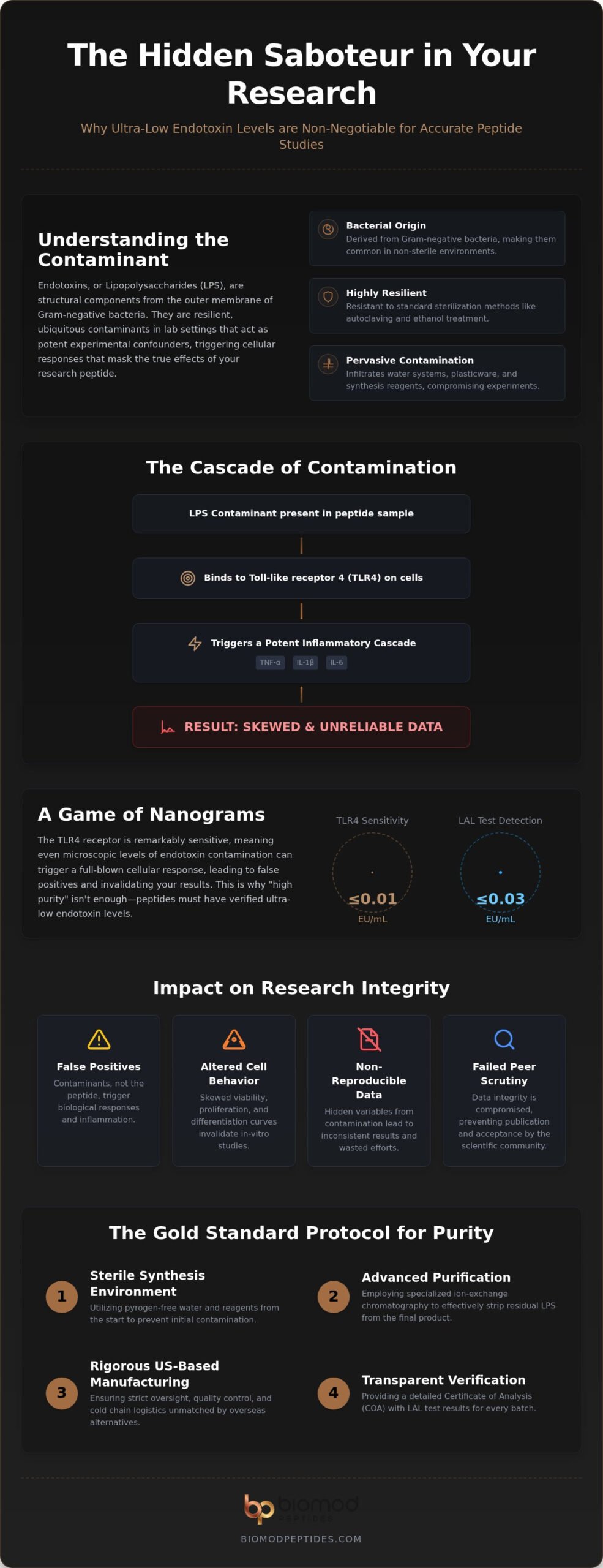
Endotoxins are structural components derived from the outer membrane of Gram-negative bacteria. These molecules, formally known as Lipopolysaccharide (LPS), are among the most resilient contaminants in laboratory settings. They aren’t destroyed by standard autoclaving or ethanol treatment. Consequently, LPS becomes ubiquitous in non-sterile environments, infiltrating water systems, plasticware, and synthesis reagents. For the modern laboratory, these molecules act as primary experimental confounders. They trigger non-specific cellular pathways that obscure the actual physiological effects of the peptide being studied. This is precisely why low endotoxin levels matter in cell research. High-purity standards are the only way to ensure that observed data reflects the peptide’s activity rather than a bacterial artifact.
The TLR4 Signaling Pathway and Immune Activation
Cellular recognition of LPS occurs primarily through the Toll-like receptor 4 (TLR4) complex. This interaction initiates a potent inflammatory cascade. Even trace amounts of LPS can trigger a “cytokine storm” involving the release of TNF-α, IL-1β, and IL-6. These responses are particularly damaging in immunological and metabolic research because they generate false positives. Such artifacts suggest bioactivity where none exists, preventing the accurate mapping of signaling pathways. Understanding why low endotoxin levels matter in cell research is the foundation of reproducible science. The TLR4 receptor is remarkably sensitive, responding to endotoxin concentrations as low as 0.01 EU/mL. US-based manufacturing protocols provide the necessary control to mitigate these risks for Las Vegas laboratories before the product reaches the bench.
The Impact of Endotoxin Contamination on Assay Integrity
Endotoxin presence fundamentally disrupts cellular homeostasis. It alters critical parameters like viability, proliferation, and differentiation in vitro. When researchers observe skewed growth curves or erratic metabolic activity, they often blame the peptide sequence or dosage. However, rigorous purity standards prove that bacterial contamination is the more likely variable. This is why low endotoxin levels matter in cell research. Without them, you’re measuring the cell’s reaction to a structural contaminant, not your intended research agent. High concentrations of Lipopolysaccharides (LPS) can even induce apoptosis in sensitive cell lines, prematurely ending studies before meaningful data is collected.
Differentiating Physiological Effects from Contaminant Interferences
Researchers must identify subtle interference patterns early in the experimental process. An unexpected baseline activation in quiescent cells often signals LPS presence. Standard 0.22 micron sterile filtration is insufficient for remediation. Endotoxins are heat stable and possess a small molecular size that easily bypasses common laboratory filters. A recent case study on endotoxin contamination demonstrates how these “silent” variables compromise longitudinal studies. This reality reinforces why low endotoxin levels matter in cell research, as even trace contamination induces chronic inflammatory markers that mask the peptide’s true pharmacological profile.
Avoiding these artifacts requires a transition to analytical grade peptides. This ensures that experimental reproducibility isn’t sacrificed for lower-tier reagents. Current peptide science trends favor advanced purification methods, such as specialized ion-exchange chromatography, to effectively strip LPS from the final product. For laboratories focused on signaling integrity, Biomod Peptides offers the verified transparency needed to eliminate these variables through US-based manufacturing and meticulous lot testing.
Achieving Ultra-Low Endotoxin Standards in Peptide Synthesis
Minimizing Lipopolysaccharide (LPS) introduction requires a sterile synthesis environment and high-purity reagents. Every step of the production process serves as a potential contamination point. We utilize pyrogen-free water and specialized ion-exchange chromatography to systematically remove residual endotoxins. This meticulous approach explains why low endotoxin levels matter in cell research, as it prevents the introduction of non-specific variables that compromise assay results. US-based manufacturing ensures rigorous oversight of the entire finishing process. This proximity allows for tighter control over cold chain logistics and purity protocols compared to overseas alternatives.
Verification Protocols and COA Transparency
The Limulus Amebocyte Lysate (LAL) test remains the industry standard for quantifying endotoxin levels with extreme precision. It can identify concentrations as low as 0.03 EU/mL, providing the resolution needed for sensitive cell assays. For deeper technical insights, researchers should review the FDA guidance on endotoxin testing regarding sampling and out-of-specification results. Biomod Peptides reinforces this rigor through independent third-party validation for every production lot, serving as a vital safeguard for Las Vegas laboratories.
Accountability depends on accessible data. Researchers can utilize our COA Verification Portal to confirm lot-specific endotoxin data and purity metrics. This transparency ensures that the reagents you use don’t introduce hidden confounders into your signaling studies. US-manufactured research peptides must undergo independent validation to meet 2026 analytical standards. By prioritizing verified purity, you address why low endotoxin levels matter in cell research and protect the integrity of your experimental outcomes.
Advancing Experimental Integrity through Analytical Purity
Ensuring data reproducibility requires an uncompromising approach to reagent selection. We’ve established that endotoxins act as potent confounders, capable of triggering non-specific immune responses that mask true physiological effects. This is fundamentally why low endotoxin levels matter in cell research; without verified purity, your assays remain susceptible to silent variables that invalidate months of laboratory work. By prioritizing rigorous LAL testing and utilizing pyrogen-free synthesis environments, you protect the structural integrity of your signaling studies.
Biomod Peptides maintains these benchmarks through strict analytical grade quality control. Every product is finished in the United States and undergoes independent third-party COA verification to guarantee absolute transparency. Explore our catalog of US-manufactured research peptides with verified purity standards to secure the precision your methodology demands. We’re committed to providing the reliable reagents necessary for your next scientific breakthrough.
Frequently Asked Questions
What is the acceptable endotoxin level for cell culture research?
Most high-quality research peptides maintain endotoxin levels below 1 EU/mg. This threshold ensures that the reagent doesn’t trigger non-specific Toll-like receptor activation in sensitive cell lines. While specific requirements vary by assay, staying below this benchmark is why low endotoxin levels matter in cell research. It prevents the confounding inflammatory responses that compromise longitudinal data.
How do endotoxins affect the stability of research peptides?
Endotoxins don’t typically degrade the primary amino acid sequence, but they significantly impact the biological stability of the experimental environment. Their presence can induce enzymatic activity in cell cultures, leading to premature peptide degradation through proteolysis. This environmental instability obscures the peptide’s true half-life. Maintaining ultra-low levels is essential for ensuring that observed metabolic effects aren’t artifacts of bacterial contamination.
Can endotoxins be removed from a peptide sample after reconstitution?
Removing endotoxins after reconstitution is technically difficult and often compromises the peptide’s concentration and structural integrity. Standard 0.22 μm filters don’t trap these molecules because they’re extremely small and heat-stable. Specialized affinity resins can strip LPS, but they often bind to the research peptide as well. It’s more efficient to source analytical-grade reagents that meet strict purity standards before the benchwork begins.
Why is the LAL test preferred over other pyrogen detection methods?
The Limulus Amebocyte Lysate (LAL) test is the gold standard due to its unmatched sensitivity and specificity. It can detect endotoxin concentrations as low as 0.03 EU/mL, far exceeding the resolution of older rabbit pyrogen tests. This precision is why low endotoxin levels matter in cell research; it allows for the quantification of trace contaminants that would otherwise go unnoticed until they skew experimental signaling results.
Disclaimer
BIOMOD products are sold strictly for laboratory, analytical, and scientific research use only. They are not intended for human or animal consumption, administration, application, ingestion, injection, or any therapeutic, diagnostic, or cosmetic use.
The statements made on this website have not been evaluated by the United States Food and Drug Administration. BIOMOD products are not intended to diagnose, treat, cure, mitigate, or prevent any disease or medical condition.
BIOMOD is a research chemical supplier. BIOMOD is not a compounding pharmacy or chemical compounding facility as defined under Section 503A of the Federal Food, Drug, and Cosmetic Act. BIOMOD is not an outsourcing facility as defined under Section 503B of the Federal Food, Drug, and Cosmetic Act.
By accessing this site, you confirm you are at least 21 years of age and that you have read and accepted the BIOMOD Terms of Sale, Privacy Policy, and Research Use Only Policy. BIOMOD does not provide dosing, medical, therapeutic, diagnostic, veterinary, or use guidance under any channel.