
What Are Peptides?
If you follow developments in scientific research, biological therapeutics, or biochemical synthesis, you have likely encountered the term. But what are peptides, exactly?
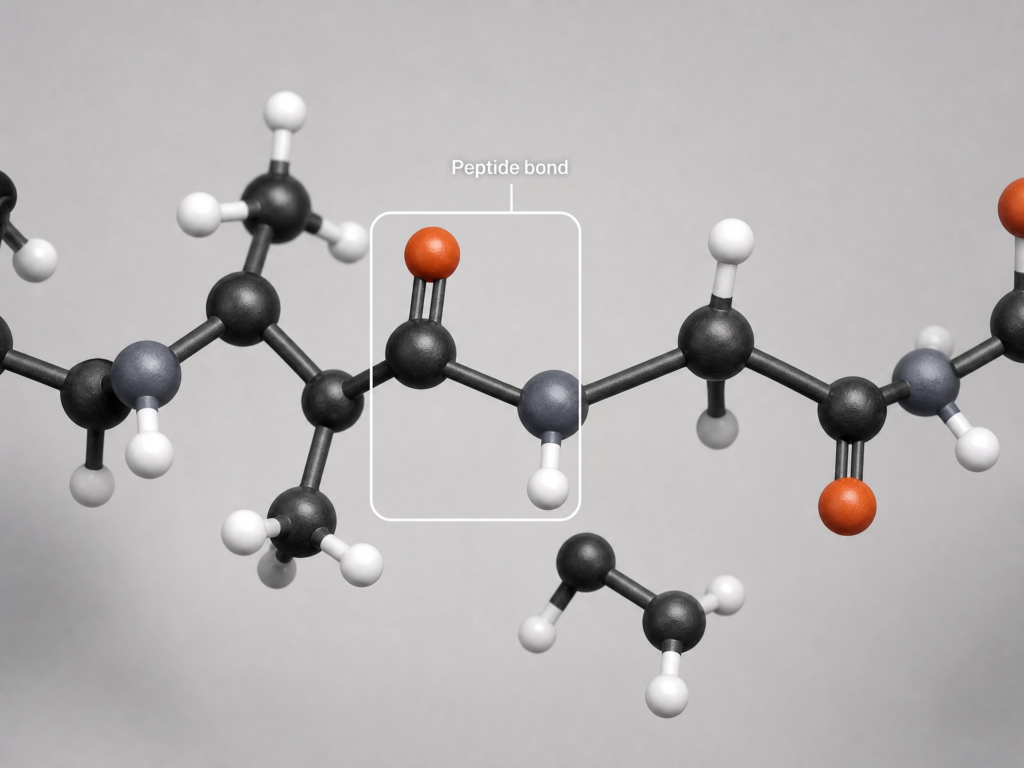
Peptides are short chains of amino acids linked together by covalent peptide bonds. They serve as fundamental biological messengers, transmitting specific instructions across cellular receptors. Today, over 25% of modern biological therapeutics and laboratory probes utilize high-potency amino acid sequences. Understanding the underlying science of these amino acid chains is essential for maintaining experimental validity, selecting proper research reagents, and applying strict laboratory protocols.
Key Takeaways
- Define Molecular Boundaries: Understand how amino acid length and peptide bonds differentiate short-chain peptides from complex proteins.
- Recognize Biological Mechanisms: Learn how small peptide chains interact directly with cell-surface targets to regulate physiological processes.
- Maintain Primary Containment: Implement Class II Biological Safety Cabinets and dual-glove protocols to prevent accidental aerosolization or exposure when handling lyophilized sequences.
- Control Environmental Factors: Utilize inert gas blanketing (Argon/Nitrogen) and strict cold-chain protocols during reconstitution to avoid hydrolytic and oxidative degradation.
- Verify Reagent Quality: Integrate Mass Spectrometry (MS) and High-Performance Liquid Chromatography (HPLC) data to confirm sequence identity and detect synthesis impurities.
Table of Contents
- Molecular Definition: What Are Peptides?
- Peptides vs. Proteins: Key Differences
- Primary Classes and Research Applications
- Primary Containment & Handling Protocols
- Environmental Controls & Reconstitution Stability
- Analytical Verification: Mass Spectrometry & HPLC Analysis
- Frequently Asked Questions
Molecular Definition: What Are Peptides?
To master laboratory protocols, one must first answer a fundamental question: what are peptides, exactly?
Peptides are organic compounds composed of two or more amino acids joined in a specific sequence. These chains act as targeted molecular signals within biological systems. Because they feature shorter sequences than full-length proteins, peptides exhibit unique bio-availability and rapid receptor-binding capabilities.
When cells communicate, peptides bind directly to specific surface receptors, acting much like a key fitting into a lock. Consequently, this binding triggers specific downstream biological actions—such as stimulating collagen synthesis, signaling hormone production, or initiating tissue repair pathways.
Peptides vs. Proteins: Key Differences
While both peptides and proteins consist of amino acid building blocks, their structural boundaries and biological functions differ significantly:
| Property | Peptides | Proteins |
| Chain Length | Typically 2 to 50 Amino Acids | 50+ Amino Acids |
| Molecular Structure | Linear or short cyclic chains; minimal higher-order folding | Complex tertiary and quaternary folded structures |
| Solubility & Absorption | High bio-availability; rapid receptor binding | Requires enzymatic breakdown for cellular utilization |
| Primary Examples | Copper Peptides (GHK-Cu), Signal Sequences | Collagen, Keratin, Monoclonal Antibodies |
Because peptides are smaller and less complex than full proteins, they can interact directly with cell-surface targets without needing prior enzymatic degradation. This high specificity makes research-grade peptides invaluable for mapping cellular pathways, modeling drug interactions, and studying tissue regeneration.
Primary Classes and Research Applications
Synthetic and naturally occurring peptides generally fall into specific structural and functional categories based on how they interact with cellular targets:
1. Signal Peptides
First, signal peptides send clear messages to target cells. For example, in dermatological and cellular research, signal peptides prompt skin cells to synthesize fresh collagen and elastin.
2. Carrier Peptides
Additionally, carrier peptides deliver trace minerals (such as copper or manganese) directly to enzymatic pathways. As a result, this targeted delivery aids in tissue repair and cell remodeling processes.
3. Neurotransmitter-Inhibiting Peptides
Furthermore, specialized synthetic peptides modulate chemical neurotransmission. In research environments, these compounds are studied for their ability to affect neuromuscular signaling.
4. Regulatory & Hormonal Peptides
Finally, biomimetic peptides replicate endogenous hormones. Specifically, researchers study these sequences to better understand appetite regulation, metabolic pathways, and growth hormone release at the cellular level.
Primary Containment & Handling Protocols
Effective handling protocols for high-purity peptides begin with physical containment barriers. Researchers should never rely on uncontained benchtop techniques when working with bioactive lyophilized powders.
Containment Framework
- Biological Safety Cabinets: All weighing, handling, and reconstitution must occur inside a Class II Biological Safety Cabinet (BSC) with HEPA filtration to eliminate the risk of accidental aerosolization.
- Designated Hot Zones: Facilities should isolate potent sequence preparation inside dedicated manipulation areas to centralize residue monitoring and prevent facility-wide cross-contamination.
PPE & Exposure Mitigation
- Dual-Gloving: Wear two layers of high-grade nitrile gloves, changing the outer layer immediately upon contact with containers or transfer tools.
- Respiratory Protection: Lyophilized fines are easily disturbed. N95 or higher particulate filtering respirators protect against inhalation during powder transfers.
- Anti-Static Precautions: Static charges pose a hidden danger during dry powder handling by causing fine particles to jump and aerosolize unexpectedly. Use grounded spatulas or anti-static ionizers during sample weighing.
Environmental Controls & Reconstitution Stability
A peptide’s structural integrity is highly sensitive to atmospheric oxygen, temperature shifts, and moisture uptake. To prevent sequence degradation and guarantee experimental reproducibility, strict environmental controls must be maintained during liquid transfer and storage.
Plaintext
[Lyophilized Cake] ➔ [Inert Gas Purge (Argon)] ➔ [Reconstitution Buffer] ➔ [Single-Use Aliquoting] ➔ [Ultra-Low Thermal Storage]
Preventing Oxidative Degradation
Oxidative stress can alter amino acid side chains (particularly methionine and cysteine residues). Implementing inert gas blanketing with Argon or Nitrogen during reconstitution purges atmospheric oxygen from the vial headspace. Argon is preferred in laboratory settings due to its higher density, forming a protective barrier over the liquid surface during pipette operations.
Thermal & Moisture Management
- Hygroscopic Cake Protection: Lyophilized peptide cakes absorb atmospheric humidity rapidly. Vials must acclimatize to room temperature before opening to prevent internal moisture condensation, which triggers hydrolytic breakdown.
- Avoiding Freeze-Thaw Cycles: Reconstituted stock solutions should be divided into single-use aliquots immediately. Repeated thermal fluctuations accelerate peptide bond cleavage, invalidating quantitative assays.
Analytical Verification: Mass Spectrometry & HPLC Analysis
Physical handling controls are only as reliable as the underlying data validating the reagent. Accurate laboratory risk assessments require absolute certainty regarding the purity and sequence identity of the material.
1. Mass Spectrometry (MS)
Mass Spectrometry provides the definitive molecular weight of the peptide. By measuring the mass-to-charge ratio ($m/z$), MS analysis confirms that the amino acid sequence matches the exact theoretical weight of the target compound.
2. High-Performance Liquid Chromatography (HPLC)
High-Performance Liquid Chromatography quantifies purity by separating the primary target sequence from short-chain synthesis byproducts or truncated sequences.
- Purity Thresholds: Research applications require a purity baseline (typically $\ge 98\%$).
- Peak Integrity: Chromatograms should exhibit a single, sharp primary peak. Jagged baselines, shoulder peaks, or secondary spikes indicate impurities that could cause unintended biological activity or skew assay data.
Verifying Reagent Provenance
Researchers must cross-reference lot numbers with independent third-party testing documentation. Accessing a dedicated Certificate of Analysis (COA) portal ensures that the documentation corresponds to the physical batch in your workstation, eliminating the risk of mislabeled or substandard reagents.
Frequently Asked Questions
What are peptides and how do they differ from amino acids?
Amino acids are the single monomeric units (building blocks) of proteins. Peptides are short polymers created when two or more amino acids link together via covalent peptide bonds.
What is the primary risk when handling lyophilized research peptides?
The primary risk is the accidental inhalation of fine lyophilized powders or dermal exposure during weighing. Static electricity during powder transfer increases this risk by causing particles to aerosolize. Utilizing Class II BSCs and anti-static tools effectively mitigates this hazard.
How should contaminated tools and vials be decontaminated?
Surfaces and reusable tools should be treated with a 10% bleach solution or enzymatic cleaner to neutralize residue, followed by a 70% ethanol rinse to protect stainless steel surfaces. Sharps and empty vials must be placed directly into puncture-resistant hazardous waste containers.
Why is third-party HPLC and MS testing necessary for laboratory safety?
Independent third-party analytical data provides empirical proof of sequence identity and purity. Without HPLC and MS verification, unexpected synthesis byproducts or mislabeled compounds could introduce unknown variables, skewing data and compromising laboratory safety protocols.
Disclaimer
BIOMOD products are sold strictly for laboratory, analytical, and scientific research use only. They are not intended for human or animal consumption, administration, application, ingestion, injection, or any therapeutic, diagnostic, or cosmetic use.
The statements made on this website have not been evaluated by the United States Food and Drug Administration. BIOMOD products are not intended to diagnose, treat, cure, mitigate, or prevent any disease or medical condition.
BIOMOD is a research chemical supplier. BIOMOD is not a compounding pharmacy or chemical compounding facility as defined under Section 503A of the Federal Food, Drug, and Cosmetic Act. BIOMOD is not an outsourcing facility as defined under Section 503B of the Federal Food, Drug, and Cosmetic Act.
By accessing this site, you confirm you are at least 21 years of age and that you have read and accepted the BIOMOD Terms of Sale, Privacy Policy, and Research Use Only Policy. BIOMOD does not provide dosing, medical, therapeutic, diagnostic, veterinary, or use guidance under any channel.