
A single microbial contaminant can invalidate months of longitudinal data and thousands of dollars in research capital. Precision is not a luxury in the laboratory. It is a fundamental requirement. You recognize that inconsistent results often stem from subtle reagent degradation or biological interference. Identifying exactly when to use sterile peptides in research is the difference between a definitive publication and a failed protocol. This guide identifies the specific experimental milestones where sterile-grade reagents are mandatory for data integrity and long-term stability. We analyze how to decipher HPLC and COA reports to ensure your materials meet rigorous institutional biosafety standards. You will learn to maintain peptide stability throughout extended studies and eliminate the variables that compromise reproducibility. Analytical purity requires more than a high percentage on a report. It requires a commitment to sterile methodology.
Key Takeaways
- Distinguish between chemical purity and biological sterility to eliminate biochemical interference in complex research protocols.
- Identify the specific experimental milestones for when to use sterile peptides in research, including in vivo models and primary cell line maintenance.
- Evaluate the impact of endotoxin levels on cellular signaling pathways to ensure long-term data reproducibility and institutional compliance.
- Implement rigorous quality control standards by utilizing third-party COA verification and US-based manufacturing for logistical transparency.
Sterility vs. Purity: Decoding Analytical Grade Standards
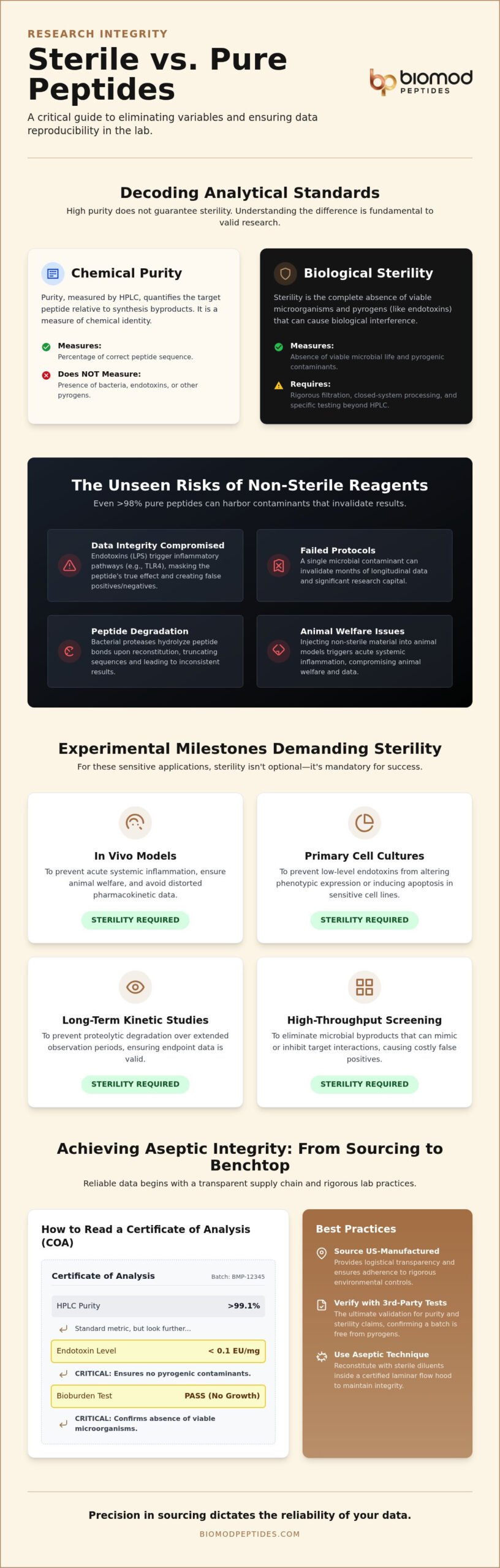
Analytical purity and biological sterility are distinct metrics. High-performance liquid chromatography (HPLC) quantifies chemical identity relative to synthesis byproducts. It doesn’t detect microbial life. A reagent with >98% purity can still harbor significant bacterial loads. Synthesis environments are not inherently sterile. Precision is non-negotiable. Researchers must determine when to use sterile peptides in research to prevent off-target biological responses. Endotoxins, specifically lipopolysaccharides, are potent inflammatory triggers. They activate Toll-like receptors, such as TLR4, which can alter cellular signaling pathways. This interference masks experimental variables and compromises data integrity. Lyophilization helps maintain a sterile state by removing moisture necessary for microbial metabolism. However, freeze-drying doesn’t eliminate pre-existing contaminants. Data integrity is paramount.
Microbial Interference and Peptide Stability
Bacteria produce proteases that catalyze the hydrolysis of peptide bonds. This leads to rapid sequence degradation upon reconstitution. Implementing aseptic laboratory techniques is vital to extend the shelf-life of your reagents. Contamination introduces enzymes that truncate sequences and yield inconsistent kinetic results. Understanding when to use sterile peptides in research is essential for longitudinal studies. Proper handling prevents environmental pathogens from compromising your stock. The ‘sterile’ standard in a research context is the absence of viable microorganisms and pyrogens. Maintaining this standard ensures that the biological activity observed is solely attributable to the peptide sequence. Rigorous filtration and closed-system processing are required to achieve this level of structural integrity. Without these safeguards, long-term studies face a high risk of metabolic interference. Precision requires accountability.
When to Prioritize Sterile Peptides in Experimental Design
Selecting the appropriate reagent grade is a critical decision in protocol development. High purity is standard, yet it’s often insufficient for complex biological systems. Determining when to use sterile peptides in research depends on the proximity of the reagent to live biological models. In vivo studies require absolute sterility. Introducing non-sterile material into animal models triggers an acute systemic inflammatory response. This compromises animal welfare and introduces confounding variables that distort pharmacokinetic data. Sourcing from reputable US-based providers ensures these benchmarks are met before the reagent reaches your bench.
Cell culture applications involving primary cell lines are equally sensitive. Standard research-grade peptides may introduce low-level endotoxins that alter phenotypic expression or induce apoptosis. In high-throughput screening, microbial byproducts can mimic or inhibit target interactions, causing costly false positives. Long-term kinetic studies also necessitate sterility to prevent proteolytic degradation over weeks of observation. Contamination at the start of a study can lead to total experimental failure by the final time point.
In Vitro vs. In Vivo Sterility Requirements
The risk profile shifts significantly between benchtop assays and live models. Understanding when to use sterile peptides in research is vital for avoiding baseline noise in sensitive immunological studies. Non-sterile peptides often induce unintended cytokine expression, such as IL-6 or TNF-alpha, which masks the peptide’s true physiological effect. In vivo environments lack the controlled buffer of a culture dish, making sterility a non-negotiable requirement for systemic administration. You can learn about Biomod Peptides’ commitment to quality and our rigorous validation processes that support these critical research demands. Precision in sourcing dictates the reliability of your resulting data.
Sourcing and Maintaining Aseptic Integrity in the Lab
Reliable data depends on supply chain integrity. Sourcing US-manufactured peptides provides logistical transparency that offshore vendors often lack. This oversight ensures manufacturing facilities adhere to rigorous environmental controls. Establishing exactly when to use sterile peptides in research is the first step toward securing reproducible outcomes. Independent third-party testing serves as the ultimate validation for purity and sterility claims. It’s the only way to confirm a batch is free from pyrogenic contaminants before it enters your protocol.
Interpreting a Certificate of Analysis (COA) requires looking beyond the HPLC purity percentage. Look for specific endotoxin units (EU/mg) and bioburden test results. Identifying when to use sterile peptides in research is a prerequisite for maintaining institutional biosafety compliance. Aseptic reconstitution is just as vital as the reagent’s initial state. Use sterile, preservative-free diluents and handle all materials within a certified laminar flow hood. Even a brief exposure to non-sterile air can compromise a lyophilized cake’s integrity. Precision in the lab demands uncompromising standards from synthesis to reconstitution.
Verification Protocols for Researchers
Accountability begins with objective proof. Utilize a COA verification portal to confirm batch-specific data against independent laboratory results. Enter the unique lot number to access specific endotoxin levels and purity markers. Once the vial’s seal is breached, maintain aseptic integrity by storing reconstituted peptides in single-use aliquots at -20°C or -80°C. This prevents repeated freeze-thaw cycles and limits environmental exposure. Red flags in vendor documentation include missing numerical values for bioburden, outdated testing dates, or certificates that lack third-party laboratory credentials. Precision requires transparency at every logistical tier.
Advancing Experimental Precision Through Analytical Standards
Reproducible data begins with rigorous reagent selection. Understanding when to use sterile peptides in research ensures that biological responses result from the peptide sequence rather than microbial interference. You’ve seen how endotoxin levels compromise cellular signaling and why high-purity reports aren’t synonymous with sterility. Maintaining aseptic integrity from synthesis through reconstitution is vital for longitudinal study success. We provide US-manufactured reagents that undergo independent third-party testing for both purity and sterility. Our transparent COA verification portal allows you to validate batch-specific data with institutional precision. Don’t let baseline contamination undermine your next breakthrough. Explore High-Purity Sterile Peptides for Your Next Research Project and secure the structural integrity your data demands. Your commitment to these standards ensures the advancement of reliable, verifiable science.
Frequently Asked Questions
Is all ‘research-grade’ peptide material sterile?
No, research-grade designation does not guarantee sterility. Standard research reagents focus on chemical purity quantified by HPLC but often contain viable microorganisms unless specifically processed for sterility. Identifying when to use sterile peptides in research is critical for preventing baseline contamination in sensitive biological assays. Always verify batch-specific sterility markers on the Certificate of Analysis before proceeding with in vivo or cell culture protocols.
Can I filter-sterilize my own peptides using a 0.22-micron filter?
You can utilize a 0.22-micron syringe filter to remove bacteria from reconstituted solutions, but this method does not eliminate endotoxins or pyrogens. Syringe filtration also risks significant peptide loss due to non-specific binding to the membrane material. For high-precision studies, starting with a pre-validated sterile reagent is superior to manual filtration. This ensures structural integrity and concentration accuracy are maintained throughout the study.
What are endotoxins and why do they matter in peptide research?
Endotoxins are lipopolysaccharides found in the outer membrane of gram-negative bacteria. They are potent pyrogens that trigger inflammatory cascades in biological models. In research, endotoxin contamination can induce unintended cytokine expression and alter cellular signaling pathways. This creates experimental noise that invalidates data. Determining when to use sterile peptides in research involves assessing the sensitivity of your specific biological target to these inflammatory triggers.
How does sterility affect the stability of peptide spray products?
Sterility is essential for the long-term stability of peptide spray products. Microbial contamination introduces proteases that catalyze the enzymatic cleavage of peptide sequences, leading to rapid degradation and loss of biological activity. A sterile formulation prevents microbial proliferation within the delivery mechanism. It ensures the structural integrity of the peptide remains intact over the duration of the study, providing consistent dosing and reproducible results.
What is the difference between sterile water and bacteriostatic water for research?
Sterile water for injection is a single-use diluent containing no antimicrobial agents. Bacteriostatic water contains 0.9% benzyl alcohol, which acts as a preservative to inhibit microbial growth. While bacteriostatic water allows for multiple draws from a single vial, the presence of benzyl alcohol can interfere with certain sensitive cell cultures or in vivo models. Researchers must select the diluent that aligns with their specific experimental requirements.
Disclaimer
BIOMOD products are sold strictly for laboratory, analytical, and scientific research use only. They are not intended for human or animal consumption, administration, application, ingestion, injection, or any therapeutic, diagnostic, or cosmetic use.
The statements made on this website have not been evaluated by the United States Food and Drug Administration. BIOMOD products are not intended to diagnose, treat, cure, mitigate, or prevent any disease or medical condition.
BIOMOD is a research chemical supplier. BIOMOD is not a compounding pharmacy or chemical compounding facility as defined under Section 503A of the Federal Food, Drug, and Cosmetic Act. BIOMOD is not an outsourcing facility as defined under Section 503B of the Federal Food, Drug, and Cosmetic Act.
By accessing this site, you confirm you are at least 21 years of age and that you have read and accepted the BIOMOD Terms of Sale, Privacy Policy, and Research Use Only Policy. BIOMOD does not provide dosing, medical, therapeutic, diagnostic, veterinary, or use guidance under any channel.