
A laboratory relocation is not merely a logistical transition. It’s a high-stakes stability experiment where the variables are often outside your direct control. You’ve invested significant resources into your current inventory, and the fear of thermal degradation during transit is a legitimate concern for any principal investigator. Maintaining molecular integrity isn’t just about packing boxes; it’s about preserving analytical consistency across different environments.
Mastering the protocols for transporting research peptides during a lab move is the only way to ensure your samples remain viable for future study. This article provides a critical stability checklist designed to eliminate material loss and maintain regulatory compliance. We’ll detail the precise requirements for cold-chain validation, documented inventory integrity, and the verification steps needed to prove post-move stability. Efficiency is the goal. Data integrity is the benchmark. Prepare for a transition that prioritizes the structural data of your research over the simple mechanics of the move.
Key Takeaways
- Conduct a comprehensive inventory audit to categorize reagents by stability requirements. Differentiating between lyophilized powders and reconstituted liquids is essential for establishing transport priority.
- Establish rigorous cold-chain protocols for transporting research peptides during a lab move. Utilize phase-change materials instead of standard ice packs to ensure precise thermal regulation.
- Deploy secondary containment strategies to protect samples from vibration and physical damage. This step is critical for maintaining the structural data of high-purity reagents.
- Verify analytical consistency immediately upon arrival through detailed visual inspection and COA cross-referencing. Use professional verification portals to document that no thermal excursions occurred during transit.
Pre-Move Assessment: Evaluating Peptide Stability and Inventory
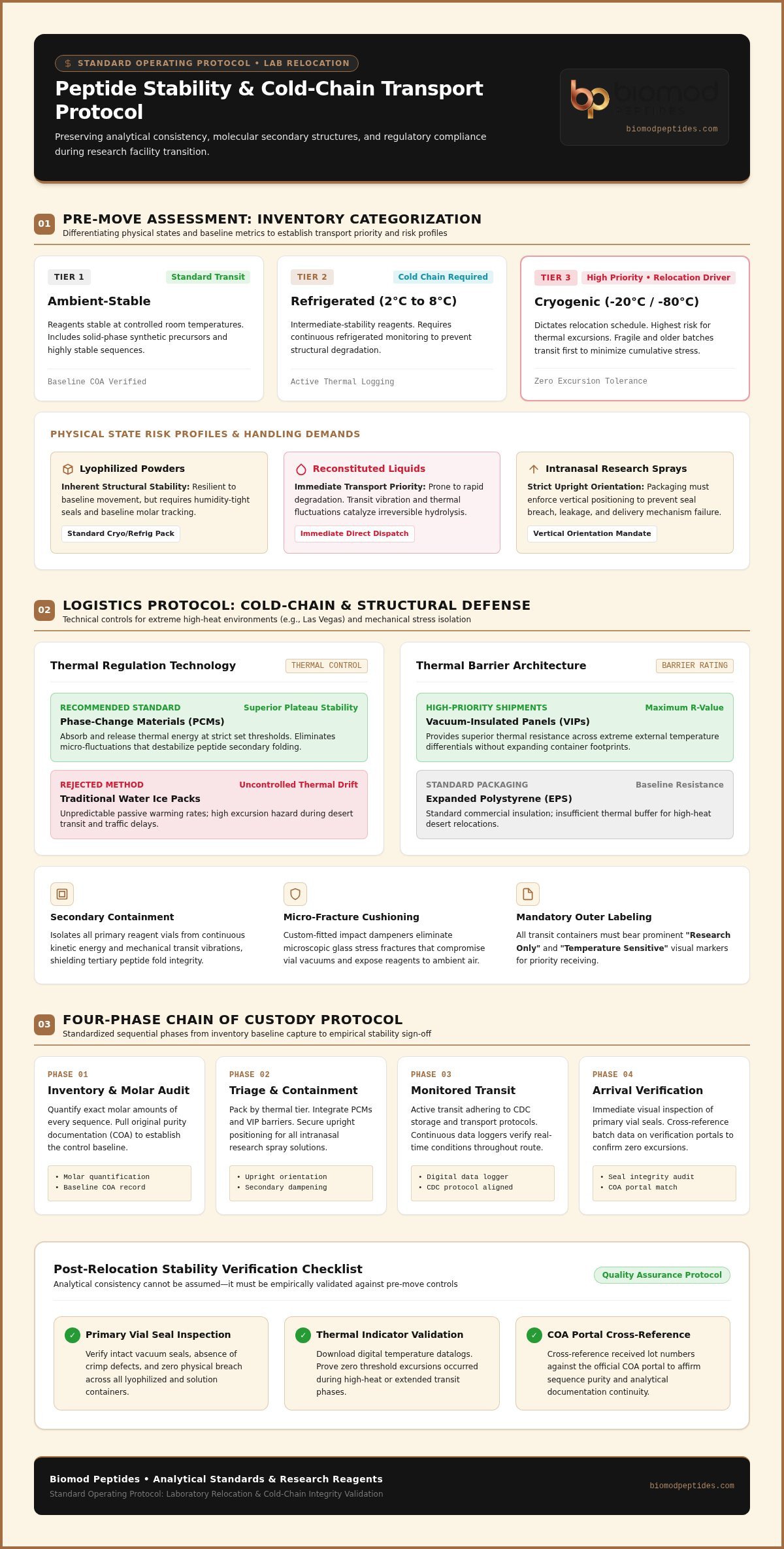
Successful relocation begins with a rigorous audit of existing inventory. Identify high-value, analytical-grade reagents first. Quantify the specific molar amounts of each sequence. It’s vital to review original peptide purity verification data to establish baseline stability metrics. This documentation serves as the control group for post-move analysis. Without a clear record of initial purity, verifying the impact of transit becomes impossible. Documentation is the foundation of accountability.
Distinguish between physical states. Lyophilized powders offer inherent structural stability. Reconstituted liquid peptides do not. These solutions are prone to rapid degradation and require immediate priority. Vibration and temperature fluctuations catalyze hydrolysis in liquid formats. Identify every reagent requiring -20°C or -80°C environments. These cryogenic samples dictate the logistics of the entire operation. Effective logistics for transporting research peptides during a lab move depend on identifying which sequences are at the highest risk for thermal excursion.
Categorizing Reagents by Thermal Sensitivity
Classify the inventory into three distinct tiers: ambient-stable, refrigerated (2-8°C), and cryogenic. This classification ensures cold chain integrity throughout the transition. Establishing these tiers allows for the allocation of specialized transit containers and monitoring equipment. Document the specific shelf-life and batch dates for every sequence. Fragile or older batches must be moved first to minimize cumulative stress. Precision in categorization prevents the common error of treating all peptides as equal in stability. It’s a technical necessity. Meticulous planning at this stage ensures that your analytical consistency remains intact when you reach the new facility.
Logistics Protocol: Maintaining Cold Chain Integrity Across Las Vegas
Climate-controlled transport requires more than a refrigerated vehicle. In the high-heat environment of Las Vegas, standard cooling methods often don’t provide sufficient protection for molecular structures. Phase-change materials (PCMs) outperform traditional ice packs by maintaining precise temperature plateaus for extended durations. These materials absorb and release thermal energy at specific thresholds. This prevents the fluctuations that compromise peptide secondary structures. When transporting research peptides during a lab move, reliance on passive cooling is a significant risk to analytical consistency. It’s a variable that must be eliminated through technical planning.
Mechanical stress is a primary catalyst for molecular degradation. Secondary containment must be utilized to isolate vials from transit vibrations and kinetic energy. Implement real-time digital data loggers to monitor for thermal excursions throughout the route. Adhering to CDC storage and transport protocols ensures that monitoring data remains defensible, precise, and scientifically valid. Orientation also matters for specific formats. All intranasal peptide research sprays must be stored upright. This prevents leakage and maintains the integrity of the delivery mechanism seals during transit.
Packaging Standards for High-Purity Research Reagents
Utilize vacuum-insulated panels (VIPs) for high-priority shipments. These panels provide superior thermal resistance compared to expanded polystyrene. Label every container clearly with “Research Only” and “Temperature Sensitive” indicators. This ensures immediate processing upon arrival. Incorporate specialized cushioning materials to mitigate vial micro-fractures. Microscopic defects lead to vacuum loss or contamination. It’s vital to mitigate these risks. For researchers seeking stability, sourcing from a provider of US-manufactured research peptides provides a documented baseline for these protocols.
Post-Relocation Verification: Ensuring Analytical Consistency
Arrival at the new facility marks the beginning of the verification phase. Relocation isn’t complete until empirical proof of stability is established. Analytical consistency can’t be assumed; it must be proven. Immediately inspect all primary vial seals and thermal indicators for evidence of physical breach or thermal excursion. Cross-reference received batches with the Biomod Peptides COA portal to confirm that sequence integrity remains within established parameters. If indicators suggest a breach, the material must be flagged. Perform spot-check HPLC or mass spectrometry on critical analytical-grade batches to verify that no molecular degradation occurred while transporting research peptides during a lab move. This empirical data is your only defense against experimental drift. Once validated, update the laboratory information management system (LIMS) with the new cryogenic storage coordinates.
Re-Validation and Purity Analysis Post-Transit
Implement a mandatory quarantine protocol for all incoming materials. Samples should remain in a controlled environment until digital temperature logs are reviewed and signed off by the principal investigator. This step prevents the accidental introduction of degraded reagents into current workflows. Document any observed deviations or logistical anomalies in a formal laboratory report. This rigorous documentation aligns with evolving peptide science standards and ensures a transparent chain of custody. If a sequence fails post-transit verification, it must be discarded to protect the integrity of future data sets. Professional accountability requires that every batch is treated as a new variable until its stability is confirmed.
Securing Analytical Integrity in Your New Facility
A successful relocation is measured by the preservation of molecular data, not just the physical arrival of vials. Rigorous pre-move audits and the implementation of phase-change materials ensure that your cold chain remains unbroken. Verification doesn’t end at delivery; it requires empirical proof through HPLC spot-checks and rigorous COA portal cross-referencing. These technical protocols for transporting research peptides during a lab move are essential to protect your long-term data sets from experimental drift. Biomod Peptides provides the structural foundation your research requires. We offer US-manufactured and finished reagents validated by independent third-party testing. Every lot is accessible via our comprehensive COA verification portal to ensure total transparency. Secure High-Purity Reagents for Your New Lab at Biomod Peptides. Your next phase of discovery starts with uncompromising stability.
Frequently Asked Questions
How long can lyophilized peptides remain at room temperature during a move?
Lyophilized peptides generally maintain stability at room temperature for 48 to 72 hours under standard conditions. However, the extreme heat profile of Las Vegas requires more aggressive cooling. Ambient exposure during transit should be limited to under 4 hours to prevent moisture absorption and subsequent hydrolysis. Sequence complexity dictates specific thresholds. Always prioritize maintaining a consistent thermal environment to preserve the long-term viability of the reagent.
What is the best way to transport reconstituted peptides without degradation?
Continuous thermal regulation is the only way to preserve reconstituted sequences. Transporting research peptides during a lab move involves using phase-change materials (PCMs) calibrated to 4°C. Standard ice packs are insufficient for liquid formats because they lack precise temperature plateaus. Secure vials in foam inserts to mitigate vibration. Mechanical agitation and thermal excursions catalyze rapid degradation in aqueous solutions. Constant monitoring is non-negotiable for these high-risk materials.
Do I need specialized permits to move research peptides across Las Vegas?
Most research-only peptides don’t require specific municipal permits for transport within Las Vegas. Compliance focus should remain on institutional biosafety committee (IBC) guidelines and DOT regulations for secondary materials like dry ice. Ensure all manifests clearly state the “Research Use Only” designation. You must document the chain of custody for all US-manufactured reagents. Reviewing institutional EHS requirements is the standard protocol for ensuring legal and procedural compliance.
How do I verify if a peptide has degraded during a laboratory relocation?
Start with a visual inspection of the lyophilized cake or solution clarity. Any discoloration or changes in solubility are immediate red flags. For definitive proof, cross-reference the batch with the Biomod Peptides COA verification portal to establish the original purity baseline. Perform HPLC or mass spectrometry on critical reagents. A measurable drop in purity or a shift in the retention time confirms that degradation occurred during the relocation.
Disclaimer
BIOMOD products are sold strictly for laboratory, analytical, and scientific research use only. They are not intended for human or animal consumption, administration, application, ingestion, injection, or any therapeutic, diagnostic, or cosmetic use.
The statements made on this website have not been evaluated by the United States Food and Drug Administration. BIOMOD products are not intended to diagnose, treat, cure, mitigate, or prevent any disease or medical condition.
BIOMOD is a research chemical supplier. BIOMOD is not a compounding pharmacy or chemical compounding facility as defined under Section 503A of the Federal Food, Drug, and Cosmetic Act. BIOMOD is not an outsourcing facility as defined under Section 503B of the Federal Food, Drug, and Cosmetic Act.
By accessing this site, you confirm you are at least 21 years of age and that you have read and accepted the BIOMOD Terms of Sale, Privacy Policy, and Research Use Only Policy. BIOMOD does not provide dosing, medical, therapeutic, diagnostic, veterinary, or use guidance under any channel.