
An insulated shipping box is not a guarantee of chemical integrity. Standard parcel delivery cargo bays traversing the Las Vegas Valley regularly hit interior temperatures between 130°F and 155°F. Under these brutal conditions, maintaining peptide stability during laboratory shipping ceases to be a simple logistical checkpoint; it becomes a critical scientific control.
You already know that unchecked thermal spikes accelerate deamidation, oxidation, and sequence aggregation. These reactions disrupt fragile lyophilized cakes and introduce unacceptable variance into rigorous in vitro assays. In this guide, you’ll master the technical protocols required to maintain peptide structural integrity during high-heat transit to Las Vegas laboratories. We examine thermodynamic degradation kinetics, validated passive thermal buffering, and the analytical documentation workflows needed to confirm research-grade purity upon delivery.
Key Takeaways
- Master the chemical kinetics of deamidation and oxidation to prevent reagent breakdown during high-heat parcel transit.
- Implement multi-stage thermal barriers like vacuum-insulated panels and calibrated phase change materials for maintaining peptide stability during laboratory shipping.
- Leverage domestic, US-based manufacturing routes to drastically shorten exposure windows across extreme desert climates.
- Validate post-transit sequence purity and lyophilized cake integrity using accredited third-party certificates of analysis via an online verification portal.
Thermodynamic Risks: The Science of Peptide Degradation During Transit
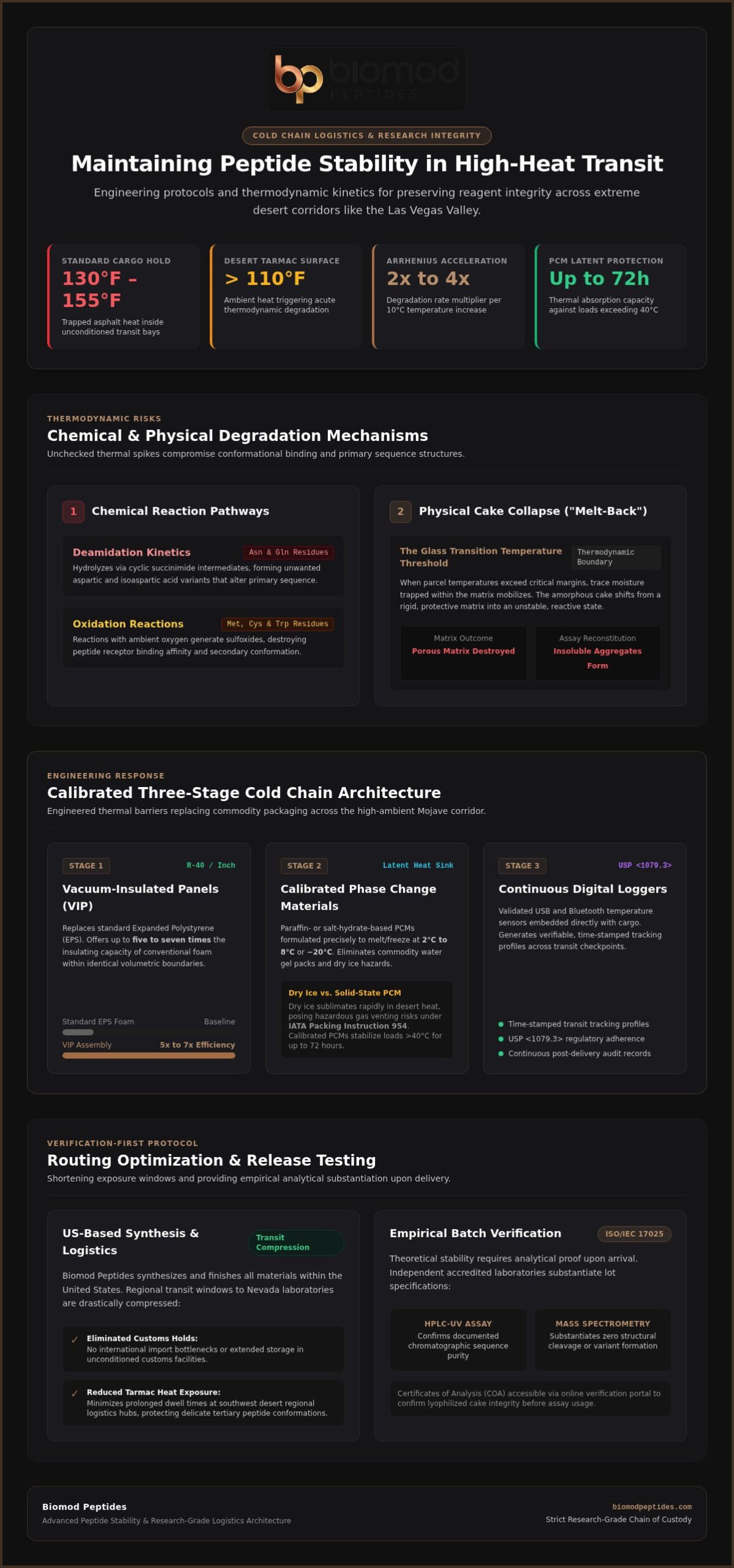
Peptide stability requires preserving exact primary sequences alongside delicate secondary and tertiary conformations. While common industry assumptions claim solid-state reagents tolerate ambient travel, desert transport violates these baselines. Ambient tarmac temperatures exceeding 110°F trigger exponential reaction kinetics. Per the Arrhenius equation, biochemical degradation rates double or quadruple with every 10°C increase. Maintaining peptide stability during laboratory shipping requires neutralizing these thermal stressors before irreversible structural loss occurs.
Thermal energy directly drives two primary pathways:
- Deamidation: Asn and Gln residues rapidly hydrolyze via cyclic succinimide intermediates, forming unwanted aspartic and isoaspartic acid variants.
- Oxidation: Met, Cys, and Trp residues react with ambient oxygen, yielding sulfoxides that destroy binding affinity.
Lyophilization mitigates these risks by removing unbound water, which arrests hydrolysis and elevates kinetic barriers. Modern cold chain distribution frameworks build on this foundation by strictly controlling ambient heat transfer.
Primary Stressors: Thermal Fluctuations and Lyophilization Integrity
Thermal spikes compromise physical structure before chemical bonds sever. When parcel hold temperatures surpass critical margins, trace moisture trapped within the matrix mobilizes. This process causes cake collapse or “melt-back,” destroying the porous matrix, ruining reconstitution kinetics, and leaving insoluble aggregates. The glass transition temperature represents the precise thermodynamic threshold above which an amorphous peptide cake transitions from a rigid, protective matrix into an unstable, reactive state. Flawed thermal insulation guarantees cake collapse, making procedural rigor essential for maintaining peptide stability during laboratory shipping across southwestern routes.
Implementing Cold Chain Protocols for High-Heat Environments
Standard packaging configurations fail across the Mojave corridor. Cargo holds frequently trap radiant asphalt heat, transforming ordinary parcel delivery into an acute degradation hazard. Mitigating these conditions requires a calibrated, three-stage engineering response:
- Step 1: Vacuum-Insulated Panels (VIP): Replace basic expanded polystyrene (EPS). VIP assemblies offer thermal resistance values up to R-40 per inch, yielding five to seven times the insulating capacity of conventional foam within identical volumetric boundaries.
- Step 2: Calibrated Phase Change Materials (PCMs): Eliminate commodity water gel packs. Deploy paraffin- or salt-hydrate-based PCMs formulated to freeze or melt precisely at 2°C to 8°C or −20°C, providing constant latent heat absorption without freezing aqueous reagents or underperforming in high heat.
- Step 3: Continuous Digital Data Loggers: Integrate validated USB or Bluetooth sensors. These devices generate verifiable, time-stamped thermal tracking profiles across transit checkpoints, confirming regulatory adherence under USP <1079.3>.
This protocol provides the baseline for maintaining peptide stability during laboratory shipping through high-ambient corridors.
Advanced Insulation and Phase-Change Material (PCM) Selection
Solid-state PCMs outperform dry ice in extreme desert logistics. Dry ice rapidly sublimates under severe ambient heat, creating hazardous gas venting challenges under IATA Packing Instruction 954. Properly conditioned PCMs act as an engineered heat sink, absorbing external thermal loads exceeding 40°C while maintaining stable internal temperatures for up to 72 hours. Laboratories procuring high-purity research materials can source directly from Biomod Peptides, ensuring their critical workflow leverages rigorous domestic logistics designed to withstand extreme last-mile exposure.
Biomod Peptides: Verification-First Logistics for Research Integrity
Domestic infrastructure dictates reagent viability. Because Biomod Peptides synthesizes and finishes all materials within the United States, regional transit windows to Nevada facilities are drastically compressed. Las Vegas laboratories receive shipments swiftly, eliminating international customs holds and prolonged tarmac exposure at desert hubs. Every hour saved protects tertiary structure. Optimized domestic routing represents the primary baseline for maintaining peptide stability during laboratory shipping across arid transit routes.
Analytical verification remains non-negotiable. Theoretical stability guarantees nothing without empirical proof. Research peptides must arrive with documented chromatographic purity, proving that transit heat did not induce deamidation or structural cleavage. Biomod utilizes independent, ISO/IEC 17025 accredited testing facilities to substantiate lot release specifications via HPLC-UV and mass spectrometry assays. Laboratories procuring reagents engineered for climate resilience can begin at the Biomod Peptides homepage.
Documented Stability: Utilizing the COA Verification Portal
Visual inspection cannot detect primary sequence breakdown. A visually intact lyophilized cake may still harbor hidden chemical modifications or insoluble multimers. Researchers resolve this operational uncertainty using the Biomod COA verification portal. Entering the specific lot identifier retrieves batch-level HPLC traces, mass identification profiles, and purity analytics. Cross-referencing these manufacturer baselines against post-arrival internal assays establishes true stability. This empirical validation loop ensures that maintaining peptide stability during laboratory shipping is backed by verifiable data rather than speculative assumptions.
Standardizing Cold-Chain Precision for Analytical Reliability
High-heat transit through the Mojave Desert presents an ongoing threat to reagent viability. Uncontrolled temperatures accelerate deamidation, compromise secondary structure, and invalidate delicate in vitro models. Maintaining peptide stability during laboratory shipping requires a multi-layered engineering strategy: calibrated phase change materials, dense insulation barriers, and tight transit windows that bypass unnecessary tarmac heat soaking.
Empirical proof transforms shipping logistics into a repeatable scientific control. Do not leave your assay results vulnerable to unmonitored desert heat. You can Secure Your Research with Temperature-Controlled Peptides from Biomod, featuring US-manufactured sequences and independent laboratory testing that substantiates analytical purity. Log in to verify your batch-specific analytical panels directly via our COA portal, and proceed with absolute confidence in your experimental data.
Frequently Asked Questions
Does the Las Vegas summer heat affect lyophilized peptides during 24-hour shipping?
Yes, unshielded 24-hour transit can compromise lyophilized reagents. Delivery van cargo bays in southern Nevada frequently surpass 130°F. These severe thermal spikes exceed the peptide’s glass transition temperature, accelerating deamidation and inducing cake collapse. Successfully maintaining peptide stability during laboratory shipping requires engineered thermal shielding rather than standard parcel envelopes.
What is the difference between gel packs and Phase Change Materials for peptide transit?
Phase Change Materials (PCMs) maintain precise, flat temperature plateaus, whereas standard water-based gel packs warm rapidly once melted. Calibrated PCMs absorb substantial latent heat at designated thresholds like 2°C to 8°C or −20°C. This targeted thermal buffering prevents temperature spikes inside the container without risking accidental freezing or degradation during prolonged desert transit.
How can I verify if a peptide has degraded during shipping to my laboratory?
Analytical verification requires chromatographic testing rather than simple visual inspection. While collapsed cakes suggest thermal stress, chemical degradation pathways like oxidation or hydrolysis remain invisible. Researchers should run reverse-phase HPLC and mass spectrometry on reconstituted samples, cross-referencing their data against the pre-dispatch baseline available in the Biomod COA verification portal to validate sequence purity.
Are US-manufactured peptides more stable than imported reagents for local use?
Domestic manufacturing ensures higher stability by drastically eliminating transit duration. Foreign shipments endure international customs holds, uncontrolled warehouse environments, and extended tarmac exposure before reaching Nevada. Sourcing US-manufactured reagents reduces transit windows to hours rather than weeks, supporting protocols for maintaining peptide stability during laboratory shipping to local facilities.
Disclaimer
BIOMOD products are sold strictly for laboratory, analytical, and scientific research use only. They are not intended for human or animal consumption, administration, application, ingestion, injection, or any therapeutic, diagnostic, or cosmetic use.
The statements made on this website have not been evaluated by the United States Food and Drug Administration. BIOMOD products are not intended to diagnose, treat, cure, mitigate, or prevent any disease or medical condition.
BIOMOD is a research chemical supplier. BIOMOD is not a compounding pharmacy or chemical compounding facility as defined under Section 503A of the Federal Food, Drug, and Cosmetic Act. BIOMOD is not an outsourcing facility as defined under Section 503B of the Federal Food, Drug, and Cosmetic Act.
By accessing this site, you confirm you are at least 21 years of age and that you have read and accepted the BIOMOD Terms of Sale, Privacy Policy, and Research Use Only Policy. BIOMOD does not provide dosing, medical, therapeutic, diagnostic, veterinary, or use guidance under any channel.