
The most expensive flow cytometry assay is the one that fails because of a reagent you assumed was pure. If you’re battling high background fluorescence or inconsistent conjugation yields, the issue often stems from the peptide backbone itself. It’s a common frustration in complex laboratory environments where noise frequently compromises data integrity. Most researchers attribute these failures to fluorophore instability, yet the root cause is typically chemical impurity.
Prioritizing the sourcing high-purity peptides for conjugation eliminates these pre-analytical variables. Rigorous purity verification and US-manufactured reagents remove the primary causes of failed protocols. This guide details the specific analytical markers, such as HPLC and MS verification, required for conjugation-ready reagents. You’ll learn to establish a reliable sourcing protocol that ensures clean, high-contrast data and repeatable research outcomes.
Key Takeaways
- Understand why >98% purity is the technical benchmark for eliminating non-specific binding and competitive inhibition from truncated sequences.
- Learn to optimize sourcing high-purity peptides for conjugation by prioritizing specific N-terminal functional groups and lyophilized formats for maximum structural integrity.
- Recognize the logistical advantages of US-manufactured reagents in preserving peptide stability during transit to domestic laboratory facilities.
- Adopt a verification-first protocol using dedicated COA portals to validate batch-specific data before initiating expensive and resource-heavy conjugation assays.
The Impact of Peptide Purity on Flow Cytometry Conjugate Issues
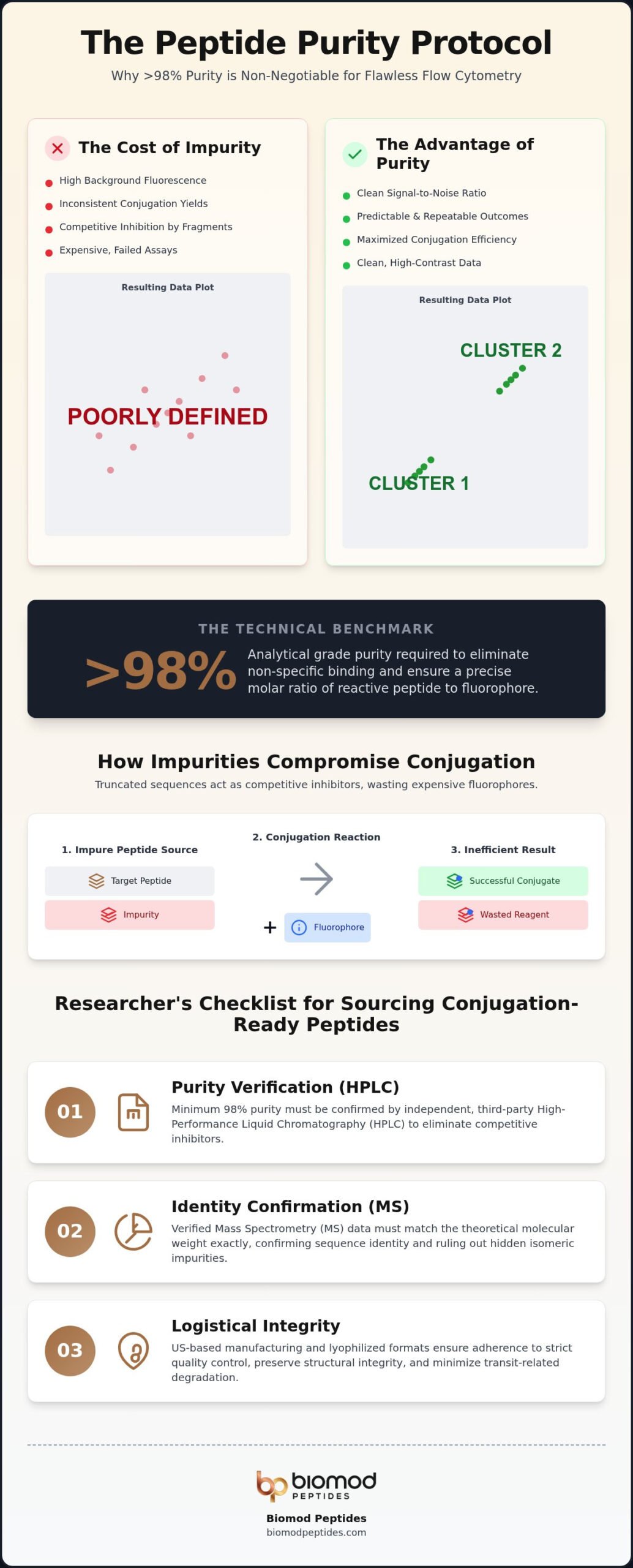
Successful flow cytometry requires reagents that behave predictably. High-purity peptides, specifically those exceeding 98% purity, are the baseline requirement for minimizing non-specific binding and fluorescent background noise. When sourcing high-purity peptides for conjugation, any deviation from this standard introduces truncated sequences and residual reagents into the reaction vessel. These impurities act as competitive inhibitors during peptide conjugation chemistry. They occupy reactive sites on the fluorophore without providing the intended biological activity. This results in a cumulative error that degrades the signal-to-noise ratio across multi-step protocols. Analytical grade purity is the precise threshold where the molar ratio of reactive peptide to fluorophore remains unaffected by non-functional sequence fragments.
Inconsistent staining patterns often trace back to lot-to-lot variability in peptide reagents. If one batch contains 95% purity and the subsequent lot reaches 99%, the resulting conjugate yields will fluctuate significantly. This inconsistency forces laboratories to recalibrate assays for every new reagent lot. It wastes valuable research hours and expensive fluorophores. Reliable data depends on sourcing high-purity peptides for conjugation that guarantee consistent, high-tier purity across every delivery lot.
Identifying Purity-Related Background Noise in Assays
Impurity-driven artifacts appear as diffuse, poorly defined populations on flow cytometry plots. A ‘clean’ signal shows distinct, high-contrast clustering that allows for accurate gating. While HPLC measures the relative abundance of the target sequence, mass spectrometry (MS) is equally critical for verifying the absence of isomeric impurities. These isomers possess the same molecular weight but different structural configurations. If a supplier doesn’t provide lot-specific MS data, the risk of isomeric interference remains high. These hidden contaminants often escape detection by HPLC alone but can severely interfere with binding kinetics. Adopting a dual-verification approach ensures that the reagents are structurally sound and ready for complex conjugation chemistry.
Technical Sourcing Criteria for Successful Peptide Conjugation
Precision in bioconjugation starts with the selection of reactive termini. When sourcing high-purity peptides for conjugation, researchers must prioritize specific C-terminal or N-terminal functional groups. For instance, Cysteine residues are essential for maleimide-thiol chemistry. These site-specific modifications ensure the fluorophore attaches at the intended position without disrupting the peptide’s binding affinity. Lyophilized formats are the industry standard for maintaining structural integrity. They prevent hydrolysis and degradation during transit, ensuring the reagent remains stable until reconstitution in Las Vegas labs. It’s best to reconstitute only immediately before the assay to avoid long-term stability issues in solution.
Evaluating supplier accountability is the next critical step. Relying on a supplier’s in-house HPLC reports is insufficient for high-stakes bioanalytical research. Internal testing often lacks the objectivity required for quantitative flow cytometry. True accountability requires independent validation when sourcing high-purity peptides for conjugation. Third-party testing provides an unbiased assessment of purity and sequence identity. This level of transparency is non-negotiable when establishing laboratory peptide supply standards. It ensures that every milligram of material meets the rigorous benchmarks necessary for reproducible data.
A Researcher’s Checklist for Sourcing Conjugation-Ready Peptides
Establishing a robust procurement protocol minimizes experimental risk. Every lot must meet these three non-negotiable criteria:
- Requirement 1: Minimum 98% purity confirmed by independent third-party HPLC to eliminate competitive inhibitors.
- Requirement 2: Verified Mass Spec data matching the theoretical molecular weight of the sequence exactly to confirm identity.
- Requirement 3: US-based manufacturing to ensure adherence to strict quality control and logistical stability during domestic shipping.
Labs can verify these metrics through a dedicated COA verification portal to ensure every reagent is ready for immediate use.
Mitigating Conjugate Issues with Verified US-Manufactured Peptides
Stability in bioconjugation is not merely a chemical property but a logistical one. US-finished peptides provide a distinct advantage for Las Vegas laboratories by minimizing transit-related degradation. Long-distance international shipping often exposes sensitive reagents to temperature fluctuations and atmospheric pressures that can compromise structural integrity. Sourcing high-purity peptides for conjugation from domestic facilities ensures that the material arrives in peak analytical condition. This logistical transparency is a core pillar of Biomod’s methodology, mirroring the uncompromising accountability found in top-tier scientific institutions.
Before initiating resource-heavy protocols, researchers must move beyond reputation-based trust. Utilizing dedicated verification portals allows labs to cross-reference batch-specific data in real-time. This practice ensures that the peptide lot matches the required analytical markers for purity and sequence identity perfectly. Precision in these early stages prevents the downstream failure of complex assays and saves significant laboratory resources.
The Role of Transparency in Scientific Procurement
Data-driven validation is the only safeguard against lot-to-lot inconsistency. Following a structured workflow for APC construction demonstrates that high product homogeneity requires precise analytical characterization at every step. Localized US supply chains enhance this reliability by maintaining strict control over the reagent environment. This oversight reduces the risk of non-specific binding caused by degraded fragments or truncated sequences. It’s essential to verify current lot data via the COA portal before purchase to ensure absolute reagent readiness for high-stakes flow cytometry applications.
Advancing Precision in Flow Cytometry Reagent Procurement
Reliable flow cytometry data depends on the structural integrity of your reagents. Achieving a high signal-to-noise ratio requires a commitment to purity standards exceeding 98%. Sourcing high-purity peptides for conjugation is the most effective way to eliminate competitive inhibition from truncated sequences. By prioritizing US-manufactured reagents and independent third-party HPLC and MS testing, laboratories ensure maximum stability and analytical accountability. Transparency isn’t a luxury; it’s a requirement for reproducible research. Accessing batch-specific data through a dedicated COA Verification Portal allows you to validate every lot before initiating complex protocols. This rigorous approach transforms potential assay failures into consistent, high-contrast results.
Secure High-Purity Peptides for Your Next Conjugation Project at Biomod Peptides. Establish a new standard for your laboratory with reagents designed for professional confidence and precision.
Frequently Asked Questions
Why does 95% purity often lead to failed flow cytometry conjugates?
While 95% purity may suffice for simple screening, it contains a 5% margin of impurities like truncated sequences. These fragments act as competitive inhibitors, binding to expensive fluorophores without providing the intended biological activity. This creates significant background noise. Sourcing high-purity peptides for conjugation at >98% ensures that molar ratios remain precise, which is essential for high-contrast flow cytometry data.
How do I verify the certificate of analysis for my research peptides?
Biomod Peptides provides a dedicated COA verification portal that allows Las Vegas researchers to cross-reference lot numbers with independent third-party data. You should always confirm that the HPLC chromatogram shows a single, sharp peak and that the Mass Spectrometry results match the theoretical molecular weight. This digital verification step provides empirical proof of quality before you invest in complex conjugation protocols.
Can residual TFA (Trifluoroacetic acid) interfere with peptide conjugation?
Residual TFA can significantly lower the pH of your reaction buffer, which may deactivate pH-sensitive reagents like maleimide. If the pH shifts outside the optimal range, conjugation efficiency drops, leading to inconsistent yields. When sourcing high-purity peptides for conjugation, ensuring the removal or quantification of TFA salts is vital for maintaining the chemical homogeneity required for successful antibody-peptide linkage.
What is the shelf life of lyophilized peptides for conjugation research in Las Vegas?
Lyophilized peptides are stable for 12 to 24 months when stored at -20°C in a desiccated state. Las Vegas laboratories must ensure vials are tightly sealed to prevent moisture ingress, which can cause hydrolysis. For the best results in flow cytometry, only reconstitute the amount needed for immediate use. Repeated freeze-thaw cycles after reconstitution will rapidly degrade the peptide’s structural integrity.
Disclaimer
BIOMOD products are sold strictly for laboratory, analytical, and scientific research use only. They are not intended for human or animal consumption, administration, application, ingestion, injection, or any therapeutic, diagnostic, or cosmetic use.
The statements made on this website have not been evaluated by the United States Food and Drug Administration. BIOMOD products are not intended to diagnose, treat, cure, mitigate, or prevent any disease or medical condition.
BIOMOD is a research chemical supplier. BIOMOD is not a compounding pharmacy or chemical compounding facility as defined under Section 503A of the Federal Food, Drug, and Cosmetic Act. BIOMOD is not an outsourcing facility as defined under Section 503B of the Federal Food, Drug, and Cosmetic Act.
By accessing this site, you confirm you are at least 21 years of age and that you have read and accepted the BIOMOD Terms of Sale, Privacy Policy, and Research Use Only Policy. BIOMOD does not provide dosing, medical, therapeutic, diagnostic, veterinary, or use guidance under any channel.