
A single unverified impurity can invalidate months of laboratory data and compromise the integrity of an entire research project. Establishing a comprehensive risk assessment for a new peptide experiment isn’t just a compliance requirement. It’s the foundation of reproducible science.
You’ve likely faced the frustration of inconsistent results or reagent degradation that stalls your progress. This article provides a rigorous framework to evaluate material purity, procedural safety, and analytical integrity before you initiate your next study. We’ll examine validated purity standards, mitigation strategies for material loss during reconstitution, and the necessity of third-party COA verification. By the end, you’ll have a repeatable safety checklist to ensure your data remains reliable and your reagents stay stable.
Key Takeaways
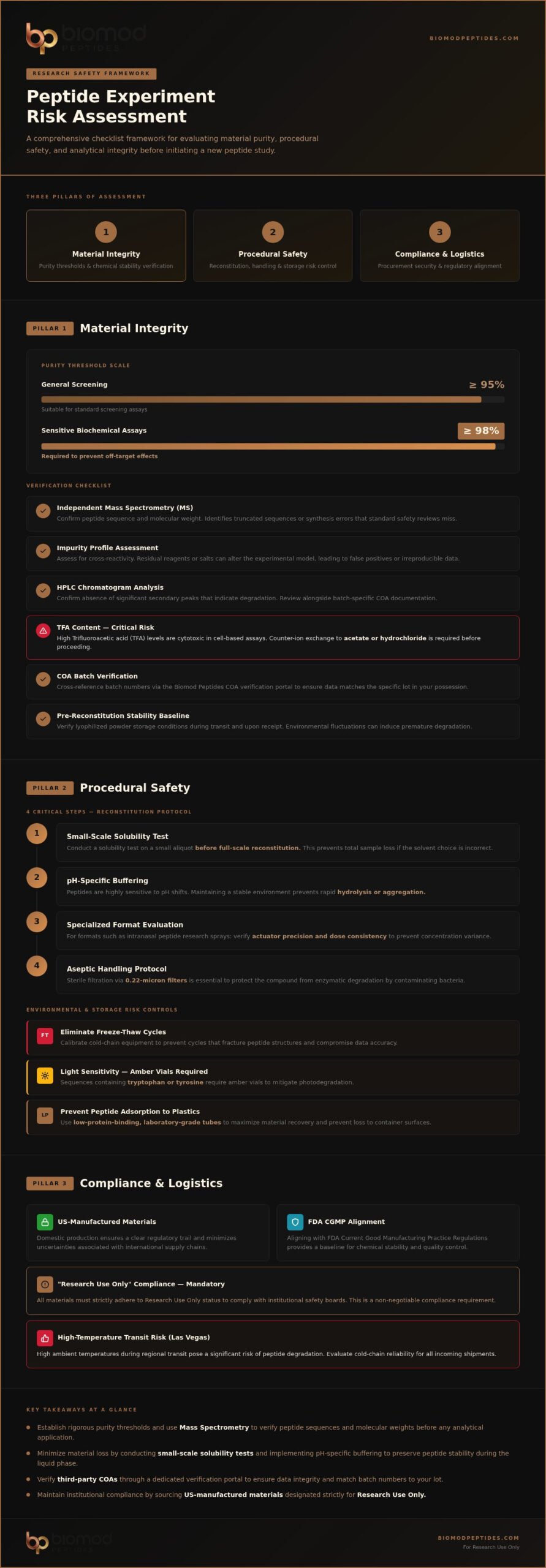
- Establish rigorous purity thresholds and utilize Mass Spectrometry to verify peptide sequences and molecular weights before beginning any analytical application.
- Minimize material loss by conducting small-scale solubility tests and implementing pH-specific buffering to preserve peptide stability during the liquid phase.
- Execute a comprehensive risk assessment for a new peptide experiment by verifying third-party COAs through a dedicated verification portal to ensure data integrity.
- Maintain institutional compliance and reagent reliability by sourcing US-manufactured materials designated strictly for research use only.
Material Integrity: Evaluating Peptide Purity and Chemical Stability
Material integrity serves as the primary variable in any laboratory study. Establishing a rigorous risk assessment for a new peptide experiment begins with defining the required purity threshold. While 95% purity may suffice for general screening, sensitive biochemical assays often demand 98% or higher to prevent off-target effects. Understanding peptide chemistry and stability is essential for predicting how these compounds behave in a controlled environment.
Verification must go beyond the label. Independent Mass Spectrometry (MS) is required to confirm the peptide sequence and molecular weight. This step identifies truncated sequences or synthesis errors that standardized safety reviews often miss. Assess the impurity profile for potential cross-reactivity. Residual reagents or salts can alter the experimental model, leading to false positives or irreproducible data.
Verification of Analytical Documentation
Authenticity relies on transparent documentation. Cross-reference batch numbers using the Biomod Peptides COA verification portal to ensure the data matches the specific lot in your possession. US-manufactured reagents provide a higher tier of logistical transparency. Analyze HPLC chromatograms to confirm the absence of significant secondary peaks that indicate degradation. Additionally, document Trifluoroacetic acid (TFA) content. High TFA levels can be cytotoxic in cell-based assays, necessitating a counter-ion exchange to acetate or hydrochloride before proceeding.
Establish a baseline for lyophilized powder stability before reconstitution. Verify storage conditions during transit and upon receipt. Environmental fluctuations can induce premature degradation, compromising the structural integrity of the material before the first aliquot is prepared. Meticulous verification at this stage prevents the loss of expensive reagents and ensures research continuity.
Procedural Safety: Handling, Reconstitution, and Delivery Format Risks
Transitioning from analytical verification to procedural execution requires a disciplined approach. A comprehensive risk assessment for a new peptide experiment must prioritize the stability of the compound during the liquid phase. Follow these four critical steps to maintain experimental integrity:
- Step 1: Conduct a solubility test on a small aliquot before full-scale reconstitution. This prevents total sample loss if the solvent choice is incorrect.
- Step 2: Implement pH-specific buffering. Peptides are highly sensitive to pH shifts; maintaining a stable environment prevents rapid hydrolysis or aggregation.
- Step 3: Evaluate mechanical risks associated with specialized formats, such as intranasal peptide research sprays. Verify actuator precision and dose consistency to prevent concentration variance.
- Step 4: Establish strict aseptic handling protocols. Sterile filtration via 0.22-micron filters is essential to protect the compound from enzymatic degradation by contaminating bacteria.
Sourcing materials that align with FDA compliance standards for peptide procurement ensures the foundational quality of your reagents.
Environmental Control and Storage Risks
Storage conditions dictate long-term reagent viability. Establishing a risk assessment for a new peptide experiment involves calibrating cold-chain equipment to eliminate freeze-thaw cycles. These cycles fracture peptide structures and compromise data accuracy. Assess light sensitivity for sequences containing tryptophan or tyrosine; utilize amber vials to mitigate photodegradation. Finally, address the risk of peptide adsorption to plastic surfaces. Use low-protein-binding, laboratory-grade tubes to maximize material recovery. For researchers requiring consistent batch standards, Biomod Peptides offers US-manufactured solutions designed for rigorous laboratory use.
Compliance and Logistics: Procurement Security for Las Vegas Facilities
Finalizing a risk assessment for a new peptide experiment requires a thorough audit of procurement security and logistical transparency. Researchers must verify that all reagents are manufactured and finished within the United States. Domestic production ensures a clear regulatory trail and minimizes the uncertainties associated with international supply chains. Aligning with FDA Current Good Manufacturing Practice (CGMP) Regulations provides an authoritative baseline for chemical stability and quality control. All materials must strictly adhere to the “Research Use Only” status to comply with institutional safety boards and the Biomod Peptides terms of sale.
Regional logistics are particularly critical for Las Vegas laboratories. High ambient temperatures during transit pose a significant risk of peptide degradation. Evaluate the reliability of distribution networks to ensure that cold-chain protocols remain intact during the final mile. Minimize transit times by selecting vendors with established domestic shipping routes. Additionally, audit the vendor’s third-party testing frequency. Reliable providers don’t just test once; they verify batch-to-batch consistency to ensure every shipment meets the established analytical grade.
Establishing a Chain of Custody
Standardizing internal intake procedures is the final step in a rigorous risk assessment for a new peptide experiment. Review the Protocol for Peptide Purity Verification to align your laboratory’s analytical standards with industry benchmarks. Document the manufacturing origin and analytical grade for all specialized formats, such as peptide softgels for research, utilized in the study. Maintain a digital log of all COAs and purity reports. This documentation serves as the primary verification during peer review or institutional audits, proving the structural integrity of your reagents was never compromised.
Advancing Laboratory Standards Through Rigorous Verification
Executing a comprehensive risk assessment for a new peptide experiment ensures that every variable, from sequence accuracy to logistical stability, is strictly controlled. This disciplined framework moves beyond basic safety protocols by prioritizing analytical documentation and precise reconstitution techniques. By verifying material purity through independent testing and securing domestic supply chains, researchers eliminate the inconsistencies that compromise complex data sets. Establishing these benchmarks early protects the integrity of your methodology and the long-term viability of your reagents.
Secure your next experiment with US-manufactured, third-party tested peptides from Biomod Peptides. Our facility provides third-party HPLC/MS verification for every batch and offers specialized research formats, including softgels and sprays, to meet diverse analytical needs. Precision in the planning phase remains the most effective way to ensure the reliability of your final results.
Frequently Asked Questions
How does peptide purity affect the risk assessment of a new experiment?
Peptide purity is the primary determinant of analytical baseline stability. When conducting a risk assessment for a new peptide experiment, low purity levels introduce unknown chemical variables that can trigger off-target biological responses or cross-reactivity. High-purity reagents, verified through HPLC, minimize these risks by ensuring that observed data points result from the target peptide sequence rather than residual synthesis contaminants.
What are the specific hazards of handling lyophilized research peptides?
The primary hazards involve chemical degradation and structural instability. Lyophilized powders are highly hygroscopic; they rapidly absorb atmospheric moisture which initiates peptide hydrolysis and reduces shelf life. Additionally, fine powders present an inhalation risk if they aren’t handled in a controlled environment like a laminar flow hood. Meticulous environmental control prevents the loss of material integrity during the weighing and reconstitution phases.
Why is third-party testing critical for Las Vegas laboratory compliance?
Independent third-party testing provides objective verification of material specifications, which is essential for meeting institutional safety board requirements in Las Vegas. Given the regional climate and heat-related logistical challenges, verifying that reagents haven’t degraded during transit is vital. Utilizing a COA verification portal allows local researchers to confirm HPLC and Mass Spectrometry data before integration, ensuring that US-manufactured products meet rigorous standards.
What steps should be taken if a peptide shows unexpected solubility issues during an experiment?
Immediate intervention should involve testing solubility on a small aliquot to prevent total sample loss. If the peptide remains insoluble in standard buffers, researchers should evaluate the sequence’s hydropathy index and consider adjusting the pH or utilizing sterile-grade organic solvents. Integrating these steps into a risk assessment for a new peptide experiment helps mitigate material loss and preserves the structural integrity of the remaining stock.
Disclaimer
BIOMOD products are sold strictly for laboratory, analytical, and scientific research use only. They are not intended for human or animal consumption, administration, application, ingestion, injection, or any therapeutic, diagnostic, or cosmetic use.
The statements made on this website have not been evaluated by the United States Food and Drug Administration. BIOMOD products are not intended to diagnose, treat, cure, mitigate, or prevent any disease or medical condition.
BIOMOD is a research chemical supplier. BIOMOD is not a compounding pharmacy or chemical compounding facility as defined under Section 503A of the Federal Food, Drug, and Cosmetic Act. BIOMOD is not an outsourcing facility as defined under Section 503B of the Federal Food, Drug, and Cosmetic Act.
By accessing this site, you confirm you are at least 21 years of age and that you have read and accepted the BIOMOD Terms of Sale, Privacy Policy, and Research Use Only Policy. BIOMOD does not provide dosing, medical, therapeutic, diagnostic, veterinary, or use guidance under any channel.