
Analytical purity is a dynamic variable, not a static assumption. You likely recognize that inconsistent purity across peptide batches and degradation during handling can jeopardize months of laboratory work. It’s a systemic failure that compromises data integrity. This guide introduces a clinical, step-by-step framework designed to eliminate these variables. By implementing a standardized peptide research project management template, you’ll ensure that every phase of your study, from procurement to experimental execution, adheres to rigorous verification protocols. We’ll examine how to streamline reagent acquisition and utilize a COA verification portal to validate molecular integrity. This 2026 methodology focuses on repeatable project architecture and US-manufactured reliability. You’ll gain a methodical approach to managing complex sequences and maintaining structural integrity throughout the research lifecycle. It’s time to prioritize empirical proof over vendor promises.
Key Takeaways
- Define your research as a closed-loop system that prioritizes sequence precision and analytical purity variables from the outset.
- Utilize a comprehensive peptide research project management template to standardize the transition from formulation selection to procurement.
- Integrate third-party verification as a non-negotiable protocol within the laboratory supply chain to eliminate batch inconsistency.
- Leverage dedicated COA verification portals to automate documentation and support the structural integrity of longitudinal studies.
The Structural Phases of a Peptide Research Project
Effective research requires more than a valid hypothesis. It demands a closed-loop system of synthesis, verification, and analysis. This peptide research project management template treats every stage as a dependent variable. You must account for the specific peptide sequence, exact purity requirements, and the final delivery format. Whether utilizing lyophilized powders, softgels, or spray products, the structural integrity of your reagents dictates the validity of your data. A failure at the procurement stage compromises every subsequent calculation.
Data corruption often stems from impure reagents or unverified batches. We establish a “Verification-First” mandate to mitigate this systemic risk. Inconsistent purity across lots leads to reproducibility crises that stall progress. For Las Vegas laboratory facilities, regional procurement logistics are essential for supply chain stability. Minimizing transit times and ensuring climate-controlled handling prevents premature degradation. High-fidelity Peptide Synthesis is the baseline. Rigorous project management is the safeguard.
Phase 1: Analytical Verification and Purity Benchmarking
Phase 1 focuses on empirical proof rather than vendor assumptions. Execute mandatory HPLC and Mass Spectrometry sequence verification for every new lot received. Don’t rely on historical data from previous batches. Document the initial impurity profile as a project baseline. This documentation is critical for longitudinal stability studies and troubleshooting unexpected experimental outcomes. You must cross-reference these results with the Protocol for Peptide Purity Verification to ensure alignment with current analytical standards. This step ensures that your research begins on a foundation of verified molecular integrity. Accountability starts in the chromatography lab.
The Peptide Research Project Management Template: A 5-Phase Framework
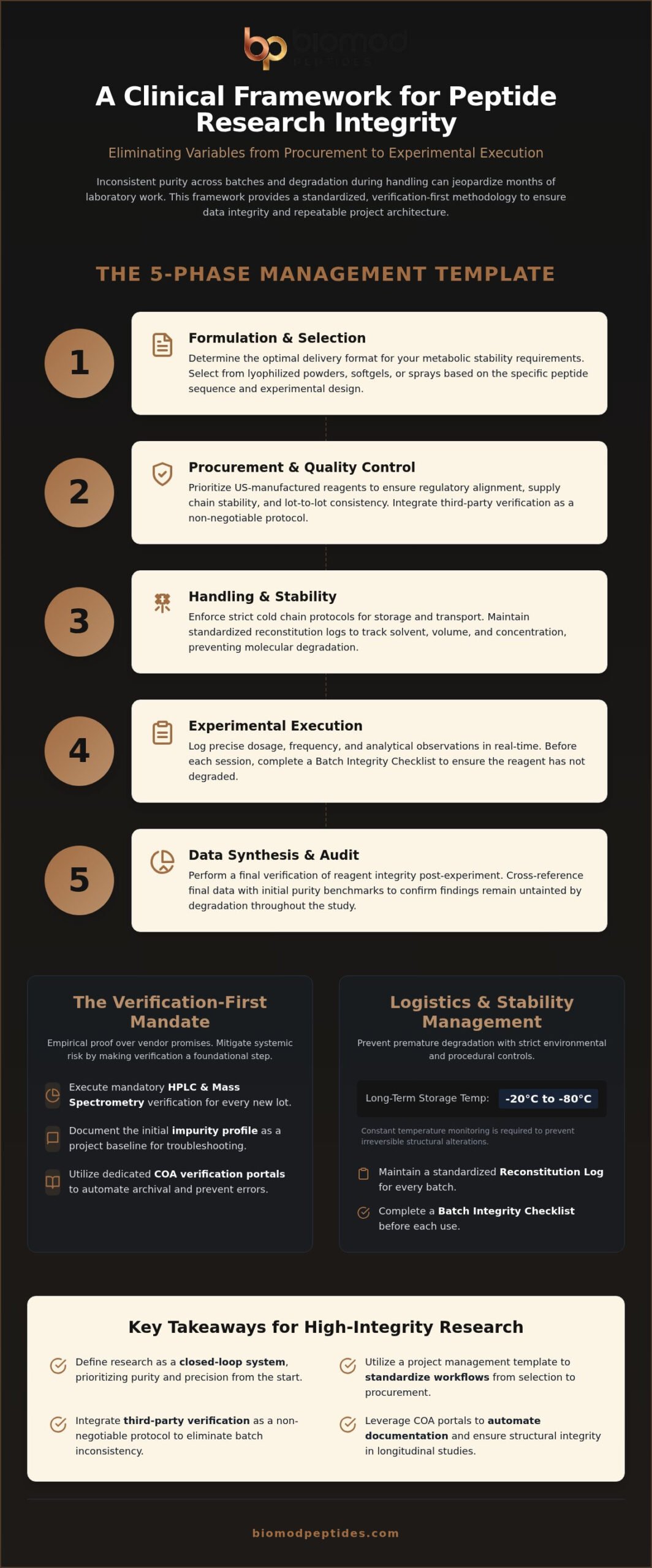
Scientific rigor is sustained through structural discipline. This peptide research project management template provides a 5-phase architecture to bridge the gap between theoretical design and empirical output. Developing Project Management Skills for Scientists is essential for maintaining this level of operational control. Every variable must be documented to ensure reproducibility.
- Phase 1: Formulation and Selection – Determine if peptide softgels or lyophilized powders best suit your metabolic stability requirements.
- Phase 2: Procurement and Quality Control – Prioritize US-manufactured reagents to ensure regulatory alignment and lot-to-lot consistency.
- Phase 3: Handling and Stability – Enforce cold chain protocols and standardized reconstitution to prevent molecular degradation.
- Phase 4: Experimental Execution – Log precise dosage, frequency, and analytical observations in real-time.
- Phase 5: Data Synthesis and Audit – Perform a final verification of reagent integrity to confirm findings remain untainted by degradation.
Establishing these phases early prevents the loss of longitudinal data. For high-integrity research, sourcing from a verified peptide provider ensures your project starts with validated materials. Accountability is the foundation of the laboratory environment.
Logistics and Stability: Managing Cold Chain and Reconstitution
Cold chain management is a primary variable in peptide stability. Lyophilized peptides require constant temperature monitoring at -20°C or -80°C for long-term storage. Fluctuations can cause irreversible primary structure alterations. Every lab must maintain a standardized reconstitution log. This log must track the solvent type, volume, and final concentration achieved. Before any experimental session, complete a Batch Integrity Checklist. This ensures the reagent hasn’t visually degraded and remains within the stability window established in Phase 1. Precision is the only path to reproducibility.
Optimizing Laboratory Workflows with Verified Peptide Reagents
Optimization of laboratory workflows requires more than just skilled personnel. It demands a rigorous approach to reagent acquisition. Integrate third-party verification as a non-negotiable step in the laboratory peptide supply chain. By utilizing automated verification portals, you can streamline the archival of Certificates of Analysis (COAs) and eliminate manual documentation errors. Sourcing reagents with pre-verified analytical reports significantly reduces project downtime by bypassing internal re-testing delays. Your peptide research project management template must include a Supplier Accountability Scorecard to track lot-to-lot consistency and vendor reliability. This empirical approach ensures that only high-purity reagents enter your experimental pipeline. It also provides a quantifiable metric for evaluating supply chain health over longitudinal studies.
Leveraging Third-Party Verification for Project Integrity
A valid HPLC report is the primary document for molecular confirmation. It must display clear retention times, precise peak areas, and a calculated percentage purity. These metrics are the only objective way to verify that the synthesized sequence matches the intended target. Before any in vitro or analytical testing begins, establish a mandatory Verification Milestone in your project timeline. This checkpoint prevents the use of degraded or misidentified compounds that could skew results. We recommend a protocol for utilizing the Biomod COA portal as your centralized project repository. This portal allows for instant validation of batch integrity and provides a permanent digital audit trail for your study. Precision in documentation is as critical as precision in synthesis. High-integrity data relies on a foundation of objective, third-party proof. You cannot afford to treat reagent quality as a given.
Advancing Analytical Standards in 2026
Precision in methodology is the only safeguard against the reproducibility crisis. Implementing a robust peptide research project management template transforms your laboratory workflow from a series of assumptions into a verifiable closed-loop system. By prioritizing analytical verification and standardized stability protocols, you eliminate the risks associated with batch inconsistency and molecular degradation. Success in 2026 requires a transition to documented, third-party proof as the primary benchmark for reagent integrity. Biomod Peptides supports this rigorous approach with US-manufactured reagents and independent third-party testing on every lot. The dedicated verification portal provides instant access to COAs, ensuring your project milestones remain grounded in empirical data. Secure High-Purity Reagents for Your Research Project and maintain the structural integrity of your findings. Your commitment to precision starts with verified reagents. Let’s advance the science of discovery together.
Frequently Asked Questions
What are the essential components of a peptide research project template?
An effective peptide research project management template includes sequence verification, purity benchmarks, and procurement logistics. You must also incorporate standardized handling protocols and verification milestones. These components ensure data integrity from synthesis to final analysis. Standardizing these variables prevents batch inconsistency. It supports reproducibility across longitudinal studies.
How do I track peptide stability throughout a long-term research project?
Stability tracking requires consistent temperature monitoring and detailed reconstitution logs. Store lyophilized peptides at -20°C or -80°C. Document solvent type and concentration accurately. Periodic purity audits using a COA verification portal allow you to compare current batch integrity against the manufacturer baseline. This systematic approach identifies degradation; it’s essential for maintaining data integrity.
Why is third-party HPLC testing critical for project management?
Third-party HPLC testing provides an objective audit trail for reagent purity and sequence identity. It serves as a critical verification milestone in any peptide research project management template. Relying on external validation eliminates vendor bias. It prevents the use of impure materials. This accountability is essential for maintaining the structural integrity of your findings.
How should I manage procurement for Las Vegas-based peptide research?
Las Vegas laboratories should prioritize US-manufactured reagents to reduce transit times and environmental stress. Sourcing from regional providers like Biomod Peptides ensures logistical transparency and supply chain stability. Utilizing local procurement channels allows for better oversight of the cold chain. This proximity minimizes the risk of degradation during the final stages of reagent delivery.
Disclaimer
BIOMOD products are sold strictly for laboratory, analytical, and scientific research use only. They are not intended for human or animal consumption, administration, application, ingestion, injection, or any therapeutic, diagnostic, or cosmetic use.
The statements made on this website have not been evaluated by the United States Food and Drug Administration. BIOMOD products are not intended to diagnose, treat, cure, mitigate, or prevent any disease or medical condition.
BIOMOD is a research chemical supplier. BIOMOD is not a compounding pharmacy or chemical compounding facility as defined under Section 503A of the Federal Food, Drug, and Cosmetic Act. BIOMOD is not an outsourcing facility as defined under Section 503B of the Federal Food, Drug, and Cosmetic Act.
By accessing this site, you confirm you are at least 21 years of age and that you have read and accepted the BIOMOD Terms of Sale, Privacy Policy, and Research Use Only Policy. BIOMOD does not provide dosing, medical, therapeutic, diagnostic, veterinary, or use guidance under any channel.