
The reliance on biological matrices like Matrigel is the primary bottleneck in 3D cell modeling. These “black box” scaffolds introduce significant experimental noise and batch-to-batch variability that compromise data integrity. You’ve likely faced the frustration of inconsistent organoid maturation or the prohibitive costs of recombinant growth factors. Achieving a chemically defined environment is no longer optional for high-sensitivity research. Using peptides in organoid culture provides the modular control necessary to replace unpredictable biological scaffolds with precision-engineered synthetic matrices.
This article provides a rigorous technical overview of how high-purity peptides functionalize synthetic environments and act as cost-effective growth factor mimetics. We’ll examine the specific sequences required for scaffold functionalization and the importance of third-party verification in maintaining sequence integrity. You’ll learn how to implement these tools to reduce experimental noise and achieve precise signaling control. Our analysis focuses on the transition toward disciplined, verifiable methodology in 3D modeling. We prioritize data and empirical proof to help you refine your methodology and ensure structural integrity in every culture.
Key Takeaways
- Replace animal-derived matrices with synthetic hydrogels to achieve a fully chemically defined culture environment.
- Learn the technical requirements for using peptides in organoid culture to mimic growth factors like Wnt and BMP with greater stability and lower cost.
- Discover how RGD and other bioactive motifs functionalize scaffolds to provide precise, modular control over the 3D microenvironment.
- Identify why 98%+ purity and minimal residual TFA levels are non-negotiable for maintaining the viability of delicate 3D cell clusters.
- Implement rigorous third-party verification protocols to eliminate batch-to-batch variability and enhance the reproducibility of your 3D models.
Peptide-Functionalized Scaffolds: Engineering the 3D Microenvironment
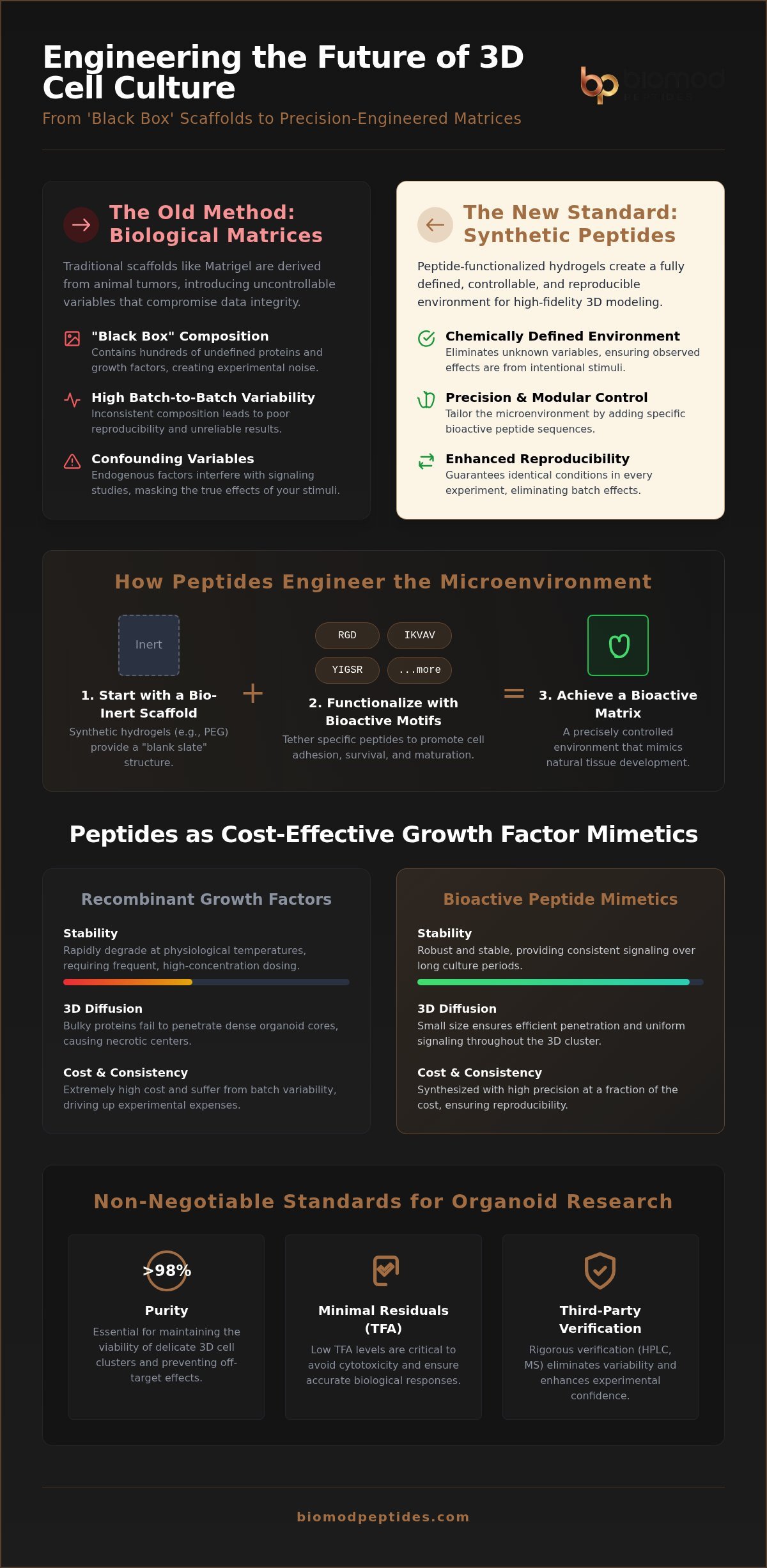
Traditional culture methods rely on basement membrane extracts derived from animal tumors. These biological matrices lack chemical definition. They introduce confounding variables into every study. The shift toward synthetic hydrogels is a requirement for reproducible science. By using peptides in organoid culture, researchers can precisely engineer the extracellular matrix (ECM) to support specialized tissue development. This methodology replaces unpredictable biological mixtures with a defined chemical landscape.
Integration occurs through covalent or non-covalent tethering. Covalent attachment, often achieved via Michael-addition or click chemistry, ensures stable peptide presentation within 3D polymer networks. Non-covalent methods utilize high-affinity interactions. Both strategies allow for a “blank slate” approach. This eliminates the “black box” nature of animal-derived scaffolds. It enables the isolation of specific signaling pathways without interference from endogenous proteins.
Adhesion Motifs and Matrix Interaction
Synthetic scaffolds are bio-inert. They require functionalization with adhesion motifs like Arg-Gly-Asp (RGD) to promote cell survival. RGD density directly dictates organoid morphology and polarity. High densities may lead to excessive spreading; low densities risk apoptosis. Beyond RGD, laminin-mimetic sequences like IKVAV and YIGSR are essential for neural and epithelial maturation. Dynamic remodeling is achieved by incorporating enzyme-cleavable peptides. These sequences allow cells to degrade and restructure the matrix as they expand. This creates a responsive environment that mimics natural tissue development.
Synthetic vs. Biological Matrices
The primary advantage of using peptides in organoid culture via polyethylene glycol (PEG) over Matrigel is the quantification of inputs. Matrigel contains hundreds of undefined growth factors and proteins. This causes significant experimental noise. Synthetic matrices provide a controlled environment for signaling studies. High-purity peptides ensure that observed cellular responses are a direct result of intentional stimuli. Verification of sequence integrity is paramount. It prevents off-target effects that compromise data. This rigorous approach is necessary for high-sensitivity research and pharmacological screening.
Bioactive Peptides as Growth Factor Mimetics in Organoid Maturation
Recombinant growth factors are inherently unstable. They undergo rapid proteolytic degradation at physiological temperatures. This instability necessitates high-concentration dosing and frequent media replenishment. It drives up experimental costs. Bioactive peptides offer a robust alternative. They mimic the binding domains of essential proteins like Wnt, BMP, and TGF-beta. By using peptides in organoid culture, researchers achieve consistent signaling without the volatility of protein-based ligands. These mimetics are synthesized with high precision. They don’t suffer from the batch-to-batch variability common in animal-derived proteins.
Diffusion kinetics favor small molecules in dense 3D environments. Bulky recombinant proteins often fail to penetrate the organoid core. This creates necrotic centers or uneven differentiation. Peptides are significantly smaller. They navigate the interstitial spaces of Peptide-functionalized hydrogel scaffolds with high efficiency. This ensures that every cell within the 3D cluster receives the intended signal. Uniform signaling is critical for achieving physiologically relevant maturation across the entire model.
Signaling Precision and Cost-Efficiency
Replacing recombinant proteins requires a systematic protocol. Researchers must first validate the molar potency of the peptide mimetic against the target receptor. Peptide mimetics for the Wnt pathway can maintain stemness in intestinal organoids at a fraction of the cost of Wnt3a protein. Combining multiple mimetics allows for tissue-specific differentiation. This synergy replicates the complex signaling crosstalk found in vivo. For those requiring high-purity sequences for these protocols, sourcing from a verified research peptide provider ensures experimental reproducibility.
Cell-Penetrating Peptides (CPPs) for 3D Delivery
The diffusion barrier remains a challenge for large molecular cargo. Cell-penetrating peptides (CPPs) overcome this hurdle. These short sequences facilitate the translocation of proteins, nucleic acids, and molecular probes across cell membranes. In 3D models, CPPs are used to deliver CRISPR/Cas9 components directly to the organoid core. This enables precise genetic editing within established structures. It bypasses the need for disruptive dissociation and re-aggregation steps. CPPs maintain the structural integrity of the model while allowing for complex molecular interventions.
Analytical Standards for Peptides in Organoid Research
Precision is mandatory in high-sensitivity 3D modeling. Using peptides in organoid culture requires a level of analytical rigor that exceeds standard 2D protocols. Purity levels of 98% or higher are non-negotiable. Lower grades introduce deletion sequences and residual reagents that trigger off-target toxicity. These impurities compromise the structural integrity of the model. They lead to premature organoid dissociation or stunted maturation. Verification through High-Performance Liquid Chromatography (HPLC) and Mass Spectrometry (MS) provides the empirical proof required for high-impact research. These reports confirm both the sequence identity and the absence of inhibitory contaminants.
Trifluoroacetic acid (TFA) presents a specific risk to delicate 3D cell clusters. TFA is a standard counter-ion used during synthesis; however, its residual presence is cytotoxic. In dense 3D environments, TFA can accumulate within the matrix, altering the local microenvironment. Researchers must prioritize peptides with low residual TFA or opt for acetate/hydrochloride salt exchange. Validating these parameters ensures that Peptide scaffolds for 3D organoid culture remain biocompatible and predictable over long-term incubation periods.
Purity and Impurity Profiles
Common synthesis contaminants like truncated sequences inhibit organoid growth by competing for receptor binding sites. Relying on verified peptide certificates of analysis is essential for establishing a baseline of accountability. These documents allow researchers to correlate experimental outcomes with specific chemical profiles. US-based manufacturing further ensures logistical reliability. For Las Vegas laboratories, local supply chains protect cold-chain integrity, preventing the degradation that occurs during prolonged international transit.
Solubility and Reconstitution Protocols
Reconstitution must be handled with technical precision. Strategies for improving peptide solubility should never compromise the 3D scaffold pH. Acidic or basic shifts can denature delicate hydrogel networks. Lyophilized peptides must be stored at -20°C or -80°C to maintain sequence stability. Once reconstituted, aliquotting is necessary to avoid repeated freeze-thaw cycles. This disciplined approach to reagent management is fundamental to achieving a chemically defined and reproducible culture environment.
Advancing Precision in 3D Biological Modeling
Transitioning from biological “black box” matrices to chemically defined environments is the only viable path toward experimental reproducibility. By using peptides in organoid culture, laboratories eliminate the variability inherent in animal-derived scaffolds while gaining modular control over cellular signaling. This shift requires a commitment to rigorous analytical standards. Sequence verification and purity profiles aren’t just administrative tasks; they’re the foundation of data integrity in high-sensitivity research.
Biomod Peptides supports this transition with laboratory-grade reagents designed for the most demanding 3D modeling protocols. Every lot undergoes independent third-party testing to ensure sequence integrity and 98%+ purity. Our US-based manufacturing facility prioritizes logistical speed and uncompromising quality control to keep your research on schedule. All researchers have full access to our COA Verification Portal to validate the technical specifications of their materials before starting a culture. Secure High-Purity Research Peptides for Your Laboratory to refine your methodology and achieve a new tier of experimental precision.
Frequently Asked Questions
Can peptides fully replace Matrigel in organoid culture?
Peptides can replace Matrigel when integrated into synthetic hydrogel frameworks like polyethylene glycol (PEG). These systems utilize specific adhesion motifs to replicate the basement membrane’s function. This transition ensures a fully chemically defined environment. It eliminates the batch-to-batch variability found in animal-derived products. Synthetic scaffolds provide a “blank slate” for isolating specific signaling pathways without interference from endogenous proteins.
What is the recommended purity for peptides used in 3D biological models?
A purity level of 98% or higher is the industry standard for 3D models. Lower purity grades contain deletion sequences and residual reagents. These contaminants interfere with cell signaling and maturation. Using high-purity sequences is essential for maintaining the integrity of sensitive organoid cultures. Always verify purity through HPLC and Mass Spectrometry reports to ensure experimental reproducibility.
How do I conjugate peptides to a synthetic hydrogel scaffold?
Conjugation is typically achieved through covalent tethering methods like click chemistry or Michael-addition reactions. These techniques anchor peptides to the polymer backbone of synthetic scaffolds. Using peptides in organoid culture this way ensures stable ligand presentation. It allows for precise control over the density of biochemical cues. Non-covalent strategies are also available but offer less stability during long-term incubation.
Are peptide growth factor mimetics as effective as recombinant proteins?
Peptide mimetics provide signaling potency similar to recombinant proteins while offering superior stability. They resist proteolytic degradation and penetrate dense 3D structures more effectively due to their smaller molecular size. This ensures uniform signaling across the organoid diameter. They serve as a cost-efficient and reliable alternative for protocols requiring consistent Wnt, BMP, or TGF-beta activation.
What are the advantages of using US-manufactured peptides for Las Vegas research?
US-based manufacturing ensures logistical reliability and strict adherence to verification protocols. For research institutions in Las Vegas, domestic sourcing minimizes transit times and protects cold-chain integrity. This is vital for preserving the bioactivity of sensitive peptide sequences used in scaffold functionalization. Local manufacturing also provides greater transparency through accessible COA verification portals and direct accountability.
How does residual TFA affect organoid viability?
Residual trifluoroacetic acid (TFA) is cytotoxic and can induce localized pH shifts within the 3D matrix. Using peptides in organoid culture with high TFA levels often results in stunted growth or cell death. Researchers should utilize acetate or HCl salt exchange to ensure biocompatibility with delicate 3D cell clusters. Maintaining a neutral pH is fundamental to the structural integrity of the synthetic scaffold and the health of the organoid.
Disclaimer
BIOMOD products are sold strictly for laboratory, analytical, and scientific research use only. They are not intended for human or animal consumption, administration, application, ingestion, injection, or any therapeutic, diagnostic, or cosmetic use.
The statements made on this website have not been evaluated by the United States Food and Drug Administration. BIOMOD products are not intended to diagnose, treat, cure, mitigate, or prevent any disease or medical condition.
BIOMOD is a research chemical supplier. BIOMOD is not a compounding pharmacy or chemical compounding facility as defined under Section 503A of the Federal Food, Drug, and Cosmetic Act. BIOMOD is not an outsourcing facility as defined under Section 503B of the Federal Food, Drug, and Cosmetic Act.
By accessing this site, you confirm you are at least 21 years of age and that you have read and accepted the BIOMOD Terms of Sale, Privacy Policy, and Research Use Only Policy. BIOMOD does not provide dosing, medical, therapeutic, diagnostic, veterinary, or use guidance under any channel.