
A single milligram of inter-lot variance can invalidate three years of longitudinal data. For researchers, the integrity of a study depends entirely on the stability of the chemical inputs. You understand that even minor deviations in purity or concentration between batches create noise that masks primary findings. Managing peptide supply for longitudinal studies requires more than just placing recurring orders; it demands a rigorous, lot-locked procurement strategy. This article provides a technical framework for securing, validating, and maintaining a stable peptide supply to eliminate variables in long-term research. You’ll learn how to implement lot-locking protocols, verify purity through independent third-party portals, and navigate the 2026 regulatory landscape to protect your milestones. We prioritize the structural integrity of your data through a secure, US-based supply chain and absolute transparency in laboratory-grade standards.
Key Takeaways
- Eliminate inter-lot variability by transitioning from just-in-time ordering to a centralized procurement model that protects longitudinal data consistency.
- Secure a single production run through a lot-locked protocol to ensure zero variance in peptide concentration across the entire study duration.
- Optimize the process of managing peptide supply for longitudinal studies by utilizing US-based supply chains that offer greater logistical transparency and regulatory stability.
- Maintain rigorous documentation through third-party COA verification portals to provide an objective, audit-ready trail of purity for all research reagents.
The Challenge of Inter-Lot Variability in Longitudinal Research
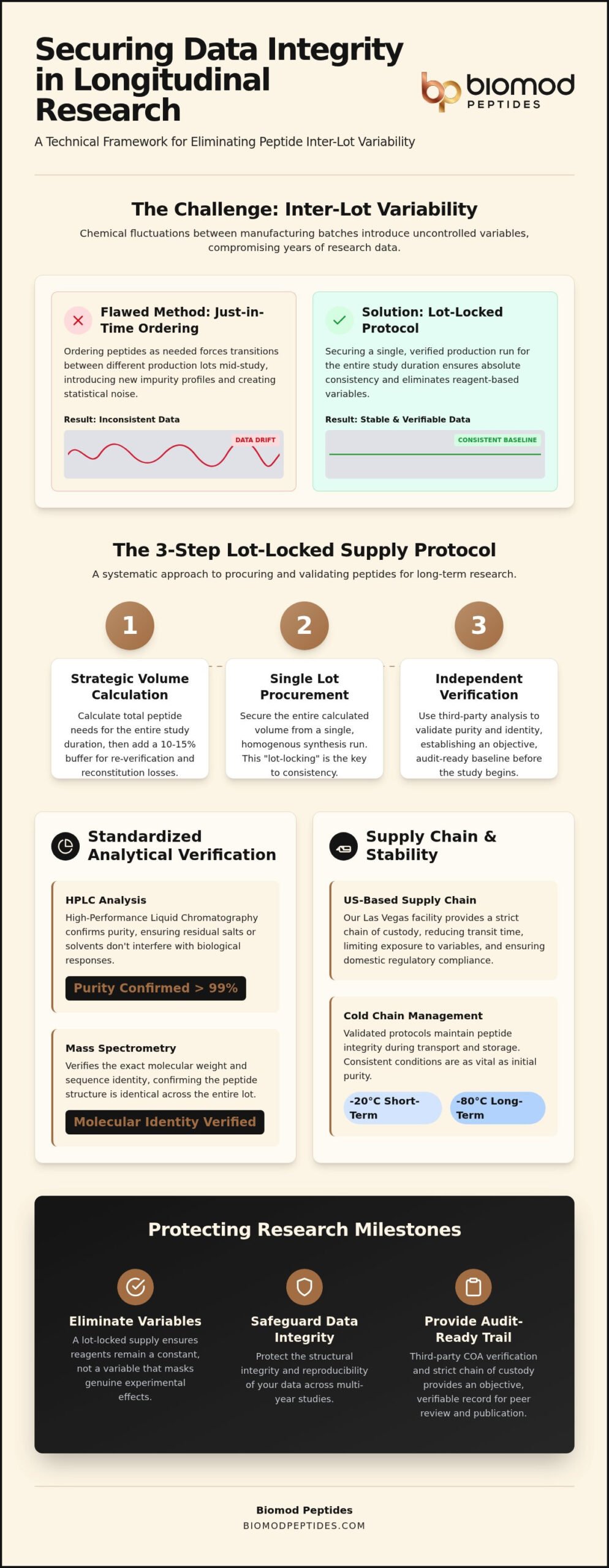
Inter-lot variability refers to the chemical fluctuations between separate manufacturing batches. In a Longitudinal study, these fluctuations represent uncontrolled variables that compromise data integrity. Many researchers fall into the trap of “just-in-time” ordering. This approach forces a transition between production batches mid-study, which introduces new impurity profiles. Even when two lots report identical purity percentages, the specific residual reagents or truncated sequences often differ. These subtle deviations create statistical noise. This makes it impossible to distinguish between genuine experimental effects and reagent inconsistency over time.
Managing peptide supply for longitudinal studies demands a proactive approach to impurity profiles. Every synthesis run produces a unique fingerprint of secondary products. If your supply chain shifts, your baseline shifts. Establishing a rigorous verification protocol at the start of the study is the only way to mitigate this risk. Without a verified baseline, you’re building research on a moving foundation. This leads to data drift that becomes apparent only when it’s too late to correct.
Standardizing Analytical Verification with HPLC and Mass Spec
Rigor in managing peptide supply for longitudinal studies requires independent, third-party validation. You cannot rely solely on manufacturer-provided data if you want to maintain professional standards.
- HPLC Analysis: High-Performance Liquid Chromatography must confirm purity levels exceeding 99%. This ensures that residual salts or solvents don’t interfere with long-term biological responses.
- Mass Spectrometry: This verifies the exact molecular weight and sequence identity. It confirms that the peptide structure remains identical across every milligram used in the study.
These methods provide the transparency required for high-tier research. Analytical standards must be applied consistently to ensure that your reagents remain a constant, not a variable. Initial verification isn’t a formality; it’s a structural requirement for any study spanning months or years.
Strategic Procurement: The Lot-Locked Supply Protocol
Successful procurement starts with a comprehensive volume calculation. You must account for the entire study duration plus a 10 to 15 percent overage. This buffer compensates for reconstitution losses and unexpected analytical re-verification. Managing peptide supply for longitudinal studies effectively requires securing a single production lot. This lot-locked approach ensures that every vial used over multiple years originates from the same synthesis run. This methodology aligns with rigorous standards regarding characterization and control, such as those outlined in the EMA Guideline on Synthetic Peptides.
Securing supply reserves with US-based manufacturers provides a critical buffer against global supply chain disruptions. By locking in a specific lot, you eliminate the risk of mid-study synthesis changes or vendor lead-time fluctuations. We maintain a strict chain of custody from our Las Vegas facility directly to your laboratory. This regional proximity reduces transit time and limits exposure to logistical variables. For researchers requiring absolute consistency, securing a lot-locked supply is the only way to safeguard long-term data integrity.
Long-Term Stability and Cold Chain Management
Peptide integrity depends on thermal stability over time. Lyophilized compounds should be stored at -20°C for short-term use or -80°C for multi-year longitudinal designs. In high-heat regions like Las Vegas, managing temperature excursions during transport is paramount. We utilize validated cold chain protocols to prevent degradation during the final stages of delivery. For specific storage benchmarks and degradation curves, refer to our guide on Peptide Stability for Research. Consistent storage conditions are as vital as the initial purity verification.
Ensuring Long-Term Accountability in Peptide Supply
Accountability requires a shift from passive record-keeping to active digital verification. Managing peptide supply for longitudinal studies is a multi-year commitment that demands a verifiable audit trail. US-based manufacturing ensures that your reagents comply with domestic regulatory frameworks and standardized quality controls. Sourcing from our Las Vegas facility reduces transit-related risks. It minimizes the risk of thermal degradation during critical delivery windows in high-heat environments. Reproducibility hinges on this transparency. You should document exact batch numbers and synthesis dates in your final research publications. This practice allows peer reviewers to verify the chemical consistency of your findings years after the initial procurement.
Leveraging the Biomod Peptides Verification Portal
Accountability is maintained through the Biomod Peptides COA Verification Portal. This digital tool allows you to track batch-specific data across the entire study timeline. You can integrate third-party lab reports directly into your longitudinal study documentation. This creates a centralized repository for analytical proof. It ensures that every vial used in your research meets the rigorous purity benchmarks of 2026. Our portal provides a mechanism for verifying vendor claims long after the physical product has been reconstituted.
Meeting 2026 Analytical Standards
Your laboratory peptide supply must align with current analytical expectations to ensure data validity. High-tier research requires objective, third-party verification of purity and sequence identity. By utilizing digital tracking and US-based finishing, you secure a chain of custody that withstands rigorous institutional scrutiny. Professional accountability isn’t just a best practice; it’s the standard for modern longitudinal design. This protocol ensures that your research remains reproducible and scientifically sound throughout its duration.
Precision Procurement for Future-Proof Research
Longitudinal integrity isn’t accidental; it’s engineered through rigorous procurement. You’ve seen how inter-lot variability can compromise years of data. Eliminating this risk requires a transition to lot-locked supplies and verified US-based manufacturing. By managing peptide supply for longitudinal studies with a focus on structural consistency, you ensure that every milligram used across your timeline remains identical. Accountability depends on transparent documentation. Our Las Vegas facility provides the logistical stability and third-party verification required for high-stakes research. We provide independent testing for every batch and a dedicated COA verification portal to support your audit trail. Secure your longitudinal study supply with Biomod Peptides today to guarantee zero-variance data. Your research objectives deserve a foundation of absolute chemical certainty.
Frequently Asked Questions
What is lot-locking and why is it essential for longitudinal studies?
Lot-locking is the procurement of a single production batch for the entire study duration. It’s essential because it eliminates inter-lot variability, which can introduce statistical noise into longitudinal data. By using one batch, researchers ensure that impurity profiles and peptide concentrations remain constant. This practice is a cornerstone of managing peptide supply for longitudinal studies to guarantee reproducible results.
How much peptide overage should I order for a 12-month study?
Standard laboratory protocols suggest ordering an overage of 10% to 15% beyond your calculated requirements. This buffer accounts for volume loss during reconstitution, residual material in vial dead space, and unexpected analytical re-verification. For a 12-month design, this ensures you don’t run out of your locked lot prematurely. Maintaining this reserve protects the study from having to switch batches mid-way.
Can I use different peptide delivery formats like softgels and sprays in the same study?
Yes, provided each format is validated for consistency and the study design accounts for different pharmacokinetic profiles. Biomod Peptides offers research peptides in specialized formats including softgels and spray products. When managing peptide supply for longitudinal studies across formats, researchers must verify that each delivery method originates from a batch with identical purity standards. Consistency across these formats is verified via our COA portal.
How does US manufacturing impact the reliability of my longitudinal research supply?
US-based manufacturing ensures greater supply chain transparency and adherence to domestic quality standards. For labs in Las Vegas, regional sourcing reduces transit-related degradation risks caused by extreme heat. Local finishing and distribution provide faster lead times for bulk orders. This logistical control is critical for maintaining the stability of temperature-sensitive reagents throughout the multi-year timeline of a longitudinal study.
Disclaimer
BIOMOD products are sold strictly for laboratory, analytical, and scientific research use only. They are not intended for human or animal consumption, administration, application, ingestion, injection, or any therapeutic, diagnostic, or cosmetic use.
The statements made on this website have not been evaluated by the United States Food and Drug Administration. BIOMOD products are not intended to diagnose, treat, cure, mitigate, or prevent any disease or medical condition.
BIOMOD is a research chemical supplier. BIOMOD is not a compounding pharmacy or chemical compounding facility as defined under Section 503A of the Federal Food, Drug, and Cosmetic Act. BIOMOD is not an outsourcing facility as defined under Section 503B of the Federal Food, Drug, and Cosmetic Act.
By accessing this site, you confirm you are at least 21 years of age and that you have read and accepted the BIOMOD Terms of Sale, Privacy Policy, and Research Use Only Policy. BIOMOD does not provide dosing, medical, therapeutic, diagnostic, veterinary, or use guidance under any channel.