
A manuscript’s failure rarely stems from the results themselves; it collapses under the weight of unverified analytical chains. You’ve likely spent months refining your methodology, only to face a rejection letter questioning the fundamental integrity of your reagents. It’s a common pain point in high-impact publishing. Overcoming reviewer objections to peptide data requires more than just a standard COA. You need a robust framework for identity verification and stability testing.
This guide provides the analytical and procedural defenses necessary to satisfy peer-review scrutiny regarding peptide purity and long-term stability. We’ll examine how to utilize independent third-party validation and US-based manufacturing standards to preempt skepticism. You’ll gain a clear roadmap for documenting HPLC and Mass Spectrometry data that leaves no room for ambiguity. By the end, you’ll have the technical protocols needed to secure manuscript acceptance and prove data integrity.
Key Takeaways
- Identify the specific purity thresholds required for quantitative research and the necessity of Mass Spectrometry for sequence verification.
- Standardize stability protocols by documenting lyophilization states and utilizing deoxygenated solvents for precise reconstitution.
- Establish a technical defense for overcoming reviewer objections to peptide data using independent, third-party analytical validation.
- Enhance manuscript transparency by providing reviewers with direct access to raw HPLC and MS data through standardized verification portals.
Validating Peptide Identity and Purity Standards
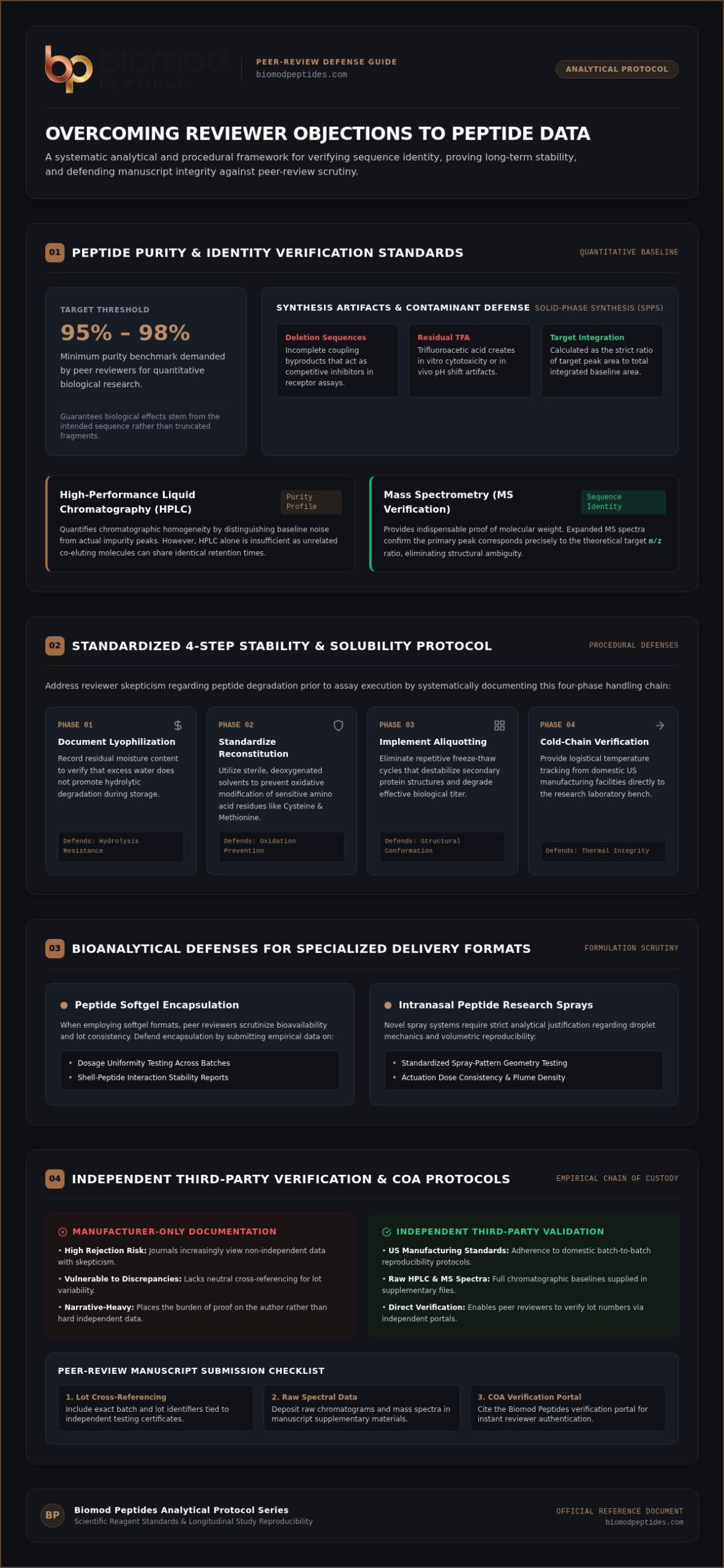
Reviewers typically demand 95% to 98% purity for quantitative research. This isn’t an arbitrary benchmark. High purity ensures that observed biological effects stem from the target sequence rather than truncated fragments or residual reagents. During solid-phase peptide synthesis mechanisms, deletion sequences and incomplete couplings frequently occur. These byproducts can act as competitive inhibitors; potentially skewing your results. Overcoming reviewer objections to peptide data starts with proving these contaminants are absent.
Mass Spectrometry (MS) is now a baseline requirement. HPLC alone is insufficient because unrelated molecules might share identical retention times. MS confirms the molecular weight matches the theoretical sequence precisely. You must also address Trifluoroacetic acid (TFA) concentrations. Residual TFA can induce cytotoxic effects in cell cultures or alter pH levels in vivo; this often leads to “artifact” concerns from skeptical reviewers. A standardized chromatographic profile with a clear baseline is your best defense.
Addressing HPLC and Mass Spectrometry Discrepancies
Distinguishing baseline noise from actual impurity peaks requires high-resolution data. You should provide expanded MS spectra to verify that the primary peak corresponds to the correct m/z ratio. HPLC purity is the ratio of the target peak area to the total integrated area. If discrepancies arise between your lab results and manufacturer claims, utilize the Biomod Peptides COA Verification Portal. Providing reviewers with direct access to raw data demonstrates a commitment to transparency and technical accountability.
Standardizing Stability and Solubility Protocols
Stability data remains a primary target for peer-review skepticism. Reviewers frequently question whether the observed biological activity reflects the initial concentration or degraded byproducts. Overcoming reviewer objections to peptide data requires a documented, four-step stabilization protocol:
- Document the lyophilization state: Record moisture content to ensure excess water isn’t promoting hydrolytic degradation during storage.
- Standardize reconstitution: Use sterile, deoxygenated solvents to prevent oxidative damage to sensitive residues like cysteine or methionine.
- Implement aliquotting: Eliminate repetitive freeze-thaw cycles that destabilize secondary structures and reduce effective titer over time.
- Verify cold-chain integrity: Cite logistical documentation from the US-based manufacturing facility to the laboratory bench to ensure thermal stability.
This procedural transparency proves the peptide’s structural integrity remained uncompromised before the initial assay began. It establishes a rigorous baseline for all subsequent data points and eliminates ambiguity regarding reagent quality.
Justifying Specialized Delivery Systems in Research
Novel formats face scrutiny regarding bioanalytical consistency. When using peptide softgels for research, defend the encapsulation with data on dosage uniformity. For intranasal peptide research sprays, cite spray-pattern testing to prove consistent delivery. These formats require validation for overcoming reviewer objections to peptide data. Verify metrics through our COA verification portal to strengthen your methodology.
Strengthening Data Integrity with Third-Party Verification
Manufacturer-only data is increasingly scrutinized in peer review. Journals now prioritize independent validation to confirm reagent authenticity. Relying solely on internal documentation often triggers rejections. Data integrity is non-negotiable. Overcoming reviewer objections to peptide data requires a shift toward external verification. US-manufactured reagents provide a critical advantage here. Domestic production ensures rigorous adherence to batch-to-batch reproducibility standards. This consistency is vital for longitudinal studies. Reagent variability can invalidate months of work.
Transparency acts as your primary defense. Providing reviewers with direct access to raw analytical data eliminates ambiguity. It shifts the burden of proof from your narrative to empirical evidence. This approach aligns with the necessary analytical standards for research. By integrating third-party validation into your submission, you establish a chain of custody that is difficult to challenge. It proves that your reagents aren’t just high-purity on paper; they are verified by a neutral laboratory.
Utilizing Independent COA Portals for Peer Review
Supplementary materials should include direct links to a COA Verification Portal. This allows reviewers to cross-reference lot numbers with independent HPLC and MS results. Third-party reports nullify identity objections instantly. It’s a critical step in overcoming reviewer objections to peptide data. Ensure your vendor provides verified peptide certificates of analysis for every lot used in the study. This level of documentation proves that the material matches the theoretical sequence. It transforms your methodology into a verifiable technical record. Reviewers respect data that can be audited at the source.
Securing Data Integrity for Peer-Review Success
Success in high-impact publishing demands more than accurate findings; it requires a transparent analytical chain. By standardizing your purity thresholds and implementing rigorous stability protocols, you eliminate the variables that often trigger manuscript rejection. Overcoming reviewer objections to peptide data depends on your ability to provide empirical proof of reagent identity and structural integrity. Meticulous documentation is your most effective tool for neutralizing skepticism before it compromises your publication timeline.
Transparency is the ultimate defense against analytical scrutiny. Utilize reagents that offer independent validation and US-based manufacturing to ensure your results are reproducible and verifiable. Secure high-purity, third-party verified peptides for your next study at Biomod Peptides. Our instant COA verification portal and lot-specific testing provide the documentation necessary to satisfy the most rigorous peer-review standards. With the right analytical support, your research stands on a foundation of objective truth.
Frequently Asked Questions
What is the most common reason reviewers reject peptide data?
Rejection often stems from insufficient characterization or a lack of independent verification. Reviewers frequently flag data when HPLC traces aren’t accompanied by high-resolution Mass Spectrometry confirmation. In Las Vegas laboratories, we’ve observed that failure to document stability or reagent integrity during transit is a frequent trigger. Providing a transparent analytical chain is essential for overcoming reviewer objections to peptide data.
How do I justify the use of a specific peptide delivery format to a reviewer?
Justification requires citing standardized testing for dosage uniformity and bioanalytical consistency. For formats like peptide sprays or softgels, you should provide data on spray-pattern testing or encapsulation stability. Referencing US-based manufacturing standards helps establish that these specialized formats meet the same rigorous benchmarks as traditional lyophilized powders; this ensures reproducible results across different experimental models and delivery methods.
Can I use a manufacturer’s COA as primary evidence for purity in a high-impact journal?
High-impact journals increasingly view manufacturer-only COAs as insufficient evidence. They often demand independent, third-party validation to eliminate potential conflict-of-interest concerns. Biomod Peptides addresses this shift by offering an instant COA verification portal. This allows researchers to present externally audited HPLC and Mass Spectrometry data; it serves as a more robust form of evidence than internal documentation alone.
How does TFA content affect reviewer perception of biological assay results?
Residual Trifluoroacetic acid (TFA) can skew biological assay results by inducing cytotoxicity or altering the local pH environment. Reviewers often suspect that observed biological effects are artifacts caused by these impurities rather than the peptide sequence itself. Overcoming reviewer objections to peptide data involves documenting TFA removal or quantifying residual levels to prove the counter-ion doesn’t interfere with outcomes.
Disclaimer
BIOMOD products are sold strictly for laboratory, analytical, and scientific research use only. They are not intended for human or animal consumption, administration, application, ingestion, injection, or any therapeutic, diagnostic, or cosmetic use.
The statements made on this website have not been evaluated by the United States Food and Drug Administration. BIOMOD products are not intended to diagnose, treat, cure, mitigate, or prevent any disease or medical condition.
BIOMOD is a research chemical supplier. BIOMOD is not a compounding pharmacy or chemical compounding facility as defined under Section 503A of the Federal Food, Drug, and Cosmetic Act. BIOMOD is not an outsourcing facility as defined under Section 503B of the Federal Food, Drug, and Cosmetic Act.
By accessing this site, you confirm you are at least 21 years of age and that you have read and accepted the BIOMOD Terms of Sale, Privacy Policy, and Research Use Only Policy. BIOMOD does not provide dosing, medical, therapeutic, diagnostic, veterinary, or use guidance under any channel.