
A researcher discovers a critical potency variance mid-study, rendering months of longitudinal data useless. When batch inconsistency or logistical delays disrupt an experiment, the primary casualty is the integrity of the research itself. Managing research anxiety with reliable suppliers is not a matter of trust. It’s a matter of rigorous analytical verification. You understand that unverified certificates of analysis from gray market sources represent a critical failure point in modern procurement. This article provides the blueprint to eliminate that volatility. You’ll learn how to mitigate procurement-related experimental risks by implementing standardized supplier vetting and data-driven verification protocols. We’ll detail a repeatable framework for auditing suppliers, utilizing COA verification portals, and ensuring reagent purity through objective, third-party data. This protocol transforms procurement from an administrative burden into a pillar of experimental precision.
Key Takeaways
- Identify how unverified “gray market” sourcing and batch-to-batch variability jeopardize the reproducibility of longitudinal research data.
- Implement a 5-step protocol for managing research anxiety with reliable suppliers by demanding independent, lot-specific analytical verification.
- Utilize dedicated COA verification portals to confirm reagent purity and structural integrity before initiating critical experimental phases.
- Leverage the logistical stability and transparency of US-finished supply chains to mitigate international shipping delays and ensure regulatory oversight.
The Anatomy of Research Anxiety: Identifying Procurement Risks
Research anxiety stems from a data deficit. “Gray market” suppliers often prioritize volume over verification. This creates a high-stakes environment where researchers cannot guarantee the chemical identity of their reagents. Marketing slogans about “highest purity” are frequently decoupled from actual batch testing. Without empirical proof, every new vial represents a variable that could invalidate months of laboratory work. Managing research anxiety with reliable suppliers requires moving beyond trust. It necessitates a shift toward verifying the structural integrity of every lot before it enters the laboratory workflow.
Batch-to-batch variability is the primary threat to longitudinal study reproducibility. If a peptide’s salt concentration or secondary structure fluctuates between orders, the biological response changes. Understanding the basics of peptide synthesis reveals how easily impurities can enter the chain during deprotection or cleavage steps. Surface-level claims of quality often mask a lack of rigorous analytical oversight. When suppliers fail to provide lot-specific data, the researcher inherits the risk of experimental failure. Managing research anxiety with reliable suppliers is achieved through the demand for transparency and objective proof.
The Technical Cost of Substandard Reagents
Substandard reagents introduce truncated sequences and residual solvents into sensitive assays. These impurities don’t just skew results; they force extensive recalibrations. A single failed batch can result in weeks of lost labor and thousands of dollars in wasted consumables. Precision demands accountability. Following The Protocol for Peptide Purity Verification ensures that analytical standards dictate procurement. This rigorous approach mitigates the risk of degradation, ensuring that purity profiles meet documented benchmarks. By prioritizing verified data, researchers can reclaim the time typically lost to troubleshooting unverified reagents.
Vetting Protocols: 5 Steps to Identify Reliable Suppliers
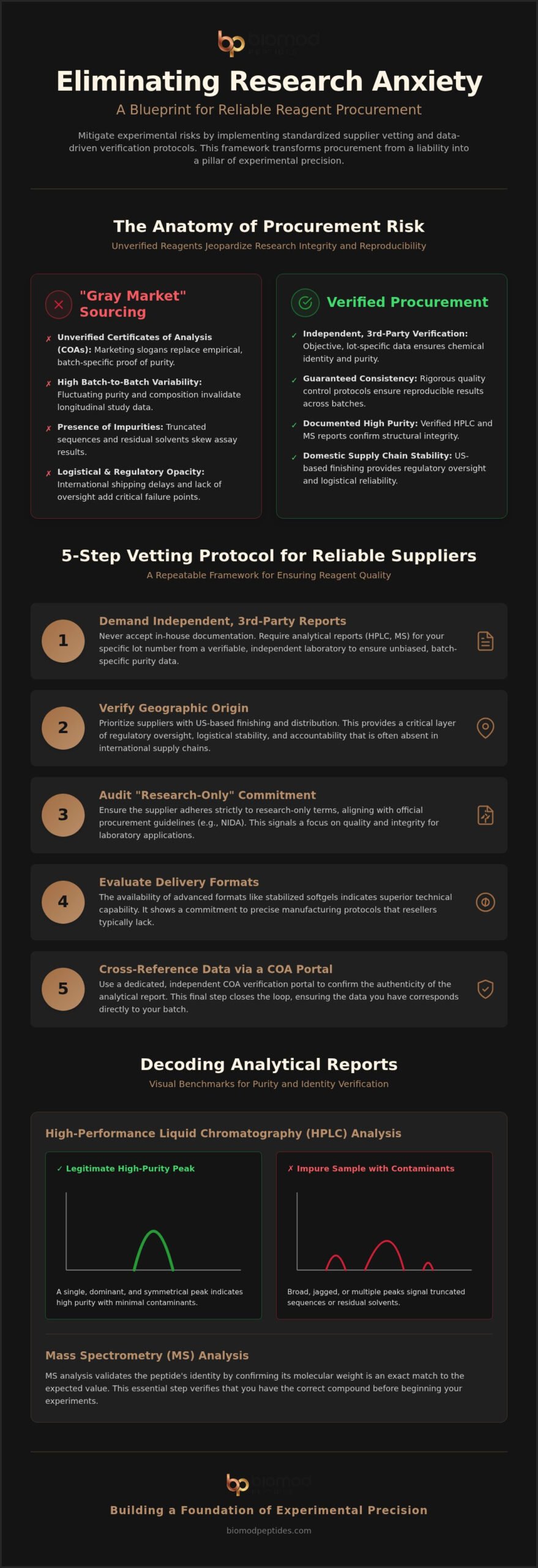
Standardizing procurement requires a multi-layered vetting protocol that prioritizes objective data over marketing claims. Managing research anxiety with reliable suppliers starts with moving beyond generic documentation. It’s about establishing a repeatable framework for verification that mirrors the rigor of your own experimental designs. This process ensures that the chemical identity of your reagents is never a variable in your research.
- Step 1: Demand independent, third-party analytical reports for every specific lot number to ensure batch-specific purity.
- Step 2: Verify the geographic origin of manufacturing and finishing. US-based finishing provides a necessary layer of regulatory oversight.
- Step 3: Audit the supplier’s commitment to research-only terms, ensuring they align with NIDA’s official procurement guidelines for high-integrity sourcing.
- Step 4: Evaluate the sophistication of delivery formats. Advanced options like peptide softgels indicate superior technical capability.
- Step 5: Cross-reference all analytical data through an independent COA verification portal to confirm report authenticity.
Sophisticated delivery formats are a hallmark of institutional-grade providers. These systems require precise stabilization and manufacturing protocols that resellers often lack. Choosing a partner that prioritizes this level of structural integrity is vital for managing research anxiety with reliable suppliers. Researchers can review analytical benchmarks to ensure their reagents meet laboratory standards before deployment.
Interpreting HPLC and Mass Spectrometry Reports
Legitimate High-Performance Liquid Chromatography (HPLC) reports must show a dominant, symmetrical peak. Broad or jagged peaks indicate the presence of truncated sequences or residual solvents from the synthesis process. Mass Spectrometry (MS) then confirms the molecular weight to validate the peptide’s identity. A legitimate Certificate of Analysis must correlate directly to a specific, unique batch ID via an independent laboratory portal. This data provides the empirical proof necessary to maintain experimental reproducibility and confidence.
Securing Your Supply Chain: The Value of Domestic Partnerships
International bulk resellers often operate in regulatory shadows. They provide opacity where researchers require absolute clarity. Managing research anxiety with reliable suppliers is significantly more effective when the vendor is subject to US jurisdiction. Domestic finishing ensures adherence to rigorous safety and labeling protocols. For example, legitimate domestic providers must comply with OSHA’s Hazard Communication Standard. This mandate ensures that every reagent is accompanied by precise hazard documentation and accurate Safety Data Sheets (SDS). This level of accountability eliminates the legal and ethical ambiguity often found in the gray market.
For Las Vegas laboratories, regional partnerships provide a critical logistical edge. Short-range transit preserves cold-chain integrity and eliminates the risk of customs-related delays. Partnering with a regional provider like Biomod Peptides ensures that reagents move from finishing to the laboratory without the degradation risks of international transit. This proximity fosters a culture of professional accountability. It’s a fundamental shift from reactive troubleshooting to proactive quality assurance. This proximity transforms the supply chain from a point of failure into a foundation of experimental stability.
Leveraging Verification Portals for Real-Time Accountability
Real-time verification portals serve as the ultimate defense against fraudulent documentation. These systems prevent the circulation of altered or outdated Certificates of Analysis (COAs) by linking directly to third-party laboratory databases. Researchers can cross-reference batch numbers instantly to confirm chemical identity. This process removes the possibility of human error or intentional obfuscation in reporting. We recommend that institutions prioritize vendors that offer laboratory peptide supply transparency as a standard service. This protocol ensures that your analytical data remains as precise as your experimental objectives. Managing research anxiety with reliable suppliers is achieved through this uncompromising commitment to real-time data integrity.
Advancing Experimental Integrity Through Analytical Standards
Precision in the laboratory is inseparable from the integrity of the supply chain. Transitioning from unverified sourcing to a structured verification protocol eliminates the volatility that compromises longitudinal data. Managing research anxiety with reliable suppliers is achieved by replacing trust with empirical proof. You’ve learned that lot-specific transparency and domestic manufacturing are not just preferences; they are essential safeguards for experimental reproducibility. By auditing analytical reports and utilizing real-time verification portals, researchers can secure their workflows against chemical inconsistency. This methodical approach ensures that every reagent meets the high-tier benchmarks required for institutional-grade research. Biomod Peptides supports these objectives through independent third-party testing and US-finished manufacturing. You can Explore Biomod Peptides’ Analytical Standards and Verified Products to access our COA Verification Portal. Reclaim your focus by grounding your procurement in objective, verifiable data.
Frequently Asked Questions
How do I know if a peptide Certificate of Analysis (COA) is real?
Authentic COAs are verified by cross-referencing batch IDs through an independent laboratory’s verification portal. Biomod Peptides provides this access to ensure Las Vegas researchers can confirm data integrity. Real reports contain specific HPLC and MS spectra that must match the unique lot number on your reagent vial. Managing research anxiety with reliable suppliers requires this level of batch-specific, third-party validation to prevent experimental skew.
What are the most common impurities found in low-quality research peptides?
Common impurities include truncated peptide sequences, residual trifluoroacetic acid (TFA), and unreacted synthesis reagents. These contaminants typically result from incomplete deprotection or cleavage during the synthesis process. If purity levels drop below 99%, these substances can interfere with receptor binding assays and compromise the reproducibility of your data. High-Performance Liquid Chromatography (HPLC) is the standard tool for identifying these variances before study initiation.
Why is US-based manufacturing important for research peptide reliability?
Domestic manufacturing subjects the supplier to US regulatory oversight and ensures adherence to OSHA hazard communication standards. For Las Vegas laboratories, US-finished products eliminate the logistical instability and cold-chain risks associated with international transit. Managing research anxiety with reliable suppliers is more effective when the vendor operates under US jurisdiction. This proximity ensures that manufacturing and finishing protocols meet rigorous, verifiable domestic benchmarks.
Can I use a single COA for multiple batches of the same peptide?
No, a COA is strictly lot-specific and cannot be applied to multiple batches. Every synthesis cycle introduces chemical variables that can alter the peptide’s purity profile or salt content. Relying on a single report for different lots is a breach of analytical standards that can invalidate longitudinal research. Researchers must verify a new, independent third-party report for every unique batch received to maintain experimental precision.
Disclaimer
BIOMOD products are sold strictly for laboratory, analytical, and scientific research use only. They are not intended for human or animal consumption, administration, application, ingestion, injection, or any therapeutic, diagnostic, or cosmetic use.
The statements made on this website have not been evaluated by the United States Food and Drug Administration. BIOMOD products are not intended to diagnose, treat, cure, mitigate, or prevent any disease or medical condition.
BIOMOD is a research chemical supplier. BIOMOD is not a compounding pharmacy or chemical compounding facility as defined under Section 503A of the Federal Food, Drug, and Cosmetic Act. BIOMOD is not an outsourcing facility as defined under Section 503B of the Federal Food, Drug, and Cosmetic Act.
By accessing this site, you confirm you are at least 21 years of age and that you have read and accepted the BIOMOD Terms of Sale, Privacy Policy, and Research Use Only Policy. BIOMOD does not provide dosing, medical, therapeutic, diagnostic, veterinary, or use guidance under any channel.