
Could a standard laboratory reagent be the primary driver of your inconsistent experimental data? Trifluoroacetic acid is 100,000 times more acidic than acetic acid. Its pKa is 0.23. While it’s an essential tool for peptide purification, residual TFA often causes unexplained cell death and skewed results in sensitive cultures. You’ve likely experienced the frustration of variable data despite rigorous protocol adherence. This guide details the impact of trifluoroacetic acid on cell assays, providing the technical evidence needed to mitigate counter-ion interference. We’ll establish clear cytotoxicity thresholds and outline practical protocols for ion exchange. We also examine current regulatory shifts, including the EU’s 2025 review of TFA as a reproductive toxicant. You’ll gain a methodical understanding of how to verify peptide purity and select analytical-grade materials that protect your research integrity. This is a technical roadmap for precision-focused researchers.
Key Takeaways
- Identify the biochemical mechanisms that lead to TFA retention during lyophilization and how these stable salts alter experimental outcomes.
- Evaluate the impact of trifluoroacetic acid on cell assays by establishing precise cytotoxicity thresholds for sensitive in vitro models.
- Implement rigorous mitigation strategies, including counter-ion exchange protocols and quantitative verification through standardized analytical methods.
- Establish internal benchmarks for sourcing high-purity peptides backed by transparent COA documentation and US-based manufacturing standards.
The Mechanisms of Trifluoroacetic Acid (TFA) Interference in Research
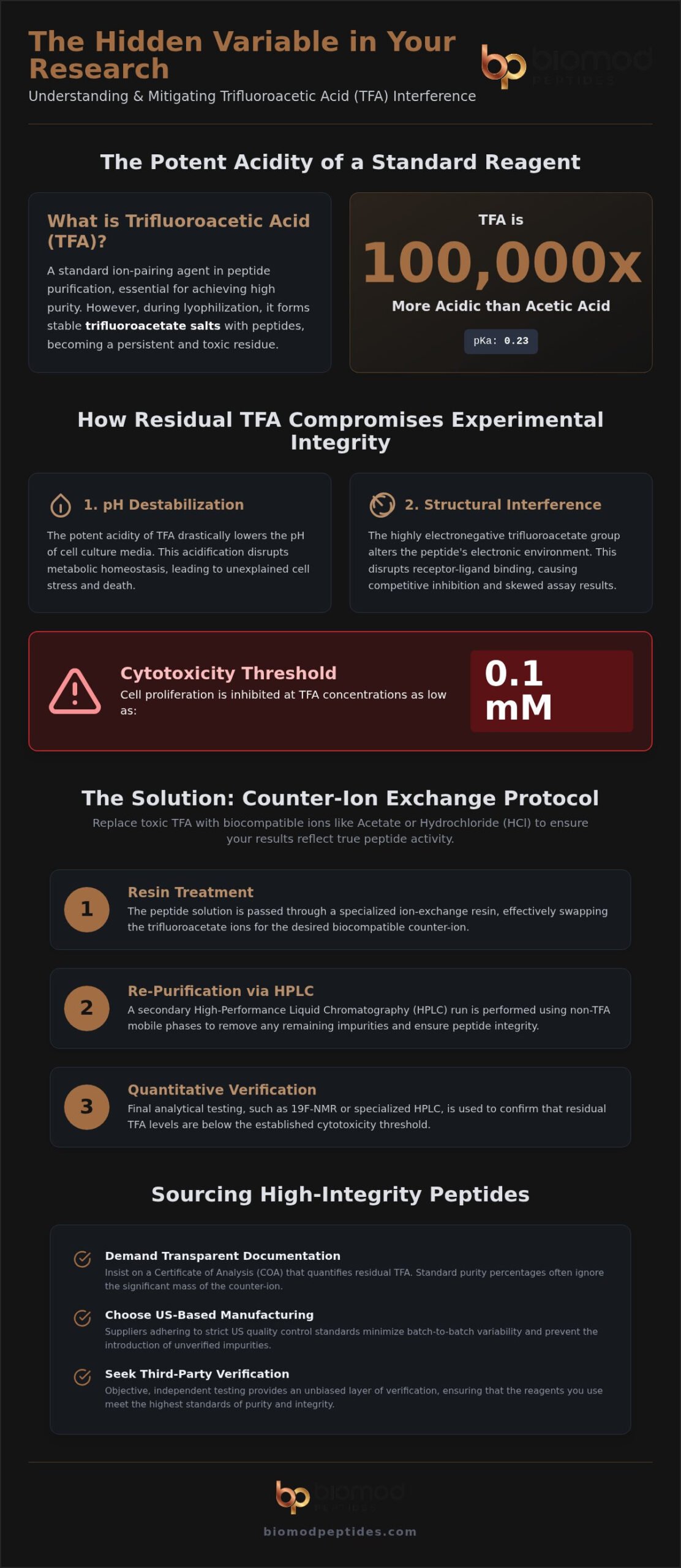
Precision in peptide synthesis requires strict control over counter-ions. Trifluoroacetic acid (TFA) is the standard ion-pairing agent used in high-performance liquid chromatography. It facilitates superior peak resolution by neutralizing charged functional groups. This ensures high chemical purity during the mobile phase. However, the purification process introduces a persistent variable. During lyophilization, peptides often retain these molecules as counter-ions. They form stable trifluoroacetate salts that bond with basic residues such as arginine, lysine, and histidine. TFA salt formation is the primary source of residual toxicity in synthetic peptides.
Cytotoxicity and pH Fluctuations in Cell Culture Media
Residual TFA is a potent acid with a pKa of 0.23. It can significantly shift the pH of unbuffered or weakly buffered cell culture media. This acidification disrupts the metabolic homeostasis required for reliable data. The impact of trifluoroacetic acid on cell assays becomes evident when it inhibits cellular proliferation or induces apoptosis. Specific laboratory data indicates these effects at concentrations as low as 0.1 mM. Such shifts can lead to false-negative results or unexplained cell death in sensitive in vitro models.
The high electronegativity of the trifluoroacetate group creates structural interference. It disrupts receptor-ligand binding assays by altering the electronic environment of the peptide. This often leads to competitive inhibition or unintended changes in peptide conformation. These biochemical disruptions compromise experimental integrity. They create a layer of noise that makes it difficult to interpret HPLC purity reports accurately. Researchers must account for these mechanisms to ensure that observed biological effects are due to the peptide itself rather than the counter-ion presence.
Mitigating the Impact of Trifluoroacetic Acid on Cell Assays
Mitigating the impact of trifluoroacetic acid on cell assays requires a proactive shift from standard analytical purification to biological optimization. Counter-ion exchange is the most effective intervention. This process replaces TFA with more biocompatible ions, such as acetate or hydrochloride (HCl), which do not exhibit the same level of metabolic toxicity. Researchers must utilize quantitative TFA analysis to verify residual levels before initiating experiments. Methods like 19F-NMR or specific HPLC protocols provide the necessary resolution to detect TFA concentrations that standard purity reports often omit. While rigorous lyophilization cycles reduce volatile residual solvents, they do not remove the stable salt form. Only a dedicated ion exchange step ensures the chemical integrity of the peptide for sensitive in vitro applications.
The Ion Exchange Protocol: TFA to Acetate
Acetate is the preferred counter-ion for most biological assays. It demonstrates lower toxicity and superior cell compatibility compared to fluorinated acids. Understanding the Effects of Trifluoroacetic Acid on Human Health highlights the necessity of these protocols in professional research. A standard exchange workflow includes:
- Resin Treatment: Passing the peptide through an ion-exchange resin pre-equilibrated with the target counter-ion.
- Re-purification: Conducting a secondary HPLC run using non-TFA mobile phases.
- Analytical Verification: Final testing to confirm TFA levels are below established cytotoxicity thresholds.
Integrating these steps into procurement is vital for Las Vegas laboratories focusing on high-sensitivity proteomics. Utilizing analytical-grade research peptides with verified counter-ion profiles minimizes experimental noise. This methodical approach transforms a potential variable into a controlled parameter, ensuring that assay data reflects the true activity of the peptide sequence.
Sourcing Analytical Grade Peptides for Experimental Integrity
Experimental reliability depends on the structural integrity of reagents. While many providers cite high purity percentages, these figures often focus solely on the peptide sequence, ignoring the significant mass of the counter-ion. High-purity research peptides must be backed by transparent documentation that accounts for residual salts. US-based manufacturing ensures adherence to strict quality control standards. This minimizes batch-to-batch variability and prevents the introduction of unverified impurities. Third-party testing provides an objective layer of verification, specifically targeting the impact of trifluoroacetic acid on cell assays by quantifying residual levels precisely.
The Global Accumulation of Trifluoroacetic Acid underscores the importance of monitoring this compound as a persistent contaminant in laboratory environments. It’s no longer sufficient to assume standard purification removes these risks. Analytical-grade sourcing requires a commitment to rigorous verification and logistical transparency.
Verification Protocols at Biomod Peptides
Researchers can utilize the COA Verification Portal to confirm the analytical profile of every lot before use. This system provides direct access to third-party data, ensuring objective transparency. Biomod’s commitment to analytical grade standards reduces the risk of artifactual data in cell-based research. By sourcing from US-manufactured facilities, laboratories gain logistical transparency and a verifiable chain of custody. This rigorous approach effectively neutralizes the negative impact of trifluoroacetic acid on cell assays, allowing for precise results that stand up to peer review. Verification isn’t just a protocol; it’s a requirement for scientific excellence.
Advancing Research Integrity through Rigorous Counter-Ion Control
Reliable in vitro data requires the systematic elimination of chemical artifacts. We’ve established that the impact of trifluoroacetic acid on cell assays extends beyond simple pH fluctuations, directly compromising metabolic pathways and binding kinetics. Mitigating these risks through dedicated ion exchange protocols is essential for high-sensitivity research. It’s no longer sufficient to rely on basic purity reports that overlook counter-ion mass. Precision-focused laboratories must demand materials that offer full logistical transparency and objective verification. You can Procure Analytical Grade Research Peptides Verified for Laboratory Use to maintain these standards. Every product is US-manufactured and finished, supported by independent third-party quality assurance and an accessible COA verification portal. Secure your experimental outcomes with reagents engineered for institutional-grade accuracy. Your methodology deserves the highest tier of chemical verification.
Frequently Asked Questions
Is TFA toxic to all cell types in vitro?
TFA toxicity is not universal across all cell types, but it demonstrates broad inhibitory effects at sufficient concentrations. While some robust immortalized cell lines tolerate higher levels, primary cultures and sensitive in vitro models often experience apoptosis or growth inhibition. The impact of trifluoroacetic acid on cell assays is most pronounced in tetrazolium-based tests like MTT or CCK-8, where it interferes directly with mitochondrial activity.
How can I tell if my peptide contains residual TFA?
You can identify residual TFA by reviewing the Certificate of Analysis (COA) for specific counter-ion documentation. Standard HPLC purity reports often exclude this data, so researchers should perform 19F-NMR or quantitative HPLC analysis to verify salt content. At Biomod Peptides, the COA Verification Portal provides transparent access to these analytical profiles, ensuring that researchers can confirm low-TFA status before starting sensitive experiments.
What is the acceptable level of TFA for a standard cell assay?
An acceptable level of TFA typically falls below 0.1 mM, though the specific threshold varies by cell line. Concentrations exceeding this limit often trigger pH shifts and metabolic artifacts that skew results. To minimize the impact of trifluoroacetic acid on cell assays, researchers should aim for peptides with less than 1% residual TFA by weight. Verification through third-party testing remains the most reliable method for establishing these benchmarks.
Why is TFA used in peptide synthesis if it is potentially toxic?
TFA is utilized because it is an exceptionally effective ion-pairing agent for HPLC purification. It improves peak resolution and solubility, which are critical for achieving high chemical purity during the synthesis process. Additionally, it serves as a primary reagent for the cleavage of peptides from solid-phase resins. While chemically essential, its biological toxicity necessitates the post-synthesis ion exchange protocols required to ensure experimental safety.
Disclaimer
BIOMOD products are sold strictly for laboratory, analytical, and scientific research use only. They are not intended for human or animal consumption, administration, application, ingestion, injection, or any therapeutic, diagnostic, or cosmetic use.
The statements made on this website have not been evaluated by the United States Food and Drug Administration. BIOMOD products are not intended to diagnose, treat, cure, mitigate, or prevent any disease or medical condition.
BIOMOD is a research chemical supplier. BIOMOD is not a compounding pharmacy or chemical compounding facility as defined under Section 503A of the Federal Food, Drug, and Cosmetic Act. BIOMOD is not an outsourcing facility as defined under Section 503B of the Federal Food, Drug, and Cosmetic Act.
By accessing this site, you confirm you are at least 21 years of age and that you have read and accepted the BIOMOD Terms of Sale, Privacy Policy, and Research Use Only Policy. BIOMOD does not provide dosing, medical, therapeutic, diagnostic, veterinary, or use guidance under any channel.